|
|
|
|||||||||
 |
|
||||||||||||||||||||||||||||||||||||||||||||||||||||||||||||||||||
|
Robert and Sandra wrote this book to honor the men and dogs who served with the 26th Infantry Scout Dog Platoon during World War II and Korea. Only about 180 men and maybe 90 dogs served in this small unit during this entire time period. The dogs did not get to rotate home, and served more than one master. These men and dogs were credited with saving numerous lives. Some of their stories are told in this book. Order Information:
Confess Confess ConfessBy Nick A. Flores
This is the story of Nick A. Flores who was captured during the first battle at Hell Fire Valley, a few miles from Chosin Reservoir. He served 36 months as a POW at Camp One in Chong-sung, Korea. While a POW, Nick attempted three escapes with the last one resulting in being captured by the Russians, after being gone twelve days from Camp One. While at Camp One, Nick nursed nineteen POWs brought in by the North Korean Army, and saved thirteen by spoon-feeding, bathing, listening to and comforting them. He gave his food to fellow POWs and hand-made moccasins for those soldiers with frostbitten feet. During repatriation at Freedom Village, General McCall Pate, commander of the 1st Marine Division, was so impressed by words spoken about Nick that he summoned Nick over to sit next to him. It was at this time General Pate told Nick, "I know that our country will give you the highest honor that you could receive for your heroism while a POW." After returning home, Nick began yet another battle that lasted for forty years. He was driven with determination to write a book about his life, events, and the often times painful memories he endured while in the hands of the Chinese People's Army and his homeland tragedies. Order Information:
Chopper: A history of American military helicopter operations from World War II to the War on Terror.By Robert F. Dorr
"Chopper" is a beautiful, new hardbound book (100,000 words and 100 photos) that covers U.S. helicopter pilots and crews in combat from the very beginning straight up to today's headlines. The cover price is $24.95. Bookstores and amazon.com are offering "Chopper" at discounted prices. What's different about this history of rotary wing combat is that the story is told in the first-person, in the words of the men (and one woman) who were there --- from the first, primitive Air Commando R-4 combat rescue in 1944 to a battle between Marine AH-1W Cobras and Iraqi tanks in 2003. There's a new and different look at the battle of Ia Drang Valley in the words of men who flew UH-1D Hueys, and it covers events This is a story of helicopter pilots and crews in rescues, in covert operations, and in straightforward, point-blank fighting. There are extended segments on Medal of Honor missions. We encounter Marine Corps UH-34D and UH-1E crews. The first-person memoirs in this book cover all military service branches. About the book's price: The cover price is $24.95. The lowest price for the book is available from amazon.com. Currently, it's $16.45. You can also get a personally inscribed copy by contacting Bob. Send him a check for $29.06 (that's the undiscounted cover price plus priority mail postage plus a few cents). If you're planning to do that, send Bob an e-mail message first:
[Posted 12/24/2005]
Christmas in JulyTwenty co-authors have published Christmas in July, a tale of a forgotten battle in Korea, told a half century later by 20 of the young men who fought it. They left the good ole USA for war as boys from all parts of our country. They returned home as men, changed forever. The telling of this story has released these 20 former soldiers from nightmares that plagued them whenever they recalled and relived their youth. The reader goes back with them on patrols in pitch black nights, listening to every sound, and is with them in their trenches as they fight a critically important, though forgotten, battle -- to beat back hordes of advancing Chinese troops. Christmas in July is a moving story of fear and courage, related by those who had to live through those challenges, day by day. Order Information: [Posted 6/18/06]
Cold Ground's Been My BedAuthored by Daniel Wolfe "Cold Ground’s Been My Bed: A Memoir of the Korean War" by Daniel Wolfe is the no-holds barred story of a nice kid from the Bronx who grew up fast on the battlefields of Korea. The title, from a blues song sung by his first bunker buddy, speaks to the conditions experienced by soldiers when suddenly faced with the reality of war. Bronze Star recipient Wolfe tells his story with boyish innocence gone awry, injecting gallows humor into the heart-breaking pathos of daily life in reserve and in combat. In recounting his story, he never pretends to be more than he was, a young man shocked and shaped by the brutality of war. Now 55 years later, on the anniversary of the beginning of the Korean War, he recalls the earsplitting silence as his Company L, 15 Regt, 3 Division walked warily along a ridge above the Imjin River. Over his left shoulder, the glow of lights from the fruitless Panmunjom peace talks mocked the operation as his company was soon to be ambushed by the Chinese. “The ambush was perfect. We walked into a crescent of blue flashes from the Chinese burp guns,” says Wolfe. He was the last man out once the withdrawal began. He crawled over a fire-swept terrain to retrieve the body of Sgt. Massengale then dragged him down a 60-foot cliff and waded into the Imjin River while overhead fire tried to stop him from reaching the safety of his outpost. It was for such bravery and selflessness that the modest Wolfe received the Bronze Star with a “V” for Valor, presented by Congressman David Price 46 years later in Chapel Hill, North Carolina, where the Wolfes lived briefly. Wolfe had never spoken about his war experience before he began writing about it in a creative writing class at Duke University in North Carolina and at the Hudson Valley Writers Center in Sleepy Hollow, NY where he currently attends. Wolfe’s daughter, Sharon, of Toronto, Ontario, recalls that neither she nor her brother Marc, nor their late brother David, knew of their father’s brave deeds until he was awarded the Bronze Star. “He is an unassuming man,” she reflects. “I’m very proud. It’s in keeping with his morality and loyalty to his friends and family.” Upon discharge from the service, with the aid of the GI Bill, Wolfe attended the City College of New York, where he received his Bachelor’s Degree. He taught biology for 35 years at a high school in the South Bronx, New York. His stories have been read on National Public Radio’s “All Things Considered” and published in “The Urban Hiker,” a literary magazine in Durham, North Carolina. He is currently working on a book about his childhood in the Bronx and coming of age in the Great Depression. Wolfe also keeps track of the survivors of Company L and publishes a newsletter for them, full of reminiscences, corny GI humor, and reports of knee replacements, by-pass surgeries, and visits to VA hospitals. Whether recounting the antics of the hapless young GI’s or paying witness to the tragedy of their untimely deaths, Cold Ground’s Been My Bed leaves an indelible impression of the toll of war on soldiers and their families. As the threat of nuclear build-up in North Korea and Iran looms large, now, more than ever "Cold Ground’s Been My Bed" has an important story to tell. Order Information: Published by iUniverse, Inc. Ordered by calling 1-800-AUTHORS or on-line from www.Barnes&Noble.com or www.Amazon.com. Contact: Daniel Wolfe at Pitcha96@aol.com or phone 914-961-5709. [Posted 10/18/06]
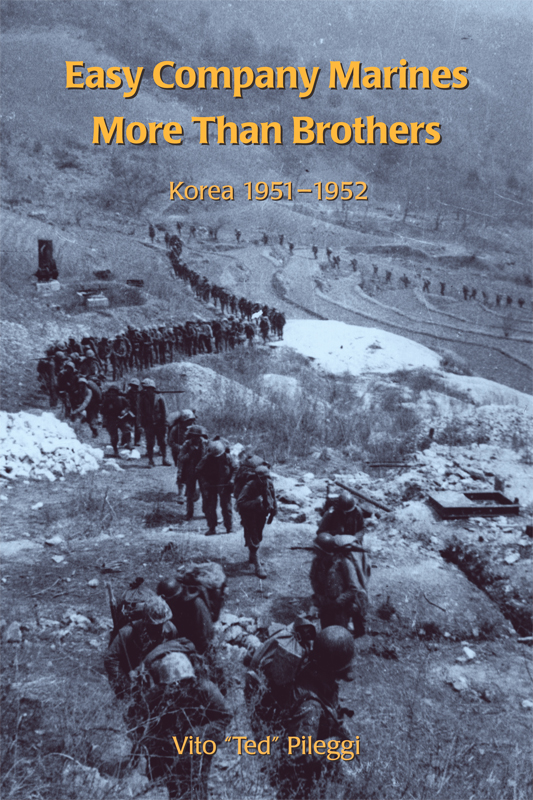
Easy Company Marines - More Than Brothers
|
||||||||||||||||||||||||||||||||||||||||||||||||||||||||||||||||||
|
|
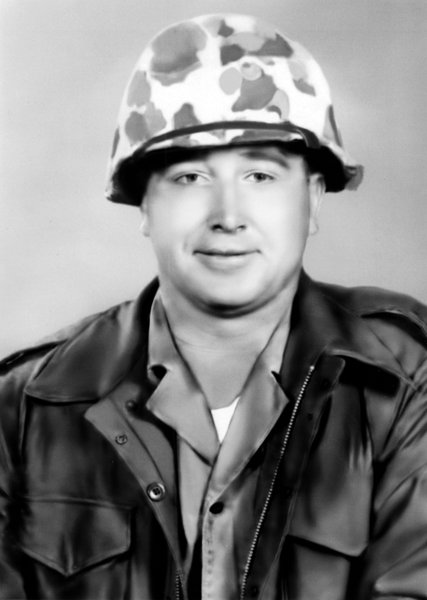
About the Author
The oldest of six children born to Ethel and Elmer Pileggi, Vito was raised in rural Oregon on a small farm and attended schools near Sherwood. After serving one
three-year enlistment in the Marines Corps and attaining the rank of sergeant, he entered the Oregon State Police, employed as a patrol officer. After serving three
years with the State Police in Astoria and Tillamook, the author re-enlisted in the Marines, retaining his old rank as sergeant. A year later he was stricken with polio
and was eventually discharged from the service. The State Police rehired him even though his right arm and shoulder were severely restricted by the disease. He was
assigned to communications in the Eugene Patrol Office for eight years, after which he transferred to the State Police Identification Bureau as a fingerprint technician
in Salem. Before retiring at the rank of lieutenant, the author supervised the Oregon State Police data processing section. Throughout the years he has been very
active as a singer and board member with Festival Chorale Oregon, a regional concert choir of approximately one hundred professional and amateur singers. The author
has coordinated performance tours for the Chorale throughout mainland Europe and Carnegie Hall in New York. He currently lives in Stayton, Oregon, was married and has
five children: Stephen, Thomas, Angela, Richard and Joseph.
Order Information
Fourth Edition – additional photos; 328 pages, 6 x 9 inches; 94 black & white photos. Trade paperback, eBook. ISBN - Paper: ISBN 978-0-9830292-1-2; ebook:
ISBN 978-0-9830292-2-9. Available now as paperback at www.createspace.com/3775734, in print and as ebook on Amazon.com,
and from the author at vito@wvi.com. Publisher website: www.cohopublishing.com.
Author: KB Taylor
Summary:
The critical role of the hospital trains during the Korean War
told through firsthand accounts of a nurse and a medic who cared
for the wounded on their journey from the frontlines.
Until September 1950 when the first mercy trains arrived from
the States, Korean passenger cars were used to evacuate the
wounded. By year end 1951, additional hospital-ward cars
had arrived and the 8138th Hospital Train Unit was formed
and divided into eight trains: 101 through 108. In one
location, the hospital trains went as far forward as 8,000 yards
from the enemy lines (30 miles north of the 38th parallel).
Each train's capacity was 216, but during heavy fighting, as
many as 300 or more were transported. (General James A.
Van Fleet/Rail Transport and the Winning of Wars stated:
"Evacuation of wounded by hospital trains (Korea) saved
thousands of lives.")
Order Information:
ISBN: 9781733369756 (copyright 2021); 7x10 Soft Cover, 174
pages, 200 = pictures, 70 of these in color. Amazon.com =
$14.95 (50w paper); BarnesandNoble.com or Bookshop.org = $17.25
(70w paper)
About the Author:
KB Taylor, raised in Grays Harbor County, Washington State,
worked as a project-control manager for an aerospace contractor
in San Diego. She and her husband now reside in Washington
State. She is an award-winning author whose previous novel
is the WILLA award winner: The Seagirls of the Irene--a
children's book based on family history. The author's
website is www.kb-taylor.com.

Authored by Glenn M. Justice
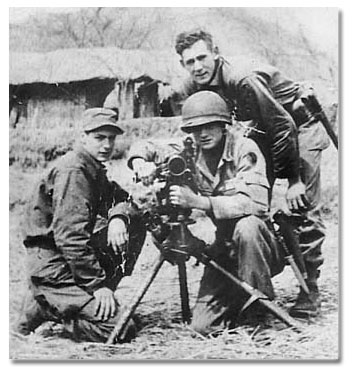 The Korean War had no TV glitter or Hollywood hype. The few movies made
of the Korean War were in no way close to the type of war fought there in 1950/53. With such immense frontline, it is doubtful Hollywood could produce a movie that
would encompass such a large battle area. In Fightin’ "George" Light Infantry, the author takes you there with real accounts of day-by-day action in the Korean War.
The battle weariness, the frontline humor, fear, sadness and living conditions of the infantryman are vividly portrayed, in clean language, of the lowly GI—the Army
infantry soldier, the winner of all our wars.
The Korean War had no TV glitter or Hollywood hype. The few movies made
of the Korean War were in no way close to the type of war fought there in 1950/53. With such immense frontline, it is doubtful Hollywood could produce a movie that
would encompass such a large battle area. In Fightin’ "George" Light Infantry, the author takes you there with real accounts of day-by-day action in the Korean War.
The battle weariness, the frontline humor, fear, sadness and living conditions of the infantryman are vividly portrayed, in clean language, of the lowly GI—the Army
infantry soldier, the winner of all our wars.
Fightin’ "George" Light Infantry was chosen as the title because the Great White Polar Bear is the mascot symbol of the 31st Infantry. Sometime several years ago the bear was named "George." The veterans of the 31st do not believe it was named for "G" or George Company, but for the Regiment as a whole. The author’s serving in George Company did help decide the name of the title. The standing bear on the dust jacket with wounds of many wars depicts the durability of the Regiment and speaks loudly of service to our country. [ more info ]
Order Information:
$29.95, 488 pages, 167 photographs. . ISNB 0-9702145-0-2. To order: JUSTPUB, 137 Lynn-Justice Rd., Bainbridge, GA 31717. E-mail
justpub@surfsouth.com or phone 229-246-5828. Georgia residents add appropriate sales tax.
Authored by Anthony J. Sobieski
About the Book
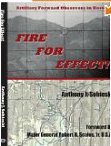 FIRE FOR EFFECT! is more than just a book about the Korean War. It is the
untold history of the Korean War Artillery Forward Observer, told by the men themselves. From the earliest days of the war in 1950 through the harrowing battles of
1951 and on into the so-called ‘stalemate’ period of the hill battles of 1952 and 1953, into the final climactic battles before the cease fire, the Forward Observer,
or FO, was there. Korea was and is known as the ‘Artillery War’ because more rounds were fired in Korea than in all of WWII, and it was the job of the FO to direct
these rounds onto their targets. FOs are the eyes of the artillery, and the importance of their job in Korea has been largely overlooked until now. Serving as infantrymen,
but not being considered one, Forward Observers lived, ate and slept on the front lines, ever ready to respond to an attack, or defend friendly troops and positions,
and sometimes losing their lives doing it. The awesome responsibility and firepower that was placed on a 22 or 23 year-old lieutenant or sergeant was staggering, and
after reading these first hand accounts, one can easily imagine what these young men faced on a daily basis. With over 100 interviews of Forward Observers, from all
time periods and from all locations and battles of the war, the grittiness and reality of what these servicemen went through in the ‘Forgotten War’ is brought to life
so that their deeds may be remembered for future generations, so the battlefield known as Korea and it’s veterans will not be forgotten any more.
FIRE FOR EFFECT! is more than just a book about the Korean War. It is the
untold history of the Korean War Artillery Forward Observer, told by the men themselves. From the earliest days of the war in 1950 through the harrowing battles of
1951 and on into the so-called ‘stalemate’ period of the hill battles of 1952 and 1953, into the final climactic battles before the cease fire, the Forward Observer,
or FO, was there. Korea was and is known as the ‘Artillery War’ because more rounds were fired in Korea than in all of WWII, and it was the job of the FO to direct
these rounds onto their targets. FOs are the eyes of the artillery, and the importance of their job in Korea has been largely overlooked until now. Serving as infantrymen,
but not being considered one, Forward Observers lived, ate and slept on the front lines, ever ready to respond to an attack, or defend friendly troops and positions,
and sometimes losing their lives doing it. The awesome responsibility and firepower that was placed on a 22 or 23 year-old lieutenant or sergeant was staggering, and
after reading these first hand accounts, one can easily imagine what these young men faced on a daily basis. With over 100 interviews of Forward Observers, from all
time periods and from all locations and battles of the war, the grittiness and reality of what these servicemen went through in the ‘Forgotten War’ is brought to life
so that their deeds may be remembered for future generations, so the battlefield known as Korea and it’s veterans will not be forgotten any more.
About the Author
Tony Sobieski wears a number of ‘hats’ working for the U. S. Air Force. As a civilian he is the Information Security Manager for McGuire Air Force Base in New Jersey, and as a reservist he is a Senior Master Sergeant assigned to the HQ Air Force Security Forces at the Pentagon where he serves as the Assistant for Nuclear Security and Integrated Base Defense Policy. Tony also is still actively involved as a U.S. Air Force Phoenix Raven, force protection and anti-terrorism specialists who protect U.S. aircrew and aircraft around the world. After the success of his first book FIRE MISSION! concerning the history of his Father’s unit in Korea, Tony has become an avid and recognized Korean War artillery historian. Tony’s love and respect for his Dad, a Korean War Veteran, and others like him, is the continuing motivation for his interest in the ‘Forgotten War’. Combining his military background and using a unique ‘matter of fact’ interviewing style are becoming Tony’s trademark, enabling him to shed light on how American artillerymen lived and died in the wasteland known as Korea. This is his second book.
Order Information
Paperback, 8.5 x 11". ISBN: 1420838369. Price = $19.95
http://www.authorhouse.com/BookStore/ItemDetail~bookid~29980.aspx
AuthorHouseTM
1663 Liberty Drive, Suite 200
Bloomington, IN 47403
888.519.5121
Authored by Anthony J. Sobieski
About the Book
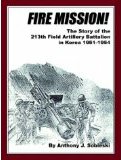 FIRE MISSION! is a historical record and personal insight of the 213th Field
Artillery Battalion during the Korean War. With over sixty interviews from former members, the pages come alive with personal memories about a unique time in our history.
The number of allied lives saved, and the amount of enemy destruction wrought by this unit is almost incalculable.
FIRE MISSION! is a historical record and personal insight of the 213th Field
Artillery Battalion during the Korean War. With over sixty interviews from former members, the pages come alive with personal memories about a unique time in our history.
The number of allied lives saved, and the amount of enemy destruction wrought by this unit is almost incalculable.
With the motto ‘Confidence in Calibre’, the 213th set the standard for artillery in Korea, firing over 10,986 Tons of artillery shells at the enemy in 893 days of combat. From when the 213th was a National Guard unit in 1950 to the final climactic battles of June and July 1953, the record of the 213th stands heads above the rest.
This unit history is written not only from a large scale, unit type perspective, but it also shows the personal side of the war from the perspective of the everyday life and hazards of the artilleryman. Read how the 213th played a major role in such battles as The Kapyong Perimeter, White Horse Mountain, and Outpost Harry, and many smaller incidents that occurred weekly that history and time have almost forgotten.
About the Author
Tony Sobieski is a Master Sergeant with the U.S. Air Force Phoenix Ravens, force protection and anti-terrorism specialists who protect U.S. aircrew and aircraft around the world. Tony’s love for his Dad, a Korean War Veteran, and the respect he has for his Dad’s service to our country became an odyssey of discovery and knowledge about the Korean War and the artillerymen who served there. Using his military background to better understand the life of an artilleryman in Korea, Tony has been able to bridge the gap of fifty years between what happened to U.S. Servicemen in Korea and now to present a work giving the reader an excellent ‘what was it like?’ feeling for those reading it. This is his first book.
Order Information
Electronic Book ISBN 140339024X = $4.95
Paperback (8.5x11) ISBN 1403390258 = $19.95
http://www.authorhouse.com/BookStore/ItemDetail~bookid~14192.aspx
AuthorHouseTM
1663 Liberty Drive, Suite 200
Bloomington, IN 47403
888.519.5121
Authored by James L. Hendricks
The 440th Signal Battalion - An Oral History is not a history in the traditional sense, but rather, a chronology of the memories of the men and women who lived the 440th experience throughout its 65 years.
The 440th was activated in March of 1942 and first served in Australia, then on to New Guinea. It was then sent to Indonesia, some of the Pacific Islands, and finally to the Philippines in late 1944. After VJ Day, it went on to Japan and remained there until the outbreak of the Korean War. It was inactivated in Korea in 1956. In 1961, the battalion was reactivated in Germany where it remained until inactivation in 2007. During its years in Europe, it participated in many joint NATO exercises, and served twice in Bosnia, as well as two tours in Iraq. It is one of the most highly decorated and respected Army Signal Battalions.
The 300-page book includes nearly 500 short stories/memories, and includes numerous footnotes and an extensive index. It also includes nearly 50 photographs, some of which have never been published. Most of the others are totally unknown to the general public. The book's publisher has placed this oral history book on its prestigious "Editors Choice" list, as well as naming the author as a "Rising Star."
About the Author
James L. Hendricks was drafted in 1952 and, after basic and signal training, was assigned to the 440th Signal Aviation Construction Battalion in Korea where he served
from 1953 to 1954. After attending his first battalion reunion in 2001, he felt the need to collect some of the great stories and memories they were all telling
while sitting around the table. Hendricks began earnestly recording and collecting in 2003. In 2006 he went to Germany to visit with the handful of 440th
men and women who had not deployed to Iraq. He returned to Germany a year later to attend the inactivation ceremony in Darmstadt.
Order Information
Visit the author's blog at http://440thsignalbattalion.blogspot.com/ or www.iUniverse.com.
Cover Photo
Authored by Joseph Donohue
Frank and Me at Mundung-ni is a Korean War memoir remembering the unforgettable moments of two 21-year old childhood pals who were drafted for Korea in 1952. It's the story of their journey to war as gung-ho recruits and their return home 12 months later as sober, combat hardened veterans. It's a story about bunkers, bullets and friendships. It features tales of the routine boredom of everyday living on the front lines, to sudden hair-raising moments of sheer terror, and the ultimate exhilaration and comic relief of simple survival.
Book Review by Rego Barnett
Joseph Donohue's Korean War memoir is one of the more readable books of its genre. The book is broken into the traditional three sections of such a volume: the
writer's pre-war years, war experiences, and homecoming. Donohue's background as a college instructor shines through in the well-written prose that fills the
pages of the book.
Donohue served with the 40th Infantry Division, 224th Regiment. He was unlucky enough to fight at Heartbreak Ridge and Punchbowl. He and a childhood friend, Frank J. Milisits, joined the Army together in the hopes of serving together in Korea. They completed jump school and awaited their assignments. They got their wish--but never knew it. (Both survived the war, however.)
Milisits was assigned to the 45th Infantry Division, which was located pretty close to the 40th in Korea. They were writing to each other without knowing how close their fighting positions were. In fact, they could almost have walked across a few trenches and hand delivered their letters had they known how close they were. That was one of the ironies of military life, as are other strange incidents that Donohue discusses in the book, e.g., his close brush with death, which was prevented because he turned his head the right way at the wrong moment (or maybe the wrong way at the right moment).
Donohue's descriptions of the conditions under which he and his buddies fought are chilling. Readers can almost see the huge rats on the front lines, feel the terror the troops experience as Chinese artillery shells pour down on them, exalt in the joy of finding civilized people while on leave... in short, he runs the gamut of emotions front-line troops felt as they strived to earn the number of points required to go home.
Simply put, Donohue described his book this way: "It's a story about naive, enthusiastic, 20-year old kids sharing their journey to war. It's about friendship, sadness, and joy during 20 months of service to their country. It's about growing up and facing the realities of war. It's about the boredom and routine of living on the front lines, which could suddenly turn ugly and become a hair-raising, deadly, heart-thumping moment of terrifying fear and exhilaration. It's a memoir of unforgettable personal moments...."
Most of all, it's readable. That is the best reason for anyone to get the book.
About the Author
Joseph Donohue was born and raised in Yorkville, Manhattan. He joined the Seventh Regiment National Guard in 1948 before being drafted in the Korean War,
where he served as a squad leader in the Fortieth Infantry Division. Donohue is a retired Yonkers assistant superintendent of schools, an adjunct professor, and
an educational consultant. He resides in Manhattan.
Order Information
ISBN 978-1-4620-7283-5 (softcover), 466 pp with photos. $29.95. Also available in Kindle and Hardcover formats. Printed in the USA by iUniverse, 1663
Liberty Drive, Bloomington, IN 47403. Ph. 1-800-288-4677. Also available on Amazon.com.
Authored by Ralph Hockley
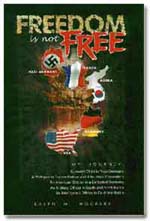 This well documented book begins with a down-to-earth account of Hitler’s rise to power
in Germany. Mr. Hockley traces 20th Century events as he experienced them, first as a child in Germany and in pre-war and Nazi-occupied France; later as a US soldier
in Germany, a combat officer in the Korean War, and an intelligence officer in Germany during the Cold War. But it is the personal relationships, the acts of dedication
to the many causes of the century, anti-Nazism, Quaker humanitarian, and the fight against Communism in Korea and Berlin, that make this book a valuable tool for those
who want a better understanding of the background and the events of WWII, the Korean War and the Cold War. Mr. Hockley highlights the fate of countries that fail to
provide for an adequate national security.
This well documented book begins with a down-to-earth account of Hitler’s rise to power
in Germany. Mr. Hockley traces 20th Century events as he experienced them, first as a child in Germany and in pre-war and Nazi-occupied France; later as a US soldier
in Germany, a combat officer in the Korean War, and an intelligence officer in Germany during the Cold War. But it is the personal relationships, the acts of dedication
to the many causes of the century, anti-Nazism, Quaker humanitarian, and the fight against Communism in Korea and Berlin, that make this book a valuable tool for those
who want a better understanding of the background and the events of WWII, the Korean War and the Cold War. Mr. Hockley highlights the fate of countries that fail to
provide for an adequate national security.
Details from well-kept journal entries bring home the reality of Korean War battles. Colonel Ralph Hockley...presents a keen insight and analysis of the causes, conduct and effects of that military adventure, writes Brigadier General Robert D. Upp - JAGC-Ret. My family and I met him at the Quaker office in Marseille, France, as a 14-year-old youngster. He was gifted with open eyes, ears and mind and the knowledge of three languages (German, French and English).... Fred Buch, Engineer, former internee at Les Milles Internment Camp, France, born 1900.
Ralph Hockley was one of the five or six outstanding intelligence officers of my experience in 25 years of the ‘Great Game’... Colonel Thomas F. McCord, Ret., former Chief, US Military Liaison Mission to Group Soviet Forces Germany. A life story of an extraordinary man of many talents who always put service to his country ahead of personal interest and whose expert counsel was sought by our highest political and military leaders. The moving account of multiple and turbulent lifetimes packed into one reads like a novel. Edward Rybak, European Security Affairs Advisor, USAINSCOM
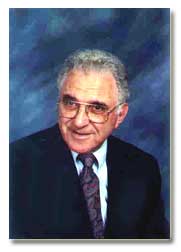 Ralph M. Hockley was born in Karlsruhe, Germany in 1925. His family left Nazi Germany and
moved to Marseille, France when he was nine years old. At age 14 after the fall of France, he worked as a volunteer interpreter (speaking French, German and English)
and office boy for the American Quakers in Marseille. In May 1941, the Quakers assisted his family in getting US immigration visas and thereby the release of Ralph’s
father from the Gurs Concentration Camp. 1945 found Ralph back in Germany as a US soldier in Counter Intelligence.
Ralph M. Hockley was born in Karlsruhe, Germany in 1925. His family left Nazi Germany and
moved to Marseille, France when he was nine years old. At age 14 after the fall of France, he worked as a volunteer interpreter (speaking French, German and English)
and office boy for the American Quakers in Marseille. In May 1941, the Quakers assisted his family in getting US immigration visas and thereby the release of Ralph’s
father from the Gurs Concentration Camp. 1945 found Ralph back in Germany as a US soldier in Counter Intelligence.
Upon his return to the US, he earned his BA in Political Science/Russian Area Studies from Syracuse University on the GI Bill; while there he was commissioned a 2nd Lt in Military Intelligence Reserve. In August 1950, 2nd Lt Hockley landed in Korea with the 2nd Infantry Division and participated in seven campaigns as an Artillery Officer. After the Korean War, and for most of the next 25 years, (joined by his late wife, Eva) he held various military and civilian Intelligence assignments in Germany (in beleaguered Berlin, then in Frankfurt, Bonn and Munich). Simultaneously, he served in the Army Reserve and rose to the rank of Colonel, Military Intelligence. In 1969, Ralph received a MS degree in Education from the University of Southern California. He retired in 1981 to the San Francisco area. In 1985 he and his wife, Carolyn, moved across the Golden Gate Bridge to Tiburon. Since 1997, he and Carolyn have resided in Houston, Texas.
Order Information:
$16 plus $4 S&H - 10027 Pine Forest – Houston Texas 77042-1531 - email: cghrmh@sprintmail.com
ISBN 1-887918-40X. Texas residents add appropriate sales tax.
Authored by Jan Herman
Synopsis:
For better or worse, Americans have defined military medicine during the Korean War by a novel, a movie, and a long-running TV show. But was the Korean War really like M*A*S*H? This was the war characterized by innovation--helicopters swiftly airlifting wounded patients from the battlefield to medical care, the first large-scale use of antibiotics during wartime, and the pioneering practice of vascular surgery that saved many a limb from amputation.
In these oral histories, both Navy medical personnel and their patients recount their "forgotten war," the dirty little conflict that somehow has fallen through history's cracks since it was fought more than fifty years ago. Neophyte physician Henry Litvin describes how he practiced medicine during the Chosin Reservoir campaign while trying to survive 30-below-zero temperatures and a ferocious enemy bent on annihilating him and his comrades. Hermes Grillo, a Harvard Medical School graduate, recalls how he ended up a few miles from the front operating on scores of mangled young men--without the benefit of x-ray equ8ipment--and forced to use retractors made from the brass of discarded artillery shells. Physician Clifford Roosa remembers the day an accidental explosion aboard his ship snuffed out the lives of thirty men in an instant. The legendary Dr. Joel Boone, World War I Medal of Honor recipient, tells how he came up with the idea of equipping hospital ships with helicopter landing decks. And Pearce Grove, once a machinist's mate aboard USS Consolation, gives an account of the historic first-ever landing of a patient-carrying helicopter aboard one of those gleaming white ships. Sarah Griffin Chapman, a former Navy nurse who lost a leg in an accident before Korea, reveals how she fought to be recalled to active duty so she could teach young amputees like herself to walk again. Sergeant John Fenwick, a Marine who had nearly been torn to pieces by a North Korean machine gunner, details his rescue by a Navy corpsman and the long road to recovery from his wounds. That corpsman, Glen Snowden, relates the same story from his own perspective. Was the Korean War really like M*A*S*H? These men and women--caregivers and patients--answer that question.
About the Author:
Jan K. Herman is Historian of the Navy Medical Department, editor of its journal, navy Medicine, and author of Battle Station Sick Bay: Navy Medicine in World War II. He has spent more than twenty years interviewing veterans of Navy medicine and chronicling their stories in articles, books, and videos.
Order Information:
256 pp Hardcover. $28.95 plus $6.14 shipping to USA. Website: BookLocker at www.booklocker.com.
Authored by Gonzalo Garza, Ph.D
Synopsis:
For anyone who has ever had a dream, Gonzalo Garza - A Texas Legend: Paso por aqui can provide the inspiration needed to make the dream come true.
This is the story of Gonzalo Garza's life, complete with stories from his childhood, his time in the Marines, education, courtship, marriage, children, and his career
as a legendary Texas educator.
As a young boy, he had dreams. As a young man, he made them come true. Take a lesson from this distinguished man's life, and make your own dreams come true. From the streets of Corpus Christi to the shores of Tripoli, this Marine veteran has distinguished himself in the service of his country and the students of the great State of Texas. A man of many talents and interests, Dr. Gonzalo Garza is a true Texas legend.
About the Author:
Dr. Gonzalo Garza was born January 10, 1927 in New Braunfels, Texas, the sixth of nine children of a migrant family from Mexico. He dropped out of school at the
age of 17 to join the Marines in 1944. He served in World War II in the Pacific Theater as an infrantryman and as an interpreter before leaving in 1946. He later reenlisted
in 1950 and saw action during the Korean War, receiving the Purple Heart and the Bronze Star for Valor.
After returning from the Pacific, Garza finished high school. He eventually got his Bachelor's degree in History, Government and Spanish from St. Mary's University after the Korean War interrupted his senior year. He went on to receive a Master's degree in Education from Our Lady of the Lake University and a Ph.D. in Curriculum and Instruction from the University of Texas.
From there, Garza began his career as one of the most distinguished educators in Texas history. He has served as a teacher, Assistant Principal, Principal, Associate Superintendent and Superintendent in numerous school districts including Corpus Christi, Houston and Austin. He retired in 1992 after ten years as the Superintendent of the Austin Independent School District. For his contribution, a Gonzalo Garza Independence High School in Austin has been named in his honor.
Order Information:
321 pp. Hardcover. $32.95 plus $3.50 postage and shipping. (Texas residents add 8.25% sales tax.) Please send check or money order for books
to: WordWright.biz, Inc., P.O. Box 9770, Alpine, TX 79831. Website: http://www.wordwright.biz.
Since our nation was founded, America has called upon its men and later women to answer the call to defend and protect our country. Millions have answered that call to arms and have made the sacrifices necessary to keep our nation free. Many have paid the ultimate price, "their lives." Our country can never repay them for what they have done, but we can honor them and their memories by preserving their stories so that future generations may know. These heroic individuals are called veterans, and many of them never tell their experiences to anyone. As they disappear with age, a valuable national treasure is lost. They serve their country, come home and lead productive and useful lives raising families and serving their respective communities in various ways. Yet their stories remain untold and a secret known only to them. How sad that future generations are deprived of this part of history. History books in our schools and libraries cannot and do not reveal the intimate feelings of these veterans. This book responds to the need, pulling together a group of veterans who have agreed to "tell their story." Time and space does not allow for all veterans' stories to be told, but I would suggest that the chapters in this book give a good cross section of the veteran population and would be a fair representation of all. I have been privileged to be a part of this book and I am sincerely thankful to the authors and the publishers for their vision as they put many hours of interviews together to educate those that may not know. We are all richer for having participated in its production. Let us all Thank God for those who have served faithfully until the end. To the future generations, I hope that you will never be called upon to make the sacrifices our veterans have made, but should it become necessary for you to do so, please remember that you must uphold the standards that the past generations so nobly set. Today's veterans wish you well and hope that you can enjoy our precious liberty and freedom; this is what we fought for and now hand the mantle to you. - GySgt. Gene Dixon, U.S. Marine Corps, Retired, 1st Bn 5th Marines, 1st Provisional Marine Brigade & 1st Marine Division (Korea 1950-1951).
--
Stewart Portela is a Teacher and Coach at the Firth, Idaho High School and teaches classes in “Military History”. Like Stewart, Russ Rapp also teaches at Firth High School and assisted in editing this book. From the author: I know how many times veterans will say the real heroes are the ones that didn’t come home and that is true. I didn’t interview a single veteran for this project, approximately eighty two right now that feels like they are a hero. But a hero can also be someone that serves, sacrifices, does the dead and comes home to raise a family, work and become the strength of our communities. That is what this book is about, an oral history of individuals that have served our nation in armed conflict and now serve and care for their communities and schools. Part of this book also centers on advice from these individuals to our youth of today. Hopefully the chapters are historically correct, patriotic and motivational. They have been for me and all of my students who are reading them. I have between thirty and fifty Military History students per year. It is a unique and wonderful class. I have never heard of this being taught in any other schools. I get to focus an entire trimester on just military issues. Each year I have numerous veterans’ come into my class and share their history and our nation’s history with my students. I know the impact these men and women have had on these young people is enormous. Gene, your web based material has been used by my students for the past couple years. Easily I have had over 100 students benefit from your sites. The other veterans’ stories, in the Korean War Educator Site, have also been extremely helpful. The greatest effect this project has had is on me. I wish I had begun this project years earlier. I have had a few family members serve in the military. I still know very little about their experiences and their history. These men have all passed away and I lost the opportunity to learn about them. We have pictures and I use division and unit insignia to research where the men were. I never thanked them for their service so this might be my way of thanking them. My individual testimony has grown from this work. It has truly been an honor to sit in the homes of so many wise individuals and listen and learn. This is a project that will affect me for the rest of my life. I am not an author or much of a writer. My degree is in Bio-Chemistry and Natural Science and I am working on an advanced degree in Athletic Administration. Russ Rapp has a Masters degree in Literature so he is the writer of us two. He has an amazing flair for writing and is an extremely talented individual. Russ and I have both been in the public schools for many years. I am on my twenty-second year of teaching science and history and Russ is our Special Education Director. Thanks again Gene for all of your time and work. You are an inspiration to us all here at Firth High School. Sincerely, Stewart Portela.
Order Information:
This book is for sale by Tate Publishing Company and orders may be submitted at the following link:
http://www.tatepublishing.com/bookstore/book.php?w=1-59886-14-3-3. Also orders may be
submitted directly to Stewart Portela, Email: sportela@d59.k12.id.us. 470 Pages. $19.95. "Heroes Among Us"
Authored by Bill Barry
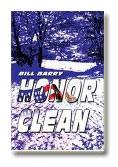 A couple of old ex-Marines stand up for GI's accused of murder at Nogun-Ri, the Naktong River,
and elsewhere. Through them (when younger), the story of the war is told in flashbacks, from start to finish, though the bulk of action occurs in the months after the
Chosin Reservoir, when the PLA was driven back and the MLR was established. Some new insights about the conduct of the war are revealed in just 284 tightly packed pages,
and they challenge some basic tenets of the historical record. The book is dedicated to that selfless generation which fought the war, and it tells their story, no
phony poetic lyricism. The author is one of them. At age 19, he was a platoon sergeant with the 1st Marine Division, later becoming an award-winning journalist and
criminal investigator. Of Honor Clean, one reviewer said: "This is must reading...for anyone who wants to know what really happened during the Korean War...a brutal
and unforgettable lesson about war itself..."
A couple of old ex-Marines stand up for GI's accused of murder at Nogun-Ri, the Naktong River,
and elsewhere. Through them (when younger), the story of the war is told in flashbacks, from start to finish, though the bulk of action occurs in the months after the
Chosin Reservoir, when the PLA was driven back and the MLR was established. Some new insights about the conduct of the war are revealed in just 284 tightly packed pages,
and they challenge some basic tenets of the historical record. The book is dedicated to that selfless generation which fought the war, and it tells their story, no
phony poetic lyricism. The author is one of them. At age 19, he was a platoon sergeant with the 1st Marine Division, later becoming an award-winning journalist and
criminal investigator. Of Honor Clean, one reviewer said: "This is must reading...for anyone who wants to know what really happened during the Korean War...a brutal
and unforgettable lesson about war itself..."
Order Information:
$15.95 plus S&H - Order from
Amazon.com
or Barnes and Noble. Also available directly from the publisher at their website, or call toll free: 1-877-823-9235.
Any local bookstore can also order the book.
Authored by Robert Winston Mercy
This highly decorated author's memoir is one of the most exciting and comprehensive to come out of America's "Police Action." It stands as the only known historical first-hand account of a U.S. frontline infantry soldier that fought through the initial hectic year of the Korean War. It records the near total destruction of the South Korean Army on two occasions and shows the ensuing chaos; how during eight major campaigns the course of the entire war was changed by a few determined acts of small unit heroism. Robert, his twin brother Richard and best friend Robertson voluntarily command and lead an "expendable" all Asian assault platoon that was assigned to their Company, a distinct rarity for the U.S. Army, and they suffered heavy casualties.
The book's content is unique not only in prose and style, but relevancy to our nation's current acceptance of a state of continual and unending war; and how the propaganda of film makes that possible. It gives a startling glimpse into the murderous nature of the North Korean Army, their countless savage atrocities against Allied troops and civilian populations alike.
I Hear No Bugles reveals the nature and character of the post-World War II American Army in occupied Japan; then into the war with its heroes, cowards and the heretofore unrevealed individual and mass unit desertions; and the author's thoughts during the heat of battle. It also chronicles the daily sicknesses, disillusionments and inner struggle of morality and conscience in making life and death combat choices. It questions the honor of line officers and aid station nurses that stole from the living, the wounded and the dead.
This meticulous history ranges between thunderous battle scenes and the muted reluctant chuckles drawn from the grotesque bravado creations of battlefield 'combat humor' that altered between the psyche and spirit of men who were bonded together in a brotherhood of desolation and hardships. As a comparison note that sustains the ferocity of the Korean War, as many U.S. soldiers were killed, wounded and missing in its three years as were in the twelve year Vietnam campaign. Over 1.5 million Chinese and an unspecified number of North Korean troops died, along with an estimated three to five million civilians on both sides of the 38th parallel. Yet Korea, nearly sixty years later, persistently remains 'The Forgotten War.'
Order Information:
Paperback; 436 pages; publisher - Lulu.com (April 27, 2008); ISN-10: 143571704X; ISBN-13: 978-1435717046; price - $37.95.
Source of this review: The Buffalo Bugle Newsletter's "From the Bookshelf," page 36, Vol. 18, No. 1.
Authored by R. B. Campbell, USMC veteran
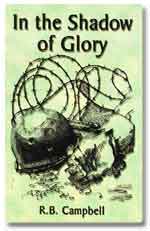 A gripping story about the coming of age of an 18 year old Marine fighting in Korea during
the last half of that bloody war. There is no Hollywood hokum in this book. It is a riveting, eye-opening account of the Forgotten War from the grunt's perspective--how
they lived, how they talked and how they died. Much of the book is based on the author's experiences during the Korean War. Campbell, a former Marine sergeant,
has drawn on his experiences as a Marine infantryman to craft a masterful depiction of men at war. R. B. Campbell spent three years in the Marines, including
a year fighting in Korea. He was discharged with the rank of sergeant. He then attended the Cleveland Institute of Art for four years before going to work for American
Greetings Corp. where he spent 37 years as a cartoonist, art director and humor writer. Campbell resides in Medina, Ohio with his wife Judy. He began writing novels
after his retirement in 1996.
A gripping story about the coming of age of an 18 year old Marine fighting in Korea during
the last half of that bloody war. There is no Hollywood hokum in this book. It is a riveting, eye-opening account of the Forgotten War from the grunt's perspective--how
they lived, how they talked and how they died. Much of the book is based on the author's experiences during the Korean War. Campbell, a former Marine sergeant,
has drawn on his experiences as a Marine infantryman to craft a masterful depiction of men at war. R. B. Campbell spent three years in the Marines, including
a year fighting in Korea. He was discharged with the rank of sergeant. He then attended the Cleveland Institute of Art for four years before going to work for American
Greetings Corp. where he spent 37 years as a cartoonist, art director and humor writer. Campbell resides in Medina, Ohio with his wife Judy. He began writing novels
after his retirement in 1996.
Order Information:
Book prices start at $18.98, 6x9 inches, 223 pages, soft cover.
Read reviews and order from www.authorsden.com
Authored by Jim Blagg
About the Book:
There are not many books written about the Navy in the Korean War as they really weren't the ones in the "front lines." But Navy personnel were there for support.
The author explores the everyday life of a sailor during the Korean War years aboard a provisions cargo ship for the period of 41 months (mostly in Japan). The methods
of replenishing ships with food at sea and in port are described in detail.
About the Author:
My son Jeff was looking for anything pertaining to my ship, USS Polaris, on the Internet. He came across Korean War Veterans. Then, he picked out "Navy", and then "Ship
reunions." I didn't know until 1999 that the Polaris held a reunion each year. It's not a large group, but we've bonded like family. We look forward to meeting for
the reunion held each year in a different U.S. city. In this group, I want to give special thanks to "Bill" Scott and Lee Nunez for the hours they put into keeping
these reunions running smoothly. Anyone who served aboard the Polaris, World War II through its 1957 when it was decommissioned, is welcomed to our reunion. http://usspolarisaf11.us
Sayonara to all the little farms with their neat, little vegetable gardens and rice patties, the familiar "chug-chug" of the fishing boats, the tunes of "China Night"
and "Kum-Kum Monsume," and the shy, little children who don't know what to make of Americans. Sayonara to the beautiful scenery created by trees with their lacy leaves
in different shades of green, and the light, drifting snow flurries in winter.
Order Information:
Paperback: 64 pages. Publisher: Xlibris Corporation (January 23, 2007). Language: English. ISBN-10: 142574219X. ISBN-13: 978-1425742195.
$10 plus shipping. Order through www.amazon.com.
Authored by Anthony J. DeBlasi
Dedicated to all who served and still serve in Korea
There were plots and bloodshed in South Korean prison camps, riots in Seoul, and an angry president who refused to sit down and negotiate a peace treaty, planning
instead to invade North Korea with his own troops. Never mind the US/UN forces and the "peace talks"!
In spite of an armistice, the war wasn't over when I got my assigned unit in Korea. The ceasefire had stopped the thunder at the front but fighting continued. Bed-Check Charlie stopped his bomb and grenade raids, flying low in a single-prop plane. Off the radar screen and too slow for jet interception, the Gook pilot hoped in the dark of night to hit something or somebody in this communications outfit in Bupyong.
1.8 million of us were sent to Korea between 1950 and 1953 after hell broke loose in Korea--just five years after World War II. When Soviet-backed North Korea invaded South Korea, US and other UN troops rushed in to keep South Korea out of the jaws of Communist North Korea. The question on many minds then was: is this the start of World War III? The Soviet Union was armed with nuclear warheads and nervous Americans built bomb shelters.
Between 1950 and 1953, on a peninsula between China and Japan one-third the size of California, over 36,000 American servicemen lost their lives. The staggering death toll on both sides, military and civilian, was over 2 million. How could Americans forget such a war? How many Americans know that no peace was ever concluded and our troops are still in Korea, facing the same enemy we did more than 50 years ago? What other armed conflict keeps producing veterans after half a century!
This intense little book tells who we were and what sent us off to war. It sketches the role of a radio company, reports a chilling moment during prisoner exchange, takes a trip to the DMZ, samples first-hand accounts of GIs before the cease-fire, speaks of the Korean people and their culture during those war-torn years, and answers the question: "What did we accomplish?" It winds down with some incisive commentary and a poem, "Our War." It concludes with the service medals for duty in Korea. The book is illustrated with photos I took there, including rare ones found in the company dark room taken at Panmunjom during the prisoner exchange. I wrote this book to highlight a decisive chapter in history, forgotten by too many older Americans, hardly known by younger Americans.
Despite its small size, the book conveys a wealth of information in very readable form. Korea: Back when... is not just for veterans and war buffs but for anyone wanting to get a handle on the Korean War without getting stuck in it--while gaining a vivid sense of the place, the time, and the people involved in this mid-20th century tragedy.
About the Author
Anthony J. DeBlasi is a "retired" writer living in West Newfield, Maine. (Tony and Janet have three children and six grandchildren.) After digitizing
the 35mm slides he took in Korea, Tony found himself reliving his tour of duty in Korea as he worked on the many images to remove age spots, scratches, etc. Time,
place, people, and events came right back to him and begged for some kind of book to get written. The idea to write a book about the Korean War for everyone came
when he tried to explain the war to his daughter, Linda. Not an easy job. So--motive, images, memoirs, letters, and research fired up into Korea: Back
when...
Tony's sense of the hell that the men on the line went through haunts him still. Almost daily he fights a sense of guilt for not having been in the thick of it. In part, his book is a tribute to the men who lived that hell, to the POWs, and to those who never made it back.
Order Information:
ISNB 978-1-59824-462-5; paperback, 55 pages, 20 photos, 2 maps, 3 hand sketches; Available at www.e-booktime.com; 1-877-613-2665;
E-BookTime3, LLC-6598 Pumpkin Road, Montgomery, AL 36108. Price: $8.95; shipping and handling: $5.95 (flat rate per order). Also available at Amazon.com
and other on-line book dealers and by special order through most book stores.
Authored by Boris R. Spiroff
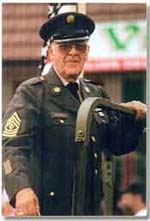 A man can live several lifetimes in only thirteen months when he is fighting enemy
fire in bitter cold and waist deep snow, or torrential rains and slick, ankle-sucking mud. Boris Spiroff spent just such a year in combat against North Korean forces
as a sergeant in the United States Army, Company G, Seventh Calvary Regiment in 1950 and 1951. Spiroff's journal account of his experiences provides a written testimony
to the horrors and tragedies endured by so many gallant American soldiers. Having been discharged from the army in 1945 with eight years of service in Panama
and Germany behind him, Spiroff was called again to serve in Korea in 1950, after only five months of marriage. Threaded throughout his journal entries are letters
written to and from his beloved Cassie, revealing the fear and pain of a combat soldier's heart and the uneasy patience of a combat soldier's wife. The journal and
the letters present a snapshot of one soldier's experience warmed by love, strength, and unyielding faith. Boris Spiroff, ISG-E8 USA retired from the U.S. Army
in 1962 after twenty-five years of service having received the Korea Victory Medal, the Army Commendation Medal, a pendant from the South Korean government, the Combat
Infantry Badge with Wreath, and the Parachute Combat Badge. In 1990 Catherine, his wife of forty years, died of cancer. It is the letters that were written to her during
his time in Korea that were the foundation for "Korea: Frozen Hell on Earth." Spiroff resides in Severna Park, MD.
A man can live several lifetimes in only thirteen months when he is fighting enemy
fire in bitter cold and waist deep snow, or torrential rains and slick, ankle-sucking mud. Boris Spiroff spent just such a year in combat against North Korean forces
as a sergeant in the United States Army, Company G, Seventh Calvary Regiment in 1950 and 1951. Spiroff's journal account of his experiences provides a written testimony
to the horrors and tragedies endured by so many gallant American soldiers. Having been discharged from the army in 1945 with eight years of service in Panama
and Germany behind him, Spiroff was called again to serve in Korea in 1950, after only five months of marriage. Threaded throughout his journal entries are letters
written to and from his beloved Cassie, revealing the fear and pain of a combat soldier's heart and the uneasy patience of a combat soldier's wife. The journal and
the letters present a snapshot of one soldier's experience warmed by love, strength, and unyielding faith. Boris Spiroff, ISG-E8 USA retired from the U.S. Army
in 1962 after twenty-five years of service having received the Korea Victory Medal, the Army Commendation Medal, a pendant from the South Korean government, the Combat
Infantry Badge with Wreath, and the Parachute Combat Badge. In 1990 Catherine, his wife of forty years, died of cancer. It is the letters that were written to her during
his time in Korea that were the foundation for "Korea: Frozen Hell on Earth." Spiroff resides in Severna Park, MD.
Order Information:
$12.00, 96 pages, paperback. Send check or money order to author Boris R. Spiroff, 524 Old Annapolis Rd., Severna Park, D 21146. Ph. 410-647-4503. Maryland residents
add appropriate sales tax.
Authored by James Hollis
According to the author, this book is not meant as a detailed chronology of battles fought and units that participated in each battler. Rather, it is primarily a story about Hollis' service and how the Korean War affected his life and the lives of thousands of other veterans who served in Korea.
Hollis was drafted into the Army after graduating from high school in the Class of 1950. He reported for duty in November 1952, and after completing basic training was immediately shipped to Korea. He received artillery training, but when he arrived in Korea he was assigned to an intelligence section.
A large portion of Hollis' book comes from actual experience or first hand reports from other soldiers who remember major accomplishments and loss of lives--American lives--in Korea. In the author's opinion, some of the battles were fought unnecessarily, causing the deaths of many young soldiers. In May of 2008 Hollis returned to Korea on a revisit, where he no longer saw a war-torn country. Where he once saw battlefields and complete devastation, now there are towering cities. "South Koreans are living in prosperity and good health. These things are a direct result of America's help in blood and money," notes Hollis.
Order Information:
$19.95 +$3.50 shipping. Mail check to: Jim Hollis, 1950 Eaton Avenue, Hemet, CA 92545. Or call "Authorhouse" at 1-800-839-8640. Also
www.Authorhouse.com or online through Amazon Books, Barnes and Noble, or any book store.
Compiled by the Illinois Korean Memorial Association
This 57-page, soft-bound booklet includes a brief history of the Korean War, statistics, photographs, newspaper headlines, a combat chronology of the war from 1950 to 1953, maps, list of American commanders in Korea, casualty statistics, information about the Illinois Korean War Memorial, and a list of Illinois KIA in the war.
The Illinois Korean Memorial Association distributes the booklet free to any Illinois school or library that asks for a copy of it. The public can purchase a copy at the price of $10 check or money order. Tax deductible donations are also welcome. All donations go toward the book project and upkeep of the Illinois Korean Memorial.
Order Information:
Illinois Korean Memorial Association, P.O. Box 8554, Springfield, IL 62791.
Authored by Charles Reilly, Jr.
All proceeds for this book go to:
The Medical Center,
The Veterans Administration
Coatesville, PA 19320
Attn.: Mr. Earl JohnsonThe book is not for sale But contributions are made to this VA Medical Center to benefit hospitalized veterans. Those wishing an autographed copy of the Korea simply send a check in whatever amount (we suggest a minimum of $10) they wish to contribute to the VAMC to:
Korea book
c/o Charles Reilly
Suite 111
500 Midland Circle
St. Davids PA 19087Checks should be made out to VAMC, Not to the author, and sent to Charles Reilly at the address above along with a note indicating to whom the book should be autographed. The author will send the autographed copy postpaid to the person sending the check. At about the same time, The Veterans Administration will send the book requester a receipt for a tax deduction for the amount contributed.
"Korea 1950-1953; The War That Never Was" follows a group of young men from a small town in Pennsylvania to their duties in Korea and throughout the world. As everyone who ever served in the military recognizes, "you go where they send you." Even as Russia and China were backing up the North Korean forces who invaded South Korea, American military personnel were gearing up expecting a Russian attempt to sweep westward across Europe.
This book is written by the men who served on the ground, in the skies above and on the waters off Korea as well as elsewhere during that Forgotten War.
HomeOfHeros.com e-book
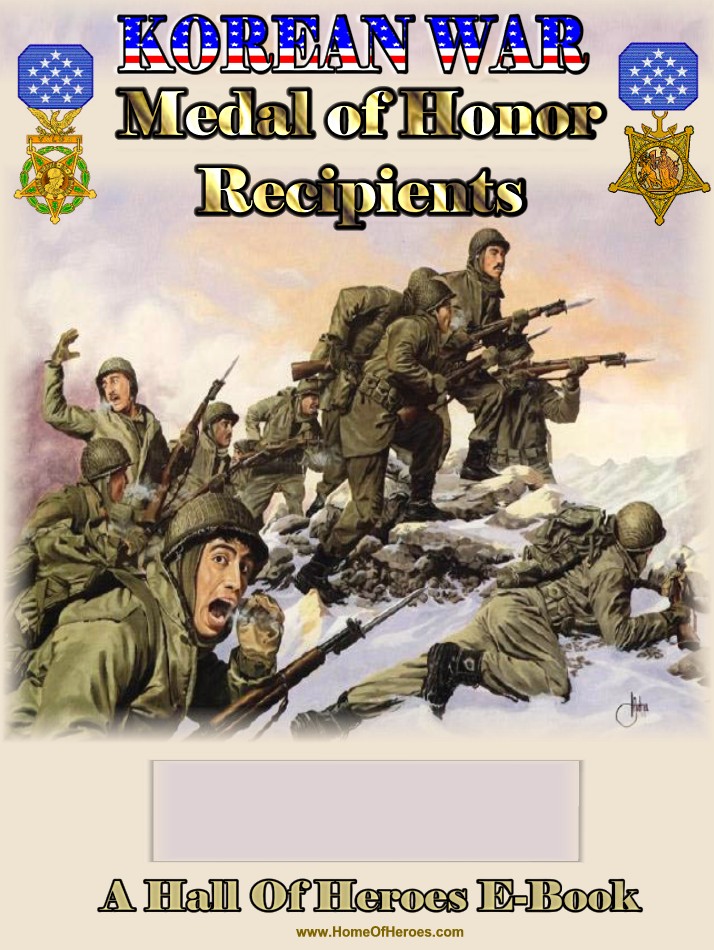 A printable book on all the Medal of Honor recipients from
the Korean War. It is a FREE book that can be downloaded in MS WORD and printed in full-color. It even has a place where a person can customize it with
a dedication message on the title page if they want to give it as a gift to a Korean War vet.
A printable book on all the Medal of Honor recipients from
the Korean War. It is a FREE book that can be downloaded in MS WORD and printed in full-color. It even has a place where a person can customize it with
a dedication message on the title page if they want to give it as a gift to a Korean War vet.
You can find the book at:
http://www.homeofheroes.com/publisher
Direct download link:
http://www.homeofheroes.com/e-books/publisher/W_Korea1950.doc
Authored by William Stedman
The author tells about his tour in the Army from his date of enlistment November 27, 1950 to November 26, 1953. A member of the 936th Field Artillery Battalion, Stedman was wounded while in Korea and evacuated to the 8055th MASH. In his post-Korea military duty, he served in the Presidential Honor Guard in Washington, D.C.
Order Information:
$22.00 purchase price includes shipping and handling to anywhere in the 50 states, including Alaska, Hawaii, or Puerto Rico. Approximately 143 pages hardbound.
No photographs. No chapters. Just a running account. Self-published by the author. Send check or money order to: William Stedman, 23 Mill Road,
Hyde Park, NY 12538-2065.
Authored by Denzil Batson
It was the winter of 1951-52 and Denzil Batson was a sergeant in the Second Platoon of F Company, 15th Regiment, 3rd Division, ordered to recapture a hill called Little Gibraltar from the Chinese. Denzil Batson tells about a two-day assault on a 60-degree slope with chilling detail. At the end of the assault, half of his platoon had been killed or wounded. At the time, Batson was eighteen and newly married.
Batson recreates the sights and sounds that caused him to sometimes shut his eyes to block out the horror, from artillery fire to heart-sickening screams for medics--all the things he would remember for a lifetime.
Order Information:
$15.95 per copy plus $3.00 shipping. To contact the author: Denzil Batson, 158 Brooks Street, Republic, MO 65738; ph. 417-732-7423 or e-mail batsondenz12@aol.com.
Authored by Richard E. Ecker
On June 28, 1950, five U.S. airmen died when their aircraft were shot down over Korea. They became the first U.S. casualties in a war that started three days earlier, when the North Korean People’s Army crossed the 38th parallel and invaded the Republic of South Korea. The losses of U.S. military personnel that began with those five airmen would continue for 37 months and would ultimately total 33,985 American fatalities and more than 100,000 other American casualties. This is a history of U.S. involvement in the Korean War as told through those casualties—by the dates they occurred, their causes, their numbers and the units in which they served. This work is subdivided into three units including The Peninsular War, Active Defense and The War of the Hills.
About the Author: Retired scientist and educator Richard E. Ecker is a combat veteran of the Korean War. He lives in Downers Grove, Illinois.
Order information: ISBN 0-7864-1980-6; tables, notes, appendix, index, 215pp. illustrated case binding (7 x 10) 2005, $55, available for immediate shipment. Visit http://users.aol.com/ocomm/ for more information.
Compiled by JoAnne Foley and Tami K. Plank
 This is a history of the Korean War from the perspective of rural America.
Compiled by a museum volunteer for their Korean War exhibit, this is a complete local history of the Stevens County Korean War Veterans. Serving in the Army, Air Force,
Navy and Marines, ninety-four men from a rural farming community lived, fought, were injured, went missing and died on Korean soil. This is their version of the Korean
War story. It includes photos, brief service records, the names of their parents and their experiences.
This is a history of the Korean War from the perspective of rural America.
Compiled by a museum volunteer for their Korean War exhibit, this is a complete local history of the Stevens County Korean War Veterans. Serving in the Army, Air Force,
Navy and Marines, ninety-four men from a rural farming community lived, fought, were injured, went missing and died on Korean soil. This is their version of the Korean
War story. It includes photos, brief service records, the names of their parents and their experiences.
Order Information: $14.95 paper + $3.00 shipping & handling. 144 pages, 156 illustrations. Send a check or money order to Stevens County Historical Society & Museum,
116 West 6th Street, Morris, MN 56267
Ph. 1-320-589-1719 or email info@stevenshistorymuseum.com.
authored by Ed Parmenter
The author wrote this book after finding over 300 errors in Korean War histories that were already in print. Published in the summer of 2011, his book makes corrections to incorrect statements made by other historians.
In addition to his own experience in participating in combat training in Japan and pre-Korea as a member of the 1st Cavalry Division, Parmenter conducted years of research, including numerous trips to the National Archives in College Park, Maryland, and to the Army Military History Institute in Carlisle, Pennsylvania.
Order Information:
Hard copies = $15.00 plus $3.50 shipping; soft cover = $10.00
plus $3.50 shipping. Order through Ed Parmenter, P.O. Box
15421, Syracuse, New York 13215.
By Herbert G. Renner, Jr.,
Master Chief, Hospital Corps, U.S. Navy, Retired
Synopsis:
In part an anthology of articles surrounding the era of the Korean War, giving a historical view of the events that shaped the conduct of the war from both the enemy
and United Nations sides and events that were on-going on other than war fronts. The focus of the manuscript is the collection of the actual letters written by the
Marines and Corpsmen in what was probably the last sustained trench warfare that will ever be seen. Also included is a collection of stories and vignettes of the episodes
of actual combat on the front lines at the Marine company level.
A saga of the life of a young Corpsman, to whom the manuscript is dedicated, is told to give the reader an understanding of the route a man takes to become a Navy Corpsman and his ultimate insertion into the chaos with his Marine comrades and the courage that developed.
In all, it gives the convoluted and narrow picture from the eyes of a combatant to a broader picture of the war from summaries and excerpts. There is a multi-fariousness to the manuscript as it is prepared as a table of articles that are interconnected only as to the general subject – the era of the Korean War.
Author's Biography:
Herb Renner was born in the early nineteen thirties in Washington, D.C. and enlisted in the Navy immediately after high school graduation. Graduate of nine naval schools
which included the Navy’s Nuclear power schools related to nuclear powered ballistic missile submarine operations, in the fields of health physics and radiation safety.
He served aboard the nuclear powered, ballistic missile submarine USS Theodore Roosevelt (SSBN 600) for 5 years as Chief of the Watch and with medical duties.
In the early days of his naval career, served with the Marines in Easy Company, 2nd Battalion, 5th Marines, an infantry company, as a Corpsman, rendering first aid to battle casualties during the Korean War. After the armistice served with the 1st Engineer Battalion on mine clearing details and in the battalion aid station. During the Vietnam War, served with a naval medical research unit studying diseases of military importance in Southeast Asia.
Retired with 22 years naval service in 1971 as a Master Chief Hospital Corpsman, USN, after which employed as a Purchasing Agent and later a Director of Materials Management in civilian hospitals for 16 years. Widower, two grown children. Presently living in Nevada on the High Desert.
Order Information:
ISBN: 1-4241-3938-4, Title: Letters of War, $34.95, 527 pages, including photos, paper back. Published by PublishAmerica, LLLP;
www.publishamerica.com, Baltimore, MD. Genre: History, Military, Non-Fiction, An Anthology. Premise: Comrades, Chaos
and Courage
Edited by Ann Marie
|
|
Letters to Ann is not what you expect. It is the Korean War as seen through letters sent to a four-year-old. Fathering from the violence of Korea, Capt. John F. Hughes finds and shares bits of humor about his everyday military existence to reassure his daughter that life indeed goes on, even in times of war. A very different snapshot of the "Forgotten War", the book is edited by Ann Marie (not the Ann to whom the letters were sent).
"The great truism of war is that it makes good men do bad things, and bad men do terrible things. Letters to Ann offers an important addendum: that through the worst moments of war, the best part of humanity, our ability to love and comfort one another, survives intact. It's impossible to read this collection of a soldier's letters from the battlefield in Korea to his 4-year-old daughter at home without being charmed, and touched."
Ann Marie started her career in television news and then went to law school. She was a trial litigation attorney in Colorado before she turned to editing.
184 pages, hardcover $24.99 through Amazon.com. ISBN-10: 0989378802. ISBN-13: 978-0989378802. Contact: Ann Marie, Editor, annmarie83@mac.com. Ph. 303-399-1261.
Authored by David Baillie
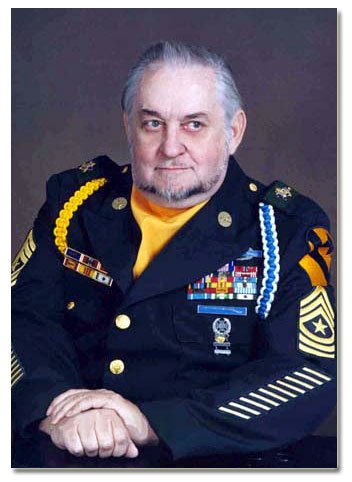 The events depicted throughout the book are short stories of experiences
that took place in Korea during and through the years 1950 to 1958. While not in actual combat, the author provides information about many events that tell the story
of the day to day life of one GI and the men he served with during these times. Every GI who has been in a campaign which involved the loss of life can recall the events,
but each in his own way. Though they all saw the same action take place at the same time, when asked about it later, they retold it differently from others, as only
their eyes saw it.
The events depicted throughout the book are short stories of experiences
that took place in Korea during and through the years 1950 to 1958. While not in actual combat, the author provides information about many events that tell the story
of the day to day life of one GI and the men he served with during these times. Every GI who has been in a campaign which involved the loss of life can recall the events,
but each in his own way. Though they all saw the same action take place at the same time, when asked about it later, they retold it differently from others, as only
their eyes saw it.
Combat is an experience that few ever forget, at least knowingly. Some suppress it within their minds to protect the mind from the real horrors of what the eyes have seen. These events become a color film in one's memory, and from time to time replay themselves to the viewer; the GI who went through it all. "They become our dreams, our baggage, and even our nightmares," says the author of "Line Kansas." "Some of us come to this point right after the event takes place and can't deal with it. Others block it out and some for 40 years or more, and still others never come to grasps with it."
 Baillie's book contains many types of experiences, told in a down-to-earth
manner with as little technical language as possible. A reader doesn't have to be a veteran to understand it. Baillie hopes it reflects the more human side of the soldier
and that his readers understand that the dangers of war are not always getting shot at from on the line--Line Kansas.
Baillie's book contains many types of experiences, told in a down-to-earth
manner with as little technical language as possible. A reader doesn't have to be a veteran to understand it. Baillie hopes it reflects the more human side of the soldier
and that his readers understand that the dangers of war are not always getting shot at from on the line--Line Kansas.
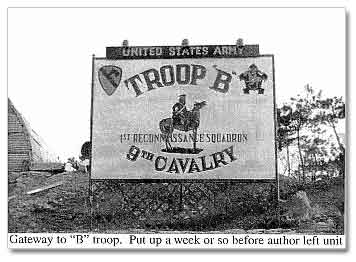
The author of this book served in Korea with the 24th Infantry Division, 34th Infantry Regiment, 34th Tank Company. He later did tours there with the 1st Cavalry Division. His final tour in Korea was with B Troop, 1st Recon Squadron, 9th Cavalry Regiment.
For detailed information about his book and a good website about the 24th Infantry Division in Korea, see the Line Kansas website.
Order Information:
$20.00, plus S&H. Illinois sales tax: $1.50 (7.25%) for a total of $24.00 pre-paid by check or money order. E-mail David at
scottie16@earthlink.net or send a check or money order to the author David Baillie at P.O. Box 5, Elburn, IL 60119.
Authored by Warren Gardner MacDonald
 A nonfiction memoir providing the reader a close-up look at ground combat
in Korea, 1951-1952. The Korean War was deadly, the enemy fought ferociously, with no quarter given by either side. This is a personal account of a 1950’s American
soldier with the basics, barracks and bullets described in all the warts and glory of the era. The ending is bittersweet as the soldier leaves the service and reenters
civilian life.
A nonfiction memoir providing the reader a close-up look at ground combat
in Korea, 1951-1952. The Korean War was deadly, the enemy fought ferociously, with no quarter given by either side. This is a personal account of a 1950’s American
soldier with the basics, barracks and bullets described in all the warts and glory of the era. The ending is bittersweet as the soldier leaves the service and reenters
civilian life.
About the author: Warren Gardner MacDonald was born in Medford, Massachusetts in 1933. His family was of modest means and they worked hard to provide the basics of food, clothing and shelter during the depression years.
In 1950, Warren enlisted in the U. S. Army, serving for three years. While in Korea, he was awarded the Combat Infantry Badge, two Purple Hearts, the Korean Campaign Medal with two Bronze Stars, and other earned ribbons and medals. He spent eighteen months in Army Hospitals recovering from wounds received in combat.
He is a graduate of Boston University, with a Bachelor of Science in Business Administration degree, and Long Island University, NY, with a Masters in Business Administration degree. Married, with four children, he is retired and resides with his wife, Dorothy Ellen, in Jupiter, Florida.
Order Information:
Published by Lulu Press, Inc., Morrisville, NC 27560; First Edition March 2006; ISBN 1-4116-7307-7 Hardcover with color jacket $22.95; ISBN 1-4116-7894-X Paperback
$14.95; 152 pages with photos; Available: At all fine bookstores and on line at Amazon.com and Lulu.com. Link to publication:
http://www.lulu.com/wmacdonald. Media contact: Warren G. MacDonald,
wmacdonald@adelphia.net (561)743-8650
|
|
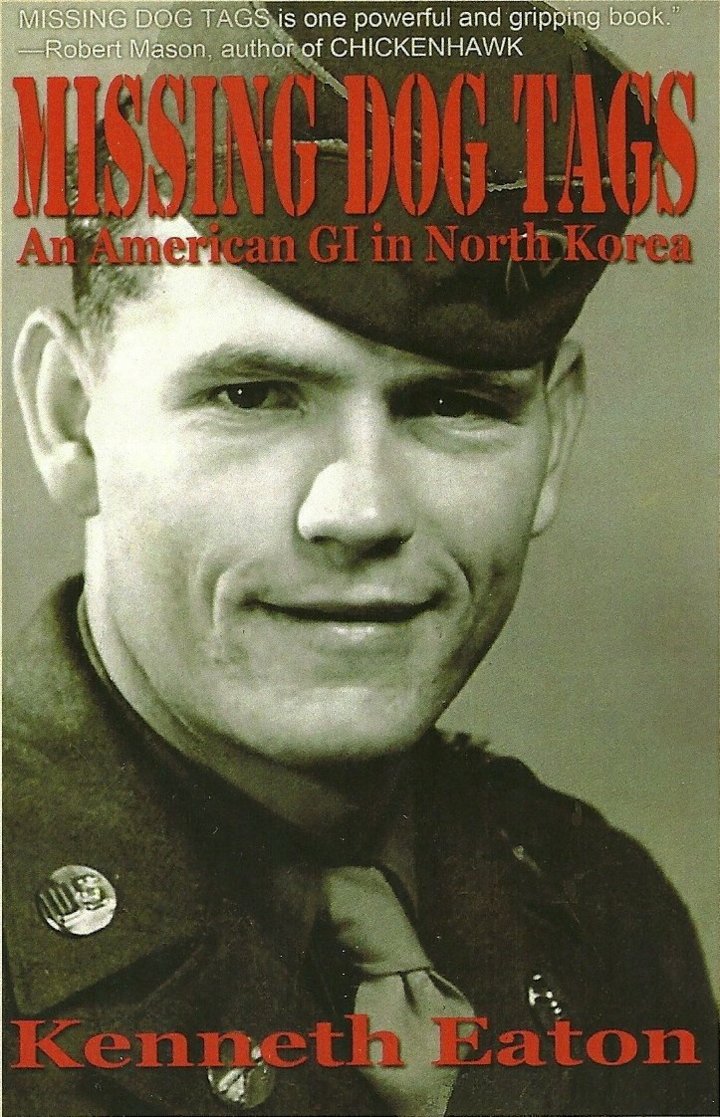
Authored by Kenneth Eaton
Synopsis:
Kenneth Eaton was a Corporal in the 9th Tank Company (RCT) of the 2nd Division, U.S. Army when he was captured near Hoengsong during the Korean War. This book
is a true account of his life as a prisoner of war and his three attempts to escape from his captors. Too few Americans understand the cruelty shown by the North
Koreans and Chinese when they captured U.S. and other foreign troops. Prisoners walked miles and miles up and down Korea on forced marches. They were starved,
beaten, mutilated, wounded and murdered. The rules of the Geneva Convention were ignored. There was little to no medical treatment for the men who had not
only been wounded in battle, but also suffered inhumane beatings and other physical and mental cruelties meted out by their captors. Prisoners lived in the worst
sanitary conditions, experienced the terror of strafings and bomb attacks, and were forced to endure extreme winter conditions with inadequate clothing and shelter.
The author walks his readers through his months of captivity, describing these and more horrendous conditions with gruesome, but matter-of-fact details. A book
well worth reading and recommended by the Korean War Educator for those who need to be reminded that "Freedom is not free."
Review from Amazon.com:
Missing Dog Tags is an awesome read about a first-hand account of the Korean War and the hardships Ken Eaton and others, endured as soldiers and in his case a prisoner
of war. Im a person that is very interested in the history surrounding what happened in the wars American fought in last century. This is a book everyone should take
a look at because unlike most, this is written entirely by the person who experienced it.
You may wonder why I am buying this book instead of another one written on the Korean War. I am buying this because I met and know Ken Eaton, the author of this book. He goes to the church that I went to. This man is one of the most honorable people I have meet in my life. I had a once in a lifetime opportunity when he willingly shared stories of his experience in Korea with me, when my family visited him. I thought I knew what had happened in the war but talking to a person that was actually there is totally different and I am very privileged to have done that. Ken Eaton is a man that I hold in great regard and he is a hero in my book. Thanks Ken Eaton and everyone that helped bring this book into print. I'm glad I bought this.
Order Information:
Missing Dog Tags: An American GI in North Korea by Kenneth Eaton. 288 pages, paperback. Patience Press, P.O. Box 2757, High Springs, Florida 32655.
ISBN 978-1-892220-13-4. $19.95 plus shipping on Amazon.com.
Authored by Bob Ringma
 This is a story of the Korean War in 1951/52 – with an unusual twist - the subject
is not combat. It is about one of the very few amenities that Canadian troops had in that barren land, a Mobile Laundry and Bath Unit. Strangely enough, in the Canadian
Brigade, it was this small unit which captured the first prisoners of war.
This is a story of the Korean War in 1951/52 – with an unusual twist - the subject
is not combat. It is about one of the very few amenities that Canadian troops had in that barren land, a Mobile Laundry and Bath Unit. Strangely enough, in the Canadian
Brigade, it was this small unit which captured the first prisoners of war.
War is usually portrayed in the popular media as the firing of weapons and the movement of troops, ships and aircraft. Occasionally a movie such as M*A*S*H will show another side of war such as the medical. But we don't often hear about the logistical operations: the furnishing of food, water, supplies, and laundry and bath facilities.
Bob Ringma, as a Canadian officer in the army during the Korean conflict, was assigned to the Mobile Laundry and Bath Unit - the MLBU. It was his responsibility to move huge vans and personnel to locations near the Front where there was some form of running water, so he could provide weary troops with the luxury of a shower and clean clothing. The process of locating these sites was in itself an adventure.
According to the books forward by Lewis MacKenzie, OStJ, OOnt, MSC, CD, Major General (ret'd):
"Bob Ringma gives us a view of the Korean War through the prism of those who provided the essential support to the soldiers on the front lines. It gives the reader a peek at a perspective infrequently found in books on the war and by his own admission was the primary motivator for his putting pen to paper some fifty years after this galvanizing event in his life."
About the Author
Bob Ringma transferred from the Canadian Army Special Force to the regular Canadian Army while serving in Korea. He served in instructional, technical, staff and command
positions in various positions with tours of duty in Fort Lee, Virginia, Vietnam, Supreme Headquarters Allied Powers in Europe and throughout Canada. He retired in
the rank of Major General in 1983.
He was the member of Parliament for Nanaimo-Cowichan (BC) from 1993 to 1997. Married to Paula MacDowell of Brockville, Ontario, in 1954, they have three children. Bob and Paula live in retirement in Kingston, ON.
Order Information:
ISBN#1-894263-85-5
ISBN#9781894263856
170 pages, soft-bound, with photographs. $ 19.95 CAD. General Store Publishing House, Box 28, 1694B Burnstown Road, Burnstown, Ontario, Canada K0J 1G0; phone 1-800-465-6072. Website: www.gsph.com.
Authored by William M. Allen
Mr. Allen is an ex-prisoner of war.
Order Information:
$18.00 plus $3.00 for shipping. E-mail: wallen2@Tampabay.rr.com or write to William Allen, 421 4th Avenue., N. Tierra Verde, FL 33715
Authored by Medora Van Fleet
 I have written a book about my uncle, General James A. Van Fleet. I did
not attempt to give a play by play account of all the battles, which were: Mexico and Pancho Villa, World War I, World War II landing on D-Day at Utah beach at the
beginning, the Communistic terrorists of Greece who were trying to take over the country (he did not lose one American but won the war), and the one you know so well,
Korea. This was like the Greek war in that they were fighting terrorists. He trained the Koreans through setting up a Korean "West Point", helping the ROKs and starting
the Korean Service Corps. Later after retiring, he was appointed roving ambassador of Asia. He was on the boards of 20th Century Fox and Reynolds Aluminum and others.
Uncle Jim said encyclopedias could report the battles.
I have written a book about my uncle, General James A. Van Fleet. I did
not attempt to give a play by play account of all the battles, which were: Mexico and Pancho Villa, World War I, World War II landing on D-Day at Utah beach at the
beginning, the Communistic terrorists of Greece who were trying to take over the country (he did not lose one American but won the war), and the one you know so well,
Korea. This was like the Greek war in that they were fighting terrorists. He trained the Koreans through setting up a Korean "West Point", helping the ROKs and starting
the Korean Service Corps. Later after retiring, he was appointed roving ambassador of Asia. He was on the boards of 20th Century Fox and Reynolds Aluminum and others.
Uncle Jim said encyclopedias could report the battles.
As a local ROTC instructor historian friend said, "She told about the man behind the stars." It was the man and his ideas and ideals and how he accomplished them in which he was interested and wanted told.
General Van Fleet graduated from West Point with the class of 1915 "that the stars fell on." His last year only he played fullback football. The army/navy game was the last one. The New York Herald Tribune said: "Navy 0, Van Fleet 20" as its headline. Later he coached at the University of Florida for two years and it took about another 50 to equal his scores. That is why the "Fullback" General.
The book is filled with pictures which aid in telling his story. It is paper back. If you or your friends would be interested in my book, I can send it to you. The book is $29.95 and the postage is $3.00. Please contact me at the address below.
Contact information:
Medora Van Fleet, PhD
1024 East Lake Silver Drive
Winter Haven, FL 33881
Phone: 863-294-1098
e-mail: medoravf@yahoo.com
|
|
Authored by Frank "Bud" Farrell
Synopsis:
No Sweat is a Korean War B-29 combat crew memoir written by Bud Farrell of Georgetown, Texas. It is a collection of 85 non-fiction short stories.
Book Reviews:
"I have essentially finished reading NO SWEAT...I found it refreshingly different from most books because it is constructed in such a way that one can read an article,
look at photos, news clippings, and other items without losing continuity. In other words, it is easy to read. The book is well written and does not contain most of
the typos found in other self -published books. You are to be congratulated on your attention to detail that resulted in an excellent end product. Your memory must
be superb." - Lucien Thomas, Scottsdale, Arizona
"...I laughed and cried a number of times, some while even on the same page." - Ted Parker WWII B-29 Combat Crew Member
“Your Christmas Homecoming (HOMO GO) brought tears to my eyes. Really! Thank you for making me remember how lucky I am!” – Londa Boots, Assoc.Dir. Author Services, Authorhouse Publishing Co.
“Bud, I read all your postings, some times with tears, others with laughter but always with enjoyment” Bud, I not only enjoyed NO SWEAT but treasure it!" – Don Brzezinski, WW II B-29 Combat Crewman, Massapequa, NY
“EVERYBODY STAND UP"..."I thought I was in that airplane. You should take up writing or maybe you have.” -Earl Johnson, USAF Maj. Gen. Retired, WW II B-29 Aircraft Commander & 19th Bm.Gp.C.O.,Orlando, Florida
“NAMSAN-NI…What an excitingly told tale. Your ability to tell a story is a wonderful gift. You bring it to life as if we were really there!” - Jean Allen, WW II B-29 Combat Crewmember - WAS really there!
“…I laughed my ass off. Great stuff, if the rest of the book is as good, it should be a best seller.” –Don MacHenry, Graphic Artist, New Kensington, Pa.
“ I read your story with Tears…” – Iris Fry, B-29 Web Site
“OH BABY! I was right there…rocking in my chair to gain momentum…go GO! GOOOOOOOOOOO!!! What an excellent piece…EVERYBODY STAND UP…you made it so real…amazed at how you can vividly describe so much! I almost feel like I am sitting on your shoulder, feeling what you feel, taking in all your emotions. Oh what a wonderful work!! I love you my HUBBA HUBBA GUNNER!” Susan Bryan, Lt. US Army, Poet/Writer, Computer Artist
About the Author:
Bud Farrell was raised in Philadelphia and Aldan, Pennsylvania, attended Penn State for just one semester before quitting school to enlist in the Air Force on his 18th
birthday. He volunteered for aircrew duty and Gunnery School, and a 25-mission B-29 combat tour over North Korea, completing his service as an Air Refueling Operator.
After his service Farrell returned to Penn State, met his wife Carole, and had a rewarding career in sales with great opportunity to travel and meet and reunion with
many people, all of whom contributed to both the serious and humorous memories shared in his book.
Order Information:
ISBN-10: 1410766217 and ISBN-13: 978-1410766212. 350+pp. Price is $28.00 if ordered directly from the author, Bud Farrell, Georgetown, TX. Phone 512-591-7731.
It can also be ordered ($30.25) from http://www.authorhouse.com at 888-280-7715.
Authored by Robert Bateman
 In the Fall of 1999 the world was shocked when the Associated Press revealed what appeared
to be an account of a mass killing of defenseless civilians over a three-day period in the opening days of the Korean War at a place called Nogun-ri, Korea. According
to the sources in the AP story, as many as 400 innocent civilians were wantonly gunned down for no reason by American soldiers who "played with our lives like little
boys playing with flies," (as one of the Korean claimants put it) during a three day slaughter lasting from 26-29 July 1950. The unit accused of this crime was the
7th Cavalry regiment of the 1st Cavalry Division.
In the Fall of 1999 the world was shocked when the Associated Press revealed what appeared
to be an account of a mass killing of defenseless civilians over a three-day period in the opening days of the Korean War at a place called Nogun-ri, Korea. According
to the sources in the AP story, as many as 400 innocent civilians were wantonly gunned down for no reason by American soldiers who "played with our lives like little
boys playing with flies," (as one of the Korean claimants put it) during a three day slaughter lasting from 26-29 July 1950. The unit accused of this crime was the
7th Cavalry regiment of the 1st Cavalry Division.
In the AP version of this story the American soldiers were witnesses and participants, and at least three of these American witnesses say they took part in or witnesses to what could only be called a case of mass murder. Six months later the AP team won the Pulitzer Prize for their reporting of this "massacre." But immediately after that the problems with their "investigative" reporting began to bubble to the surface. What made the story especially compelling was the AP's assertions that no story like this had ever been reported before, that historians were unaware of events like those they portrayed took place, and that they had "dozens" of American witnesses to the slaughter.
Order Information:
Book sells for $14 to $17 and can be ordered from
www.amazon.com.
by Barbara Demick
According to the National Book Foundation, this book is: "A gripping, astounding view into North Korea through the lives of six ordinary citizens—-an important story that has never been told before."
Order Information:
http://nothingtoenvy.com/
by co-authors George G. "Pat" Patrick and Henry H. "Jimmy" Patrick
Author Pat Patrick tells the Korean War Educator:
"The book is in memory of the men killed or missing in action and never found during the minesweeping operations and the bombardment of the Korean coastal waters, harbors, inlets and sea lanes, Inchon, Wonsan, Hungnam and the miles of shoreline of North Korea. It is my story about the Korean War. Sixty years ago my brother Jimmy and I served on the USS Tawakoni ATF-114, a US Navy sea-going fleet tug.
The book is about the Task Force and naval operations during the war. Our job was fleet assistance, rescue towing, recovery, patrol, marking channels during minesweeping operations, and assisting the minesweepers, landing craft and ships in distress.
The book follows the war and the Tawakoni and our fight against Communism and tyranny. America's fight still goes on today against the socialist-communists, world-wide war on terror, and radical extremist terrorists. Our American military was and still is the most organized, well-equipped and well-trained military in the world."
The 200-page book includes stories about minesweepers that sank during the Korean War, providing casualty lists of the crews that went down with their ships. It includes segments of news articles about minesweeping and rescue operations, as well as the authors' personal memories of serving on the Tawakoni.
Order Information:
Publishing company: Lulu Publishing Services at
www.lulu.com; Paperback ISBN:
978-1-4834-6182-3 ($14.99); Ebook ISBN: 978-1-4834-6183-0
($8.99). To contact the author call 910-326-3608 (North
Carolina - home phone) or 910-376-2797 (cell).
by Warren A. Trest
Synopsis:
This book is a biographical story of General Cleveland's life to
date (2014), with the longest and most important chapters (4 and
12) about his experiences in the Korean War and how he was
declared an Ace some 56 years later. It begins with his
early years, studies at West Point, flight training, flying the
F-86 Sabre in Korea, duties in England, service in the Vietnam
War, and a variety of command and staff assignments that
culminated in command of the Air University at Maxwell AFB.
Review:
"Warren Trest's Once a Fighter Pilot is the biography of Lt.
Gen. Charles G. "Chick" Cleveland's 35 year career with the
United States Air Force. Much more than a standard review of
assignments, it serves as a history of the Cold War's effect on
the military and the country as a whole. His remarkable career
serves as an example to young people today, both military and
civilian."
Order Information:
267 pages hardcover $21.66. Kindle version $9.99.
Publisher: River City Publishing; 1st Edition edition (October
31, 2012). ISBN-10: 1579660916. ISBN-13: 978-1579660918.
Order through Amazon.com.
by Colonel Douglas C. Dillard
 A firsthand account of secret operations during the Korean War. Operation Aviary consisted
of a series of airborne special operations conducted by US and Korean partisans behind the lines.
A firsthand account of secret operations during the Korean War. Operation Aviary consisted
of a series of airborne special operations conducted by US and Korean partisans behind the lines.
Endorsement by Nels Running, Major General, USAF (Ret), Executive Director, Department of Defense, Korean War Commemoration Committee.
The history of the Korean War remains unknown to far too many who owe gratitude to those whose courage, commitment and sacrifices secured a victory for freedom and democracy over communist aggression. Even deeper in the shadows of the unknown, lay the clandestine operations of 'special' forces, whose actions often serve to enhance the conventional forces' opportunities for success in combat operations. Cloaked in "special secrecy" at the time, the stories of special operations emerge from the shadows much later than conventional combat histories.
In this work, Colonel Doug Dillard illuminates an important arena of operations heretofore largely ignored: airborne special operations. Special operations teams and individuals, sometimes supported by or in conjunction with 'available' conventional resources, made daring airborne penetrations of the enemy's rear areas and areas of current combat operations to disrupt or defeat the enemy's operations. They gathered and reported critical elements of information regarding enemy dispositions and capabilities to the conventional forces. The men of "Operation AVIARY" were indeed force multipliers whose actions contributed immeasurably to the United Nations Command's victory over communist aggression. A FASCINATING READ!
Order Information:
146 pages; perfect bound; catalogue #02-0602; ISBN 1-55369-789-8; US$20.00 (Can$30.60) - Available from
All Bookstores.com or
Amazon.com.
Authored by James Edward McAleer
|
|
The compelling story of the men of Dog Company, 10th Infantry Battalion, USMCR, and the 182 men who bravely served in the Korean "police action".
This is an historical account of Dog Company, 10th Infantry Battalion, United States Marine Corps Reserve, and the experiences of the 182 men from Savannah, GA who came from all walks of life to serve together in the life-changing and world-changing Korean Conflict from 1950 to 1953.
Reviewed by The Leatherneck magazine in January, 2004, the reviewer stated "James Edward McAleer has done a superb job in capturing the experiences of these Korean veterans. Considering that he was writing about a war that took place more than a half-century ago, it is a truly extraordinary achievement."
"...their frostbitten fighting withdrawal from the Chosin Reservoir would be an unforgiving experience. McAleer writes, 'Dante made no mistake in The Inferno when he made the lowest levels of hell ice, not fire.'
Besides being a good read, the value of McAleer's book lies in its singular look at that bitter conflict, and chronicles the experiences of 56 of these Reserve Marines. Rarely does a reader of military history enjoy such an opportunity to examine a complex campaign from so many different personal perspectives."
The author served in World War II as well as the Korean Conflict and retired from the practice of law in 2003 after 50 years.
Order Information:
412 pages, with photographs and maps, soft cover. $25.00 per book, plus $5.00 shipping, handling, and taxes. Order through
marinemcaleer@bellsouth.net
Authored by Jack R. Siewert
 I am writing to inform you of a new book-- Outpost Kelly :
A Tanker’s Story --that is about a personal Korean War experience. I think it would be of interest to your members.
I am writing to inform you of a new book-- Outpost Kelly :
A Tanker’s Story --that is about a personal Korean War experience. I think it would be of interest to your members.
My 82 year old father, Jack R. Siewert, wrote the book that was published recently by the University of Alabama Press. The memoir tells of his life altering experience in an outpost battle in Korea during 1952. While the book was undergoing the expert review process Dr. Paul Edwards, Executive Director of the Center for Study of the Korean War, was so impressed by this work that he offered to write the book’s forward.
I think this book is important to the memory of the Korean War veterans. I am including a copy of the press release and a picture of the book’s cover. If you need any further information please let me know. Thank you for your consideration! Cathy Gibney
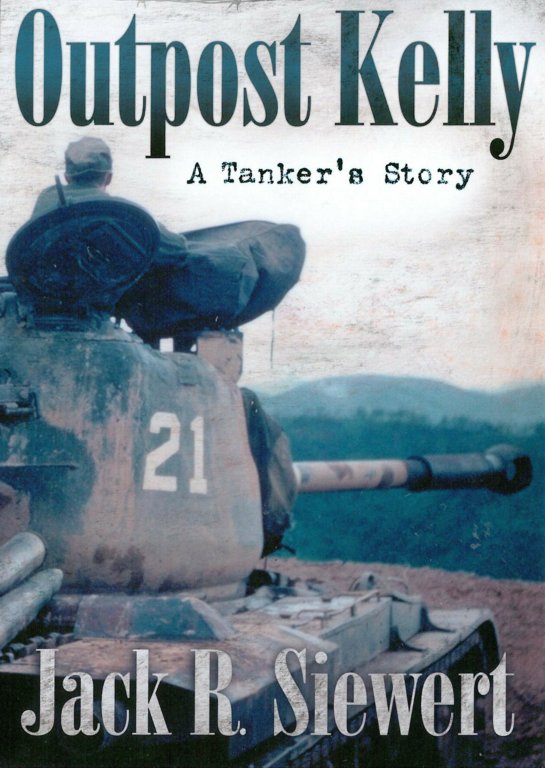 Front Cover (Click picture for a larger view) |
 Back Cover (Click picture for a larger view) |
 Press Release (Click picture for a larger view) |
In Outpost Kelly, Jack R. Siewert describes his experiences as a first lieutenant in command of the 2nd Platoon, C Company, 64th Armored Battalion, during the Korean War. His weapon, the M-46 Patton tank, was a development of the M-26 Pershing. Entering service at the end of World War II, the M-26 was better than the Soviet T-34/85 and German King Tiger, but it--and the M-46--were still inferior to the formidable Josef Stalin JS-3 heavy tank. In Korea, however, tanks seldom engaged each other.
In July 1952, Siewert's 2nd Tank Platoon was ordered to reinforce the 2nd Battalion, 7th Regiment, 3rd Infantry Division, to relieve disabled tanks of the unit's integral 7th Tank Company. That routine operation brought him to Hill 199 and nearby Outpost Kelly, from which his tanks bombarded Hill 317, then occupied by the 348th Regiment, 116th Division, 39th Army of the Chinese People's Volunteer Army.
Siewert got to know the United Nations troops fighting alongside the U.S. 3rd Infantry Division: the Greek Expeditionary Force and the 1st Division of the British Commonwealth. He explains how Korea's mountainous terrain dictated the tank's primary role as mobile artillery. Engines froze in the Korean winter, and the monsoon season meant that tanks were bogged down in mud, both factors that the U.S. Army staff should have taken into consideration when it studied World War II battles on the Eastern Front.
Amid the monsoons, the U.S. Army's I Corps replaced the 7th Regiment with the 15th, while Siewert's 2nd Tank Platoon was ordered to remain in position on Hill 199. Meanwhile the Chinese, who had already learned of the change in regiments, took advantage of the muddy terrain to launch an infantry assault that occupied Outpost Kelly. In spite of artillery preparation by Siewart's 90mm guns, the first American counterattack failed. At that point, it became a point of honor for the I Corps to retake Outpost Kelly.
The second American assault, on July 31, was better organized and resulted in the occupation of both Outpost Kelly and Hill 164. With one of his tanks out of action, Siewert supported that attack with his remaining 21. To increase the rate of fire, he developed a new, faster method of reloading the cannons that he called the "bucket brigade." For his courage and dedication, the 3rd Division put him in for the Bronze Star, which he received in December 1952. By then, however, the Chinese had retaken Outpost Kelly.
Siewert rightly observes that the U.S. Army in Korea seemed more reminiscent of 1918 than of 1952. Behind his writing I detected an underlying sorrow, not only for the loss of so many lives for an outpost but also as a reflection on the entire execution of the Korean War. Outpost Kelly is an excellent book on a forgotten aspect of the "Forgotten War" that could be particularly informative to young officer candidates training to be future commanders.
Unfortunately, Korean War books are few and far between--and combat memoirs by soldiers who fought there are almost nonexistent. Why is that? I don't really know. But what I do know is that when a new Korean War book comes my way, I always give it an especially close look. Too many American soldiers died in that war, and it's a crime that it's still rightfully called the "forgotten war." When I received Outpost Kelly from Fire Ant Books, I got my hopes up--and I'm happy to report that I wasn't disappointed. To be honest, it exceeded my expectations.
When you begin reading the story of Jack Siewert, commander of a platoon of M-46 tanks, you won't stop. Siewart's descriptions of combat are so dead-on, it's as if you're there in the morass with him. The focus of this outstanding memoir is four days of intense fighting between Siewert's unit and Chinese forces. The objective: a seemingly unimportant hill named Outpost Kelly. But Siewert had his orders, and he was going to fight for the hill, come hell or high water. The fight was surely hellish itself and when the high water came in the form of monsoon rains, Siewart and his men found themselves fighting in a foot-deep field of mud.
Outpost Kelly doesn't only fill a gap in the history of American wars. It takes you on a mind-blowing trip into the heart of the Korean War. B/w photos. 176 pages.
Authored by Ben Hardy and Duane Hall
Fifty years after the Korean War, Ben Hardy and Duane Hall, photo interpreters in that conflict, could proudly say, "We were the first to know." Photo interpreters contributed volumes of intelligence information for many of the Korean air missions--including the Inchon landing and the Sukchon/Sunchon paratroop campaigns--in support of combat forces. "Never before in the history of warfare," the authors state, "were ground forces so rapidly supplied with photo intelligence as they were in the Korean conflict.
Admittedly caught off guard by the "unanticipated explosion on Korea's 38th Parallel," the Far East military establishment rushed American troops to South Korea from Japan, outlying areas of the Far East, and the United States, as well as from America's UN allies. Combat forces and the supporting intelligence community were pressed into immediate front-line support.
Ben Hardy and Duane Hall were part of this early support personnel, suddenly on alert status: U.S. Air Force photo interpreters with a new and awesome responsibility.
Aerial intelligence reports from photo reconnaissance missions, flown by pilots in unarmed planes, were critical to front-line operations. The photo interpreters were charged with preparing these reports, monitoring all enemy activity in the whole of North Korea and surrounding territory, gleaning all the information possible from a study of the aerial photos. Interpreters provided daily reports on the enemy to Commanders, from quickly processed film: reports on the enemy order of battle, the status of their airfields, their transportation lines and industries, and their artillery and antiaircraft installations--everything the U.S. Air Force could target and destroy that might adversely affect the enemy. Yet the Photo Intelligence people--and the photo interpreters--have been frequently overlooked in accounts of the Korean War.
Hardy and Hall have put together a record of their very personal experiences while stationed with the Far East Air Forces during the early stages of the war, with well over 100 photographic and documentary illustrations. Their purpose, they state, "has been to preserve some of the documents, photos, and memories." As part of the 548th Reconnaissance Technical Squadron at Yokota Air Base, Japan, and then the 67th RTS at Taegu and Kimpo Air Bases, Korea, the authors contribute to the historical record of the men on the ground, the often unsung support people who "enable the front-line troops to continue their task of defeating the enemy."
Order Information:
124 pp., illus., index, softcover; ISBN 0-89745-275-5 ; US$25.95. - Available from Sunflower University Press, P.O. Box 1009, Manhattan, KS 66505-1009.
Ph. 785-539-1888. Orders: 800-258-1231.
Authored by Merry M. Helm
Prairie Boys at War: Korea is a unique, riveting, fast-paced account of men from the northern prairies who received the Medal of Honor, Distinguished Service Cross and/or Navy Cross for heroism in the Korean War. Through their experiences, as well as those of other combat veterans, the history of the war is told in graphic detail. These were depression-era farm boys, miners, sharpshooters, paperboys and athletes. Two were young physicians who thought they were spending a pleasant 90-day rotation in Japan before landing on the front lines of Korea instead. There’s no other book like it.
Volume 1: June– October 1950 covers the deadly delaying actions of the war’s first four months. Future volumes will cover the terrible winter and spring of 1950-51 during which hundreds of thousands of Chinese soldiers abruptly came to the aid of North Korea. The final volume of the series will cover the vicious but little known "outpost wars" of 1952-53.
Book Reviews:
“From Bunker Hill to Baghdad, the valor of America’s
fighting forces has often been shrouded by the prolific prose of
hyperbolic historians. In Prairie Boys at War, however, author
Merry Helm takes the compelling tack of subtly mitigating the
treatment of the tactical in favor of underscoring the humanity
and selflessness of young Midwesterners called to duty to often
do the unthinkable, and in the process reminds readers—lest they
should ever forget—that every battle helmet represents a beating
heart.” Steve Stepanek, PhD, Georgia Southern University
“In a time when all most people know of Korea comes from “MASH” reruns, and when we pay lip service to honoring our soldiers, Merry Helm has done them the highest honor – she gives them a chance to tell their stories. And they are fascinating stories, told in vivid, propulsive prose that hooked me from the first page. Very well done. I’m green with envy.” Tom Pantera, Northwestern Oklahoma State University
“Outstanding. I have never read a book describing mortal combat as this does.” Joe Langone, Task Force Smith
“Dynamite!” Addison Terry, forward observer, 8th FAB, 25th ID
“Absolutely amazing and fantastic.” Jim Yeager, Sunchon Tunnel Massacre survivor
“One of the best books on the Korean War.” James Bolt, 63d FAB, 24th ID
“. . . chronicles the Korea War, during its formative phase, with utmost vividness and factual skill. It is so markedly exceptional and unlike other portrayals. You have described the horrors of war with a lucidity that no other author has done.” Leonard Becicka, 29th RCT and 35th Regiment, 25th ID
“I was reading some to our daughter, and I had tears before I was through. You have done some amazing work on this.” Sherri Willey (niece of Ray Rindels, Sunchon Tunnel Massacre)
About the Author:
Merry Helm is the recent recipient of the 2014-15 General and
Mrs. Matthew B. Ridgway Military History Research Grant,
bestowed by the U.S. Army Military History Institute (Army War
College) to assist with further research for the Prairie Boy
series. Helm is also an award-winning documentary
filmmaker and researcher who has written more than a thousand
history-based radio scripts for Dakota Datebook, a popular daily
program on Prairie Public Radio. She also worked as a
screenwriter in the movie industry from 1994 to 2008. The 24th
Infantry Division Association bestowed on her an honorary
lifetime membership in 2009, after her research helped secure a
posthumous Medal of Honor for Master Sergeant Woodrow Wilson
Keeble, a Dakota Sioux warrior, and she now serves as the
association’s historian. She lives with her husband Roger Gress
in Fargo, ND, and honors Korean War veterans throughout the
northern prairies by engaging in book tours and speaking
engagements.
Order Information:
ISBN 13: 978-0-9960959-0-7; LCCN: 2014906610; Trim Size: 6in. x
9in.; Number of Pages: 512. Soft cover = $22.00.
Where to Order:
https://secure.mybookorders.com/Orderpage/1427. Visit also:
www.prairieboybooks.com.
Written & Illustrated by Robert Allen Carpenter, Sr.,
United States Army Sergeant, 185th Engineer Battalion Combat Korean War
In this book the author writes about his experiences in the Korean War and after. Sadly, he died before the book was completed, so his wife, who also acted as editor, saw the project through to its completion. This is a used 8-1/2" x 11" hardcover with a pictorial cover, apparently issued without a jacket, that contains ink illustrations by the author as well as some black-and-white photographs. 109 pages. The author's wife (who also edited the book) signed the copyright page. Someone wrote on the inside of the front cover the words: "In loving memory of Robert Allen Carpenter, Sr." and dated it "September 2003". The pages have no creases or tears. The cover is scuffed along the edges and the corners turn inward. Black ink is smeared near the spine on the front cover (see photo). The entire book is detached from the spine beginning at the top and going down about 2" and, as a result, the top half of the book leans to the left (this could be corrected if the the 2-inch gap is re-attached with fresh glue). I am happy to say that no pages appear to be in danger of completely detaching. In fact, the binding is cracked only between two blank pages near the end and remains tight throughout the rest of the book.
Order Information: $30.00 plus $3.00 shipping/handling. Click here to order: http://tinyurl.com/57afc. This book is being offered for sale by a private individual.
Authored by Frances Omori, Commander, US Navy
 Quiet Heroes tells the personal stories of the Navy nurses stationed at the Naval Hospital
Yokosuka and aboard the hospital ships, USS Consolation (AH-15), USS Repose (AH-16) and USS Haven (AH-12). For fifty years the US Marines who were their patients held
a deep desire to thank the nurses who saved their lives. Their efforts to find these nurses were thwarted as they never knew their names. Quiet Heroes tells of the
Marines’ heroes as seen through their stories.
Quiet Heroes tells the personal stories of the Navy nurses stationed at the Naval Hospital
Yokosuka and aboard the hospital ships, USS Consolation (AH-15), USS Repose (AH-16) and USS Haven (AH-12). For fifty years the US Marines who were their patients held
a deep desire to thank the nurses who saved their lives. Their efforts to find these nurses were thwarted as they never knew their names. Quiet Heroes tells of the
Marines’ heroes as seen through their stories.
Order Information:
$18.95, 7x10, 256 pages, 120 photos, ways to order:
- Mail 2700 Rice St., St. Paul, MN 55114 (check or credit card) - Call toll free phone 1-888-220-5402 9 a.m.-5 p.m. CT Mon-Fri; fax 651-490-1450; - E-mail
smithhseprs@aol.com
Authored by Lloyd W. Pate
Reactionary was the tag the Chinese put on Lloyd W. Pate when he was captured during the Korean War. It was a badge of honor for the young soldier. Placed with others in a Reactionary Squad, he did his best to torment the enemy, as was his duty. Looking back from a half-century afterward, 1SG Lloyd W. Pate, Ret. Inf., tells his story of combat and his term as a POW in frank, honest language. Torture and attempted brainwashing were the rule of the day and he depicts this in unflinching detail. Sabotage, misery, and the pain of seeing one's own countrymen collaborate with the enemy all had their part to play. Reactionary-Revised 2000 is a griping and important work. 1SG Lloyd W. Pate, Ret. Inf., served as an Infantryman for twenty-three years. In addition to his Korean service, Pate pulled two tours in Vietnam in the Second Battalion, Twelfth Cavalry, 1st Cavalry Division (1965-66) and in the Reconnaissance Platoon, First Battalion, 505th, Eight-second Airborne (1968-69). Now retired, Pate enjoys coin collecting and metal detecting. He is a resident of Georgia.
Order Information:
$15.00 Paperback, 200 pages. , autographed, postage included. Order through Lloyd W. Pate, 5720 Broad Oak Drive, Grovetown, GA 30813. Georgia residents add appropriate
sales tax.
Authored by Jake Miller, retired Navy veteran of multiple wars
The book affords the reader an opportunity to explore the little details of the lives of over fifty people who served their country in the military during the twentieth century from cultural and social perspectives, emphasizing the human and personal dimensions shouldered by them. The primary thrust of this book is to provide an honest look into those remarkable young people born in the 20th century who helped stave off the yoke of tyranny and save democracy in the United States until the 21st century. [ more info ]
Order Information:
$22.94. 599 pages, soft cover. ISBN 0-7388-6903-1. Also available in e-book format at ISBN 1-4010-0635-3. Available through the publisher telephone 1-888-795-4274.
On line: www.xlibris.com/JakeMiller.html. By mail: Xlibris Corporation, 436 Walnut St., 11th Floor,
Philadelphia, PA 19106.
Authored by Bob VandeLinde
Book Review by Col. William E. Weber, USA-Ret.
"There is an undeniable truism in the title of this book and sadly so. Yes, those whose stories appear are part of the "Greatest Generation" but only by inference--not by being featured. What the author has done is to provide a microcosm of the foregoing but in what could be called a 'homespun' format. Here you will find not only the wartime exploits in an abbreviated form as well as the 'everydayness' of their lives as if you were a close friend or neighbor.
There are the ingredients for a movie in almost every chapter in this book. Not combat action type movies, though that could be possible, but rather the stories of everyday Americans who got caught up in one of the major events of the 20th Century, World War II.
Bob VandeLinde has complied through research and the personal recollections of the personnel the events that are the subjects of each of his chapters. The stories are primarily first person and the events as they are remembered by those who lived them.
One can tell by the manner in which the events are depicted, those that were seared into memories by the trauma experienced versus those that the teller was a spectator or lesser involved participant. But, the difference in intensity does nothing to lessen the reader's interest in what is being presented, for these are the sixty plus years recall of those who 'were there and done that'!
Don't expect to find the remembrances of the famous or well known of World War II. These are the stories of the average 'Joe' or 'Jane' who were thrust into the caldron of a nation at war either willingly or by edict. And yet, their stories are truly what the war was all about for them. One will find willing volunteers--in fact, an entire family of four brothers, each who voluntarily sought duty--and one will also find those who became soldiery because the system so demanded.
Most appropriate is the title of this book for once one has made their way through the chapters it is apparent why the subjects in each deserves 'respect'. They were ordinary citizens who when called upon performed in an extraordinary manner! Not all were 'heroes' as depicted in film or autobiographical coverage. Rather, they were heroes in the sense they did their duty to the best of their ability--had they not, we could not have prevailed over an enemy that had the capability of defeating a lesser motivated nation of ordinary people had they failed to perform in an extraordinary manner. I recommend this book to those of the Greatest Generation who want to find their counter parts. You'll find their stories are yours.
Order Information:
$30 plus $5 S&H to Robert L. VandeLinde, 109 Wagon Wheel Trail, Moneta, VA 24121-3329. Phone 540-296-1404. E-mail:
blh187ar@netzero.net.
Authored by Doug and Pam Sterner
|
|
Stolen valor occurs when a person lies about receiving military decorations that he or she has in fact never earned. It has become a major societal problem that has been discussed numerous times in the news and, most recently, by the US Supreme Court. According to The New York Times, the Department of Veterans Affairs paid disability benefits to more than six hundred people falsely claiming to have been POWs in the Vietnam and Persian Gulf wars. The number of stolen valor cases reported to the FBI has tripled in the last decade. In fact, more imposters lie about earning high military declarations for battlefield bravery than the actual number of real-life hero recipients. These imposters trade on tales and the trappings of military valor to secure privileges such as career advancements and even unearned veterans’ benefits.
Because officially recognized valor is a calling card of trust and courage, many of these imposters “steal” it to invade the lives of people and institutions, for personal gain and often with criminal results. In Restoring Valor, Doug Sterner provides riveting case studies of the stolen valor imposters he’s investigated and exposed, and the serious crimes — including murder — they’ve committed. He chronicles the evolution of stolen valor from the inception of the republic to today. Sterner demonstrates why the federal law he and his wife Pam helped to enact, called the Stolen Valor Act, is necessary.
With regards to the Korean War, there are several instances of veterans who have stolen valor. According to the Sterners, "Some were phonies from other wars who also included Korean War claims. Three specific Korean War 'heroes' who got significant portions in chapters of the book include: Werner “Jack” Genot – POW and Silver Star among other claims, Pat Putnam – Claimed POW, Navy Cross and 3 Purple Hearts (he was the famed Sports Illustrated Boxing Writer), and Myron Brown – Claimed DSC and SS in Korea (Tricked a Congressman into awarding him these years later)."
About the Authors:
Doug Sterner is a Vietnam veteran and two-time Bronze Star
recipient. He has been a frequent guest on news shows such as
Anderson Cooper and is the media’s “go-to” person for the Stolen
Valor Act. He is the founder of the Hall of Heroes website and
curator of the Hall of Valor data base on Militarytimes.com. Pam
Sterner is a graduate of Colorado State University, where, as a
student in 2004, she authored the study that became the
framework for the Stolen Valor Act. They live in Pueblo,
Colorado.
Order Information:
Available as Kindle $13.99 or Hardcover $16.24. 272 pages.
Skyhorse Publishing, February 2014. ISBN-10: 1626365512 or
ISBN-13: 978-1626365513. Available on Amazon.com.
Authored by John Kronenberger
 This is a compilation of short stories about the many happenings and strange occurrences
in the life of John Kronenberger, who grew up in a poor family in the southern part of Belleville, Illinois. John says, "Quite often we tend to blot out some of the
more unpleasant things that happen to us. I find it easier to write about them than to hold them within." Pages 165 to 239 are devoted to John's military experience,
including his time while stationed in Korea during the war. Comments from readers of John's Short Stories: "This is John's way of paying tribute to his many associates
while in the military and with others. A celebration of his spirit in his way through life." "John, I will be passing this and other books by veterans on to my grandson
who is in the Marine Corps. Semper Fi. Well done." "I enjoyed reading your book. The part I enjoyed most was your military time because I could relate to that. Your
personal life was very interesting." "When I started reading the book I said to my wife, 'My goodness, these stories bring back some nice memories of the early years
in my own life. These stories could have well been about my childhood years in Pennsylvania during the 1930's. You see John, I too grew up during the great depression
when everybody had nothing but their families and friends and shared everything with everybody including their joys and miseries. I truly believe that the similarity
of our backgrounds, the time of our growing up followed by our military service during the Korean War era is what made your book of short stories so enjoyable for me."
This is a compilation of short stories about the many happenings and strange occurrences
in the life of John Kronenberger, who grew up in a poor family in the southern part of Belleville, Illinois. John says, "Quite often we tend to blot out some of the
more unpleasant things that happen to us. I find it easier to write about them than to hold them within." Pages 165 to 239 are devoted to John's military experience,
including his time while stationed in Korea during the war. Comments from readers of John's Short Stories: "This is John's way of paying tribute to his many associates
while in the military and with others. A celebration of his spirit in his way through life." "John, I will be passing this and other books by veterans on to my grandson
who is in the Marine Corps. Semper Fi. Well done." "I enjoyed reading your book. The part I enjoyed most was your military time because I could relate to that. Your
personal life was very interesting." "When I started reading the book I said to my wife, 'My goodness, these stories bring back some nice memories of the early years
in my own life. These stories could have well been about my childhood years in Pennsylvania during the 1930's. You see John, I too grew up during the great depression
when everybody had nothing but their families and friends and shared everything with everybody including their joys and miseries. I truly believe that the similarity
of our backgrounds, the time of our growing up followed by our military service during the Korean War era is what made your book of short stories so enjoyable for me."
Order Information:
$15.00 plus $2.50 shipping & handling. Soft-cover Book. Send check or money order to: John Kronenberger, 102 Williamsburg Dr., Belleville, IL 62221-3157. Ph. 618-277-2311.
E-mail: skronen266@aol.com. Website: www.johnkronenberger.com
Authored by Raymond B. Maurstad
BOOK REVIEW BY RICHARD C. KAGAN, PH.D., HAMLINE UNIVERSITY
Local writer recalls first days of Korean War
SOS. Korea 1950
They were There Then . . . & Write About it Now. Eyewitness Accounts of Americans in South Korea when the North Attacked.
Author Raymond B. Maurstad
Illustrated.
Beaver's Pond Press: Edina, MN.A review from Richard C. Kagan, Ph.D., Hamline University
"The embassy security people asked those of us who were healthy and young to volunteer to be on the last plane out." This quotation is not from the fall of Saigon in 1975, or the retreat from Mogadishu, or from Haiti. It is a quotation from Robert J. Rudolph who was ordered to leave Kimpo Airport in Seoul, Korea on June 27, 1950. The Korean War had begun just two days earlier on June 25th.
Raymond Maurstad has compiled dozens of autobiographies, diaries, biographies, and photographs to narrate the lives of Americans, civilian and military, living in South Korea from 1947 until their evacuation in 1950. These stories are very folksy tales which provide detailed descriptions of daily life: traveling to Korea on small ships; setting up a household, using uni-sex bathrooms, watching executions; surviving a train wreck; shopping and cooking; and learning about Korean customs and history.
Mr. Maurstad was born in Minnesota in 1928 and served in the U.S. Maritime Service. He served in pre-War Korea where he became friends with the small company of Americans who dedicated themselves to working for the American government and for the Korean people. The conditions then were very chaotic and rudimentary. The Americans overcame tremendous obstacles to develop and maintain an effort to rebuild Korea after the degradation of Japanese rule and World War 2. Mr. Maurstad's book provides us with a little known history of the American experience in Korea before the Korean War. He now lives in retirement in Coon Rapids, MN.
Mr. Maurstad's compilation of first-hand materials, photographs, letters, government documents, helps to remind us of the sacrifices and achievements of Americans in this "Forgotten War." On the positive side, this material is unique. It provides a thicker description of the lives and attitudes of Americans and Koreans during a time of severe crisis. There is a wonderful amount of information of how Americans "discovered" Korea and how they were treated on a day-by-day basis. Compared to the anti-American feelings today in both North and South Korea, this historical memory is refreshing. It reminds us that in the beginning, we were well-liked.
On the negative side, this work exposes the limits of eye-witness accounts. There is no recognition at all of the larger political, colonial, economic, and intellectual issues. If one only read this book of the lives of about 100 individuals, one would never expect that Koreans would have been hostile then, and now, to American interference in their lives. Many contemporary critics were jailed, tortured, and even executed. Today, we see rampant anti-American feelings. These are expressed through novels, movies, and demonstrations.
Many of the youth in South Korea today are not aware of the sacrifices of the late 40's. Many blame America for their current problems. Mr. Maurstad's narration of the goodwill and effort of American advisors would give these folk a little balance and perhaps a moment of tolerance for a past that was complex and unclear to many who lived through it.
(end of review)
Order Information:
414 pages, over 140 photos, ISBN#1931646910. For those interested in purchasing this book, send a check, money order or cash for $20 to R.B. Maurstad, 12082 Goldenrod
St NW, Coon Rapids, MN 55448. The author will send you an autographed copy immediately. Makes a great gift. (The book is available in all the book stores but it would
cost you more, be slower to ship, and no autograph.)
Authored by John Charles Cheek
(Click to enlarge) Promised that he won't have to fight in combat, instead of being drafted for 2-years, 19-year old John Lefter enlists for a 3-year hitch in the Army Security Agency and ends up in the Korean War.
At first, Lefter has a "candy ass" assignment 30 miles behind the fighting area. He spends a lot of time drinking beer, laughing and partying. Then he is forced to face his own mortality after being assigned bunker duty in the fighting area.
He breaks down after his foul mouth buddy is hit with burp gun fire while saving Lefter's life. In a hospital psychiatry ward, his recovery is aided dramatically by an innovative doctor and the only man he has ever hated.
Back on the front line and atop the bunker celebrating just after the cease-fire, Lefter is again confronted with a shocking incident that takes him over fifty years to find closure.
Fiction. This soft-bound book has 298 pages. The ISBN is 159286631X. A signed copy may be ordered by sending a check for $20 (U.S. delivery) to: John C. Cheek, 17401 SE 39th Street, #104, Vancouver, WA 98683. The book is also available from the publisher at www.publishamerica.com, www.Amazon.com and most other online book sellers. With shipping, it typically costs around $25 from them.
Authored by John W. Harper
|
|
The most dramatic events of the Korean War all took place during the year following the June 25, 1950, invasion of South Korea by the North Korean Peoples Army. This has led too many people to believe the second and third years of the war involved no real fighting but only public relations battles and quibbling about repatriation of prisoners of war. In fact, thousands of military personnel on both sides were killed or wounded during this so-called quiet period.
It is the reality of this fierce fighting that 1st Lieutenant John Harper recalls and recreates in this well-crafted memoir. His portraits are drawn from the generally untold portion of the Korean War narrative. They deal not with grand strategy and politics, but with the lives, deaths and psychological stresses of the junior officers and enlisted men who were in the foxholes and fighting to hold the lines in that "forgotten war."
The author shares a Marine heritage with his father and brother, and various ancestors joined in battles ranging from the Civil and Revolutionary wars back to medieval European clashes. John left Yale University in 1943 to join the Marines and saw service on Guam and in the north China occupation. Recalled to active duty in 1951, he came under fire in the Korean War - the subject of this book. He completed his Yale degree in 1947 and subsequently worked in advertising for such agencies as Leo Burnett and J. Walter Thompson until his retirement. He now lives in Evanston, Illinois, also the city of his youth.
Order Information:
$19.95 plus $3.00 shipping - hardcover edition; $13.95 plus $3.00 shipping - softcover edition. Illinois residents add 7.75% sales tax to book subtotal.
Make check payable to Conversion Press, Inc. Order by telephone call 1-800-848-5224. By fax order 847--441-5617. By mail: Conversion Press, Inc.,
P.O. Box 172, Winnetka, IL 60093.
Authored by MSgt R. L. Hanson
The Boys of Fifty - the 625th Field Artillery Battalion, 40th Infantry Division, California National Guard. This is the battalion's history from the time of its organization in 1946 until it was reorganized and re-designated the 214th Armored Field Artillery Battalion in 1954. More than five years in the making, this book covers the battalion from its beginnings in Southern California following World War II, through its Korean War activation and training at Camp Cooke, service in Japan, combat in Korea and return home. It includes pictures, a battalion roster of more than a thousand names, casualty list, and battery TO&E's for a light field artillery battalion of the 1950's.
Order Information:
ISBN: 978-1-4116-8849-0
The Boys of Fifty is a 6x9, 200+ page paperback. $25 including shipping and handling. Make check payable to R. L. Hanson. Order by phone: 1-858 695-0407. By Mail: R.
L. Hanson, 10777 Pointed Oak Lane, San Diego, CA 92131
The Boys of Fifty can also be obtained at www.lulu.com/contact/263930.
Authored by David Halberstam
DETAILS COMING SOON!
by Louis Diggs
|
|
Diggs' book is about a Maryland National Guard unit that served in Korea in 1950. As a matter of fact, his unit, the 726th Transportation Truck Company of the Maryland National Guard, was the first United States National Guard to arrive in Korea on December 31, 1950, and pressed into providing transportation services to the 1st Calvary Division immediately upon debarking from the converted Liberty Ship, the Sergeant Sylvester Antolak.
"The Forgotten Road Warriors" documents the history of the 726th Transportation Truck Company with its parent
battalion headquarters, the 231st Transportation Truck Battalion which was among the second United States National Guard to arrive in Korea on January 1, 1951. Unfortunately,
the 726th was separated from the 231st Battalion, and never reconnected during the service of both units from 1951 until 1952 when most of the National Guardsmen of
those two units returned to the States.
These two units were descendants of an all African American military unit from the Baltimore, Maryland area called "The Monumental City Guards," who had their beginning in 1879. They were accepted into the Maryland National Guard in 1882 as a "Separate Company." This all African American military unit was called to active duty during the Spanish American War, World War I when they fought in France, World War II when they ended up in Hawaii, and was the only Maryland National Guard unit ordered to active duty to support the Korean War. By then the unit was converted to a truck battalion (the 231st) with three truck companies. One truck company was deployed to Germany, one truck company was deployed to Fort Eustis, Virginia, and one truck company, the 726th was deployed to Korea with the battalion headquarters. The battalion was headed by an African American Lieutenant Colonel.
When the Korean War ended, in 1955 the 231st was returned to Maryland State control. The Adjutant General wanted to revert the unit to its original segregated status, but the unit was totally integrated in Korea in 1951, and the officers rebelled against reverting to the old segregated status. With help from the social and civic organization, the Governor of Maryland in 1955 ended segregation in the Maryland National Guard. Diggs' book documents the history of this unit from 1879 until 1955. According to Diggs, "Researching and publishing a book on this African American military unit has been the job of my life. I thoroughly enjoyed putting the book together with its numerous interviews of the Korean War era veterans and reflecting the many photographs in the book." Diggs retired from the Regular Army in October 1970.
Order Information:
"The Forgotten Road Warriors" can be purchased from Diggs' web site (www.LouisDiggs.com), or e-mail at
Louis.Diggs@comcast.net. Cost of the book is $29.95. There is no postage charge. It is soft-bound, with larger print for
easier reading. It contains 188 pages, it is indexed, and it has about 100 photographs, with lots of them from the units when they served in Korea. Check or Money Order
should be sent to: Louis S. Diggs, 8724 Groffs Mill Drive, Owings
Mills, Maryland 21117.
By Grant W. Cole
 |
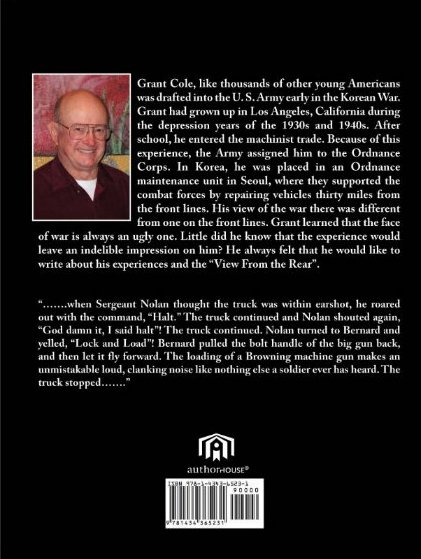 |
| (Click to enlarge) | |
Synopsis:
"The Korean War: A View from the Rear" is an account of life in the rear support area for both soldiers and Korean civilians during the war.
About the Author:
Grant Cole, like thousands of other young Americans, was drafted into the U. S. Army early in the Korean War. Grant grew up during the 1930s and 1940s in Los Angeles,
California. After school, he entered the machinist trade. Because of this experience, the Army assigned him to the Ordnance Corps. In Korea, he was placed in a maintenance
unit in Seoul and remained there for the remainder of his active duty. His view of the war there was very different from one on the front lines. Grant learned that
the face of war is always an ugly one.
Order Information:
ISBN 9781434365231. Paperback. 8 1/2x11 format. Over 45 full-page pictures and maps, mostly in color. Order from the publisher for $26.95 plus
shipping charges. Allow 12 to 14 days for delivery. The publisher can be reached on line or by telephone. authorHouse, 1663 Liberty Drive, Suite 200,
Bloomington, IN 47403. Ph. toll free 1-888-519-5121.
Authored by Ted Pailet
The Korean War and Me is a memoir covering Ted Pailet's first 24 years. The story centers on the author's experiences in Korea during the war and includes his growing up in the South. As an ROTC lieutenant, Ted’s assignments included searching for missing-in-actions and commanding the United Nations Military Cemetery in Korea. These assignments provided a variety of extraordinary experiences and encounters with extremely interesting individuals. Embedded in the story are scenes from the author's childhood, high school days, and college. He also shares his opinions on matters such as religious beliefs, racial relations, ideology, and politics.
Format: Paperback
Size : 6 x 9
Pages: 134
ISBN: 0-595-33433-4
$13.95 US
Order Information:
iUniverse
2021 Pine Lake Road, Suite 100
Lincoln, NE 68512
Transcription and Editorial by John Harris
Synopsis:
Albert Harris was a hometown hero in the small east Texas town
of Greenville. He was captain and quarterback of the high school
football team and married Mary Alice Norwood, the pretty
daughter of the local county judge, in 1945. Trained as an
artillery officer in the Marines, Lieutenant Harris joined the
reserves shortly after his marriage. When the Korean War broke
out in the summer of 1950, Lieutenant Harris knew he would be
leaving his wife and one-year-old son for the hills of North
Korea. There was no more practice—it was going to be the real
thing.
In 323 Days, we travel back in time to 1951-1952 and the
early stages of the Cold War. The United States was battling
international communism and there was the ever-present danger of
World War III. The Marine Corps had already suffered significant
losses in the first year of the Korean War and Lieutenant Harris
knew his tour of duty would not be easy.
During the war, Albert Harris wrote over 50 letters to Mary
Alice detailing a wide variety of subjects. The letters are
packed with information and reveal both a love story and a
brutal war story. They are an important and unique window to a
critical segment of the Korean War and are published here for
the first time.
Order Information:
223 pages
over 60 graphics
Hardback ISBN number: 978-1-63337-292-4
Amazon. Hardback = $24.95, paperback = $14.95, E-book = $9.95
Authored by Col. Douglas C. Dillard
This book is entitled, Tiger Hunters as the result of the author's research of the first time US forces fought Korean Forces in 1871. A US Naval party sailed up the Han River to enter the (Hermit Kingdom), as Korea was referred to by the West that wanted open trade and Korea refused. The naval party fought Koreans at Kangwha Do where a fortress guarded the access to Seoul. Lt. Hugh W. McGee, a US Naval Academy graduate, scaled the fortress wall and was killed by a spear. The defending Korean forces were "the Tiger Hunters." Each had to have single-handedly killed a tiger--hence the name Tiger Hunters. They were sworn to fight to the death and never be captured. Their uniforms were solid white. The Korean General in command's colors are still at the US Naval Academy awaiting a united Korea before they may be returned. Six Marines and nine sailors were awarded the Medal of Honor, at the time the only medal for bravery awarded and the first awarded for foreign service. Officers received brevet promotions in lieu of medals. Lieutenant McGee has a plate in his honor on the wall in the US Naval Academy Church in Annapolis.
In view of this history, the author entitled his book in recognition of our men, but in historical recognition of our partisans and agents equated to the bravery of the original Tiger Hunters. The book covers all aspects of the Partisan warfare waged against the Chinese and North Korean Forces from July 1950 until July 1953 when hostilities ceased. Tiger Hunters is thoroughly documented with citations from the National Archives, as well as personal interviews of Korean agents and partisans and US veterans who served in the 8086 and 8240th Army Units that conducted the unconventional warfare.
About the Author:
Then Lieutenant Dillard, a combat veteran with the 82nd Airborne
Division in World War II, was intrigued by his classified
assignment, reminiscent of his days working with the French
resistance in Southern France and the Maritime Alps along the
French/Italian border. As Chief, Special Airborne
Missions, Lieutenant Dillard completed 115 missions over North
Korea where he successfully dropped hundreds of Korean partisans
and agents. Lieutenant Dillard was awarded the
Distinguished Flying Cross by the Commanding General, 5th U.S.
Air Force, for extraordinary heroism. Lieutenant Dillard
also holds the Combat Infantryman's Badge with star and is a
master Parachutist. Lieutenant Dillard was temporarily
assigned to the TLO Team, 1st Marine Division, where he led
agents through the Chinese/North Korean lines to collect
tactical intelligence. The ROKA Ministry of Defense
decorated Lieutenant Dillard with the Wharang Medal with Silver
Star for his frontline operations. Colonel Dillard retired
with 35 years of active duty. He experienced combat duty
in World War II, Korea and Vietnam. His commands included
the 14th MI Battalion, the 48th MI Group at Fort Bragg, North
Carolina, and 500th MI Group in the Pacific. He is
currently a member of the SFA, SOA, Air Commandos, 82d Airborne
Division Association, and Veterans of the Battle of the Bulge.
Order Information:
$29.99. Hardcover, 367 pages. ISBN:978-1-45008-8480.
Order through www.Xlibris.com
or phone Xlibris Corporation, 1-888-795-4274.
Authored by Bob Drury and Tom Clavin
On May 11, 2008, a Marine Corps battalion serving in Afghanistan dedicated its camp in honor of Col. William E. Barber, a Medal of Honor recipient who served with the battalion during the Korean War. though Barber was one of the few in any branch of the United States military to have commanded men in World War II, Korea, and Vietnam, he is perhaps best known for his heroic command of Fox Hill in the winter of 1950, during which his small band of Marines saved the lives of nearly 8,000 of their brethren.
Though well-known in military circles as one of the greatest military achievements of our time, the true story of what happened on that hill has never been told--until now. With The Last Stand of Fox Company: A True Story of U.S. Marines in Combat, Bob Drury and Tom Clavin, bestselling authors of Halsey's Typhoon, use first-hand interviews with survivors as well as recently-opened archives to bring to life the story of then-Captain Barber and the 246 Marines of Fox company. In an interview, Drury and Clavin can discuss:
The Last Stand of Fox Company reads like a fast-paced thrilled, a story that is all the more astonishing for being true. The men of Fox Company were everyday soldiers who faced extraordinary circumstances. When called upon to hold a strategic piece of land against crushing odds, they "fought like Marines."
About the Authors:
Bob Drury is a contributing editor and foreign correspondent for Men's Health magazine who has reported from numerous war zones. His last book, The Rescue Season, was made into a documentary by the History Channel.
Tom Clavin is the author of eight books, including Dark Noon: The Final Voyage of the Fishing Boat Pelican.
Order Information:
Atlantic Monthly Press; January 13, 2009; ISBN:978-0-87113-993-1; 336 pages; $24; cloth. Contact: Grove/Atlantic, Inc., 841 Broadway, New York, NY 10003-4793; phone 212-614-7850; fax 212-614-7886.
Authored by Young S. Koo
This book is a brief history about why the Korean War was started and how the DMZ was made. The North invaded the South on June 25, 1950 and the cease fire was commanded by the International Military Armistice Committee in July 1953 and then the DMZ was created to secure each side. It tells how young Korean soldiers defended their territories under the enemy's constant attacks in order to distract the soldiers' military performance. The DMZ is the lasting regret to Korean people and it will be the sleeping volcano as long as the North is developing the nuclear weapons. - Young S. Koo
Preview:
How many people remember “the forgotten Korean War”? The Korean War developed on June 25, 1950 and lasted for three years until the cease fire was initiated on 1953, and then the DMZ was formed by the Military Armistice Agreement to secure each side. When Korea was liberated by America right after the Pacific War, the country was divided into north and south because of the territorial disputes between USA and the Soviet Union.
I joined the army when I was a freshman in college to finish the mandatory military service because I wanted to study medicine in America. When I finished the military training, I was sent to the front line to protect our country from the enemy. While serving my military obligation I experienced many enemy attacks. Here’s the part of military services in the DMZ and tells how we have fought against the enemy.
The North sent many soldiers to infiltrate the South and disturbed our soldiers’ moral and spiritual performances, but we overcame the enemy’s military and mental challenges and then sealed our territories intact.
There were a few young soldiers who fell into the mental disorders due to persistent DMZ guarding day and night. Furthermore, the North Korean enemy constantly propagandized through the loud speaker to seduce and distract our soldiers’ military duties. It is a painful country separation since our independence and the birth of the DMZ will be the lasting regret to Korean people for many years to come. South Korea is under constant threats and intimidations by North Korea from developing nuclear weapon. As long as the DMZ exists there will be no peace in Korea. Most of all, the USA and Soviet Union are responsible to reunify the country into one nation. - Young S. Koo
About the Author
Young S. Koo was graduated from the Busan Medical College, Busan National University, Busan, Korea, in 1966. He is now retired from medical practice
and spends most of his time writing his biography. He lives in northwest Indiana.
Order Information:
ISBN: 9781434364142; hardcover; 308 pages, $20.90; also available in paperback. Contact: AuthorHouse, 888-519-5121.
|
|
Authored by Lt. Col. George A. Larson
The information for this book is based on the Korean Air War Powser Symposium, sponsored by Headquarters Pacific Air Air Forces in June 2001, "Assessing the Korean War Bombing Campaign."
About the Author
Lieutenant Colonel George A. Larson, United States Air Force, Retired, graduated from Iowa State University, Ames, Iowa, in May 1969 with a Bachelor of Science in History.
He earned a Master of Arts in History from the University of Stanislaus, Turlock, California in June 1978. He served as a strategic intelligence officer with the former
Strategic Air Command (SAC) and with the Defense Intelligence Agency (DIA). In the Air Force he completed: Air Force Squadron Officers School, Air Command and
Staff College and Air War College. One of his special assignments was as Commandant of Cadets, Air Force Reserve Officer Training Corps (AFROTC) at the University
of Iowa, Iowa City, Iowa. He also completed the Naval War College, Industrial College of the Armed Forces, Foreign Service Institute and many specialized military
courses. He has written four books and over 300 magazine articles on military history, aviation, naval and general history.
Order Information:
390pp. Amazon.com. Soft cover = $19.99. Hard cover = $29.99. ISBN13 Hardcover: 978-1-4415-8382-6. ISBN13 Softcover = 978-2-4415-8381-9.
Published by Xlibris.
Written by Robert Levy
Follow the author through his three-plus years in the Korean War. Using letters and photographs that were preserved through the decades that followed the war--along with his memories of Korea, Bob Levy tells the story of his time in the Army 1951 extending into 1955. He states that his book "is an accurate description of what we did, how we lived, and some of the people with whom I shared Army life."
Levy was a radio operator with the 501 Signal Battalion (a non-combat outfit) based northeast of Seoul in the Korean community of Chip-o-ri. His book provides detailed information about living conditions in Korea, his thoughts on everyday life in his unit, events that took place (including a chronology of daily happenings), and more. To those who were there, this book will bring back some strong memories. To those who were not there, you will get an education about Korea during the war years.
Order Information:
218 pp., paperback. $22.06 includes handling and shipping. Order through www.lulu.com.
Compiled by Ronda Bagnall Rohde
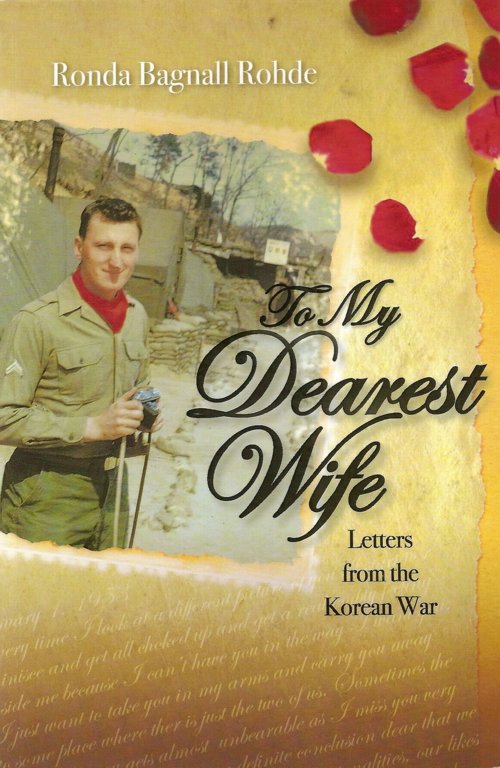 The author's husband, Leroy C. Rohde,
served in Korea from July 1952 until the end of August 1953. During this time he wrote letters nearly every day, and every letter started, "My Dearest Wife."
Mrs. Rohde has written a book about their life together and has included many of the letters. The letters tell about the living conditions and the war.
They tell about going to Japan on R&R, about USO shows, building bunkers and moving from one location to another. There are many pictures of Korea and the military,
including a helicopter removing the wounded.
The author's husband, Leroy C. Rohde,
served in Korea from July 1952 until the end of August 1953. During this time he wrote letters nearly every day, and every letter started, "My Dearest Wife."
Mrs. Rohde has written a book about their life together and has included many of the letters. The letters tell about the living conditions and the war.
They tell about going to Japan on R&R, about USO shows, building bunkers and moving from one location to another. There are many pictures of Korea and the military,
including a helicopter removing the wounded.
Order Information:
Soft-bound, 234 pages. $15.00 plus $4.00 postage and handling. Contact: Ronda Rohde, 215 Park Forest Blvd., Englewood, FL 34223.
Authored by Arnold Silveri
Turning the Corner on Life is a book covering more than seventy years of the author's life. Like any other autobiography, it is about family, friends, and personal experiences shared. It does not include every single thing that happened in Arnold Silveri's life, but there are, however, humorous nostalgic references to music, movies, radio, television, sports, social/cultural political names, places, and events intermingled within the chronology of his life.
Arnold Silveri was serving in Korea in 1957 when he was granted permission to go on R&R. Minutes into the flight that was supposed to take him to Japan, the giant C-124 transport that he was in crashed in the Han River. Chapter Twenty-Two of the book describes the flight, crash, and aftermath in detail.
About the Author:
Arnold Silveri was born in Brooklyn, New York. After quitting high school in 1952, he got a job as a clerk and IBM operator with a Wall Street firm. To
earn more money, he left his Wall Street job and worked as a laborer. After a stint in the army, he held a number of jobs, eventually working as a clerk for the
United States Post Office. He has authored three books in the past ten years. He currently resides in Staten Island, New York.
Order Information:
ISBN13 Hardcover: 978-1-4691-8356-5. ISBN13 Softcover: 978-1-4691-8355-8. ISBN13 eBook: 978-4691-8357-2. Published by Xlibris at
www.xlibris.com or call 888-795-4274, extension 7879. The softcover book is 410 pages.
Authored by Dr. Charles J. Gross
This graphics-intense booklet features five chapters: Mobilized; Baptism Under Fire; Containing the Conflict; Global Air Power; and Revamping the Reserves. Mobilized: Eighty percent of the Air Guard was called up for the Korean War, exposing its weaknesses as a reserve program. Baptism under Fire: Air Guardsmen flew 39,530 combat sorties and destroyed 39 enemy aircraft. However, the war claimed 101 of its own.
Containing the Conflict- The Air Guard played an integral role in strengthening NATO defenses in Europe and trying to prevent another world war. Global Air Power: While some Air Guardsmen deployed to Korea, most remained in the U.S. bracing for a possible Soviet attack.
Revamping the Reserves- The mobilization fiasco forced the Air Force to accommodate the Air Guard and overhaul its reserve system. "When Are We Going? The Army National Guard and the Korean War, 1950-1953" Authored by Renee Hylton, this 65-page soft-bound booklet tells the story of the Army National Guard during the Korean War.
This booklet includes the following chapters:
The booklet includes lots of truly wonderful pictures associated with the Army National Guard. In addition, it has appendixes which list the Army National Guard units that served in Korea, as well as Army National Guard units federalized for the Korean War
Order Information:
FREE, 39-page booklet by written request through: National Guard Bureau (PA), 1411 Jefferson Davis Highway, Suite 11200, Arlington, VA 22202-3231.
Authored by Jim Escalle
This book tells the life story of the author's uncle, 2nd Lieutenant Jimmy L. Escalle, a United States Air Force fighter pilot who became missing in action during the Korean War. Growing up in a small farming town in California's San Joaquin Valley during the 1930s and 1940s, Jim was a devoted son, a caring older brother, a talented athlete, and a young man of moral character who always put others first. He started high school as the Second World War was at its peak, and graduated during a time of transition within America and around the world. He had always wanted to fly airplanes someday, and with the introduction of jet propulsion during his high school years, he dreamed of becoming a jet pilot.
Called to serve his country after the Korean War began, his dream became a reality when he joined the Air Force and eventually got the opportunity to fly the F-86 Sabre, regarded as the most advanced jet fighter of its time. Soon after arriving in Korea he went on his first missions, which were MiG Alley sweeps. However, since Jim was assigned to a fighter-bomber squadron, the majority of his combat missions were air-to-ground. These were the most dangerous missions.
In Korea, more pilots had been killed or listed as MIA due to being shot down by ground fire rather than enemy aircraft. For Jim, this fact was realized only five weeks before the armistice was signed. He paid the ultimate price for freedom when he disappeared while on a combat mission over North Korea and was never seen or heard from again.
About the Author
Jim Escalle was born on September 23, 1959 in the San Joaquin Valley town of Delano, California. After attending the College of the Sequoias in Visalia, he went on
to receive a degree in Liberal Studies from Fresno State in 1983. He has been involved in public education for over 25 years. Jim currently lives in Bakersfield, California.
When Jim was around eight years old, he was told that he had an uncle who fought and died in the Korean War. At the time, he had been fascinated with anything related to World War II, especially the air war. Jim liked to watch movies on the subject, along with reading just about every book he could find. He also enjoyed going to local air shows and seeing airplanes such as the P-51 Mustang and P-47 Thunderbolt going through their amazing aerial maneuvers.
But it wasn't until Jim began the research on his uncle's life and his involvement in the Korean War that he came to appreciate the sacrifice his uncle's generation made for our country. His book not only pays tribute to his uncle, but to every airman who fought and died over the skies of Korea.
Order Information
Available through Amazon.com. Hardcover = $25.87; paperback = $12.29; eBook (Kindle, Nook and Google Play) = $6.95.
A few years ago, Robert J. Speights decided to do some reading about Korea and the "police action." He started at the local library where he found Volume I of the five volume series, U.S. Marine Operations in Korea, published by the Historical Branch, G-3 Division, Headquarters, USMC. According to Speights, "It read like the best war novel, but it wasn't fiction. Maps and footnotes documented each action, but they were separate and didn't get in the way of the narrative. Each page was filled with the names of Marines. I even found a reference to my own outfit on page 156. It wasn't a flattering reference, and it wasn't one of our better days, but the memories it brought back about that particular action were priceless."
Speights had the idea to reprint the entire series U.S. Marine Operations in Korea, and did so with the permission of the Historical Branch, G-3 Division, Headquarters, U.S. Marine Corps. The reprints are exact reproductions of the original hard-cover volumes. End papers (maps) are in three colors. Blue cloth covers featuring the Marine Corps emblem stamped in gold leaf are used throughout. Acid-free paper (an improvement on the original) and library binding are standard.
If you are a Marine, were a Marine, know a Marine, or are just plain interested in the Corps and/or the Korean War, you'll want these books for your library. This is a limited printing. Orders are for immediate delivery, but they are filled on a first come, first served basis.
Order information:
Volume I - Pusan Perimeter (August 1950-September 1950) - 272 pages
Volume II - Inchon-Seoul (September 1950-October 1950) - 363 pages
Volume III - Chosin Campaign (October 1950-December 1950) - 432 pages
Volume IV - East Central Front (January 1951-March 1952) - 342 pages
Volume V - Western Korean Front (March 1952-July 1953) - 644 pages
Each volume costs $27.50 per book. Postage is $3.50 for the first book and $1.25 for each additional book. Texas residents must add .0825 sales tax. Allow 4 to 6 weeks for delivery. Send your check to R.J. Speights, P.O. Box 140733, Austin, TX 78714-0733. Phone 512-836-0458. [KWE NOTE: Bob Speights died in 2015.]
Their Treatment and Handling by the North Korean Army and the Chinese Communist Forces
The Korean War Ex-POW Association joined forces with Turner Publishing Company and M. T. Publishing Company, Inc., to publish this book in commemoration of the 50th Anniversary in 2003 of the end of the Korean War. It is an historical resume of the experiences undergone by U.S. military personnel interned by the North Korean Army and the Chinese Communist Forces during the Korean War. During this time, information as to the existence and activities of the POWs was almost entirely dependent upon enemy propaganda and media. It was only after the release of these prisoners in 1953 that the full story as to their treatment became available. Based on the intensive debriefing of 34 returnees ranging in rank from Private First Class to Lieutenant Colonel by the Army Security Center as well as information from the debriefing of additional returnees and information gathered from various studies, this publication presents an accurate and shocking review of the methods utilized by the Communists to contain and exploit U.S. POWs.
Order Information:
312 pages, 8 1/2x 11. $49.95, plus $7.00 shipping and handling, and tax.
Send payment to U.S. Prisoners of War in the Korean War History Book, Turner Publishing Company, P.O. Box 3101, Paducah, KY 42002-3101.
Compiled by Richard Peters and Xiaobing Li
Synopsis:
Six beginning chapters of the book are devoted to summarizing
the Korean War. These chapters are followed by an oral
history of the Korean War as told by survivors from both sides.
American, South Korean, North Korean and Chinese veterans
discuss the war from their perspective. The final chapter
was written by a Chinese colonel who gives his perspective of
the Koje-do prison riots. One reviewer describes the book
as, "a fine book of tragedy, heroism, and survival."
Order Information:
312 pages hardcover $36.00; 264 pages paperback $22.21; plus
Kindle version $21.19. University of Kentucky Press,
copyright 2004. ISBN: 0-8131-2293-7 and ISBN:
978-0813122939. Available on Amazon.com.
Authored by Jack M. Anderson
 Covers the life of Jack M. Anderson as an infantry soldier during World War II in the SWPAC
area and the Korean War.
Covers the life of Jack M. Anderson as an infantry soldier during World War II in the SWPAC
area and the Korean War.
In the Korean War, Anderson was with the 2nd Infantry Division, 38th Infantry Regiment. He was the Operations Sergeant for the 1st Battalion, 38th Infantry Regiment. He joined the battalion on August 1, 1950 and was wounded and captured on February 12, 1951. Anderson escaped three times and got back to Allied lines on February 24, 1951.
Order Information:
$24, 374 pages, hard cover, 54 graphics. Send check or money order to Jack Anderson, 1717 Rockefeller Ave., Apt. 312, Everett, WA 98201-5912. This Book is also available
from www.amazon.com.
Authored by William D. Dannenmaier
The book’s author, William D. Dannenmaier served in Korea with the U.S. Army from December 1952 to January 1954. His military service began as a radioman and then as a radio scout with the 15th Infantry Regiment. Eager to serve a cause in which he fervently believed—the safeguarding of South Korea from advancing Chinese Communists—he enlisted in the army with an innocence that soon evaporated. Woven throughout is Dannenmaier’s narrative account of his combat experiences, including a vivid re-creation of the bloody battle for Outpost Harry, which he describes as "trivial and insignificant—except to the men who fought it." A high-intensity, eight-day battle for a hill American forces would abandon three months later with the signing of the truce, Outpost Harry was largely ignored by the press despite heavy casualties and many official citations for heroism.
From Dannenmaier's vantage point as an Everyman, Dannenmaier describes the frustration of men on the front lines who never saw their commanding superiors, the exhaustion of soldiers whose long-promised leaves never materialized, the transitory friendships and shared horrors that left indelible memories. Endangered by minefields and artillery fire and ground down by rumors and constant tension, these men returned—if they returned at all—profoundly and irrevocably changed.
Order Information:
$24.95, 208 pages, 6x9 inches, 11 photographs, cloth. ISNB 0-252-02449-4 Send check or money order to University of Illinois Press, 1325 South Oak Street, Champaign,
IL 61820. Illinois residents add appropriate sales tax.
Authored by Curtis J. Morrow
Reviewed by Ian Ralston. Book review forwarded to the KWE by Curtis J. Morrow.
Although the title of What’s A Commie Ever Done To Black People: A Korean War Memory clearly suggests that this book will be about the war recollections of a young African American soldier, this work is in fact more far reaching.
In the first section the author recounts his experiences of training and eventual combat in Korea, in almost forensic detail. The horror of the conflict and its impact on American soldiers, Korean civilians and Korean troops (both North and South) is portrayed in vivid and often disturbing detail. The many and detailed verbal exchanges the author recounts also highlight the contradictions many African Americans troops faced whilst ‘fighting for freedom’ but at the same time (mainly recounted by the conversations with soldiers from the American deep south) the inequalities and racism faced (back) in America.
In later sections the author recounts his growing awareness of the world outside the USA. Consequently, the text could also be considered a personal rite of passage, yet despite this the reader is often left with the feeling of wanting to know more about the author’s life, family and aspirations before joining the military. The sections dealing with his recuperation from injury, court martial and service in Japan, add weight to the author’s views regarding the nature of military life. Particularly of significance are the recollections of Japan that seem to draw together both his ability to ‘play’ the system in order to survive, and to find purpose. His increased awareness of ‘place’, his extensive sexual activities (that say much about male attitudes, particularly at time of war) and growing sense of awareness brought on by the experience of war and the military culture are also apparent, though not often 'comfortable’ for the reader. This is particularly the case regarding attitudes to women.
The point of awareness and sense of identity is highlighted in his discussions with a fellow (African American) soldier over their African heritage and history. “I first took it as a racist insult. How dare he connect me with Africa, me, an American soldier that had proven myself on the battlefield…..later during that night….I thought of my grandfather….telling us small kids that his father had told him he was an African…..then I too was of African descent. The realization startled me. How could I be so stupid? Then I realized it wasn’t so much stupidity as ignorance…” (page 126)
There is also, in the later section of the text, some ominous foreshadowing when the author recounts his service with an airborne unit dropping supplies to the French in Vietnam.
Overall, this text makes a valid contribution to not only the study of oral history of war (particularly the too often neglected area of Korea) but also to studies of masculinity and African American identity. This is achieved essentially through the strongly narrative driven nature of the text.
Order Information:
McFarland Publishers. ISBN:0-7864-0333-0
Visit this blog for more info: http://warandaftermath.blogsource.com/post.mhtml?post_id=309866.
|
||
|
View and/or Sign Our Guestbook |
|
|
 |
||
|
| Contact | What's New | About Us | Korean War Topics | Support | Links | Memoirs | Buddy Search | |
||
|
© 2002-2016 Korean War Educator. All rights reserved. Unauthorized use of material is prohibited. |
||
|
- Contact Webmaster with
questions or comments related to web site layout. |
||

| . |


 A Very Long Weekend: The Army National Guard
in Korea 1950-1953
A Very Long Weekend: The Army National Guard
in Korea 1950-1953 ISBN: 0-7414-1443-0 ©2003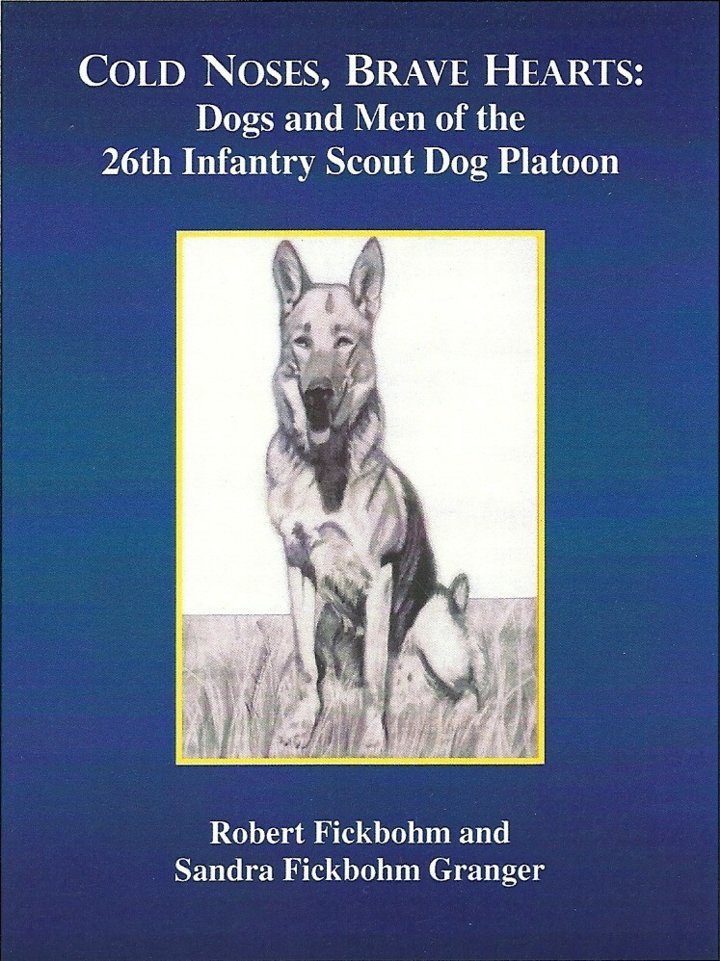
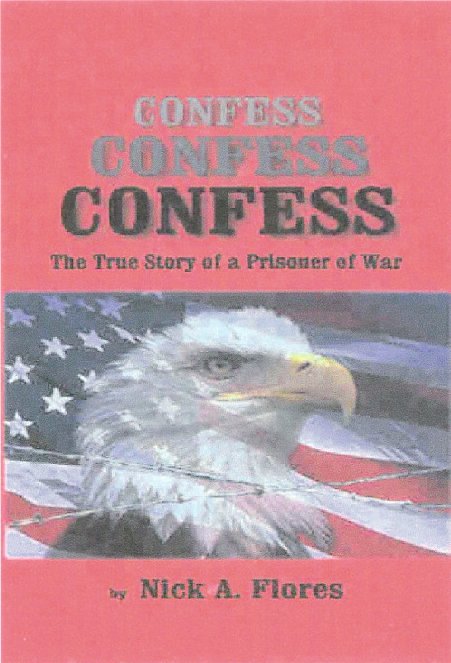
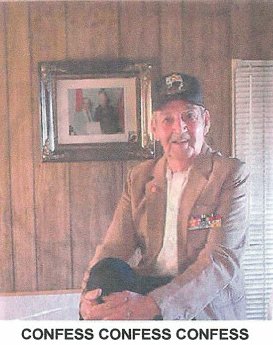
 (New York: Berkeley Caliber Books, 2005)