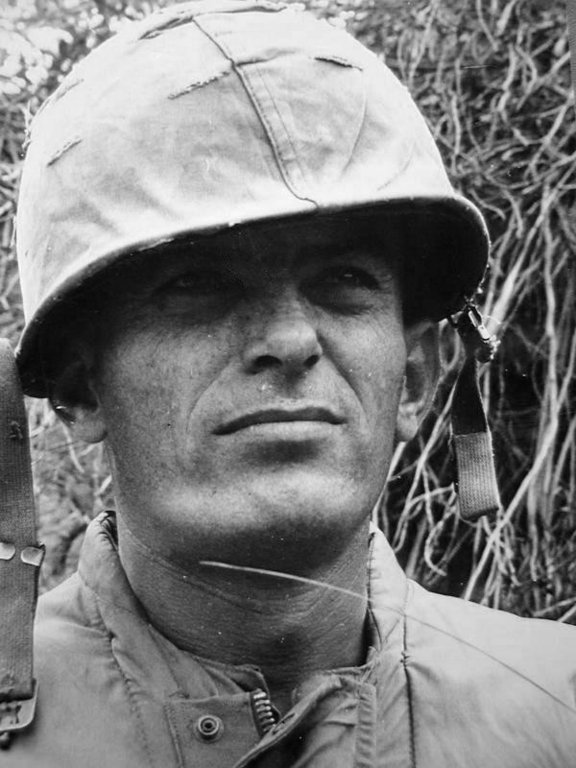
[The following is the result of an online interview between Bob Caulkins and Lynnita (Sommer)
Brown that took place in November of 2002. Bob, who drew heavily from his own personal bio to relate his
memoirs of Korea during the interview, served in Korea from 1953 to 1954, first in A-1-11 and then in the 1st
Provisional DMZ Police Company. After the war he had embassy duty in Germany, went on a Med Cruise, was in
Lebanon, and then in Vietnam from 1967 to 1968 (with lots of duties between). He was senior enlisted
writer for Leatherneck Magazine prior to his discharge in 1972.]
Memoir Contents:
Back to Memoir Contents
Pre-Military
My name is Robert Dale Caulkins of Brunswick, Georgia. I was born June 30, 1933 in Pawtucket, Rhode
Island, a son of James Stuart and Claire Veronica Wall Caulkins. I had two brothers, Donald Stuart and Dean
Thayer, both younger than me. My father had no profession. He was a jack of all trades. He was
employed as a semi-skilled factory worker, route salesman, shipyard worker, and insurance salesman. My
mother worked for the telephone company and during World War II as a civilian employee of the Army Corps of
Engineers.
Because of my father's rather transient employment record, we (my brothers and I) attended five or six grammar
schools, both Catholic and public. I joined the Boy Scouts but after a year or so, I lost interest and
retired, still Tenderfoot. I did not graduate from high school due to a lack of credits to advance into the
10th grade.
During World War II, my father worked in a shipyard building Liberty Ships. As mentioned, my mother was a
civilian employee of the Army Corps of Engineers in Providence, Rhode Island. Although there was no one in
my family or any relatives who were in the war, we supported the war effort by buying war stamps at school.
Each stamp cost ten cents. The stamps were placed into a stamp book which, when filled, could be turned in
for a $25.00 war bond. The kids in the neighborhood collected used tires, aluminum pots and pans, and paper
for the war effort.
As a youngster during World War II, I was greatly influenced by movies and comic books that featured the
Marines. I guess from the day I saw my first Marine, I wanted to be one. One day shortly after the
Japanese attack on Pearl Harbor, the U.S. Army and the Civil Defense Force came to the Chad Brown Housing Project
in Providence, Rhode Island. Using loudspeakers, they ordered everyone--men, women, and children--outside
and took us to several military trucks where they fitted everyone, even babies, with gas masks. All of the
kids of our age in America were caught up in the whirlwind of war. I'm sure that early in the war many a
youngster in bed at night, before sleep came, remembered the day's grim radio and newspaper reports of Japanese
successes throughout the Pacific and sometimes seriously expected that in a very short time (maybe next morning),
the streets would be crawling with the Emperor's little, bandy-legged, bespectacled soldiers and their tinny
looking tanks. It was almost an overload to the brain of a little kid in those early war days.
We guys (8, 9, and 10-year olds) decided that if we were going to be overrun by the Japanese, we should at
least go down fighting. From the movies, we all knew that the Filipinos, even the little kid Filipinos, were
slaughtering the Japanese as fast as they stepped off their landing boats. So we elected a neighborhood
Filipino kid as our leader. His father was a Navy mess steward at a local military base. He was not
elected because his father was in the Navy, but because he could make the most ferocious face while at the same
time screaming something in Tagalog at the top of his lungs. It scared the hell out of us. So, by
extension, we figured it would scare the hell out of the Japanese, who would scurry back to their landing craft.
We hadn't the slightest idea what he was screaming--he might have been screaming that the bath water was too hot,
but it sounded like an Asian rebel yell and we needed that then. Next day most of us decided that, rather
than attack the Japanese physically with grimacing, screaming Ronaldo leading us, we would buy war stamps at
school and really teach those Japs a lesson.
Through it all, the dream and the conviction to become as Marine grew. The gallant Marines on Wake
Island, the intractable Marines at Guadalcanal. And it kept happening. Bougainville, Tarawa, Saipan,
Pelileu, Iwo Jima, Okinawa. The American people had a love affair with the Leathernecks. My admiration
and love of the Corps grew with each day that passed and brought me closer to the day that I would join this
famous and fabled Corps.
There were times when my resolve was tested, like the day in 1948 when I was 15 and had skipped school to see
my idols make a demonstration amphibious landing on a beach in suburban Boston. The landing was part of a
First Marine Division reunion being held that year in the swank Hotel Copley Square in downtown Boston.
About one square mile of beach and inland area had been roped off, and Marines in summer khaki uniforms were
stationed about every ten yards or so to keep people from crossing into the danger area where explosive charges
had been set.
Two thousand yards out in Boston Bay, hundreds of combat clad Marines had descended by cargo nets from the
decks of attack transports into landing craft, and were now headed for the beach at top speed. When the
boats got to within 200 yards from shore, large explosive charges were set off on the beach. Flame and smoke
and sand blew into the air. The loudness and the concussion were enough to take one's breath away.
(Newspapers of the day stated that the charges had been too large for the close proximity of the crowd numbering
in the thousands.) People had no sooner recovered from the noise and shock of the detonations when several
Grumman F4F Corsairs flew lengthwise down the beach (and over portions of the crowd) at virtual treetop level,
laying a smoke screen. As I recall, the day was bright, sunny, and without the trace of a breeze. The
smoke screen was placed well and enveloped the beach for its entire length. An eerie quiet overtook the
crowd as the smoke descended and blocked our view of the approaching landing craft.
Suddenly someone shouted, "Here they come." Through the smoke, one by one, and then by fire teams,
squads, platoons, and finally companies, the Marines charged up the beach and onto the flat land behind it and
headed for the crowd, firing blanks from rifles and machine guns, and throwing grenade and artillery simulators.
The Marines worked their way rapidly forward by fire team rushes to their pre-planned stop line about 50 yards
from the crowd. By then the smoke had cleared away, and there, in the prone position, ready to move forward
if ordered to do so, lay close to a thousand Marines. The crowd was mightily impressed. I was
ecstatic. I stated to no one in particular in the crowd, "That's what I'm gonna be--a U.S. Marine."
"Hey, kid. Don't be crazy," a voice said. I looked up into the face of one of the Marines on cordon
duty. "If you're smart, you won't come anywhere near this outfit."
I was crushed, confused, and embarrassed. But, then I looked at the Marine as he turned his attention
back to the "battlefield." I hated him with all my being. How dare this person say what he had said
about my Marine Corps, his Marine Corps. Through my embarrassment and anger I looked him up and down.
His collar and sleeve cuffs were frayed and his shoes were scuffed and un-shined. I then knew that he was
not a real Marine. A real Marine's uniform would be spotless and he would have said, "Glad to have you, kid.
See ya when you're seventeen. Gung Ho!" My resolve to be a Marine remained not only intact, but more
solid than ever.
After leaving high school, I worked in a steel fabrication plant in Quantum, Massachusetts, as an apprentice
millwright, and for an industrial luncheon service repairing leaky coffee urns. I left civilian employment
to join the Marine Corps.
Back to Memoir Contents
Joining Up
On a chilly day in April 1950, I went to the Marine Corps Recruiting Station in the Customs House in downtown
Boston. I was not yet 17, but I had convinced my parents to let me attempt to join the Marine Corps Reserve.
My mother had been adamant. She would not sign the papers for me to ship out in the Regulars, but the
meeting-a-week reserves were okay with her. My father was all for my joining up, reserve or regular.
He had joined the Navy at 15 and gotten as far as the USS Arkansas before his parents, whose permission he did not
have, asked the Navy to send him home. Actually, neither of my parents believed I would even pass the
physical. So I guess they felt on firm ground when they said that they would sign me into the Corps if I
passed all the tests required to join.
The reason my parents had doubts about my being accepted into the service was because of a serious kidney
operation that I had undergone at the age of 12. It had left me with a 14-inch horizontal scar on my left
waistline. As a matter of fact, after five months of service in the National Guard, I was discharged because
of the scar in 1948. The Guard unit used a contract doctor who gave physical examinations to persons who had
joined the Guard during the previous six-month period. On the night I was to have my physical, the doctor
came from a party and was three sheets to the wind. He took one look at the angry-looking scar on my side
and screamed, "What the hell is that?" As I attempted to tell him about the operation and that I was now
healthy and feeling fine, he interrupted me and said, "You're physically unfit, Boy. Get the hell out of
here."
So ended my career as a private, serial number 21264875, with the Ammunition and Pioneer Platoon, Headquarters
Company, Headquarters Battalion, 101st Infantry, 26th (Yankee) Division, Massachusetts National Guard. I was
discharged at the age of 15. My brother Don, who had joined with me as my bogus 17-year old twin, left the
Guard shortly thereafter. He had no big, scary scar. He just decided to resign. He was 14 years
old.
As I rode the bus and then the subway to the Marine recruiting station on that brisk April day, I had serious
thoughts about what might take place. My first worry was that I might run into one of the recruiters,
Sergeant Wolf, who had grown weary of my repeated visits asking for recruiting material. But I had not been
there for about a year, and I hoped he might have been transferred or that he would not remember me. The
second worry--and the biggest, was the long, ugly scar on my left side. If the National Guard had kicked me
out, the Marine Corps and Sergeant Wolf would certainly do the same--after beating me to a pulp for messing up his
quota.
But I was prepared to fight to get into my Marine Corps. I would not easily accept defeat. Before I
left home that morning, I took a 20-foot length of quarter-inch clothesline cord and wrapped it snugly around my
waist, under my clothes. Looking in the mirror, I was careful to make sure that the cord covered the scar.
I had tried it out before and, looking at my reflection in the mirror, it appeared as though I had worn a belt
very tightly and had a humdinger of a belt mark all the way around my waist. I hoped that it would also look
that way to the Navy doctor.
I got to the recruiting station and my nemesis, Sergeant Wolf, was nowhere to be seen. I asked a Marine
corporal if Sergeant Wolf would be coming in later, and I was informed that Wolf was on leave. Whew!
One critical worry out of the way. I sat down and filled out the enlistment papers and was then told to take
my physical examination forms upstairs to the medical department. I asked if I could use the bathroom before
I went up and was told to go ahead, but not to lollygag. I didn't know what lollygag was, but I certainly
didn't intend to do anything but uncoil the rope from around my waist and get up to the medical department.
In the men's room I entered a stall, dropped my trousers and my underpants, and uncoiled the rope. I dropped
it into the used paper towel container, straightened out my clothing, and went upstairs to the physical exam room.
There were several other guys there who were applying for the Navy. At least I would not be the sole
object of the examiner. At one point in the exam a corpsman checked me over for the "marks and scars"
section of the exam report. My heart was in my mouth as he tapped my side with his pen and asked, "What's
that?" But, as soon as he asked the question he answered it himself by saying, "Oh, a belt mark." He
then wrote "None" under marks and scars. My hearing was tested by a doctor who clicked two coins together
and asked me how many times I heard the click.
A short time later I was bounding down the street, a mile-wide smile on my face, whistling the Marine Hymn.
In my hand I had a large, brown manila envelope containing enlistment papers. I had been ordered by the
recruiter to report to the Second Infantry Battalion, United States Marine Corps Reserve, headquartered in the
Fargo Building, near the Boston dockyards. I had made it. I was going to be a Marine!
My mother and father, true to their word but with a bit of apprehension on my mother's part, signed the
parental consent forms and on April 12, 1950, I was sworn into what was known then as the Organized Marine Corps
Reserve. I attended a two-week summer camp at Camp Jejune, North Carolina, in June. Summer camp
consisted of infantry training, including firing the M-1 rifle and making an amphibious landing on the coast of
North Carolina. It was a very confusing time because we new guys were supposed to think and act like
Marines, but we hadn't the training or the experience to really know what was going on. My memories of that
two-week summer camp 53 years ago are very faint. However, I do remember the amphibious landing. We
were aboard (I don't remember how we got aboard) a landing ship (LEST). It was the kind where the bow doors
opened and a ramp dropped down onto the beach. Only in this case, the ramp was dropped down into the sea so
that amphibious tractors could drive down the ramp into the ocean and head for the shore. I remember how
subdued we new guys were when we filed down into the well deck, loaded into the tractor, and sat down inside.
The tractor engines were idling and the carbon monoxide was so thick we could see it shimmering in the air.
After about a minute or two, most of us were sick from the fumes, but I don't remember anyone throwing up. I
guess we were too busy wondering what was going to happen next.
All of a sudden the engines revved up and we began to move forward toward the bow of the ship. The metal
tracks of the tractor screamed as they skidded along the steel floor of the well deck. All of a sudden the
tractor reached the end of the ramp and nosed over into the sea, making a terrible steel on steel scraping sound
as we went down into the water. We were all terrified at the noise and erratic movement of the tractor, and
when sea water splashed over the top of the tractor into the troop compartment, someone shouted, "Jesus Christ,
we're going down!" But we didn't go down. We bobbed back up and the tractor began the run into the
beach. I was never so glad as when the tractor ramp finally went down and we charged across the beach 50
yards or so and hit the dirt. Fifty yards was no great distance, but I was exhausted from the strain of the
trip from ship to beach. When I lay in the sand, I almost couldn't get up and continue on. The
sergeants yelling to get off the beach and head inland forced me to move. I remember thinking how horrible
it must have been during the war to go through what we had just experienced, as well as landing on a beach where
the enemy was waiting and shooting at us.
Back to Memoir Contents
Parris Island
Upon activation for the Korean War, my reserve unit--the 2nd Infantry Battalion of Boston, Massachusetts,
departed for Camp Jejune on August 14, 1950. There were 700 of us, and I knew many of the Marines who
traveled with me to boot camp. I am still in contact with a couple of them even today. One, Joseph
Capiachetti, is a retired instructor of fine arts at the Museum of Fine Arts in Boston. The other, Albert
Leahy, is a retired Marine colonel who is an artist/illustrator living in North Carolina. As we traveled
south, the train stopped at each large city--New York, Philadelphia, Baltimore, Richmond, etc.--and picked up more
Marines. When we arrived at Camp Lejeune, we numbered in the thousands. At Camp Lejeune, those who had
attended three summer camp training sessions were deemed ready for combat. Those of us who had less training
were assigned to recruit training at Parris Island.
At dusk we arrived at Yemassee, South Carolina. Yemassee is remembered by hundreds of thousands of
Marines as the last step before the abyss. With a minimum of ranting and raving by several sergeants, no
indication of what was yet to come, we were loaded with amazing speed into tractor-trailer type buses for the 25
or 30 mile trip to Beaufort, South Carolina, and then a short way beyond. Parris Island is an island off the
coast of South Carolina near Beaufort. Palmetto trees were the norm, along with some type of small palm
trees. The island was surrounded by a tidal marsh. There was only one way onto and off of the
island--a causeway supposedly built by recruits of another day.
Great, gnarled oak tree branches draped with gray Spanish moss formed a tunnel as we sped along the rural
two-lane highway through the ever-darkening countryside. The moss waved in the wind generated by the buses.
It was a scene straight out of a Boris Karloff movie. The damp night air whipped through the open windows of
our bus, filling it with the fetid smell of rotted vegetation, mud banks, and pinewood smoke. Occasionally
the moon, now full in the sky, glinted off flooded creeks and rivers on both sides of the highway. We went
deeper and deeper into tidewater country. The smell of salt water was in the air. We were headed to
our appointment on an island with a reputation second only to that of another island off the coast of French
Guinea known as Devil's Island. Parris Island, South Carolina, home of the famous, or infamous, Marine Corps
Recruit Training Regiment. This is the place where all Marine recruits from all locations east of the
Mississippi River are sent to train.
We drove by a large red sign at the gate to the island. It was illuminated by floodlights. On
either side of the sign were large, ornate Marine emblems. Between the emblems, gold lettering stated,
"Marine Corps Recruit Depot, Parris Island, South Carolina." Beyond the brightly lighted sign, the direction
in which we were headed, stygian blackness. None of us had ever been on the island before, but when we
passed the brightly lit sign into that blackness and the unknown beyond it, complete silence descended on the
group. We drove for several more minutes and then came to a large, square, grassy area lighted by
floodlights. I will never forget the greenness of the grass or the brightness of the lights. The buses
stopped one behind the other along three sides of the grassy square. Coming toward the buses from the open
side of the square marched a line of uniformed men who suddenly broke into three and four-man groups which then
headed for each bus.
Our bus driver opened the folding door, said, "Good luck, guys," and was gone in an instant. Seconds
later, a large man dressed in the Marine Corps field uniform stepped up into the bus and screamed at the top of
his lungs, "You turds have 10 seconds to get off this #@%$& bus and form into three $@#%# ranks on the grass.
If any swinging dick is left on this bastard when I get to the end of the aisle, I will kick your ass up to your
shoulder blades. Now move!" He strode toward the back of the bus. As he passed by each row of
seats, the occupants shot out of the seats and headed for the door at the front of the bus. It wasn't
pretty. Some reached for handholds to get up, missed, and were ran over by their seat partners. Some
made it to the aisle, only to lose their footing and be trampled by their fellow recruits.
As we tumbled out of the bus door there were two or three other Marines standing at the bottom of the exit
stairs. They were screaming and yelling at us and using switches on people who had missed their footing and
fallen off the bus to the ground. We were pushed and shoved and cursed and formed into ragged ranks for a
roll call. Some people were dazed because of the assaults that had taken place and did not hear their names
called, which led to more assaults and screams to "Listen up for when your scuzzy names are called, maggots."
We were then marched (and whipped with switches) to the Hygienic Unit where four or five civilian barbers
roughly and unskillfully sheared our heads like drunken Australian sheep shearers. We all came out of the
barber chair bald, but some people came out of the chair bald and bleeding from cuts inflicted by barbers who were
angry because of being called in after hours to cut a bunch of Yankee heads.
From the barber chair we were made to run into a room where we were ordered to strip down and get into an
ice-cold shower to wash the hair off of our bodies and, "Wash that civilian bullshit attitude" down the drain.
We were not allowed to dry off, but were immediately lined up and given a "short arm inspection" for venereal
disease by a Navy corpsman. As I recall, no one was found to be suffering from such a disease. We were
then told to dress and be outside the building in 30 seconds. We made it outside in 10.
We were again formed into a three-column herd and marched off at a very rapid pace along roads that passed
through areas containing warehouses, barracks, and even structures that appeared to be single family houses.
The houses tugged at my heart. I wanted to be in one of those houses, not in this group of lost souls being
marched off to the dark unknown. The one thing that stood out most of all in my mind was the overhead steam
pipes dripping hot water and spitting out clouds of steam into the hot night air. These pipes, which seemed
to be everywhere, supplied hot water and heat in the wintertime to all the buildings on the island. They
were supported ten to twelve feet above the roadways by telephone poles. Because Parris Island was so close
to sea level, it was impossible to dig ditches for pipelines due to the water table, so all the pipes and cables
and other utilities were suspended in the air above the island.
We finally arrived at our destination and were called to a halt. We could hear NCOs at the
back of the column verbally and physically abusing several persons who were not able to keep up with the main
group. We stood in front of a group of old World War II Quonset huts, where we were broken down in groups of
15 or 20, told to get inside a designated hut, and ordered to keep our mouths shut. The Boston group was
divided into two recruit platoons by alphabet. Platoon 118 contained men whose names began with A through K.
Platoon 119 contained the remainder. I was in Platoon 118. I, along with my group, dashed into a hut
as instructed. Apparently neither the quartermaster department nor the drill instructor staff had expected
us. We were told to hit the sack but there were no mattresses or pillows--just the steel springs.
After the NCO left, there was a murmur of protest and indignation, but all we really were desperate for was peace
and quiet. We all picked out a bunk and lay down and slept--or tried to sleep. The next day was even
more severe.
Looking back, I am proud, and will be proud until the day I die, that I was able to survive this brutal
introduction to recruit training. Not survive in the sense of living or dying, but survive by not collapsing
emotionally in the face of being plunged into such a terribly violent atmosphere without warning. I would be
very remiss, however, if I didn't mention the other men who underwent the same experience at the same time I did.
As mentioned, we did not have enough training or experience to go into the operating forces of the active duty
Marine Corps. However, the majority of us had been in the reserve for a while. Time enough, in many
cases, to have attended numerous drill meetings. And there were those of us who had been to two weeks summer
training at Camp Lejeune, where we made amphibious landings and underwent combat training. Until the 2nd
Infantry Battalion was called to war, we were reserve recruits. Although we had not been to real boot camp,
we were trying our damnedest to become Marines. In most instances we were treated as fellow Marines by the
officers and enlisted men of the battalion. To be suddenly plunged into a hostile world where we were held
in contempt, ridiculed, and manhandled for being reservists was for many of us, devastating. Many of us felt
betrayed by the very organization we had been trying so hard to become a member of. Before sunrise, to the
accomplishment of screamed oaths, trash cans being kicked over, and people being literally pulled from their beds,
we were welcomed into our first full day in the "real" Marine Corps.
Corporal Calbaugh was our senior drill instructor. I don't remember the names of the two assistants he
had. I only know that they were both privates first class. Corporal Calbaugh was a calculating,
vicious bully. As we stood there in ranks in the gathering light of dawn, Calbaugh stormed back and forth in
front of the platoon and proceeded to inform us that we were the lowest form of life on earth. First of all,
we were "pansy-assed reserves who didn't have the balls to enlist in the regulars." Secondly, we were
Yankees, and for that "we would rue the day we ever tried to contaminate his Marine Corps."
To make us understand Calbaugh's utter contempt for us, he reached out and grabbed the most pleasant,
mild-mannered, inoffensive recruit in the platoon. I knew him. His name was Joe. I liked him.
He was of Italian extraction and was, I found out later, an excellent artist and painter. Calbaugh threw Joe
against the wall of a Quonset hut and proceeded to pummel him unmercifully with his fists. Joe was helpless
with astonishment. The more he protested the treatment he was receiving, the more Calbaugh punched him.
Joe finally went down. Calbaugh stood over him like a victorious gladiator. He kicked Joe and told him
to get back in ranks. Joe did, and stood there shaking and bleeding. We were all shaking, too.
We were astonished and scared--so scared and unsure of our standing in this continuing nightmare that not one of
the 75 reservists in the platoon came to Joe's assistance. Not one of us protested. We were just
relieved as individuals that Calbaugh had not picked us.
Assuming that he had thoroughly cowed us--which he had, Calbaugh proceeded to expand his power base by
challenging, "Any one of you Yankee Reserve shitheads who think you can whip my Confederate ass, step out here.
Now!" I was shaking in my boots. I just wanted this to end. I just wanted a return to relative
normality, an end to being terrorized. I am sure my comrades did also. (Actually, I wanted more than
anything else to get back on the train and go back home.) From somewhere in the back of the platoon a voice
said, "I'll try." Stepping through ranks to the front of the platoon came a tall, muscular guy most of us
had seen from time to time on the train, but no one really knew. I found out later that he was a member of a
reserve unit in California, and was visiting Massachusetts when the reserves were activated. So, he had
reported in to the nearest reserve organization, the 2nd Infantry Battalion in Boston. His last name was
Christy.
When he stepped out, my heart fell, as did I'm sure, the hearts of the entire platoon. Rather than an end
to this terrifying episode, it was to continue. Christy moved forward, but it was Calbaugh who got in the
first strike. His punch knocked Christy's head back, but did not stop him from moving forward. Christy
reached out and wrapped his arms around Calbaugh, who continued to flail away at Christy's face. They fell
to the ground and commenced to roll this way and that with no one seeming to gain the upper hand until, suddenly,
Calbaugh was able to maneuver himself behind Christy and put a choke hold on him. "Give up, son of a bitch,"
he panted, and applied more and more pressure to Christy's throat with his forearm. By this time, Christy
was unable to speak from lack of air and began to wave his arms about in surrender. Calbaugh continued to
apply pressure until Christy was about to pass out, and then released him. Christy lay flat on the ground
bleeding from several cuts and gasping for breath. Calbaugh got up, reached down and pulled Christy to his
feet by his shirt collar, and kicked him back into ranks with the epithet, "Next time I'll kill you, puke."
I felt doomed. Rather than hold Christy in esteem for his boldness, we collectively hated him for his
stupidity in bearding the lion. We would suffer for this impudence, and we did, until the day we left Parris
Island four months later.
Today, almost 50 years later, trying to understand Calbaugh's brutality, I have come to two explanations or
conclusions. The first is, I believe that Calbaugh found himself in a very dangerous situation. He was
a drill instructor charged with the training and disciplining of a group of reservists--people who were already in
uniform, people who had already experienced life in the Marine Corps. Limited experience to be sure, but
Calbaugh could not take the chance that anyone in the platoon might challenge his authority. So, he used
draconian measures right from the start. The second conclusion is I believe that the recruit training
command, more accustomed to receiving recruits straight from civilian life, wanted no problems with recalcitrant
reserve recruits who might balk at being pushed around as normal recruits were in those days. So to nip the
potential problem in the bud, the command gave the drill instructors a relative carte blanche to get the
reservists ready to go to war. Although I will never forgive Calbaugh for his viciousness, which I also
became the beneficiary of on several occasions, I can understand his predicament. Of course, another
explanation is that Calbaugh was a sadist who enjoyed inflicting pain, both physical and mental. I don't
know what happened to Christy or Calbaugh after I left boot camp. At the end of recruit training, the
platoons were split up and the recruits were sent to various bases for training or assignment based on their
assigned military specialty.
I remember always being hungry at boot camp. We were herded into the mess hall and rushed through the
meal with the admonition from the DI that we had better be finished and standing in ranks outside the mess hall
when he got up from the DI's mess table. If he saw anyone speaking, he hurled a spoon at them and told them
to report to him after chow. To avoid any hassle, most of us gulped down our food and got out of the mess
hall in minutes. Being hungry made us develop a scheme whereby, when it rained and we wore ponchos, several
people were selected to steal a loaf of bread and others were charged to get a jar of apple butter. W
carried these to the huts and gorge ourselves on them, making sure to get rid of the bread wrapper and empty apple
butter jar. Luckily we were never caught.
The fabled sand flea was the villain of and the bane of all of us who were ever on the island. This set
of "flying teeth" was given free rein to eat on as many recruits as it desired, and the recruit was forbidden to
strike, brush away, or even grimace as the little devil dined away, usually on the most sensitive portion of the
recruit's face.
During our training, we were shown combat films of the Marines in the Pacific during World War II. It was
a very confusing feeling--feeling proud to be a part of the Marine Corps and its tradition of victory and
dedication to duty, but at the same time feeling sorry for ourselves for being in the Corps because of the way we
were being treated. I was very sorry for joining the Marines during boot camp because I thought that we (I)
would be subjected to the same abuse for the entire time I was in. The sudden transition from a fairly
protected home life to a shockingly brutal life as (according to the Drill Instructor) "a piece of whale shit, the
lowest thing on the face of the earth" was, for me, the most difficult aspect of being in boot camp. I came
to understand my DIs a bit when I became a DI in the 1960s. I came to find out that there are people who
just don't understand without "the laying on of hands." But I never appreciated the DIs use of maltreatment
for the possible pleasure of maltreating.
I don't recall being subjected to tear gas training during boot camp, but each recruit had to qualify with the
rifle. This was the most important thing a recruit had to learn during boot camp, besides unquestionable
obedience. Those who failed to qualify with the rifle were set back in training two weeks to shoot the
two-week rifle range course over again. To our misfortune, the entire platoon of 75 men had to repeat the
two weeks at the range when, on qualification day, the island was sideswiped by a hurricane, causing such violent
winds that only one or two people made the proper score. Needless to say, we were all devastated. We
did eventually qualify.
Church was offered. I attended Jewish services on Friday, Catholic Confession on Saturday evening,
Catholic Mass on Sunday mornings, and Protestant services Sunday evening. The DI never paid attention to who
went to what service, so I went to them all just to get away from the dreariness of the barracks. We had no
"fun" in boot camp. We went to an outdoor movie once and the DI continually walked through the platoon
smacking people for falling asleep.
I was hard as nails, both physically and mentally, when I graduated from boot camp. The young boy died at
Parris Island and the Marine was born. I felt like a Marine when I left Parris Island, and I do to this day.
I took all that was thrown at me and survived. Several of the original group, however, did not make it
through boot camp. They just disappeared one day and never returned. I have no idea why they were
dropped. I didn't know any of the "dropees." When we "graduated" from boot camp in the 1950s, the DI
yelled, "Get on the God damn bus before I change my mind about letting you shitheads leave my island." Our
graduation present. Nowadays, there is a graduation parade which is attended by parents and loved ones
at Parris Island. The band plays martial aires and it is rather powerful. I have attended several
graduations because Parris Island is "just up the road" from where I live in Brunswick, Georgia.
Back to Memoir Contents
Duty Before Korea
We got ten days leave after boot camp. On the trip home, a memorable incident took place. Some of
the recruits in my platoon who had money had their parents send money to them and they flew home from Savannah,
Georgia. We "Po' Folks" went back to New York and New England by Greyhound bus. Several hours after
leaving the gates of Parris Island, we pulled in to a roadside restaurant on Highway 17. (This was many
years before I-95, the main north/south artery of today.) It was lunch time. We all got off the bus,
filed into the dining room, and sat down. We were looking at the menu when we heard a waitress say, "You two
boys can't eat in the dining room." The "two boys" were two colored Marines (I use the term "colored"
because that was the accepted term 50 years ago) who, although not from our platoon, were traveling with us back
north. We protested that these two men were Marines and that they would eat with us. The waitress went
and got the manager, who marched in and said that if the two boys wanted to eat, they would have to eat in the
kitchen. To a man, we all got up and walked out of the restaurant and back aboard the bus. The bus
driver was apoplectic--he was losing his cut for bringing us to the restaurant. He explained that this was
just the way it was in the south. We told him to go back into the eatery and tell the manager that we were
not coming back in unless our two colored Marines came back with us into the dining room. The driver went
back in and several minutes later he came back and said it wouldn't work. So off we went and fasted until we
got north of the Mason-Dixon, where we feasted with our colored Marine comrades. I wore my uniform
everywhere I went while on boot leave. In those days the military was respected, especially Marines.
We carried the reputation of the Corps on our shoulders.
In those days there was no advanced training on the east coast. Those on the way to Korea got advanced
infantry training at Camp Pendleton, California. After ten days recruit leave at home in Massachusetts, I
reported in to Battery I, 3rd Battalion, 10th Marine Artillery Regiment at Camp Lejeune, North Carolina. I
went from Boston to Camp Lejeune by bus.
The 10th Marines were the artillery arm of the 2nd Marine Division headquartered at Camp Lejeune, North
Carolina. The battery was armed with six 105mm Howitzers. Several fellow Marines and I were assigned
to the various gun sections in the battery. Most of what we learned was OJT. No formal training was
given in artillery battery procedures. We spent a good part of the time in police details, i.e., raking
leaves, mowing grass, and general fatigue duties. On several occasions we went into the field for maneuvers.
My post boot camp training did not include infantry training. Much of our time was spent doing menial tasks
in between doing some training as cannoneers. In those early days of the Korean War, men were selected out
to go to Korea by some method unknown to me. I remember the barracks lights being turned on in the middle of
the night, men's names being called out, and in the morning these guys were gone. During this period of my
service (2 1/2 years), liberty was given every weekday at 4:30 p.m. and from 4:30 p.m. Friday until 8:00 a.m.
Monday morning. I remained at this unit until my first enlistment expired.
Back to Memoir Contents
Ace Makes His Mark
I wrote the following story for the Marine Corps magazine, Leatherneck, which they published. There is
some jargon, but remember--it was written for Marines.
Ace Makes His Mark
By: MSgt. Bob Caulkins, USMC (Ret)
1,578 Words
In 1950, I was a young cannoneer serving with I Battery, 3rd Battalion, 10th Marines at Camp Lejeune. I
had been activated with Boston's 2nd Infantry Battalion, U.S. Marine Corps Reserve, for the Korean War.
One cold, blustery, boring December afternoon when liberty call sounded, I walked into Camp Lejeune's
Mainside from the 5th Area, home of the 10th Marines, and took a bus into the quaint, pastoral town of
Jacksonville (affectionately called "Jayville" by Marines), North Carolina.
Jayville owed much of its prosperity to the Marines at close by Camp Lejeune. But, the prevailing
attitude of the citizens and merchants was one of strict indifference. The Marines were considered to be
an annoying pestilence that swarmed out of the swamps and piney woods and descended on the town twice a month.
The swarm left behind a large pile of valuable green paper residue, and then migrated back to "Swamp Lagoon,"
and prepared to swarm again in two weeks.
Since I had already seen "The Sands of Iwo Jima" about 32 times at the Jayville USO, did not yet like the
taste of beer, on two separate occasions had been asked to leave the only decent restaurant in town for playing
The Marine's Hymn six or seven times in a row on the juke box, and that "The Sands of Iwo Jima" was surely
playing at the USO, it dawned on me, half way into town, that I had no real purpose for going into town.
Jayville was just as boring as the base was!
So with nothing better to do, I decided to get a tattoo.
Ace Harlen kept shop on Jayville's main drag near the bus station. A sign in the window of his tattoo
parlor proclaimed, "100,000 Marines have been decorated here." I believe he was the only electric needle
virtuoso in town. When I walked in, Ace, wearing a green eye shade and garters to hold up his shirt
sleeves and puffing on a Hava-Tampa cigar, was busy tattooing a sailor. "Be with ya in a minute, Marine,"
he said. "Pick out something ya like."
I looked at the multitude of tattoo designs Ace had thumb tacked to the wall of his shop and listened to the
vicious buzz of the electric needle as Ace indelibly inscribed the sailor for life. I could see that this
was not the first time the sailor had visited Ace's shop or one like it. He had tattooed hinges where his
arms bent, dragons around each wrist and, the piece de resistance, a dotted black line around his neck with the
instruction, "Cut on the dotted line."
The dotted line around the neck appealed to me because of its whimsy, but then I remembered the war in Korea
and that I could be sent there with very little notice, and some son of a North Korean might take the
instructions seriously.
Ace finished a brilliant red rose on the sailor's upper arm and then dropped the electric needle into a Mason
jar full of some clear liquid. Antiseptic, I assumed. Then I noticed that the reason that the newly
tattooed rose was so brilliantly red was because the sailor's arm was bleeding! While Ace stanched the
flow of blood with a paper towel, I began to slowly edge toward the door almost convinced that seeing "The Sands
of Iwo Jima" for the 33rd time didn't seem so boring after all.
Ace rubbed some Vaseline on the new art work, wrapped the sailor's arm with a clean paper towel, secured it
with two strips of adhesive tape, and then, cutting off my escape route, walked the sailor to the door.
"Y'all come back now," he said. "If that begins to fester like last time, make sure y'all go to sick bay."
Fester? Like the last time? Sick bay? My determination grew less and less.
Ace turned from the door and walked over to me. He put his hand on my shoulder, and asked, "Well,
Marine, have ya found one ya like? I'm havin' whatcha might call a sale on a lot of these designs," he
said, waving a heavily tattooed arm at the wall.
"Well, sir, these look pretty expensive," I mumbled. "I probably don't have enough money." "How
much ya wanna spend," he asked. "If there's one ya like, maybe we can work somethin' out. You can
always pay a little at a time, ya know!" "I appreciate it, but I really don't want to go into debt," I
stammered. "I send most of my money home," I lied.
"Okay. Tell me how much ya got." "I've got ten bucks, but it's all I've got 'til the end of the
month when I ship out," I lied again--big time. "You shippin' out for Korea?" he asked. Ace had a
look of genuine concern on his face. "Yeah," I said, trying to look appropriately resigned to my fate.
"Tell ya what, kid," he said. "A lot of guys are comin' in lately. They drop by all the time
before they leave--to get my special tattoo. I do it at cost, as a service to Marines heading into
combat." "A special tattoo for Marines headed into combat?" "Yeah. Let me tell you about it.
If something real bad was to happen to ya over there, not sayin' it's goin' to, but suppose worse comes to worse
and your head gets blown off. With your head gone, you ain't got nuthin' to hold your dog tags on with,
right? So if yer dog tags are gone, you ain't got no identity, right?"
I had never thought about that. Ace was speaking an appalling truth. Without my head, or dog
tags, how would I be identified?
"Here's what ya do," said Ace. "Wear one dog tag around yer neck and put the other tag on one of yer
shoelaces. Now, my special tattoo has USMC to identify ya as a Marine, and your serial number to identify
you as you. I put it on your arm, or maybe to be really safe, I put one on each of yer arms. That
way if somethin' real bad should happen, not sayin' it's goin' to, mind ya, but if it should, you'll never wind
up as an unknown soldier or Marine, or whatever. Don't forget, a tattoo is permanent. It lasts
forever!"
The thought of lying headless and unidentified on some Korean hillside filled me with a sudden, overwhelming
dread. I completely forgot that I didn't have orders to go to Korea.
"I'll take one," I blurted. Thirty minutes later, I left Ace Harlen's emporium sporting a paper towel
bandage on my lower right arm. Under the bandage, in stark black ink, was inscribed my service number,
"1085536." Under the number, in large block letters, was "USMC" with some ornamental scroll work
underneath. "A little extra just to balance it out. No charge," said Ace.
I was seven dollars lighter in my wallet, but I would never be an unidentified cadaver on some distant
battlefield. Unless, that is, my head, one of my legs and my right forearm were all taken off.
Now, after 22 years of Marine Corps service, and 23 additional years of other foreign and domestic
adventures, I still have my head and all my extremities and Ace Harlen's art work continues to endure, to a
point. You can still make out the USMC and the curlicue beneath, but the serial number, my "permanent"
identifier, has, after 45 years, blurred to seven small, roundish, completely illegible black blobs.
If I had it to do over would I get a tattoo? You bet your boondockers, Bunky (a little Korean War
lingo, there). In fact, when I returned from Korea in 1954, I had a Marine emblem put on my left upper arm
in celebration of survival. This time the art work was done by one of Ace's contemporaries in San
Francisco. He said he had never heard of Ace Harlen of Jayville, North Carolina; but before I told him I
wanted a Marine emblem, he tried to talk me into letting him put serial numbers on both of my legs.
Funny thing about the old Marine Corps serial numbers. For many years and for many people they were a
particular point of pride. If you had a low serial number you were a salt. You talked the talk and
you walked the walk. You'd been around. People thought twice before they would try to snow you.
On the other hand, a high number meant you had not been in the Corps very long and you were not only subjected
to periodic harassment by your buddies, but you wound up on a lot of extra details. You were a boot,
because you had a boot serial number.
I got out of details lots of times because my serial number was saltier than the other guys in my platoon
with the same rank. When the government made the Corps switch from serial numbers to Social Security
Account Numbers, it took away another bit of our Corps' heritage.
It's really kind of sad when you think about it. When's the last time you got out of a detail because
you had a salty Social Security number, Bunky?
In early 1951, I became very dissatisfied with my role--or non-role--in the war and wrote a letter to the
Commandant of the Marine Corps requesting transfer to Korea. I was a neophyte in the military and assumed
that the Commandant would be pleased that one of his Marines was volunteering to go to war. My mistake of
not following the chain of command became evident one day several weeks later when I was summoned to the battalion
sergeant major's office. I reported to him and he said that, because I was so determined to get a transfer,
he had decided to give me one and that I should go back to the barracks and pack my sea bag as quickly as
possible. Needless to say, I ran to my barracks, my feet hardly touching the ground, I was so ecstatic.
When I got there, I packed my gear and several of my comrades asked what was going on. I told them that I
was through being a rear echelon slug and was heading to where the action was. Within an hour I was standing
in front of the sergeant major's desk with all my gear, ready to go. The sergeant major got up from his
desk, came over to me, put his face very close to mine, and said in a low, very threatening tone of voice, "Caulkins,
I'm transferring you to 30 days mess duty. That's three barracks down from yours. The next time you
buck the chain of command and go to the Commandant direct, I will lock you up until the goddamn war is over.
Now get your ass out of my sight!" I spent the next 30 days working in the scullery.
Back to Memoir Contents
Vieques
In the spring of 1951, I was assigned to a malaria control detail that was going to Vieques, Puerto Rico
several weeks in advance of the 2nd Marine Division, which was going there for maneuvers. The plan was to
spray all the tidal areas of the island against the mosquito. The method was to spray a diesel fuel/gasoline
mixture onto the water. This would put a layer of liquid on top of the water through which the mosquito
larva could not breath, thus killing them. Unfortunately, this type of spray could not be sprayed from
aircraft, so the mode of employment was by manpower. Each of the 15-man detail was outfitted with a back
pack sprayer holding five gallons of the diesel/gasoline mixture. Approximately one-third of the island
(about 18 square miles) was tidal and we sprayed and walked every foot of it in close to 90 degree weather.
Most of the back packs were leaky, so after about a week we all had blisters on our backs from the oil--but the
job had to be done. The trick was to thickly coat our backs with petroleum jelly (supplied by the corpsmen)
and wear two or three tee-shirts so that carrying the packs was not so painful. After working all day, we
jumped into the Caribbean Sea, which was right at the doorstep of our tents.
When my artillery unit arrived with the 1st Division, I rejoined my battery for the two weeks of the maneuvers.
I don't recall anything about this two-week period, but I do remember that when the 1st Marine Division and my
battery prepared to leave Vieques, I was assigned to a work detail loading unused ammunition aboard a cargo ship.
I think the sergeant major was still directing my career at that point.
Back to Memoir Contents
Mediterranean Cruise
The six-month Mediterranean Cruise began on December 28, 1951 and ended on May 22, 1952. I was on board a
landing ship dock (LSD-2), the USS Belle Grove. During the cruise we had liberty in Naples, Italy; Suda Bay,
Crete; Taranto, Italy; Porto Scudo, Sardinia; Pireaus, Greece; Beirut, Lebanon, and Cannes, France. We made
practice amphibious landings on Crete (three times) and Sardinia (twice). During one of the landings in
Crete, a landing craft hit an old World War mine and a Marine had his leg blown off.
While a portion of our time in the Med was spent at several exotic places, the majority of our time was spent
at sea. The ship became a hell hole. We Marines had nothing to do while at sea, and the boredom was
manifest among the Marines. We would come up from below decks to get a little sunshine and the Navy deck
force would choose that time to wash down the decks with fire hoses, forcing us back below decks. Small
problems became larger, minor annoyances developed into major difficulties, relations between the sailors and
Marines were poisonous, and it seemed that just as the ship was about to explode, we would arrive at a port of
call where we could take out our frustrations in the bars and brothels of Naples or Cannes, or Beirut.
Prostitution was legal in Italy and France and accepted in Lebanon. for a few lira, francs, or Lebanese
pounds, many of us learned the facts of life in a rather shabby manner.
Back to Memoir Contents
Re-enlistment
Like many Marines at the beginning of the Korean War, I was regularly promoted through a Marine Corps device
called an ALMAR. It was a sort of "all hands" announcement. According to a couple of these ALMARs, if
a Marine had the requisite time in service, time in grade, and acceptable conduct and proficiency marks, promotion
was almost automatic. My promotion to sergeant was gained through nefarious means. My commanding
officer asked me if I planned to re-enlist when my time was up in a couple of months. I answered in the
affirmative. He had the authority of the ALMAR to promote me, which he did because he thought I was going to
re-enlist. I wrote home to tell my parents about my promotion and my mother wrote back that, if I really was
a sergeant, I should learn how to spell it. I had spelled it "sargant." (Later during my 23-year
career in the Corps, I was able to complete my high school education through the GED program and gain two years of
college credit, again through the GED program.)
Two months after I received my promotion to sergeant, I took my release from active duty on August 2, 1952 and
took my stripes with me. I immediately joined the local Marine Reserve located in Hingham, Massachusetts,
close to Weymouth. I spent the following six months thrashing around the civilian world and failed to find a
niche. I had a couple of jobs during the six-month period. The first was at a naval ammunition depot
as an ammunition inspector. The eight-hour routine was to sit on a stool and watch various sizes of
artillery shells pass by on a conveyor belt. If one spotted the smallest amount of rust or corrosion on a
shell, it was removed from the belt and placed with a batch of other "unusable" ammunition and dumped at sea.
The novelty and ease of the job, along with a good hourly wage (about $4.00 an hour--good in 1952) kept me there
for exactly one week. The boredom was terrible. My colleagues were dull as turnips, and smoking was
not allowed anywhere on the base. The personnel manager was irate at my resignation, claiming that the
government had spent a good deal of money getting me cleared for the job. I told her my mind was made up.
She angrily called for a security guard to escort me off the base.
The next job was on the night shift (11 to 7) in a machine shop called The Boston Gear Works, where I became an
apprentice machinist. In those days apprentices were used as janitors, with a bit of machinist training
thrown in to keep the union happy. Most of the machinist work consisted of filing and cutting the burrs off
finished items which the real machinists had produced. Again, I was impressed at the dullness and provincial
mind-set of my contemporaries. There seemed to be no direction to their lives. I looked at the older,
professional machinists and noticed that a good number of them were missing finger tips. Some were missing
whole fingers or two, and I began to ponder if this was really what I wanted as a career. During this
period, I had a very limited social life, being a night shift worker. I had no steady girlfriend because the
effort to go with a girl and do the home town, teenage routine, i.e., sock hops and malt shops and parking, seemed
to be anticlimactic after the 1951 Med cruise.
One morning in February 1953, I came home from work and went to bed as usual. I got up around 4:30 or
5:00 p.m. and turned on the television to watch the news. The Korean War was still going on and Walter
Cronkite was in Korea, interviewing a couple of Marines who had just returned from the front line. The
camaraderie that I saw between the Marines in the interview sent a signal to my brain that this was what I was
missing from my life. The comradeship and sense of purpose and dedication to country and Corps that I saw in
that interview decided me. I didn't go to work that evening. I called in and quit and told them to
send my paycheck to my home. The next morning, February 7, 1953, I put on my uniform and went to Boston--to
the same Marine Corps Recruiting Station I had initially enlisted at--and re-enlisted in the regulars for three
six years. They told me that because I had re-enlisted for three years I could choose between three duty
assignments: any post or station on the east coast, any post or station on the west coast (no guarantee of
specific place, however), and Korea. Before the last syllable of Korea was spoken, I had chosen Korea.
Because I had joined the reserve unit near my home, I retained the rank of sergeant.
My family knew that I was having problems with the civilian world. I guess I was rather withdrawn and
sulky. I didn't get in any trouble with the police or anything, but I was dissatisfied with the way my life
was going. I didn't want to end up working a 9 to 5 job in a small town and coming home every night to a
house full of kids like my father and many men like him had done. It was not that there was anything wrong
with that, but it was not for me at that stage of my life. So when I mentioned re-enlistment, they were fine
with it.
I reported back to the recruiting station in Boston on February 13, 1953, and picked up individual travel
orders and train tickets to Camp Pendleton, California. My orders (which I still have) read that I was to
proceed to Camp Pendleton via Pullman (lower berth) class rail fare from Boston via Chicago, Santa Fe, and
Oceanside, California. I would be furnished "Four (4) Morning meals at $1.25 each; Four (4) Noon meals at
$1.75 each; Four (4) Evening meals at $2.00 each." I said my goodbyes to the family at North Station in
Boston and started out on my cross country odyssey.
When the train got to Chicago there was a layover for several hours, so I decided to wander around outside the
station, which was located near the Loop in the downtown area. I walked around for a while and decided to
get a beer. I walked into a bar and ordered a draft. The bartender looked me up and down. I was
wearing my uniform with sergeant's stripes and several ribbons. He asked me for my ID. I was taken
aback and said, "What?" He said, "I've got to see your ID card to see if you are old enough to drink here."
I sullenly pulled out my ID card and slapped it on the bar. He looked at it and announced to me--and the
entire bar population--that I was too young to get a drink anywhere in Chicago. I grabbed my ID card and
stomped out of the place. Further on down the Loop, I spotted a burlesque house and decided to kill some
time there. I was again refused admittance due to my age. I was a 19-year-old sergeant on the way to
Korea and couldn't drink a beer or look at the "girlies" for another two years in Chicago. I went back to
the train station, had a Coke, and then re-boarded the train when it was ready to leave. I made up for the
Chicago slight by spending most of my time in the club car talking with other service folks and civilians on their
way to the west coast. In those days the trains were a classy way to travel. The dining cars were a
gourmet's delight (not that I was one) and the club cars were a place where one could meet interesting people and
spend time without the plastic, stand-up, hurry-up and get out atmosphere of AMTRAK. It was a civilized way
to travel and enjoy the trip.
When I got to Camp Pendleton, I was put into Casual Company for about a week while awaiting assignment to an
infantry training company. In those days, no matter what MOS or specialty a Marine had, he was sent to
infantry training company prior to going to Korea. The philosophy of the Marine Corps then, as it is today,
is that every Marine is a rifleman and in several situations in World War II and Korea, this philosophy paid off.
Eventually I was assigned to 127 Company, 2nd Infantry Training Regiment. I commenced with training which
consisted of various infantry subjects, such as scouting and patrolling, infantry platoon in the assault, assault
of a fortified position, arm and hand signals, combat formations, familiarization firing of the .30 caliber
machine gun, M-1 rifle, flame thrower, demolitions, and other things which escape me now.
Training lasted for about ten days. It was exclusively infantry training and was physically very
difficult. We marched up and down the hills from morning to night. We spent several days in the hills
on maneuvers learning infantry tactics and working on our physical conditioning. Even though it was tough, I
enjoyed it because I had been disappointed by being assigned an artillery MOS. My idea of the Marines was
that it was all infantry. So I enjoyed doing what I thought was what Marines do. When training ended,
I felt completely ready to go to war. The unit we trained with was the First Replacement Battalion, Staging
Regiment, Camp Pendleton, California. When we "graduated" from infantry training, my company (127) did not
go to cold weather training. I have no idea why we didn't. It seemed like a day or two after infantry
ended we loaded aboard ship and headed for Korea.
The only thing I did prior to departing the U.S. for Korea was to make a recorded message to my folks.
There was a small recording booth set up in the enlisted club where, by placing two quarters in a machine, one
could record a one-minute message on a 76rpm wax disk. I sent it home in March 1953 and had it until about
two months ago. When I tried to play it, it had become so brittle that it fell apart. I can't remember
what I said to my parents in the recording. When I played it years ago, one could hear loud singing and
enlisted club noises in the background, but the words I spoke were lost.
Back to Memoir Contents
Trip to Korea
According to copies of original orders issued to me and still in my possession, I reported in to the Staging
Regiment at Camp Pendleton on 9 April 1953 and boarded ship for Korea on 17 April 1953. Now that I see the
date and reflect, I remember that the training came fast and furious. The 1st Marine Division had suffered
serious casualties in January, February, and March of 1953, requiring cooks and bakers and auto mechanics to be
sent to the front line. Perhaps the speed in which we were trained at Staging Regiment had something to do
with this.
We sailed on the USNS General Nelson M. Walker, a troop transport contracted to the US military. As far
as I know, the only troops aboard were Marines. There was no cargo that I know of. I remember being
ferried to San Diego from Camp Pendleton by bus and marching aboard the ship to the tune of a five-piece combo
playing the Marine's Hymn. There were also some rather hefty cheerleaders doing baton tosses in honor of our
departing to fight for freedom and the American way. I guess they meant well, but I remember being
embarrassed for them.
I don't recall hitting any serious bad weather on the voyage. However, as soon as the ship's lines were
cast off from the dock, people began to become sea sick. That was a malady which never affected me, being
brought up on the coast of Massachusetts and doing a lot of sailing as a youngster. Soon the heads were
overflowing with various and numerous stomach contents, and the troop compartments were not much better.
This prompted me to volunteer for the ship's newspaper (the "Jarhead"), although I was an 8th grade school dropout
and didn't really know how to spell. Luckily, we had an educated editor. I was the cartoonist and
wrote a humorous (?) article or two. I drew a cartoon based on a cartoon I had seen in a book about World
War I having to do with the steel helmet. On the way to the front, the soldier looked like a tortoise, all
big, heavy helmet (shell) with two feet protruding below. Once at the front, the helmet looked like a
thimble on top of the soldier's head, hardly any protection at all. They liked it and put me on the staff.
I came up with the original "Jarhead" figure, but then a better artist than I came aboard, adopted my Jarhead
character, and became the newspaper's cover artist. The ship's newspaper consisted of wire service reports,
interviews with Marines on the ship, an editor's column, a chaplain's column called "Chaplain's Corner," a column
called "Korean Kapers" (even though we were not yet in Korea). We also had a Spanish page titled, "Atencion
Boricuas," aimed at the Puerto Rican Marine Reservists on board.
There was no organized entertainment on board the ship except for movies every night in the mess hall.
The troops kept themselves entertained with card and crap games. I knew no one else on the ship except for
those who I came to know from working on the newspaper. One I remember was a corpsman named Robert Vinge.
Once we got to Korea, we were separated.
It took 17 days to get to Korea. Nothing of any importance happened during the trip. We crossed the
International Date Line, but the occasion was muted and not as important as crossing the Equator, which we did not
do. We stopped at Kobe, Japan, on the 16th day and stayed overnight to take aboard some Marines. We
then headed to Korea, arriving at Inchon in the daylight hours on May 3, 1953.
We got off the ship on the day we arrived. The weather was mild and presented no problem as far as
discomfort went. We rode from the dock to a tent camp located in a place called Ascom City. I believe
that "Ascom" stood for Army Support Command. My first impression of Korea was the horrible smell of human
waste used to fertilize the fields, mixed with wood smoke. We stayed at Ascom City for two or three days.
The massive presence of the military dominated the scene everywhere one looked. I also recall that in the
evenings we could hear the rumbling and the flashing of artillery to the north. On the second night, there
was an air raid. Word was that the North Koreans or Chinese flew an old World War II Russian Ilyushin
bi-plane over various UN positions and dropped 50-pound bombs. The plane flew so low and slow that our
fighter planes couldn't find it at night. Several days after we left Ascom City, the old plane dropped a
bomb on an oil drum and started a large fire.
We were not assigned to a unit when we landed at Inchon and went to Ascom City. I don't know why we were
held at Ascom City, unless it was to arrange transportation to our new units. We traveled by train from
Inchon to Munsan-ni, the rail head and main supply point for Marine units. From Munsan-ni we went to 1st
Marine Division Headquarters where we were assigned to our respective regiments by MOS (i.e., infantry, artillery,
engineers, etc.). As a field artillery cannoneer, I was assigned to the 11th Marine Regiment, then to the
1st Battalion of the regiment, and then to A Battery in the 1st Battalion.
When I got to Korea, the fighting line was static. My unit was located about four miles north of the
Imjin River on the western portion of the UN line. We were close to Panmunjom, which was several miles to
the southwest of the battery position. Except for a ten-day period during which the battery took part in an
amphibious landing practice, the battery remained in the position it was in when I reported there.
The infantry was in trenches and bunkers, and all supporting units were in what could be described as
"semi-permanent" positions. Battery A was located about 3,000 yards from the front line and was providing
artillery support to the front line infantry units. The battery, in its semi-permanent position, was
protected by machine guns set up in a perimeter defense. This was mainly for defense against infiltrators.
Any large attack by the enemy would have triggered a shift to a new battery position located further to the rear.
Only from a distance while on the train headed to the battle area did we see civilians. At the location
of my unit in a combat zone, there were no natives allowed due to the difficulty in telling the difference between
a friendly South Korean and an enemy North Korean/Chinese. During the period May of 1953 to September of
1953, our battery had no contact with the South Korean military.
The weather was just beginning to turn hot. The summer of 1953 was very hot and humid. We wore
normal Marine Corps dungaree jackets and trousers, leather boots or boondockers, and soft caps or helmets. I
seem to recall that we also had a lot of rain, possibly the monsoon. In July 1953, the rain was so heavy
that a couple of vital bridges were either inundated or washed away. The winter of 1953 was very cold, but
by that time the fighting was over and I had transferred to another unit.
Back to Memoir Contents
A-1-11
I don't recall knowing anyone in the battery when I arrived there. I was assigned as the assistant gun
section chief of Gun #6. That assignment was given to me based on my rank. I was armed with a .30
caliber M-1 Garand rifle. I was not satisfied with the job I was assigned. I wanted very badly to get
up to the front lines, but the artillery was not a front line unit. I had spoken with a lieutenant who was
an artillery officer while we were on the ship on the way to Korea. He told me that if he and I were
assigned to the same unit, he would get me up to the front. He was a forward observer for the artillery and
his place of duty would be with an infantry company on the front line. As luck would have it, he was
assigned to my unit, but I guess in the stress of getting ready to go up front, he forgot his promise to me.
I was very disappointed. I was young and eager to see what war was all about. I felt it rather "pogue-ish"
to fire at an enemy I could not see. Most of the firing we did in support of the infantry was done at night.
The Chinese used the darkness to avoid being seen by artillery observers. However, in a couple of cases
toward the end of the fighting, the CCF assaults continued into the daylight hours.
The artillery battery that I was assigned to was located in a small valley at the base of a hill. When we
fired missions, we fired over the hill. To our rear was another hill which was a bit higher than the one we
were behind. The hill to the rear had a road which was partially under enemy artillery fire and was called
"76 Alley." The "76" had to do with the caliber of the enemy guns which fired on the road from time to time.
The hills were covered with knee-high bushes, with a small tree every now and then. We lived in tents with
waist-high sandbag walls around them for protection against shrapnel. Each of the six gun positions had two
bunkers, one located on each side of the gun position. The bunker on the left was the ammunition storage
bunker. The one on the right was the personnel bunker. The personnel bunker was used as protection
against enemy fire.
My first few days with the battery were exhausting. I arrived at the battery while it was in a fire
mission, i.e., firing at the enemy at the request of a front line unit. For the next several days and nights
we fired barrages in support of an Army unit that was under heavy attack by the Chinese. I didn't even have
time to unroll my pack. I should mention that Battery A was a 105mm Howitzer battery. The gun had a
range of about 12,000 yards and fired a 35-pound shell. Because I arrived in the middle of the fire mission,
I was placed in a very "on the job training" situation. Basically speaking, I didn't learn anything that I
hadn't learned in any of my pre-war training. If the training is very thorough, operating in a combat
environment is an extension of peacetime training. Later I was briefed by the battery gunnery sergeant
regarding my duties as an assistant gun section chief on the operation of the gun. Since I had already
performed these duties during the barrage, the briefing was very cursory.
I don't remember the names of the officers in my company, but I was negatively impressed by them for the
following reason. During the war in Korea, one had to be under fire for five days out of a month in order to
qualify for hostile fire pay. Many rear echelon officers and senior NCOs made visits to front line units for
no other reason than to qualify for the hostile fire pay. As soon as a couple of enemy rounds went over,
they hightailed it out of the area and back to their regular jobs in the rear. Five such incidents in a
month qualified them for the special pay. This was done without shame. Many of my fellow Marines and I
felt the shame and indignation at this "phoniness". My battery commander was a captain. I learned very
little about him. There was very little interaction between the enlisted men and the officers. Most of
the daily business was carried out by the staff non-commissioned officers of the battery. The only thing
that sticks in my mind about the CO was that he also took part in the numerous trips to the front line area,
reputedly to gain a sufficient number of days in the proximity of enemy fire to qualify for hostile fire pay.
After I had spent some time in my unit, I was quite disillusioned at the lack of aggressiveness shown by the
members of the battery up to and including the officers. It seemed to me that everyone treated our situation
as a "job." In retrospect, this was probably normal for a rear echelon outfit. When called upon to
supply fire support to the front line units, the battery functioned well and completed the mission. I guess
I was just disappointed that I had been placed in a rear echelon organization when all my expectations were to be
in a front line combat unit. What I found most trying about my first weeks with Battery A was coming down
from my "fix bayonets, charge" attitude. I had re-enlisted in Boston for a guarantee of service in the war
in Korea. I had been given my choice of duty, but found that it was not what I had anticipated.
Perhaps if the war was still one of movement it might have been different. But once it had reached a static
stage it was, except for fire missions against unseen enemy targets, reminiscent of garrison duty back in the
States. I had the enlisted man's attitude about the war. The politics of the war meant nothing to me.
Being in Korea was merely an episode in my career as a Marine.
Several weeks after my arrival at the battery, the 1st Marine Division went into reserve and the front line was
taken over by an Army division. While the Marine artillery units remained on call to support the Army, it
was decided that certain elements of the Marine division should conduct maneuvers to maintain the amphibious
expertise of the Marine division and its leaders. Therefore we were pulled out of our position and sent to
Inchon where we boarded ship and did a couple of practice landings on some off-shore Korean islands. After a
week or two, we returned to our original support positions to the rear of the front.
My baptism of fire took place on the night of 28-29 May 1953. The 11th Marine Artillery Regiment, which my
battery was part of and which consisted of 72 artillery pieces, fired a total of 41,523 rounds in support of front
line American and Turkish Army units during those two days and nights. At one point several Marine helicopters
landed a 4.5 Rocket Battery to the rear of our position. They quickly set up their launchers and fired all 144
rockets in what was termed a "ripple," and in just minutes they pulled out of the area by helicopter--rocket
launchers and all. The reason for such haste in getting out of the area was that the cloud of dust from the back
blast of the rockets made a prime target for counter battery fire by the CCF. The enemy, knowing the speed with
which such rocket batteries could pack up and evacuate the area, apparently realized that they could not bring
fire to bear on the rocket outfit in time and did not fire at the rocket battery. Our battery officers were
concerned that the enemy would fire at the dust cloud and hit us.
It was during this night that a Turkish 105mm artillery battery located several hills away was incinerated by
enemy fire that hit one of the ammunition bunkers and set the entire battery afire in a flash. We saw a great
white glow in the sky and were astonished at its brightness. We all wondered what it was. After the big assault
petered out and we started to fire "normal" mission again, we were trucked over to the Turkish battery on the
morning of 30 May 1953 to be given an object lesson as to what could happen if ammunition was improperly handled.
The battery had been hit during the night of 28-29 May during a heavy CCF attack against the Army's 25th Infantry
Division (which had temporarily relieved the Marines). We, the Marine artillery, were not relieved and remained in
place to support the Army.
The view of the burned out battery was certainly impressive and quite grotesque due to the fact that it had
been a unit exactly like ours. However, it had no appreciable effect on how we did our jobs because we were
steeped in the proper way to handle ammunition and in particular discarded powder bags. The Turks had, indeed,
handled their ammo improperly as follows. Ammunition for the 105mm Howitzer came from the packing case in two
pieces--the projectile and the shell case. Inside the shell case were eight powder bags. Depending on how far the
projectile was to be fired, all the powder bags might not be necessary to obtain the proper range. The unused
powder bags were removed from the shell and dropped into a deep "powder pit" located well back away from the gun.
If the unused powder bags were allowed to accumulate near the gun and the ammunition bunker, an enemy round could
land and set the bags afire. This type of powder burned so hot that when purposefully disposed of, one had to back
off at least 50 feet because of the heat. The Turks allowed powder bags to accumulate and as luck would have it,
an enemy round struck in a pile of them. Because of the intense heat, the entire six-gun battery was incinerated.
I don't recall being told of the casualty count in the Turkish battery. It was probably not extensive because a
serious death count would have been registered deeply in my memory. When the battery went up, it didn't go up in
an explosion. When the powder ignited it burned rather rapidly and with extreme heat, but it would have been quite
possible to dash out of the immediate area before being engulfed in flames.
Back to Memoir Contents
20-27 July 1953
It was during this last week of the fighting that the Chinese launched all-out assaults against our front lines
in order to win the high ground in anticipation of the truce signing. During this period we often fired artillery
missions all day and into the night. One night we began to be pummeled by artillery air bursts. Shrapnel was
hitting the ground all around us. Someone determined that an Army 155mm Howitzer battery several miles to our rear
was firing shells fitted with Variable Time (VT) fuses over our heads toward the enemy.
Each VT fuse contained a miniature radio transmitter and receiver which sent out signals as the shell flew
toward its target. Once the shell began its approach to the target and the radio received a return signal at a
certain frequency, the shell exploded, usually at 80 feet in the air. The fuse was used to cause casualties by
sending shrapnel down into foxholes and trenches. It was devastating when used against troops in the open. The
problem with the VT fuse was that it was extremely sensitive and low clouds could cause the fuse to activate. To
complicate the already critical situation at the front, it was raining and the rain clouds were very low over our
battery position. I was sent to make sure that our machine guns, used for battery close-in defense, had been
situated properly around the perimeter of our position. As I ran from position to position, the shells kept going
off above me and I could see my shadow on the ground in the flash of the explosions. I could also hear shrapnel
hitting the ground around me. I made it to all the machine gun positions (they had moved all the guns into bunkers
because of the shrapnel), checked them out, and made my way back to the battery commander to report that all was
ready. I then went back to my gun and helped to operate it for the rest of the night. Someone eventually contacted
the Army battery and they ceased firing in our direction. During the last month of the fighting we lost
1,611 Marines.
I don't have a personal memory of anything special happening on the day of the cease fire. Let me quote
some Marine Corps history that described it. "For the more free-wheeling artillerymen of the 11th Marines
[my unit], that final day was one of fairly normal operations. During the day, 40 counter battery missions
had been fired, the majority in reply to Communist batteries that came alive at dusk. A total of 102 counter
mortar missions were also completed.... Action of the regiment continued until 2135 [9:35 p.m.], just ten
minutes before the preliminary cease-fire which preceded the official cease-fire at 2200 [10 p.m.]."
At the cease-fire, our battery moved from its wartime position to a new position to the rear and south of the
Imjin River in the vicinity of the town of Munsan-ni. We then commenced to dig our guns in and build a new
battery position. Through the month of August 1953, we worked on improving the battery position. All
the bunker material from the fighting position (timbers and sandbags) was brought to the rear and reused for the
new position. We refilled probably 20,000 sandbags, which we had dumped out at the old position.
The breaking down of the old battery position and the building of the new position in the terrible heat of
August 1953 was mind-numbing. We literally worked with our tongues hanging out due to the heat, and there
seemed to be no end in sight. On several occasions after we had completed a gun position, it was deemed to
be not up to the standards set by the battery commander and we were ordered to take it apart and rebuild it.
The problem was mainly that the sandbags had not been formed properly. In addition to being beaten flat with
shovels, the bags had to have a square shape to look ultra neat. I had had enough of this idiotic quest for
perfection. There is a saying in the military: "If it moves, salute it. If it doesn't move, paint it."
We had prettiness in spades.
One day word got around that a new unit that would patrol the DMZ was being formed and volunteers were needed.
A stipulation set by the Korean armistice agreement in 1953 was that both the Communist and the United Nations
Command were to police their respective sections of the DMZ with "civil police." Since no civilian police
were available to either side, requirements were modified so that a specially designated military unit, in lieu of
civil police, could be employed and the original quota enlarged if this became feasible. Due to the delicate
aspect of the DMZ, as well as the non-repatriated POWs in the custody of Indian forces, security measures were of
the utmost importance. The 1st Marine Division activated a new unit, the 1st Provisional Demilitarized Zone
Police Company, at 0700 on 4 September 1953. The new unit, charged with maintaining security throughout the
1st Marine Division sector, became operational three days later. During the period of its existence, the 1st
Provisional DMZ Police Company was attached to whichever regiment rotated into the front line position (5th, 1st,
or 7th Marine Regiment). These three regiments interchangeably bore the generic designation of "Northern
Regiment."
I knew nothing about the new unit, but I snapped up the opportunity to join it, mainly to get away from the
pettiness of my unit, but also because the new unit sounded rather adventurous. Each person volunteering was
interviewed by an officer from the DMZ Company. When reporting for the interview, we carried our service
record book for review by the officer. Once it was ascertained that the prospective DMZer was truly a
volunteer (all military units are notorious for transferring their "shitbirds" to other units), had a clean record
book as far as disciplinary action was concerned, and was motivated for the assignment, he was sent back to his
unit to await a decision by the DMZ Company Commander's selection team.
As I recall, it took about a week for the word to come down that I had been accepted for service with the newly
forming unit. In the meantime, I was sort of "persona non grata" with my parent unit for volunteering to
join another unit. I was kidded a lot about "stepping into shit" by leaving the cushy surroundings of the
artillery for a unit that might be dangerous to belong to. My personal feeling about these opinions was that
they were beneath contempt. Once I got to the new unit and was told what our duties would be, I was
ecstatic. I was to be an assistant platoon sergeant in a patrol company which had as its area of
responsibility 26 miles of the DMZ.
Prior to my transfer to the DMZ Police Company, a program was established whereby a certain number of Marines
were trucked to Seoul, about 35 miles south of where we were, for an afternoon from about noon to 4 p.m. I never
found out what the city had to offer, because on my very first trip, with newly relocated buddy, Corpsman Bob
Vinge), we were apprehended by the military police for being "Out of Bounds" minutes after getting off the truck.
We were not in an out of bounds establishment, but in an out of bounds "area" of which we had no idea. We were
written up for a violation by the MPs (one Army and one Brit) and told to report to where the trucks were to pick
us up at 4 p.m. We hung around for a while and resentment set in because, in our estimation, we had done nothing
wrong deliberately. So we took our "tickets," walked off, and had a few beers in a "legal" area of Seoul and got
back in time for the ride back to the battery area.
Back to Memoir Contents
1st Provisional Demilitarized Zone Police Company, 1st Marine Division (FMF)
The mission of the Marine provisional police company as set up by the truce agreement was to furnish military
police escort for special personnel visiting the DMZ and to apprehend truce violators or enemy line-crossers.
Visitors who rated a military escort were members of the Military Armistice Commission, Joint Observer teams,
Neutral Nations Supervisory Commission (NNSC) inspection teams (NNSC teams consisted of personnel from Sweden,
Switzerland, Poland, and Czechoslovakia), or other VIPs authorized to enter the UN southern sector of the DMZ by
the Military Armistice Commission.
I am unclear about what exact stage the camp was in when I reported aboard. I know that the headquarters
was in a tent and that we lived in tents. Except for the tents being strong-backed, i.e., wooden floors and
an inside frame of wooden planks, living accommodations never changed for the time I was with the company.
As far as I can tell from some of the Marines who served with the company after me, the company was in tents until
I left Korea in March of 1955. Each Marine was allowed one waterproofed bag and two empty waterproofed fuse
boxes for personal storage. None of these items could be locked, but as I remember, the incidents of
thievery were almost non-existent. I was very surprised to learn from other DMZ Marines almost 50 years
later that our camp was called Camp Semper Fidelis. I don't remember that at all.
I didn't know anyone in the new company when I arrived there. I know there were World War II veterans in
the outfit, but usually they were senior and did not associate with the "snuffies." My first CO was Captain
Sam Goich, a reservist who had been an efficiency expert in civilian life and recalled to active duty for the war.
He was also a "Mustang"--a Marine term for an officer who was a former enlisted man. My second CO was
Captain Clark Ashton. Prior to reporting to Korea and the DMZ Company, Captain Ashton had been CO of
Ceremonial Troops at Marine Barracks in Washington. I served with Captain Sam for several months until his
departure for the States. He was a good man and an excellent Marine. He was also a strict
disciplinarian. He had been an enlisted man before his commissioning, and knew all the various lame excuses
that enlisted men used to cover up mistakes. His favorite line when an excuse was offered was, "Don't give
me that shit. I used it already myself when I was a snuffy!"
Sam Goich found himself in the unenviable position of commanding a company charged with the enforcement of the
Korean Armistice Agreement. There was no reference for such an assignment, nor were any of the men under his
command experienced in such an undertaking. He had to start forming and training the unit just days after
the truce signing. His greatest fear, I believe, was the fact that all the Marines who were joining the new
unit, both officer and enlisted, had been involved in combat with the Chinese. Some of them had been in some
rather bloody combat, and what might happen the first time they came in close proximity to a former enemy remained
a risk that had to be taken. There were no confrontations. He ran a tight ship. Any minor
violation of the rules or regulations meant either dismissal from the company, reduction in rank or a fine, or
both. Once we knew where he stood, it was not difficult to keep our noses clean.
Past "Transgressions" Catch Up
A few weeks after my transfer to the DMZ Police Company, the MP report about my "Out of Bounds" incident in
Seoul arrived. I was told to report to Captain Goich for Office Hours (commanding officer's punishment).
I duly reported and Captain Goich asked me what my story was. I told him that I had no idea that the area we
were in was out of bounds. He told me to "knock off the bullshit"--he had been an enlisted man himself and
knew that the first place a Marine would head for in a city like Seoul was a whorehouse. I told him that we
were just walking down the street when the MP Jeep pulled up and we were asked for our ID cards. Neither MP
informed us as to what we had done until after the "tickets" had been issued to us. The captain kind of
grunted, and said that he was restricting me to the area north of the Imjin River for one month. (We only
could get passes to Seoul once a month.) The punishment was a slap on the wrist. I never went to Seoul
again except to pick up some supplies for the camp. As we used to say, the captain "cut me a huss."
When we were in garrison, so to speak, we were expected to be pressed and polished at all times because we took
pride in our appearance. Also, if VIPs showed up at very short notice, we would be called out as an honor
guard. Prior to leaving on an assignment to one of the outposts or check points, we were inspected for clean
and ready weapons, pressed utilities, and shined boots. Of course, ten minutes after arriving at our
positions in the hills, we were dusty and un-pressed, but it was the way of the DMZ Company. The average DMZ
Police Company member was said to know map-reading on an officer level, first aid, radio, and understood the fine
print of the cease-fire like a striped-trouser diplomat.
While I was with the artillery outfit, we had been offered weekly trips to a Bath and Fumigation point where we
could shower and change into clean clothes. After the Armistice, the DMZ Police Company hired some South
Koreans who lived near the south bank of the Imjin River to do our laundry. However, after a couple of guys
got sick from some type of fluke--a type of worm, from that point on we did our own laundry using purified water.
Regular personnel inspections were held to check on the cleanliness of uniforms and the people in them. We
were also required to shave every day.
At Camp Semper Fidelis, the daily routine was:
- Reveille at 6:30 a.m.
- Chow Call at 7:30 a.m. We ate canned C-rations.
- After chow, either refresher classes on military subjects such as map reading, radio procedure, scouting and
patrolling, etc., or rifle and pistol inspection and close order drill for an hour or two
- Mid-day break, which included chow call, was from about 11:30 to 1:00. the mess hall was small, so we
ate in shifts by platoons. We ate mostly powdered eggs, dehydrated potatoes, canned vegetables, and meat
such as ham or beef. Occasionally we got mutton and canned butter from Australia, but the mutton was slimy
and the butter was rancid. It was put out on the serving line regardless. There were no fresh
vegetables because the locals used human waste as fertilizer.
- After the noon break there might be more classes on the rules of the Armistice Agreement or classes on
weapons care and maintenance. If any camp maintenance was needed, such as the digging of drainage ditches
or building additional tents, this could also be done during working hours.
- The work day usually ended about 4:30 and evening chow call (more canned C-rations) was held shortly
thereafter. The evenings were spent writing letters or listening to the Armed Forces Radio or having a few
beers at our club, which we called the "Dimzel's Den." Most of what was heard on the radio was the popular
music of the day, news, and several radio shows like Jack Benny, Fred Allen, Red Skelton, and the like. We
also heard radio dramas such as "Lights Out," "Mysterious Traveler," "The Inner Sanctum," etc.
Church was offered on Sunday, but after the truce, Sunday was a sleep-in day except for those on duty, so not
many got up to go to services. I was much more religious on the way to the front during the fighting.
The Dimzels Den
We were isolated north of the Imjin River where indigenous persons were not allowed. Consequently, unlike
other military bases located close to Korean cities or towns, we had no place to go for any type of entertainment.
There were no prostitute areas in our sector north of the Imjin River, which was still considered a restricted
combat area. Occasionally a prostitute and her pimp got caught by the South Korean military trying to cross
the river. They had the hell beat out of them and were taken away to jail somewhere. Sometimes they
were shot. (This is second hand knowledge. I never saw it happen.)
For several months after the truce, there was so much going on in the zone and so much to learn that it was
almost impossible to become bored. After a period of some weeks I was made an assistant platoon sergeant,
which meant that during the time that our platoon was in the zone, my job was to drive from observation post to
observation post to make sure that all was functioning as it should--kind of like a civilian police area
supervisor. I was never bored doing the job.
All I recall doing when we were not actually on duty was sleeping, playing cards for cans of beer, going to the
"Den" for a beer, or just shooting the breeze with other DMZers. I smoked (I was a smoker before Korea--my
brand for 30 years was unfiltered Camel). I also drank beer. I knew that the beer would upset my
stomach, but boredom made me drink and suffer the consequences. I didn't know enough about cards to trust
myself with taking a hand. I played Hearts, Pinochle, Blackjack, and Poker, but not for money. I
believe we had movies at night, but I'm not sure.
The Dimzel's Den was a scratch-built beer hall located next to the mess hall in the DMZ camp. The Den
became the center of after duty activity. During the war, the beer ration was two cans of beer a day per
person. After the truce, and when the supply line was not so burdened with war material, beer began to flow
more freely. The beer ration was increased from two free beers a day to a case of beer by purchase whenever
the beer ration arrived (about once a week). In order to control the consumption of beer by individuals, the
entire company beer ration was placed under guard in the Dimzel's Den, and sold by the can. We had a
padlocked reefer behind the mess hall where the beer was kept, and the mess sergeant slept in the mess hall near
the reefer. The den itself was made completely of plywood. The floors, bar, booths, benches, and
tables were all plywood. The wallpaper (someone thought wallpaper was more attractive than paint) was
day-glow red, purchased in Japan. The surface bar was shellacked, and behind the bar on the wall was an
over-large, colored picture of Custer's Last Stand. This famous of saloon art was a picture put out by some
American brewer such as Anheiser-Busch or Schlitz. How in the world it wound up behind the bar at the
Dimzel's Den at Camp Semper Fidelis in Korea is a mystery.
Holidays
Some of us went to see the Bob Hope USO show at Christmas time 1953, but it was so crowded we turned around and
went back to camp. On New Year's Eve 1953, we had a party in Dimzel's Den, and the chaplain of the 5th
Marine Regiment came to the Den and played his trumpet for the troops. He was very good--almost
professional--and when he took a bayonet and cut out the bottom of a beer can to use as a mute for playing "Sugar
Blues," he brought down the house.
On Thanksgiving and Christmas 1953, turkey and the fixin's were flown in from Japan. That was probably
the best food I ever ate while I was in Korea. Those days were distinct days because of the special meals.
The Marine Corps Birthday on November 10 meant a ceremonial cutting of a birthday cake. We held the cake
cutting in the Dimzel's Den, where the first piece of cake was given to the youngest Marine present and the second
to the eldest Marine present. New Year's was a beer bust. I asked for, and my mother sent me, packages
containing Rolaids because the rations were really doing a job on my digestion. I suffered from almost
chronic heartburn. I sat up on the edge of my cot until three or four in the morning with serious heartburn.
Often the Rolaids didn't work. Besides my mother's packages, I received letters from her and from a young
lady I had met in New York City on my way home from my first enlistment in 1952.
The rules of the Armistice that we were taught about were the tactical aspects--that is, what to do if someone
was caught trying to cross the DML in either direction, i.e., apprehend, search, make immobile, and call for
transportation of the prisoner to Headquarters. Also, we were drilled continuously on the rule that we did
not fire on anyone unless fired upon. If fired upon, shoot until the threat was eliminated. Our
secondary mission, probably more important than the primary mission in my estimation, was to maintain observation
of the enemy side of the DMZ. We watched for any sign, movement, or grouping of enemy troops that could
signal resumption of the fighting. During the daylight hours we observed, plotted on maps, and immediately
reported by radio every sighting of enemy soldiers. Even individual Chinese were reported. During the
night and periods of poor visibility, we advanced as close to the DML as we could safely get and listened for any
movement, either human or mechanical.
I am going to have to plead ignorance and indifference regarding the technical aspects of the Armistice
Agreement. The only meaning the Agreement had on me and my contemporaries was that the fighting was over.
The details were the domain of people much senior in rank than we were. To tell you the truth, many of the
Marines who were DMZ police were disgruntled with the armistice because of several hard-fought places that were
lost when the politicians drew the lines of the DMZ. I gather that the feeling was shared with many Marines
throughout the entire Marine Division, myself among them. We felt that the job had not been done and that
too much territory had been ceded when the truce was signed. The feeling first came to the fore while I was
with the artillery right at the end of the fighting. The morale went down the tubes--a strange reaction to
many, but a good number of Marines wanted the fighting to continue because they knew that the peacetime
nit-picking would start once the fighting ended. A few, again myself included, hoped that we would be sent
to Indo-China to help the French, who were having a tough time.
Each member of the DMZ police force was armed with a .45 caliber pistol and a .30 caliber M-1 rifle.
While numerous line crossers were apprehended by the DMZ Company during its 19 months of service in the DMZ (most
were deserters who came over with their weapons), my only experience was with the capture of a North Korean
colonel who wandered too close to the demarcation line and was apprehended while sitting and talking with a group
of South Korean laborers. He was spotted by a DMZ patrol and when the patrol members approached him, he must
have thought he was on the Communist side of the line. He wasn't. He was captured, bound, blindfolded,
and dumped into a jeep trailer for the trip to our command post. After that, he was sent further and further
up the command chain for more thorough interrogation. I nabbed one of his personal photos and kept it for
many years until, in the course of many house moves, it became lost.
There were several Swiss military officers who were members of a UN Neutral Nations Truce Commission consisting
of Swiss, Swede, Polish, and Czech representatives. This commission supervised the details of the adherence
by both sides to the truce. I had no contact with any members of the truce commission.
South Korean Marines
A few months after its forming, the company was assigned a platoon of Korean Marines to accompany our patrols.
Very few spoke English, so they could not be used as interpreters, but were just extra bodies to beef up our
patrols. They were, in my estimation, not very effective.
We had observation posts on about eight hills inside the DMZ. Some of the observation posts manned by the
DMZ Marines along the 28-mile sector were, from east to west: The Hook, Boulder City, Hedy, and Hills 181 and 229.
A squad of DMZ Marines was based at the base of each of these hills and would, at random times day and night,
patrol up the hills and set up an OP or LP (listening post). These positions were always set up in different
locations.
At the base of each hill there was a tent erected for the squads who were doing the patrolling. It was
here that the men lived and began the patrols from. We used Jeeps to get to these "patrol bases." Once
at the base, which was usually just a squad tent, we broke the group into watches--i.e., 12-5, 4-8, 8-12, and ran
foot patrols on a 24-hour basis. Each platoon sergeant or assistant platoon sergeant was required to visit
each patrol base every day. For this purpose, the vehicle used was a radio Jeep. That is, the radio
was built right into the Jeep. It was not portable as were the radios that were carried by the patrolling
units. Each day one hot midday meal was delivered from Camp Semper Fidelis by Jeep. The food was in
rather ineffective vacuum containers and was usually just warm or cold when it arrived due to the distance from
the camp mess hall where the food was prepared. The closest patrol base to the camp was about eight miles
away. The furthest was about 20 miles. The patrols ran day and night, in the very oppressive heat of
the summer (up to 110-115 degrees) and in the dead of winter (down to 20-30 below zero). We were well-equipped for
the winter with parkas, thermal boots, etc. It was the summer months which were most arduous. There
was no relief from the heat.
The Demilitarized Zone
The DMZ consisted of three boundaries. The southern boundary was the line over which regular UN troops
could not pass and the northern boundary was the line over which regular Communist soldiers could not pass.
Running midway between these two boundaries was a demarcation line over which no person from either side could
cross without danger of being killed or captured by the other side. We patrolled right up to the demarcation
line. We often stood mere feet from the Chinese version of our DMZ Police Company. No one from the DMZ
Company was ever captured by the Chinese, but we nabbed a few of them.
Once some members of my platoon even nabbed a South Korean. I was not there when it happened, but I
learned about it on my return from base. On one terribly cold, snowy night in January or February 1954,
several Marines assigned to the "Explainer Gate" were huddled around a mountain stove at the front end of their
squad tent. The only light was from a sputtering Coleman lantern. A couple of the Marines were dozing,
the others were heating C-rations and water for coffee on a mountain stove. Suddenly, someone nosily pushed
through the flap at the far end of the tent. The snow-covered apparition let out a yell and began to beat
its arms against its body, knocking off the snow and revealing a .45 caliber pistol hanging around its neck by a
rope lanyard. The Marines were caught flatfooted. Their rifles and pistols were heaped on a folding
cot just out of easy reach. One Marine, grasping a mess fork, leaped up and shouted, "Don't move you no good
SOB. We've got you covered."
The apparition, now recognized by the Marines as an Oriental, threw his hands into the air. Even before
his hands were fully up, the Marines charged him, knocked him down, ripped the pistol from around his neck
snapping the rope lanyard, and commenced to thrash the man who was now a terrified prisoner. About one hour
later, a Jeep, with driver and shotgun, arrived to transport the well-worked-over, hog-tied prisoner, who was
unceremoniously thrown into the back seat, back to company headquarters. As the Jeep drove away, the Marines
discussed what they planned to do on the R&R they had just earned by capturing an enemy line-crosser.
Several days later, the Marines were called to headquarters and told that they would not be going on R&R and were
lucky that they were not going to the brig. The enemy line-crosser was actually a South Korean agent who was
coming back to report in from his mission into North Korea. The fact that the agent could not speak English
and explain who he was eased the case against the Marines. They were each given five days restriction to the
area, with no entry in the record book. Restriction to the area in the Demilitarized Zone was a way of life.
The number of Marines (90) allowed into the zone within the 20 mile plus/minus area allotted to the Marines was
a fragment of the 1,000 persons allowed in the 155 mile zone which ran across the Korean peninsula. The
1,000 persons allowed in the zone were the aggregate number for the entire 155-mile DMZ. The number of DMZ
Police (who stayed in the zone for indefinite periods) was subtracted from the total and those remaining were
those allowed in the zone for no longer than 18 hours. These were usually graves registration details
searching for the bodies of the missing. I do not know the reasoning for the 18-hour limit. No other
units were allowed into the zone.
By late October 1953, security became more threatened. As the number of enemy sightings--a daily
occurrence in the DMZ--continued to increase, the size of the police patrols increased correspondingly. A
typical example was related by a member of the police company:
"It was common practice of the Communists to have a group of their men, supposedly their DMZ Police, walk up
to the Military Demarcation (No-Pass) Line and either stand close to it or step across. When one of our
patrols approached in superior numbers to attempt to apprehend them, the Communists would immediately reinforce
with more men. This made it necessary to have our patrols at sufficient strength that they could protect
themselves from being kidnapped."
The number of Marine DMZ troopers allowed into the zone was increased to 175. By late October 1953, the
T/O strength of the 1st Provisional Demilitarized Zone Police Company was increased to six officers and 314 men.
A Leatherneck article written about the DMZ Police in October 1954 noted that Marines were only allowed 48 hours
within the zone, but I have read the text of the Armistice Agreement and find no reference to the 48-hour limit on
presence within the zone. Perhaps Leatherneck was confused at the time. Things were still developing
when the Leatherneck people came to do the article.
Lost Territory
A great deal of the Marine war time front line positions were lost when the demilitarized zone was established.
However, many of the most hotly contested Marine positions were within the southern zone of the DMZ and accessible
to us as DMZ policemen. Positions such as Boulder City, the last great bloodletting of the war, were
regularly patrolled by the DMZ Police Company. Boulder City was a barren hill devoid of any foliage.
There were shell craters every two feet or so and remnants of Chinese uniform parts and, grimly observed, parts of
Marine uniforms, badges, empty ration cans, and thousands of empty shell cases littering the ground.
Occasionally one of the guys found a rifle or Chinese or Russian hand grenade and tried to keep it as a souvenir.
But the ready availability of such dangerous items was known to the command. Periodic, unannounced
shakedowns were held, these items were confiscated, and the culprit was given a mild punishment.
Live ammunition lying around was a hazard, as were un-chartered mines. One time I was the patrol leader
of a patrol that got trapped by a large brush fire on the Hook. It started on the CCF side of the DML and
spread over to the Marine side. Our patrol was forced to take cover in an old bunker for several hours while
the unexploded ordnance (small arms stuff, mines, and mortar rounds) cooked off. On another hill top outpost
was a capsized American tank that came to grief while under heavy Chinese artillery fire. While trying to
back up to get out from under the fire, it ran off the road and turned over. I never found a body per se.
I found pieces of bodies and skeletons, and once a boot with a foot in it. Mostly in the valleys and gullies
where the wind didn't reach, the smell of death was ever present.
We lost one DMZ Marine to a mine. His name was Doyle R. Arendall. I think he was a corporal.
I did not know him, nor did any of the DMZ Marines I am currently in contact with. I'm told he was from St.
Louis, but he is not carried on the Missouri roster of Korean KIAs. He is listed at
http://www.americanwardead.com/search.htm. He was
escorting a work party along the outside southern edge of the DMZ. The purpose of the work was to establish
a path along which patrols could make their way. At one point it was decided to fell a tree to bridge a
small stream. When the tree was cut, it fell across the stream, but in doing so it set off a Bouncing Betty
mine. One Marine lost an arm, two were slightly wounded, and the DMZ Marine was killed by shrapnel which
entered his forehead just under the edge of his helmet. This was the only death that I or any of my DMZ
veteran friends know of. Several other DMZ Marines were wounded by mines during the tenure of the DMZ
Company in the DMZ.
All these former combat outposts were nothing but piles of pulverized dirt. I once took a patrol out in
front of a hotly contested hilltop position and wandered into a mine field. I saw a set of prongs sticking
up from the ground a few feet in front of me and knew immediately that the mine field consisted of a type of mine
called a "Bouncing Betty." When activated this mine popped up into the air about waist high and detonated.
It would spoil one's day and that of several people around him. I quickly halted the patrol and we walked
out of the mine field in our entry footsteps. This was one of the two times over all others when I felt that
I was in the most personal danger during my tour in Korea. (The first was when we were under friendly
artillery fire during a Chinese attack on the front line.) I acted as I thought I should as a
Marine--without real fear and with a purpose.
I know of no instance in which a member of the DMZ Police Company had any serious problems with the Communists.
I base this on my personal knowledge during my time in the company and from other Marines who served with the
company after I left. I was never concerned about a renewal of the fighting. If that had happened, I
would have been in the middle of it and would have then found out what war was all about and if I would acquit
myself as a real Marine. We lumped the Chinese and North Korean enemy under the expression "Gook", as we did
the South Koreans.
DMZ Drill Team
In early November 1953, the CO, Captain Ashton, learned of an upcoming drill competition among all the units of
I Corps, which was the senior United States Army command in western Korea. When the former CO of ceremonial
troops at 8th & I learned that the contest was to be held in the city of Uijonbu just a few miles south of Camp
Semper Fidelis, he quickly formed a drill team of 30 enthusiastic volunteers (I was one of them) and began an
intensive program to train them to perform an 8th and I specialty--an eight-minute silent drill routine. He
had only ten days in which to do it. We were taught the rudiments of ceremonial drill by Captain Ashton.
Once we had the routine down, we practiced it for hours on end to get it perfect. The routine consisted of
the drill team marching onto the drill field and halting. An officer faced the troops and commanded,
"Forward March," and 30 Marines in three ranks performed almost ten minutes of close order drill, fancy rifle
tossing, exchanges with fixed bayonets, and numerous marching movements without a single command after the initial
order of forward march. It was all done by silent count. Each movement went for so many steps, and
then another action was done for so many steps or counts, and it went like that for almost ten minutes. At
the end of the ten minutes, we formed in perfect alignment in front of the reviewing stand and performed a rifle
toss and present arms. We competed against several Army regimental drill teams and, as I recall, one Air
Force drill team. The other drill teams were good, but the one thing they couldn't do that day that we did
was do a routine that began with one command and ended ten minutes later without another command being given.
On the day of the competition, the 1st Provisional DMZ Police Company drill team literally "trooped and stomped"
the four competing Army drill teams into the dust. Even the Army spectators and some of the members of the
other teams applauded the Marine drill team. I don't know who the judges were, but I do know they were Army
officers. I didn't see one Marine officer among them. But they actually all came down from the
reviewing stand and shook the hand of our officer.
About a week after the competition, we got the word that the commanding general of the 1st Marine Division was
so pleased with our performance that he awarded every member of the drill team an R&R in Japan. For some of
us, it was the second R&R, which was unheard of. (My first one was in September of 1953.) Under normal
circumstances, we got one R&R during a tour in Korea. Those of us who had the money went off to Kyoto for a
second time around. R&R was for five days. It didn't start until we got to Japan. I went back to
visit a young lady that I had become acquainted with during my first R&R. Because of this I got a price
reduction, especially when we visited museums and places of cultural interest. :)
Spit & Polish, Literally
The DMZ Company became a magnet for visiting dignitaries. The Secretary of the Navy, the Commandant of
the Marine Corps, and numerous lesser, but important military mortals dropped in on an almost weekly basis.
They were picked up at the company helipad with a Jeep polished with Kiwi shoe polish (there was no auto wax
available) and driven to the company CP to be greeted by a DMZ Company honor guard. It was a sharp, squared
away, but somewhat bleary-eyed honor guard that greeted the Secretary of the Navy at 0800 on New Year's Day, 1954.
His visit was unannounced. The entire company had celebrated on New Year's Eve and was a bit under the
weather, but we pulled ourselves together and presented an acceptable reception for the secretary. He got
out of the helicopter, shook hands with the company commander, walked through the ranks, said not a word, got back
in his helicopter, and flew away in a cloud of snow. As the helicopter flew over the nearby hill, one of the
honor guard upchucked. I did not personally meet any VIPs. I was usually in an honor guard or some
such thing. Most of the time I didn't even know who the VIP was until after he left and we were told.
The DMZ Police Company was chosen by the UN Command to assist in the evacuation of 22,000 Chinese and North
Korean prisoners of war who had refused to return to China and North Korea. The non-repatriated POWs arrived
at their camp in the DMZ corridor west of the 2nd Battalion, 5th Marines area. Communist "explainers" were
allowed to cross into the United Nations half of the DMZ to speak to the prisoners. However, they had to be
escorted by DMZ police while on the UN side. This required a 24-hour checkpoint and escort cadre to be
established within the zone. This check point, consisting of a guard post and a squad tent, was situated on
a road in the narrow strip of land sandwiched between the Military Demarcation (No Pass) Line and the barbed wire
fence of the POW camp. The post was manned by an NCO and eight men.
Each morning during the 90-day period of "Explanations," a convoy of between 10 and 15 Soviet Jeeps was halted
at the DML checkpoint and the number of Communist personnel was compared to a checklist supplied by the NNRC by
the Marine checkpoint NCO. If the count was correct, the column of Czechs, Poles, Chinese, and NKPA was
allowed to pass. If the count did not match the list, a member(s) of the NNRC was summoned to straighten out
the discrepancy. Too many people in the Communist party meant that the Communists were possibly trying to
insert an organizer into the camp. On the other hand, if there were less people in the column than were on
the list, it was possible that the Communist "Explainers" might be planning to smuggle out a high ranking Chinese
or NKPA prisoner. When approaching the Marine checkpoint, the driver of the lead vehicle maintained his
speed as though he did not plan to stop. When the Marines brought their rifles to the ready, the brakes were
usually applied. This scenario took place almost every time the column arrived or departed the Zone.
Often while traveling from base camp to this isolated post, DMZ policemen found the bodies of POWs who had been
murdered by their mates and thrown over the barbed wire compound fence. Since the POWs had divided
themselves into Communist and non-Communist factions, those who did not toe the line on either side were
eliminated. From the top of Hill 67, DMZ Police Marines could sit and watch the various POW compounds
putting on stage shows. It was especially eerie at night when one could see the brightly lighted stages and
hear the Chinese music.
On January 23, 1954, DMZ Marines moved into each camp compound, and separated the POWs into groups of 500, with
only one Marine in charge of each group. When directed, the lone Marine, armed with a .45 caliber pistol and
M-1 rifle with fixed bayonet, gestured to his 500 squatting charges to stand up and follow him. The Marine
then marched the POWs out of the camp to the railhead to board the train to Inchon. On a side track was a
steam locomotive that had been riddled by strafing--a grim reminder of American air power during the active months
of the war. From Inchon the POWs were to be shipped to Formosa, which is present day Taiwan. The
loading of prisoners onto several cars went on from early in the morning of January 23 until late into a rainy,
windy night. Many of the Marines came away with souvenir homemade flags presented to them by the grateful
Chinese "ex-prisoners." I was one of those Marines.
I found the entire period of my assignment to the DMZ Police to be a unique experience compared to the
experiences I had had with my former artillery unit. The Marines in the unit were real professionals.
They did the job and did a bit more just to be sure. We (the Company) were lauded by every senior command up to
and including the Joint Chiefs of Staff in Washington. It was a period in my life that I will always
remember as being very rewarding and fulfilling. Compared to the other jobs that I had had in the Marine
Corps, this one was the first where I was able to see the results of my efforts and those of my comrades. I
was now a leader of infantry Marines and as such, led them in the patrols and missions that were given to us to
do. After each patrol or special assignment, we were usually given a pat on the back for a job well done.
When VIPs visited the camp, we were always complimented and held up as examples to other units. The
Commandant of the Marine Corps during an interview by Stars and Stripes newspaper stated that we were the "finest
body of troops he had had the pleasure of seeing" during his tour of the Far East. The 1954 interview said:
"On his second day of touring front-line positions the Commandant inspected the Division's Demilitarized
Police Company at their immaculate Camp Semper Fidelis. Even the name of the camp gave General Shepard a
strong indication of the high morale of the unit and as he passed through the ranks of the hand picked DMZ
police, he repeatedly remarked on the smart appearance of the men. Each stood at rigid attention, wearing
salty, oft-washed dungarees with spit-shined shoes, polished brass, and glossy white helmets gleaming in the
sun.
'This is one of the proudest moments of my career," he told the men. "Never has there been a finer unit
in the Marine Corps.'
He also told them that the Defense Department in Washington, including the Joint Chiefs of Staff, was aware
of the outstanding job the DMZ company was doing in patrolling the UN portion of the buffer zone. After
General Shepard left the area, the company commander turned to his men and declared proudly, 'That proves our
sign is absolutely correct!' He was referring to the large signpost at the entrance of the camp which
reads, 'Through these gates pass the sharpest damn Marines in all the world.'"
After the DMZ police left Korea in 1955, a unit of the Army's 24th Infantry Division trained with the Marine
DMZ Police Company for about one month before the Marines were withdrawn and shipped back to the States.
Back to Memoir Contents
Going Home
About two weeks before my rotation date, I was assigned to show a new sergeant the ropes of being an assistant
platoon sergeant. I don't recall anything special happening in regard to my departure. I know I turned
in my field equipment and weapons and at a later time was presented with a Letter of Appreciation from the
commanding general. Each Marine who successfully completed a tour with the DMZ Company got this letter from
the Commanding General of the 1st Marine Division:
"Accept my sincere appreciation for your service from 3 October 1953 to 2 July 1954 serving as a member of a
provisional demilitarized zone police company. You displayed outstanding ability and professional skill.
The demilitarized zone police company had as its mission the enforcement of the provisions of the armistice
agreement within the demilitarized zone. To accomplish this task required the highest mental, physical,
and professional attributes. It is noted by this headquarters that this difficult and exacting task was
performed by you in a most proficient manner. Your efforts and conduct contributed to the success of the
mission, thereby maintaining the highest traditions of the United States Naval Service."
On my birthday, June 30, 1954, I was still in Korea, awaiting travel to Inchon for transportation back to the
States. There was a check-out routine. One got a check-out slip and went to the various company,
battalion, and divisional offices such as supply, medics, the personnel office, chaplain, etc. At each point
either equipment was turned in, or one's name was stricken off the roster as no longer being a member of the
organization. When it came time to leave the DMZ Company, I got on a truck with a couple of other guys and
drove out of the gate, period. There may have been a handshake with the company commander, but I don't
remember it. I was excited to be off on another adventure, and that emotion overcame any negative feeling
that I might have had about leaving the company.
I left Korea on July 5, 1954 on the USNS Marine Phoenix. I had arrived in Korea as a sergeant, and
returned to the States as a sergeant. The majority of returning troops were Marines. There was a small
group of Colombian soldiers heading home, but they were kept in a different part of the ship and we did not
socialize with them. The mood on the ship was one of expectation and happiness, especially those who were
married. Again, my mood was one of curiosity about my next duty station. I had no duties on the ship.
I believe we had nightly movies in the ship's mess hall for entertainment. During my time in the Corps, I
was to sea on several ships for a total of about a year and a half, so it is difficult to remember exactly what
conditions were in general on each ship. I remember being in a hurricane once and some very heavy weather at
other times, but not on the return from Korea. If there had been any remarkable weather, I would probably
remember it. The ship sailed directly to the United States and the trip took 15 days.
We were all, of course, on deck to see the Golden Gate Bridge and the city. There was excitement because
we had now come back to the U.S. and would all go our separate ways. We were curious about what the future
held for us. However, we had a minor disruption in our contemplations. As we passed under the Golden
Gate Bridge, someone on the bridge dropped a large amount of pennies onto the ship. The bridge is quite high
and when the pennies hit the steel decking of the ship, they ricocheted around like bullets. I don't recall
anyone being hurt, but there were a few oaths sworn about killing some civilian bastards.
We disembarked at Treasure Island Naval Base in San Francisco Harbor. There was a small gathering of
people waiting on the deck, along with a four-piece combo playing some kind of music we couldn't hear. There
was also a troop of about ten drum majorettes from some local high school. As we walked down the gang plank,
we gave our name to a person standing there with a clipboard, and they checked our name off. We then loaded
into busses which took us to the reception center. We were taken to the mess hall for a meal of non-powdered
everything.
After a full day of checking in, receiving orders, and going here and there concerned with being paid and being
issued travel orders and tickets, etc., I was exhausted and went to bed. Everyone else, except for a few
like me, went into San Francisco on liberty. The next day while everyone was suffering the results of the
night before, I very leisurely got into uniform and went into San Francisco where I got a tattoo of the Marine
Corps emblem on my upper left arm and got drunk--in that order. Usually it was the other way around, but I
insist to this day that I had not had a drink when I walked into the tattoo parlor.
Back to Memoir Contents
Embassy Duty
When I returned to the United States from Korea, my new duty station was Norfolk, Virginia. I was a
sergeant of the guard--the non-commissioned officer in charge of a guard relief. In civilian terms, I was a
shift supervisor of approximately 30 men who stood guard at the gates and docks of the Navy Base. Each
relief or shift stood eight hours duty, was off duty for 16 hours, and back on duty for eight more hours.
This was done on a rotating basis.
I had seen no really serious action during my fighting in Korea and after--just a scare every now and then--so
I had no real reason to go wild upon my return to the U.S. Norfolk was a Navy town and, as such, regarded
the sailors as an annoyance. The business people liked the money, but the average civilian on the street saw
just a uniform, not the person in it. It is no urban legend that relates that there were signs posted in
places around Norfolk forbidding entrance to sailors. I never saw the fabled sign that read, "Dogs and
sailors keep off the grass," but I would not have been surprised if I had seen one. I saw several sailors,
at different times, being arrested by the local police for some type of violation. The police brutally beat
the sailors with their night sticks while putting them in the paddy wagon. If I had been armed, I probably
would have shot a couple of cops. Being a Marine in Norfolk was somehow different. We wore a uniform
that was strange to the locals and we were, most of the time, welcomed into the clubs and bars that gave sailors a
hard time. There were only a couple of hundred Marines in Norfolk and environs, while there were thousands
of sailors. The attitude of the civilians in Norfolk, however, was similar to that of the civilians in
Jacksonville, North Carolina, the town located near the Marine Base at Camp Lejeune, although I never observed the
viciousness on the part of the civilian population that I saw in Norfolk. This from the tattoo story: You
could change the word Marines to sailors and Camp Lejeune to Norfolk.
I had about 2 1/2 years to go on a four-year enlistment. I spent about nine months at Norfolk and put in
for Embassy Duty with the Department of State. I was accepted for duty with the Department of State and
underwent a ten-week period of training at Headquarters, Marine Corps. I was assigned to the American
Consulate General in Bremen, Germany. I arrived in Bremen on April 29, 1955, for a two-year duty as a Marine
Security Guard.
That year, the American Consulate gave a garden party for the anniversary of the consulate's establishment by
George Washington. I can't remember the founding year. The citizens of Bremen were invited and my
future wife Ursula and her father, a former German naval officer, came that day. We met over the champagne
and finger food. During her teen years, the most listened to radio shows were broadcast by Armed Forces
Radio Europe. The Germans loved jazz and country western types of music coming over the radio waves.
Incidental to the music, which was broadcast 24 hours a day, were the news and special entertainment programs from
which the young Germans learned English. As a result, my wife spoke excellent English when we met and had no
serious culture shock going from the German way of life to the American. It was made even easier by living
among Americans while still in Germany. I completed my tour of duty in 1957 and Ursula and I arrived back in
the States on June 16 with Ursula, who has been my wife for more than 50 years. We have no children.
Back to Memoir Contents
Lebanon & Recruiting Duty
I was assigned to an artillery battery at Camp Lejeune, North Carolina. I became a section chief on an 8-inch
self-propelled Howitzer. Ursula and I set up housekeeping in government quarters at Camp Lejeune in July 1957, and
six months later on January 9, 1958, I departed on what we thought was a six-month Mediterranean Cruise.
On the 14th of July we were heading home, our Med Cruise completed. However, an emergency in Lebanon turned us
around and we headed for the coast of Lebanon at flank speed. We arrived off the coast about three days later and
were ordered to land immediately. We now knew that it was not to be a temporary thing and that we would be ashore
and possibly involved in the fighting which we could see from the ship. Then the strange Marine phenomenon
happened again. Our morale went sky-high. We felt we were ready to kick some ass. We went ashore in landing craft
with fully loaded weapons. We were ready for anyone to look at us cross-eyed.
For the first two or three days, we set up our Howitzers on the beach northeast of the city. We then moved up
into the hills above the city and set our guns up again to cover the highway from Damascus in case the Syrians
decided to take advantage of the political unrest and fighting in Beirut and make a move to occupy Lebanon. My
unit was ashore in Lebanon from July 18 until September 14, 1958. To make a long story short, the situation
straightened out and we departed Lebanon on September 16, 1958, looking forward to our four-month delayed return
home. I arrived back at Camp Lejeune on October 4, 1958. We made a beach landing and all of our wives were waiting
on the beach.
After another year at Camp Lejeune, I was assigned as a recruiter in New York City. We spent three years in New
York and I then volunteered to be a Drill Instructor at Parris Island, South Carolina. I graduated DI School in
July of 1963 and began my tour as a DI. What I was taught in drill instructor school is just too complicated for
me to answer, so here is the DI School mission and philosophy:
Drill Instructor School
1. Mission and Curriculum
a. Mission. To develop the knowledge, command presence, leadership and instructional ability
of selected officers, staff non-commissioned and non-commissioned officers and to evaluate their suitability to
successfully perform the duties of a series officer and drill instructor.
b. Scope. The scope and concept of the Drill Instructor School training syllabus is four-fold:
(1) First and foremost, it is a Leadership School. Although an initial,
comprehensive review of the basic leadership skills is provided, the focus is on the further development of the
student's (NCO/SNCO) leadership abilities and potential. The main effort converges on the concepts of
positive, concerned, and ethical leadership.
(2) Second, it is designed to provide the student with a thorough knowledge of those basic
military subjects covered in recruit training.
(3) Third, it gives the student a thorough knowledge of the directives, regulations and
procedures governing recruit training.
(4) Fourth, it physically prepares the student to lead his recruits during daily physical
training periods.
c. Academic Subjects
(1) Leadership Program. Designed to further develop the student's practical leadership
abilities and broaden their perspectives. This will prepare them for the challenges of recruit training,
and other challenges that they will face throughout their careers.
(2) Close Order Drill (COD). The training in this sub-course is designed to develop within
each student the knowledge, ability and confidence to teach any aspect of close order drill in precise detail.
Additionally, students are instructed in sword manual, command voice, cadence, parades, and ceremonies.
Student progress is evaluated by practical application evaluations, oral presentations and a
written final examination of the entire sub-course.
(3) Core Values. The training in this sub-course is designed to teach the student how to
develop within recruits our Core Values of Honor, Courage and Commitment. This is accomplished through
guided discussions, classes, and the Crucible. DI School students not only experience this event in the
same manner recruits do, but they are also taught how to lead recruits through the Crucible.
(4) Techniques of Military Instruction (TMI). Training in this sub-course is designed to
develop individual skills, experience and confidence in the preparation and presentation of periods of
instruction. Student progress is evaluated by formal presentations and impromptu classes.
(5) Standard Operating Procedures (SOP for Recruit Training). This instruction provides
the student with knowledge of the training, organizational orders, and policies governing the conduct and
supervision of recruit training.
(6) Physical Training (PT)
(a) Physical training is one of the most visible illustrations of leadership by example.
Accordingly, your preparation in becoming a Drill Instructor must be designed to ensure confidence through
endurance and agility. The conditioning program at Drill Instructor School is designed to develop the
four components of physical fitness: strength, endurance, agility and coordination. Furthermore, the
program familiarizes the student with the recruit physical training program. To evaluate the student's
progress, the Marine Corps Physical Fitness Test is administered three times. Although the school's PT
program design is progressive in nature, it is in your best interest to report to DI School in a high first
class PFT condition.
(b) Students are required to maintain a minimum 8:00 minute per mile pace on all individual
and formation runs. Additionally, a 3-mile run in 23:00 minutes or less, while carrying a two-quart
canteen, is a graduation requirement.
(7) General Military Subjects (GMS). This sub-course presents a review of military
subjects the students, as Drill Instructors, will teach or assist in teaching with a recruit platoon.
(8) Marksmanship. Training in this area familiarizes the student with the principles of
marksmanship as applied to the recruit shooter. Students attend an abbreviated coaches course and practice
field firing line techniques.
(9) Basic Warrior Training. Training in this area provides the students with the basic
knowledge of field skills. This training will be conducted during the one week spent at Weapons and Field
Training Battalion which is located at Camp Pendleton, California. Student progress is evaluated by
practical application periods and a written final examination of the entire course.
d. Daily Routine. A normal daily routine for the students attending Drill Instructor School
is as follows:
Routine Time
-
Reveille/Expiration of Liberty/Morning Meal 0530
-
Formation/Class Muster/Morning BDR 0630
-
Instruction/PT 0700
-
Noon Meal (50 minutes) 1200
-
Instruction 1300
-
Liberty Call/Safety Brief/Evening Meal 1730
-
Liberty/Student Prep Time TBD
________________
Much of the instruction was to be memorized, such as drill movements and the manual of arms.
Here is an example of one of the facets of close order drill called, "Individual movements." It was the
first thing learned in the drill manual. It had to do with a person standing at attention. My idea of
"attention" prior to DI School was to stand straight with the hands at one's side. However, the drill manual
said this:
Attention: The basic military position from which most drill movements are executed.
This movement is executed when halted.
-
Bring your left heel against the right.
-
Turn your feet out equally to form an angle of 45 degrees. Keep your heels on the same line
and touching.
-
Your legs should be straight, but not stiff at the knees.
-
Keep your hips and shoulders level and your chest lifted.
-
Your arms should hang naturally, thumbs along the trouser seams, palms facing inward toward
your legs, and fingers joined in their natural curl.
-
Keep your head and body erect. Look straight ahead. Keep your mouth closed and
your chin pulled in slightly.
-
Stand still and do not talk.
Needless to say, the more complicated the drill became the more detail had to be memorized. It was
a monumental challenge for me. I spent many a night in the head (latrine), sitting on the floor with the drill
manual, trying to memorize word-for-word the drill movements were would be required to recite the next morning.
Why the head? Because it was the only place in the barracks that was lighted after midnight.
In July 1953 when I graduated DI School and was assigned to a recruit training company, I vowed,
based on the continuous warnings from the instructors at the school about maltreating recruits, that I would never
jeopardize my career by laying my hands on anyone. I believed that there were ways to embarrass people in front of
their peers and by so doing, force them to conform and/or learn.
Besides that, I was under the impression that ever since 1956, when a DI took his platoon into the
tidal marshes that surround the island for punishment and several drowned, that recruit training had been
radically reformed and that DIs such as the ones I had had were no longer tolerated on the island. I was very
wrong on both counts.
I have neglected to write much about my time as a Drill Instructor. I have agonized about this. I
find that I cannot objectively relate the morass that I found myself in as a Drill Instructor. I found myself
directly involved in situations that my DI found himself in 1950. I believe that I handled myself in a more
honorable and humane manner than my DI, but I did things that I am not proud of. I did them in order to produce
what I thought was a basically trained Marine, ready to take orders without question, and fearful of not carrying
out those orders to the letter.
When I left the drill field, I went into a training section at regimental headquarters where
normal working hours were worked, 9 a.m. to 4:30 p.m., with weekends off. A friend of mine helped me to get a job
at one of the local radio stations. I wound up doing the programming for the "FM Side" of the station which went
on the air from 6 p.m. to 11 p.m. nightly. In those days the FM broadcast was "easy listening music," classical
music, and show tunes. No jazz, or what passes for music today. In between the several musical genre, I read the
national news taken from a teletype machine at the station.
In 1966, based on some work that I had done at the above radio station, I was chosen to help
narrate a Marine Corps film that concerned itself with recruit training from the DI point of view. The film was
used as a tool for recruiting officers and NCOs to volunteer for duty at Parris Island. While at Headquarters
Marine Corps in Washington doing the film, I approached the people in charge of assignments with the request that
my Military Occupational Specialty (MOS) be changed from 0800 Artillery to 4300 Public Affairs. I had always been
fascinated with radio broadcasting, probably from the days of Edward R. Murrow in London during the Blitz and
seeing the romanticized version of a radio reporter in movies. I was very impressed with the various radio
announcers on the kiddy radio shows during the 1940s. I began to make a name in broadcasting at Parris Island by
narrating the events at recruit graduation ceremonies. I had a good "radio voice" and no regional accent due to
living in so many places around the world. Also, being born and living for several years in Rhode Island, I didn't
pick up the Boston "Paaak the caaa" accent.
To my surprise, the Marine Corps agreed to change my MOS. In the summer of 1957, I was sent to
Defense Information School at Fort Benjamin Harrison in Indianapolis, Indiana, for 10-weeks of journalism school
followed by eight weeks of radio broadcast school. Prior to going to the school, I was notified that upon
graduation I would be heading for Vietnam. So, prior to reporting to the school from Parris Island, my wife went
back to Germany to live with her family while I was in Vietnam. I graduated from journalism school in mid-December
1967 and shortly thereafter left for Vietnam.
Back to Memoir Contents
Vietnam
I arrived at Danang, South Vietnam, on Christmas Day 1967. I was assigned as the Radio/TV Chief in the
1st Marine Division Public Affairs Office. I was a gunnery sergeant (E-7) and in charge of the Marine
radio/television war correspondents. I was able to do whatever I wanted to do in the line of duty. I
assigned people to cover combat operations and once coverage had been assigned, I had nothing to do until they got
back from the operations. I was able to go where I wanted to, and on whatever operation I wanted to. I
even flew as a helicopter gunner for several missions until it got so hot, enemy fire-wise, that I decided to
resign as a gunner. But I did earn my air crew wings. I participated in several combat operations,
earning three battle stars and a combat action ribbon (similar to the Army's Combat Infantry Badge).
I also earned a Purple Heart Medal when I was wounded in the leg during an enemy ambush. I was
accompanying one of my radio correspondents on an operation somewhere south of Danang when the Viet Cong opened up
with a machine gun at the head of the trail we were walking on. I threw myself off of the trail and impaled
my leg on a punji stake that the VC had implanted by the side of the trail. I returned fire along with the
infantry Marines we were with and afterward, pulled the stake from my leg. I did not report the wound to the
corpsman who was with the patrol, so no telegram went out. Later the wound began to fester and around the
wound area, my leg began to turn black. I turned myself in to the medical people. I was treated with
some type of antibiotic which cleared up the infection. The tips of the punji stakes were smeared with dung
by the VC. That happened in 1967. In 1968, during a routine personal record book audit, the auditing
officer asked if I had ever received my Purple Heart for the wound received in Vietnam. I told him that I
didn't think I was eligible for one. He told me that the wound was caused by direct enemy action, and that
was the qualifier for the Purple Heart, so he put me in for it and it was duly received and pinned on me by my
commanding officer at the time.
I consider the leaders of our country in the Vietnam era as megalomaniacal war criminals. I consider
those citizens who failed to keep faith with the American forces fighting in Vietnam as traitorous swine. I
consider the civilian press, whom I worked with and observed quite closely, as a bunch of self-aggrandizing,
cowardly pot heads, in the main. There were a few good ones, but they died.
During the Korean War, I saw no death or destruction. In Vietnam, it was all around. Proving myself
as a combat Marine in Korea had not been possible, but in Vietnam, I had the freedom to test myself, and I tested
well in my mind.
I departed Vietnam in February 1968 during the height of the Tet Offensive. I went home to Massachusetts
where my wife was. She had left Germany when I left Vietnam. We were reunited and I was assigned as
the press chief at the Marine recruiting district headquarters at Kansas City, Missouri.
Back to Memoir Contents
Final Years in USMC
In November 1969, I was assigned to the Marine Air Station at Iwakuni, Japan. This was what was known as
an "accompanied tour," which meant that dependents were allowed to accompany the service member. Because
housing was short on the base, my wife and I lived in a Japanese neighborhood in a Japanese-style house.
Many of the dependent wives who were forced to live "on the economy" (meaning off base) gave up and went back to
the States due to the primitive living conditions. Ursula adjusted well to Japan. She kept herself
busy around the house and with her military wife friends and some Japanese ladies in the neighborhood.
However, after a time, the novelty of the situation wore off and the strain of living in a land where one could
not even read the signs over stores or ask where such and such a place was, began to tell. We were living in
the Japanese community and that meant having a miniature-sized kitchen. It meant sliding paper doors and
kerosene heating. It meant having a toilet that had no air trap in it and that emptied directly into the
sewer that ran by the front of the house in the street. Those sewers were drainage ditches with concrete
slab covers which overflowed when it rained. So all in all, Ursula's tour in Japan was not all beautiful
Mount Fujiyama in the background with Geisha Girls dancing in the foreground. As I mentioned before, many
wives gave up and went back to the States, leaving their husbands to finish out the tour alone. Ursula stuck
it out.
We got back to the States in December 1971. My next assignment was as senior enlisted writer/editor on
Leatherneck Magazine in Washington. During our two-week leave in Massachusetts after returning from Japan,
we discovered that my wife had contracted tuberculosis in Japan. We had no idea about the risk of TB in
Japan. We were not warned by military authorities to be careful of crowds or any such thing. How she
contracted it was the way that most people contracted it--by being close to someone who had an active case.
Since no military person would have an active case, it had to have been a Japanese person in the neighborhood or
in town. She was put on a two-year course of some type of medication which encapsulated the lesion(s).
She has had no relapse since then.
I reported to Leatherneck Magazine in January of 1972 and assumed my duties. Shortly after my arrival, I
found out that the Commandant of the Marine Corps no longer wanted active duty Marines to work at the magazine
because it was a civilian enterprise. While the magazine was written about Marines and the Marine Corps, it
was not an official organ of the Corps. For almost 70 years active duty Marines had worked on the magazine,
but as fate would have it, the decision was made shortly after my arrival to replace all active duty Marines with
civilians and retired Marines. For years the commandants of the Marine Corps had looked the other way in
regard to active duty Marines working for the magazine. Basically, it was against the law to have people
(Marines) being paid by the government to work for a civilian publication. The new commandant, who took
office in January 1972, brought with him a legal affairs officer who noted the Leatherneck situation and suggested
that it might be prudent to avoid any hint of illegality by releasing the Marines from the magazine and hiring
retirees or civilians. There are several other publications which cater to the armed forces, i.e., Army
Times, Navy Times, Air Force Times. None of these publications employ--or have they ever employed--active
duty soldiers, sailors, or airmen to work as writers or photographers. It is not legal. The Marine
Corps got away with it for 55 years. Pretty good, but not good enough for me to make a full three or
four-year tour out of it.
Again, this was in early 1972. Because my job was going to be civilianized, I was given to believe that
my next duty would be back in Vietnam. It was then that I decided to retire. On June 30, 1972, my 39th
birthday, I retired from the Marine Corps with 23 years of service. By age 39, I had satisfied my quest for
adventure. I had been to many places and seen many things. I had finally been able to test my ability
as a combat Marine. It is typical to me that, once my curiosity is satisfied, I quickly lose interest
in something and begin to look for other more interesting endeavors. I think my time in the Marine Corps
showed this restlessness. I was an artilleryman, infantryman, embassy Marine, a recruiter, and a Drill
Instructor. I rode helicopters as a gunner in Vietnam. I became a writer and a photographer. I
had been in two wars--one as a kind of spectator and the other as an active participant. There wasn't
anything left that I had a yen to try. The gloss was wearing off. I began to resent authority, mainly
because I was now a master sergeant (a member of "mid-management") and could look above me into the officer corps
and see people who were, in my mind, incompetent, career hungry, and downright stupid. I felt it better to
leave than become more disillusioned with those in command. It took me a long time to realize this, but for
the better part of my 22-year career, I was busy doing interesting things and didn't stop to look around.
After my retirement from the Marine Corps in 1972, I was employed by the Central Intelligence Agency for 17
years. I finally retired for good in 1993 with 40 years of government service. I cannot relate my
experience with the Agency, and since it has no bearing on my Korean War experience, I prefer not to anyway.
I "retired in the city that I retired in." Let me explain. My last service with the CIA was as a CIA
anti-terrorism instructor assigned to the Federal Law Enforcement Training Center at Brunswick, Georgia. I
was a GS-12, Step 10. When it came time to retire from the Agency, I decided to retire in place, Brunswick,
Georgia. A year or two after my retirement, I went to work for the local community college as a Distance
Learning Systems Operator. It was part-time and at minimum wage, just to keep busy. I now do very
little in the way of work. I write some--mostly book reviews and short articles about 2,000-3,000 words, and
produce a monthly newsletter for my Marine Corps League. I also spend a lot of time on the Internet.
Back to Memoir Contents
Final Reflections
My strongest memories of Korea are of the initial smell when we landed at Inchon, the cold, the heat, and being
able to look into the faces of the Chinese enemy, often at a distance of only four or five feet. Except for
the weather in the winter, I don't recall Korea being any more strenuous than boot camp or other training in the
United States--during the war or after the war. Korea changed me very little. I had no life-changing
experiences during the war or after during the DMZ Police Company period. Vietnam, however, changed me quite
a lot. In Vietnam I saw death and lived under the threat of death very often. I had married since
Korea and the daring-do of my younger years was tempered with the realization that I had a lot more to lose now
that I was married. My wife might wind up a widow. I guess I was more careful in Nam than Korea.
I've not been back to Korea and I have no desire to go back. There is nothing there that I want to see
again. My time in Korea was an interesting time where I grew up a little. I performed my duty the best
I could--sometimes not to my satisfaction or to the satisfaction of others, but I tried.
I believe that Korea might have been a testing ground for the Soviets and their allies to find out how the
United States and the UN would react to aggression in general. The Korean War showed the Communist bloc that
we would be pushed only so far before reacting and pushing back. It is regrettable that we did not have the
proper forces to do it immediately at the beginning phase of the war. Although I think that the United
States should not have troops there now because South Korea is quite capable of defending itself, I think we were
right in sending troops there in 1950. If we had not reacted the way we did, the next step might have been
in Europe. The final outcome was that the UN wound up generally at the 38th Parallel. Many lives would
have been spared if we had stopped there in 1950. MacArthur blustered his strategy of, "There is no
substitute for victory," after his successful operation at Inchon. The Joint Chiefs of Staff and President
Truman were initially too timid in their handling of him. Truman was right in relieving him. The
mistake Truman made was not doing it sooner.
After the big headlines of the initial attack, the defense of the Pusan Perimeter, the landing at Inchon, and
the fighting withdrawal from the Chosin Reservoir by the Marines, the headlines petered out because the front line
had become static and only small unit actions began to take place. The static warfare lasted two years.
People grew tired of hearing about it. In the words of some people who were/are smarter than me, "It was the
wrong war, at the wrong time, in the wrong place." The question then follows: "What would have been the
right war, at the right time, at the right place?" Beats the hell out of me. World War II was "The
Great Crusade." Almost everyone was involved in one way or another. Korea was a minor scrape between
two adversaries of different philosophies. Unfortunately, the minor scrape killed a lot of people who are
remembered by their families, if not America in general.
Because of my service in Korea, I received a Korean Service Medal with one battle star, a Presidential Unit
Citation, and a United Nations Service Medal. These were issued to anyone who served in Korea. I
received no individual award for bravery. My units, Battery A, 1st Battalion, 11th Marines during the
fighting and the 1st Provisional Demilitarized Zone Police Company after the truce, did not receive individual
unit awards. Battery A was included in a Presidential Unit Citation awarded to the entire 1st Marine
Division. The DMZ Company did not receive an award. Why, I don't know. It should have. I
served with a couple of people who earned medals for bravery. They were usually the antithesis of what one
would think a hero would be. Modest, quiet, often a drinker, sometimes a trouble maker.
I felt then and I feel now that the training I received in boot camp and advanced training served me well in
both Korea and Vietnam. I was never at a loss as to what to do in the line of duty and, most importantly, I
knew what was expected of me.
I made no particular friend in Korea. Transfers were frequent. People were always coming and going.
We spent a lot of time in the hills away from camp and, to tell you the truth, I was not a very gregarious person.
In addition, NCOs in the Marine Corps were required to maintain a distance from persons of lesser rank.
Friendships in the military were always short term. Today, however, I am in contact with a group of 15
Marines who I served with or who also served in the DMZ Police Company. We are continuously searching for
other DMZers. I have never attended a reunion, mainly because they were always held so far away from where I
lived. The one I had planned to attend, a Leatherneck Magazine reunion in Orlando, Florida, about a four or
five hour drive from Brunswick, was cancelled due to a hurricane.
I've been retired from the USMC for going on 30 years--more years in retirement than I served on active duty.
I receive more pay now every month than I ever received on active duty. So financially, the Corps set me up
for a comfortable retirement. My own personal habits are not changed much, and my personality has not
changed much either. I believe I am a very shallow person. I don't think too deeply into things.
I never have. I don't plan ahead because I never had to. The Corps did it for me. I have never
developed close friends, because in the military friends were gone a day later--not due to combat, but just the
nature of the service where people were always moving in and out. I am basically a radical conservative,
appalled at the downward spiral that this country is taking to gain status as a new third world nation. I
dislike the surging minorities, but I can be friends with minority individuals. I often regret that I did
not complete high school and attend college, where I might have learned to be a bit more analytical in my
relations with people and events of everyday life. But, after surviving war and disease for almost 70 years,
I am content in attaining the final rank of Curmudgeon First Class.
The Marine Corps is like a seductress. She lures you in with glitz and glamour. When you find
yourself in her clutches, it can be very unpleasant. But, from time to time, she gives you things like
travel, adventure, and a pay raise every now and then. It seems like the good times outnumber the bad, but
that is not true because it is human nature to remember the good times. As you get older, you look at the
other services and realize that they get full allowances for special duty whereas you get maybe half, if you are
lucky. After a time, for some strange reason, you become perversely proud of the fact that the Corps does a
100 percent better job with 35 percent of the allowances of the other services. Even though you know that
you are suffering under this shortage of military support and creature comforts, when it comes time to reenlist
you want to tell the unfaithful bitch that you are leaving--and then you raise your right hand and walk right back
into her clutches again for six more years.
When a band strikes up the Marine's Hymn, I cry--for the times I'll never live again, the lost comrades, and
some of the most ecstatic times I have ever lived in my life. The United States Marine Corps is a drug and I
am a recovering addict, but I don't think I'll ever be completely cured and the Betty Ford Clinic can't help.
Back to Memoir Contents
Addendum
Remembering the Past
The following article appeared on page 4 of "The Boot" (the Parris Island newspaper), April 30, 2004.
Remembering the Past
by Lance Cpl. Brian Kester, Staff Writer
Members of the 1st Provisional Demilitarized Zone Police Company, 1st Marine Division (Korea 1953-55), held
their first reunion aboard the Depot April 23. The salty veterans of the Korean War renewed acquaintances,
relived old memories and took in the sights and sounds of Parris Island during their visit.
The 1st Provisional DMZ Police Company were the first Marines to undertake the task of patrolling the DMZ after
the Korean War cease fire. "The outfit was established in August of ‘53 a few days after the July 27 cease fire,"
said retired Master Sgt. Robert Caulkins. "They sent out the word to the Marine Division that they wanted
volunteers to serve in this company. So you had people from the 1st Marines, 5th Marines, 7th Marines and 11th
Marines, all regiments of the 1st Marine Division, as volunteers."
The veterans recounted many experiences during their tour of duty in the DMZ in Korea. All of which followed
their experiences in the war itself. Prior to volunteering for duty on the DMZ each had already served a combat
tour in Korea. "They took so many men from each regiment, and they put us in the 1st Provisional Demilitarized
Zone Police Company," said Joe Mulkern, a sergeant with the 1st Provisional DMZ Police Company. "We were the first
ones to do it in Korea. We patrolled the DMZ catching line crossers or anyone who didn’t belong in there."
The men also reminisced about their position and their jobs as the first line of defense along the DMZ.
"If the Chinese decided to come, we would have been the sacrificial lambs," said Don Rock, a corporal with the 1st
Provisional DMZ Police Company. "[If they advanced on our positions] we were dead. After us, it was the 5th
Marines who would try to stop them and after that, it was up to the rest of the division."
Always on the lookout for any signs of movement, the company patrolled in pairs at first and then in groups of
four. We were looking out for them and they were looking out for us, said Caulkins. "It started out with about 150
men and wound up with a total strength of about 350," he said. "The company served from August 1953 to February
1955, when it was relieved by the 24th Army Infantry Division."
After the company was relieved and the members began to disperse, the bond between troops remained, but the
close contact was lost over time. "We weren’t in contact anymore," said Caulkins. "Like any organization, one guy
will leave and a month or two later, another will leave. After coming back to the United States some would stay in
the Marine Corps and others would do their own thing."
Moving on with their lives to raise families, patrol the streets as police or to farm the land, the close bonds
formed in Korea would once again bring them together. A need to find out what happened to the rest of the company
led some of the members to explore the Internet for signs of their past. "We all found each other on the
Internet," said Caulkins. "It just so happened that when computers became like furniture in the house, you start
fiddling around."
Before Caulkins knew it, he had searched and found the history of his old company as well as some of its
remaining members. He found enough of them to assemble a get together, and allow this band of brothers to relive
some fond memories of days gone by. "The majority of the people here went through Parris Island, and we
figured it was a good central point where we could meet and people would remember things," he said.
Their company was a mix of men from across the 1st Marine Division, and their reunion mirrored that diverse
mixture of men, as their members made the journey from a variety of states such as California, Wisconsin, Florida,
New York, Massachusetts, Georgia and Minnesota.
After a brief tour and stops at the museum and exchange, the group bid their farewells to Parris Island and
went on with the hope of keeping in contact with one another. They even joked of the next 50-year reunion in 2054. |