|
We need your help to keep the KWE online. Jim Doppelhammer, our longtime webhost, has passed away and his webserver will go offline
in 2025. The entire KWE website must be migrated to a modern server platform
before then. If you value this resource and want to honor our veterans by keeping their stories online
after 2024, please donate now.
For more information, click here.
|
|||||||||||||||||
 |
|||||||||||||||||
| Back to "Memoirs" Index page | |||||||||||||||||
 |
|
||||||||||||||||
|
|
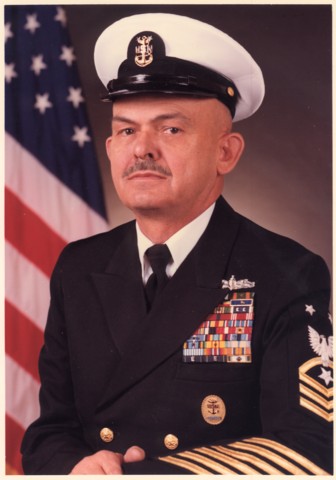
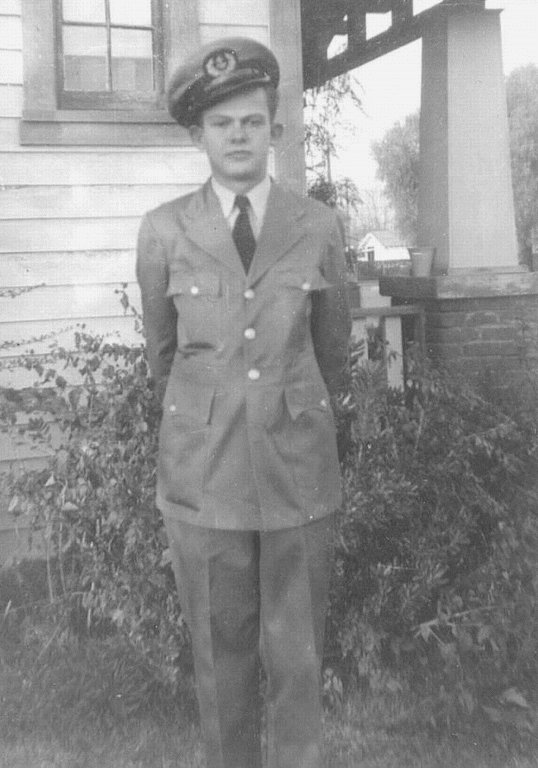
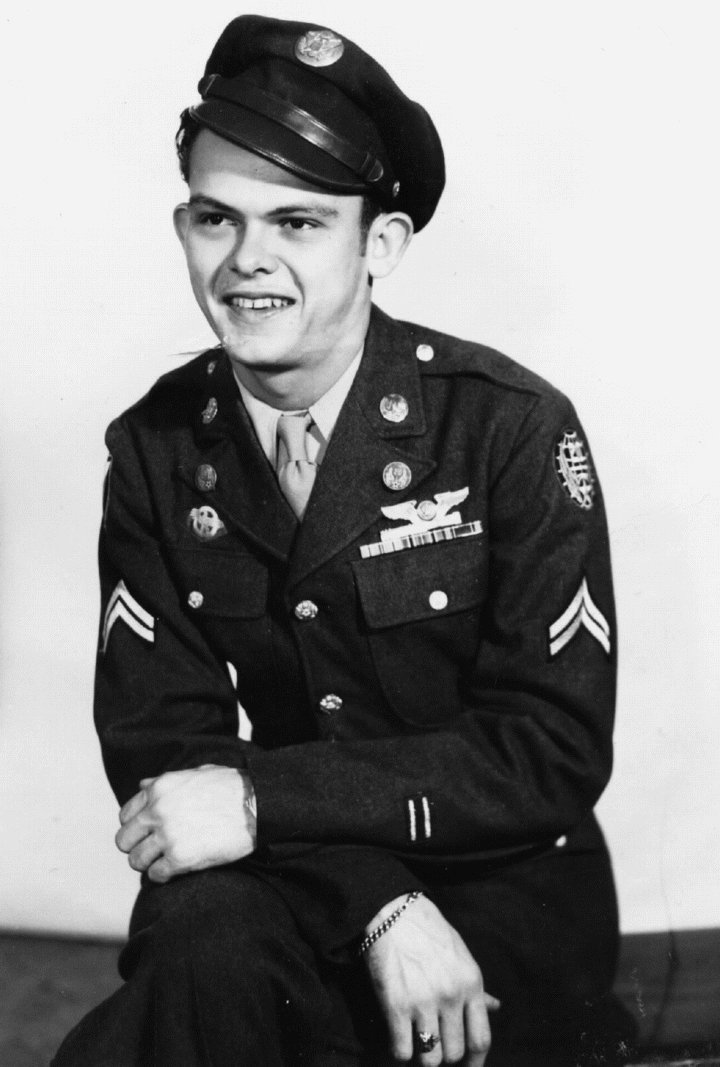
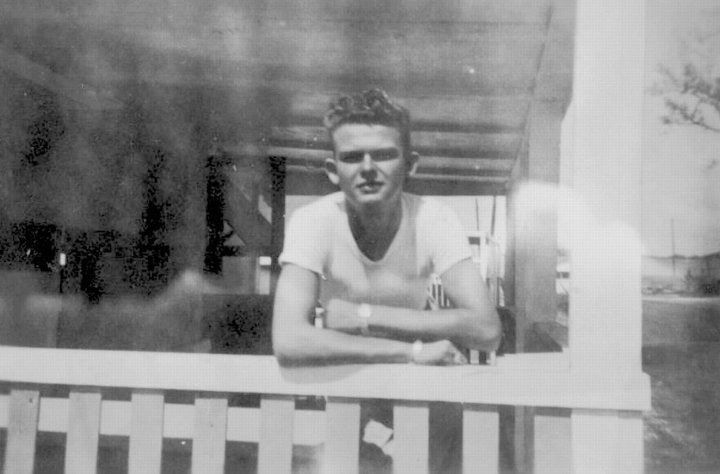
Courtland Rueben "Corky" JohnsonSelma, CA - "We were ragged, filthy dirty, bearded, hungry most of the time, and half frozen all the time. It was just one hell of a mess for the greatest fighting force in the world to be in. All this didn't even take into consideration being shot at most of the time. Several of the fellows spoke about dying from time to time, some in a joking way, and many figured we had "met our Waterloo" and were all going to be killed taking this hill we were on. But I never heard anyone say maybe we shouldn't do it or in any way shirk their duty. I felt then, and still feel today, that it was a privilege that if I had to fight, that I could fight alongside men like these." - Corky Johnson
|
||||||||||||||||
Memoir Contents:
Pre-MilitaryMy name is Courtland Rueben Johnson, nicknamed "Corky". I was born on 22 November 1928 in Kingsburg, California, eldest son of Rueben Clarance and Naomie Hildegarde Hanson Johnson. Dad was a World War I veteran and a farmer. My mother did not work outside the home after marriage. I have one brother, Mark, who is eleven years younger than me. He is a retired fireman.
I went to grade and high school in Kingsburg, but I left school in 1944 as a junior in high school to go to sea in the merchant marine. I was in the Class of 1946. When I returned, I took a test at my old high school in 1952, and received my regular diploma. I am considered a graduate with the Class of 1946 and attend their reunions, etc. I worked from the time I was eight years old doing something--farm work, paper route, selling Liberty and Saturday Evening Post magazines, and working in a winery. I had a window-washing and sweeping-out-stores route in town. My first after school and Saturday job was in a local grocery store. I received $18 a week. I also worked in a gas station. I was not too unusual. I lived in a small town which then had a population of about 1500. It was the Great Depression, and most kids my age worked wherever and whenever they could. We collected metal, old tires, etc. in what were called "scrap drives" during World War II. We kept pretty busy. I was also a Boy Scout and my troop collected scrap metal, paper, etc. for the war effort. Many Japanese lived around my area, and almost immediately after Pearl Harbor they were all shipped out to camps. Perhaps it was not right as we think now, but you had to live then and experience what was going on to understand it. One thing I thought was bad was that some element in as small a town as we were burned down the Buddhist Church/School, a couple houses belonging to Japanese, and a warehouse where they had a lot of furniture stored. It was a bad thing, but again, folks were mad--and they were scared. For months we thought we would be invaded by the enemy. In fact, their subs did shell Santa Barbara and a couple of other towns along the coast, which didn't help the situation any. I was in the latter half of World War II. I was too young to enlist, so a couple of friends and I went to San Francisco and Richmond, California, and though we were under age, we managed to ship out in the merchant marine. I shipped in a Standard Oil tanker built in, I believe, 1915. It was the SS J.A. Moffat, which carried high octane airplane fuel on a northern run to Alaska and the Aleutians. We really didn't realize what a dangerous job it was in those tankers. We were just kids looking for adventure, and we didn't want a whole war to pass us by! Army Air Corps/Marine Corps ReserveArmy Air CorpsJust before Christmas 1945, I signed off the ship for the last time and went home. I was a little upset because I had missed all the VJ-Day celebrations. I bummed around a while with some of my buddies who had just gotten out of the service, then in March 1946, I decided I would enlist in the Army. On 6 March 1946, I enlisted in the Regular Army, and was assigned to the Army Air Corps.
I did my basic training at Kelly Field, Texas, just outside of San Antonio. Air Corps basic didn't impress me that much, I guess because we weren't being taught to stick an enemy in the guts with a bayonet. The best I can do is put down what I recall, which after all these years is a little hazy. I did get into some trouble, and that is pretty vivid in my mind. I was 17 and had a lot of growing up to do. I don't believe that I really did that until I got in the Marine Corps. We arrived at Kelly Field by bus in the middle of the night. As I recall, the first day was spent just getting acclimated to our new surroundings and being assigned to a barracks. The next few days were spent getting haircuts, getting our uniforms, weapons, etc. The personal weapon in the Air Corps was a .30 carbine. The Senior DI was what in those days had the rank of a "flight officer," which was the lowest ranking Warrant Officer--kind of an oddball rank that didn't last too long. Our Junior DI was a buck sergeant. Both were veterans of World War II, but I don't remember their names. Basic was eleven weeks. We did a lot of close order drill, and most of the classroom training pertained to Army history, customs, traditions, etc. We also trained and hiked in the field, spent a certain amount of time on the rifle range--just the normal stuff to turn us from a civilian into a soldier. I recall thinking that the training wasn't too tough. Reveille every morning at 0500. Taps at 2200. We were called "squadrons." I was in Squadron SB-7. We were in a segregated military at that time. No whites and blacks served together which, being from California, was a little strange to me. We were in two-story regular World War II barracks, one squadron to a barracks. The barracks had to be kept clean at all times and each Thursday we had an all hands "field day" when everything was really scrubbed down and cleaned. We were very regimented. Chow was pretty good for those days as I remember, but nothing to write home about. I really don't remember that much about it, so it must have been adequate, although different from today's galley cuisine. We had very little free time, and what we had was mostly in the evening unless the DIs thought up something for us to do. Most guys went to church on Sunday. If someone never attended, the DI might have a chat with him, but I don't recall anyone being forced to go. I went nearly every Sunday. I don't recall being awakened in the middle of the night. In those days a DI could use corporal punishment if he desired, but I never saw much of it. We might get a kick in the butt or our helmet slapped off our head, things of that nature, but there was nothing that would injure anyone that I ever saw. I remember that I was personally disciplined. One day we were in the chow line at parade rest. I moved and the DI happened to be right behind me. I was called out of formation, taken to the barracks, made to don a full field marching pack, given my rifle, and told to make six laps around the company block with my rifle at high port (held over my head). A block in those old camps was about like three city blocks, so I was pretty worn out when I finished. I just lay down on the grass and "forgot" about chow. And I never moved in formation again! Others were disciplined, too. We had a kind of mini race riot one day, and as our barracks was right across the street from the "colored" area, we had front row seats. Many blacks had broken into mess halls, stolen knives, etc., and they came down the company street yelling and raising hell. About that time a jeep pulled up with a Colonel standing up in it with a bull horn. He gave them two minutes to disperse. There was a .30 machine gun mounted on the jeep with a gunner manning it, and when those boys didn't disperse, he opened fire over their heads. They dispersed. The whole street was littered with knives, baseball bats, sticks, boards, etc. I never did learn what caused the trouble, but from then on they marched those boys night and day. Each group had a white officer and sergeant. They marched until they were too worn out to riot. There were race problems at a lot of bases then, which, of course, finally led to desegregation. But it came slowly, and I did not serve with a black until 1951. There were the occasional troublemakers. In those days thievery was one of the worst offenses. For example, we could be taking a shower and leave our wallet or any other valuables on our bunk and they would not be bothered. One day I came back from the shower and my class ring was missing from the other items on my bunk. One of the guys pointed out the guy who took it, a young "tough" from New York City. I went over to him and asked for the ring back, and he denied taking it. This went back and forth for a few minutes, and finally he said that he had it in his pocket and if I wanted it to try and take it. I didn't want a big bru-ha-ha in the barracks, so I turned to leave. But something came over me, and I got mad. In the corner by me were several bunk separators, which were kind of like a pipe, only lighter. I picked one up, turned around, and cracked this guy on the side of the head with it. He went out--was out cold--and I retrieved my ring. He later apologized and I, at least, had no more trouble with him.
There was also a treatment for anyone who did not shower every day, although I never saw it happen in our barracks. Several guys would take the offender in the shower and "dry-scrub" him with a rough laundry brush. I'm told it was a sure cure. I don't recall anyone from my squadron not finishing basic training. When I completed it, I was sent to Camp Kearns, Utah, for a month of advanced training, then to Camp Stoneman, California, to be outfitted for transfer overseas. I had orders to Guam, Marianas Islands. I left Camp Stoneman down the Sacramento River for San Francisco. I rode the riverboat SS Delta King, which the Navy had taken over. She is now a riverboat for tourists on the Mississippi River. I left San Francisco, arriving in Guam in July 1946. My first assignment was guarding Japanese prisoners of war. Guam had many POWs awaiting shipment back to Japan. Then I was assigned to the 621st Air Material Squadron, made Corporal, and was assigned as Company Clerk. (Pretty tame for someone looking for adventure!) When my tour of duty overseas was over, I arrived back in the States in September 1947, and was assigned to Camp Beale, California (now Beale Air Force Base), and until I received my honorable discharge on 30 September 1947, I was assigned to guard German POWs. Marine Corps ReserveWhen I returned home from the Army, I went to work for Safeway Stores, where I met my future wife. Loretta Faye Woods and I were married on 30 May 1948. On 8 November 1948, I enlisted in the U.S. Marine Corps Reserves, B Company, 12th Infantry Battalion, Fresno, California. I enlisted with the rank of corporal. I enlisted because several of my friends and one of my brothers-in-law did. I also enlisted in the Corps because of a desire to serve my country. In those days patriotism seemed to be high on our list, especially among those I associated with.
In 1949, I bought a gas station in the town of Lost Hills, California, and thought we were settling down. Our only child, a son named Gregory Kent Johnson, was born on 1 July 1949. I drove about 100 miles round trip to Fresno to attend drills, and attended each summer training period for two weeks at Camp Pendleton, California. I was in summer camp when I heard the news about the outbreak of war in Korea. As I recall, we all thought it was just a matter of time, and probably not much time, before we would be called back to active military duty. The reaction of most of us was the same--a little surprised at another war so soon. But most of us had joined the Reserves to serve our country, and now the country needed us, so we were prepared to go, and did so enthusiastically--the entire company, as I recall. The only exception was our First Sergeant, whose wife was crippled and in a wheel chair. He was all she had to care for her. My wife was not happy to see me off to war, of course, but she soon became resigned to it. My wife has always supported me in my long and varied career, and this was no exception, albeit she was very young and with a small child, so it was not easy. Money was going to be scarce, as a married Corporal in those days did not make much. Then to make matters worse, my allotment to her became lost for two or three months. I finally had to make out a new one after I arrived in Korea, as I didn't find out about it until then. I was recalled to active duty on 22 July 1950. We were given ten days to get our affairs in order. My brother-in-law and my wife and I got it done somehow. Faye and Greg went to Fresno, California, where they stayed with her mother until I returned. We had little time to prepare for a separation, we just did it. In those days if your country needed you, you asked very few questions and just did as ordered, which is one reason we were Reservists in the first place. The Corps was hard-pressed in those days right after World War II, and there was no money allotted to send many Reserves to boot camp. Those who had never been in the military were sent, but those of us who were veterans were not, so I never went through Marine Corps boot camp. That has always been a regret. However, I believe I had just as great a feeling for the Corps and my brother Marines as those who did, and the leadership and other traits I learned in the Corps have stayed with me all through my long military career. Even though in one sense I feel I missed something important, on the other hand I got along just fine and learned what it meant to be a Marine with no problem--and I will be one until I die! Even though I was called back to active duty much sooner than I expected, I never regretted joining the Marine Corps. We had as much advanced infantry training as they could cram into us at Tent Camp #2 at Camp Pendleton. We stayed in the hills most of the time, training. As I recall, we had one overnight liberty, and my wife, son, and folks came to visit me. I was assigned to Company A, 1st Battalion, 1st Marine Regiment, 1st Marine Division (FMF) as a .30 caliber assistant machine gunner, attached later to the 2nd Rifle Platoon. I left the states from the point of embarkation, San Diego, California, on 16 August 1950, onboard the USS Noble (APA-218). I held the rank of corporal. First MarinesBefore I get on with the Noble and the trip to Korea, I'd like to talk a little about our outfit and our leadership. In my opinion it was quite unique, and perhaps the readers of this memoir will understand a little better why I am so proud to have been a member of this fine Marine Regiment, and especially our company. Our Regimental Commander (1st Marines) was Colonel (later Lieutenant General) Lewis Burwell "Chesty" Puller, USMC. He was a real legend in the Corps, and its most decorated officer with four Navy crosses to his credit. He was soon to earn a fifth, and the Army Distinguished Service Cross, both second only to the Medal of Honor. I had heard of him (no Marine had not), but I had never seen him. The first time I did see him, he was standing in the enlisted chow line at Tent Camp Two at Camp Pendleton. He ate with us quite often, which is probably why our chow was pretty good! I can say I was not disappointed. He was the absolute model of the tough, no nonsense Marine warrior. Our Battalion Commander (1st Battalion) was Lieutenant Colonel Jack Hawkins, USMC. He was another decorated World War II officer who had been a Jap POW. He was taken prisoner early in the war when the Philippines fell. He was also one of a very few to escape from a Jap POW camp. After surviving the Bataan Death March, then a 1st Lieutenant, he was imprisoned at the Davao POW Camp on Luzon. On Sunday, 4 April 1943, he and nine other Americans made a daring escape, even in their weakened condition. They joined up with two Filipino ex-convicts who served as their guides, and after 35 days in the jungle, joined up with a band of guerillas under the command of US Army Lieutenant Colonel Ernest McLish. These were men who had never surrendered to the Japanese when the Philippines fell, and had been fighting as a unit in the jungle, harassing and killing Japs. After nine months fighting as a guerilla, Hawkins and the others who escaped with him were transported to Australia on the US submarine USS Bowfin (SS-287). The other escapees were 2nd Lieutenant Samuel C. Grashio, US Army Air Corps, a pursuit pilot; Captain William Dyess, US Army; Commander Melvin McCoy, US Navy; Lieutenant Colonel S.M. Mellnick, US Army; Captain A.C. Shofner, USMC; 1st Lieutenant Michael Dobervich, USMC; 1st Lieutenant L.A. Bolens, US Army Air Corps (pursuit pilot); Master Sergeant Paul Marshall, US Army; and Master Sergeant R.B. Spielman, US Army. LTC Hawkins was the recipient of a Navy Cross and the Silver Star medal. Our Company Commander was Captain Robert H. Barrow, USMC. Born and raised in Louisiana, he was commissioned a 2nd Lieutenant of Marines in May 1943. During the latter part of World War II, he had served with a Chinese guerilla force which operated extensively in Japanese enemy-occupied territory in Central China. After the war he had remained in China for another year. For his service while our Company Commander in Korea, he was awarded the Navy Cross, Army Distinguished Service Cross, and the Silver Star Medal. He went on to a most distinguished 40-year Marine Corps career. In Vietnam, as Commander of the 9th Marines, he participated in numerous combat actions in the vicinity of the DMZ, Khe Sanh, and the Au Shau Valley. On 1 July 1979, while serving as Assistant Commandant of the Marine Corps, he was appointed its 27th Commandant. He retired from active duty on 1 July 1983. We stayed in contact over the years, and remain friends and shipmates. Most of our junior officers, staff NCOs, and our Sergeants and Corporals were also veterans of World War II. These then were the caliber of warriors that fate and the luck of the draw had caused me to cast my lot with for one of the biggest adventures of my life. We were truly to become a "Band of Brothers," forged in the fire of combat. I could not have possibly wished for a better outfit to serve with. Our officers and NCOs led--not only by example, but out in front. One never had to look for the Skipper. His six foot, three inch frame could always be seen in front of his troops, usually moving fast! We used to feel sorry for his radio operator, Bob Fore, who is about five foot, six inches, and who had to move fast to keep up with the Skipper's giant strides. Also, the Skipper's Marines and our welfare always came first. I truly believe that one reason I am alive today is due not only to his brilliant military strategy and expertise in battle, but also the all-around fighting ability and leadership in Able Company. Training with, serving with, and fighting alongside these men was a rare privilege in my life. In Tent Camp #2 at Camp Pendleton, we were quartered in Quonset huts. They were better than tents, but quite sparse, especially by today's standards. We didn't spend enough time there to be comfortable or uncomfortable, though. We were either going for "long walks" in the surrounding hills, conducting other infantry training, cleaning our weapons and other gear, or sleeping. We had a rather short, but extremely vigorous training schedule. It was hard and tough, and the days were long, but they were in a hurry to get us to Korea to assist our mates in the 1st Marine Brigade who were already in combat. Also, this tough training undoubtedly saved many lives later on. Inchon InvasionWhen our limited period of rugged training was over, we were about as ready as we were going to be to go to war, and in a hurry to get going. The war news had not been good. The North Koreans were making a serious effort to push our troops right off the southern end of Korea. Our help was badly needed. We received orders to board the Noble at San Diego on 8 August 1950. The USS Noble was a US Navy troop transport, carrying only Marines. I did not get seasick, and as a matter of fact, have never been seasick or airsick. The trip from San Diego to Japan was quite uneventful as sea voyages go. The weather was quite good, and most of our days were spent in additional training as well as rigorous physical training on deck, and firing and maintaining our weapons. What little spare time we had we spent in squaring away our gear, writing letters, and getting to know one another as a unit and as individuals. Many lifetime friendships were begun here. (My best friend became PFC Joe Rosati from New York. Joe stayed in the Corps, retiring as a Gunnery Sergeant. He passed away in 1998.) The "new" 1st Marines had never operated tactically as a regiment, nor had it ever been concentrated in one place as an organization until we hit the beach at Inchon. On 30 August, we docked at Kobe, Japan. There were no troop facilities in our area ashore, therefore, two large Navy transport ships (APs) were designated as barracks ships. This also made a Marine labor pool available for work on the docks. There was no liberty. Time was short, so we worked nearly around the clock. Every hour was needed for the tremendous job of transferring cargo from merchant ships to our assault ships. As a time-saving measure, it was decided to combat-load only our assault elements, allowing the other elements to go as organizational loads. This was considered acceptable in view of the enemy's lack of effective air power and submarine forces. They were two normal wartime elements we felt we would not be troubled by like we were in World War II. Things were moving along at a fast and organized pace. Then serious, unexpected trouble came our way. On 3 September, Typhoon Jane hit Kobe with a vengeance, along with winds up to 74 knots. The ship USS Marine Phoenix (TAP-195), a civilian manned vessel, developed a serious list caused by shifting cargo. Several other ships broke their mooring lines and went adrift, bumping and slamming into some of the other vessels. Some of the docks were under approximately four feet of water. It was just a hell of a mess. Luckily, however, the damage was not as serious as first believed. Amazingly, only 24 hours were lost from our tight reloading schedule. We were required to leave our full sea bags in a warehouse at Kobe, and embark with field marching packs containing only our essential gear. I was not to see my sea bag again for two years! We remained on the USS Noble. We got underway from Kobe on 11 September 1950. The sea was rough and heavy as another typhoon was headed our way from the Marianas. For a while it was feared this oncoming storm would seriously affect our task force, which was under the command of Rear Admiral James H. Doyle, USN. This latest storm was named Typhoon Kezia. Once at sea, we were briefed on our objective and mission. We were to make an amphibious assault at the Port of Inchon, South Korea. We were told that a late afternoon H-Hour was a choice of necessity, and that our assault would probably begin about 1700 hours on 15 September. The reason for this planning was because small islands, reefs, and shoals restricted the approach to the outer harbor, and currents ranging from three to six knots multiplied the chances of confusion. This all meant that daylight landings were to be necessary for all but small groups. We were also told that most of the inner harbor was just a vast swamp at low tide, penetrated only by a single dredged channel 12 to 13 feet deep. The duration of spring tides above the prescribed minimum depth averaged about three hours, and during this period the maximum in troops and supplies had to be put ashore. Literally every minute counted, because initial landing forces (us) could not be reinforced or re-supplied until the next high-water period. Time and tide seemed to have combined forces to protect Inchon from a seaborne foe. It was also why the enemy would not suspect we would strike here, thus it was believed to be lightly defended. It was no wonder General MacArthur was considered a "military genius." But if he had been wrong in his calculations, our entire assault force could have been annihilated. He wasn't wrong, and his remarks after we got ashore were, "Never have the Marines shown so brightly as today." As if such natural obstacles were not enough, the target area provided others. Two islands, Wolmi-do and Swolmi-do, located in commanding positions between the inner and outer harbors, were linked to each other and to Inchon by causeways. It was assumed that rocky, wooded Wolmi-do would be honeycombed with hidden enemy emplacements with enough guns to create a serious menace for our landing craft. This critical terrain feature had to be reduced as a preliminary to the main landing during the high tide of late afternoon. Inchon being situated on a hilly promontory, its beaches were just narrow strips of waterfront which were protected by seawalls too high for ramps to be dropped by our assault boats at any stage of the tide. Wooden ladders had been made in Japan with large iron hooks attached to the tops. These were to be secured from inside the landing craft, hooked over the edge of the seawalls, and we were to climb these ladders out of the boats in making our assault. Not a very encouraging prospect to my mind, as we wouldn't know and couldn't see what or who was going to be there to greet us on the enemy side of the hill. Once past these barriers, we would have about two hours of daylight in which to secure an Oriental city with a population roughly the size of Omaha, Nebraska. Then we were told the amphibious assault was merely the first phase of the operation. After taking Inchon, we had the assigned task of driving about 16 miles further inland, without any loss of momentum, to cross a tidal river, the Han River, to assault Korea's largest city, the capitol, Seoul. All this was not even to be the whole show! A joint operation was to be carried out by the 8th Army forces attacking northward from the Pusan Perimeter, where they had been holed up, to form a junction with the units of the Inchon-Seoul drive. It was believed that this double-barreled assault would shatter North Korean resistance. As a lowly corporal in the ranks, I didn't know yet just where my fellow Marines in Able Company and I would fit into this grand scheme of things. I was soon to find out. On D-Day, 15 September, a maximum high tide of 31 feet was expected about 1919 hours. Evening twilight was to come at 1909 hours. It just kept getting more difficult--now it would be dark. It was estimated initially that 23 feet of water would take the LCVPs and LVTs over the mud flats, but that 29 feet of water was necessary for the beaching of the much larger LSTs loaded with our vehicles and supplies. It was decided that 1700 hours would be the best time for landing our assault craft and the LSTs would be beached about 1900 hours. Our battalion (1st) was to land on Blue Beach-Two southwest of the city urban area, and after driving rapidly inland to consolidate our positions before total nightfall, we were to link up with the 5th Regiment, make a junction the following morning (the 16th), and seize the beachhead while the 17th Republic of Korea (ROK) Regiment (later replaced by the 1st Korean Marine Corps Regiment) mopped up the city. As I recall, a little after 1600 hours we went down the cargo nets slung over the side of the USS Noble with at least 80 pounds of gear on our backs, plus weapons, into the LVT assault craft. Climbing down into those LVTs on that rope netting with the craft pitching and bobbing up and down in the water was no easy task in itself. We were about to receive our baptismal of fire. Our Regiment was in waves 21 through 25, with our battalion to land in Regimental Reserve. Each man carried the following amount of gear:
Our haversacks contained the following personal items:
Our knapsacks contained all articles not carried in the haversack, including a blanket roll (green side out) attached in a half-roll across the top of the knapsack. These were tagged with our name, rank, service number, and unit, and stacked in the berthing compartment on the ship. They were to go ashore at the completion of the general off-loading and be distributed to our various units for pick up later. Luckily I received mine in good order, as did nearly everyone else in the company. Our uniforms and equipment, besides the above, for debarkation were:
Battleships, cruisers and destroyers shelled the beach heavily for several hours before the assault. Our Marine Corsairs made regular bombing and strafing runs on enemy targets ashore. As soon as the landing began, the shelling ceased. From our line of departure to the beach it was about 5,500 yards, or 3.2 miles. Due to a now drizzling, steady rain, currents in the water, and a heavy pall of smoke from the beach, there was quite a bit of confusion among some of the assault craft. They had no compasses and several began landing in the wrong places. Ah...the best laid plans! Had the approach gone smoothly, the LVT I was in would have reached the seawall at about H-plus 45 (1815 hours), but things did not go smoothly. For one thing, a searchlight on the Navy Control Ship was supposed to beam the course to the beach, but it had become so clouded the light was mistakenly pointed toward the outer tidal basin, some 45 degrees off course to the northeast. As our boat arrived, Baker Company had already debarked and a few of the empty boats had left for the channel. Our boat then banged into the seawall, and we quickly began to climb our ladders believing we were at our objective of Blue-Two. We could now hear scattered rifle fire. In the meantime, LTC Hawkins had caught sight of the error from his boat as he passed within sight of the two outlying islands between the basin and a salt evaporator that jutted out from the left of Blue Beach One. He quickly began going up and down the length of the basin shouting instructions to our Navy coxswains. We were quickly ordered back into our boats (we had all not yet disembarked). We re-grouped and headed for the correct landing spot at Blue Two to do the whole thing over again. We were more than just a little upset with our boat coxswains, but as we were to learn later, it really wasn't their fault. They had done their best under those conditions, and felt very badly about it because some of us could have been killed or wounded. One platoon of Baker Company did have to remain on the tidal basin all night because their boats had taken off before the error was noticed. That caused some anxious moments, as there were no boats left to remove them. However, they rejoined us the next morning with a gaggle of North Korean prisoners, so their night had not been a total loss. It was now dark, and still a drilling rain was coming down when we finally came ashore. We moved forward to our night assembly area about a half mile inland alongside some railroad tracks. As we came ashore there was no enemy in sight, so we took no casualties, although we could hear firing in the distance. The Inchon-Seoul highway was now the boundary between us and the 5th Marines. We did have some problems to overcome, however. Our front was much wider and the terrain ahead proved difficult. Our rapid advance had left our units scattered over hell's half acre, and for some time ahead of our supplies. It took valuable time and much shuffling around before the entire regiment could be deployed along this highway for our drive to the east. We were then scattered over 15-square miles. We finally got organized and moved up on the right flank of the 2nd Battalion, but the going was tough through the terrain we were in. We went into the attack at 1600-hours. At first, on our front there was a lot more hiking and climbing up rough, rocky hills than fighting. Our battalion (1st) moved up the line to plug the line between the 2nd and 3rd Battalions. The enemy had retreated, and we attacked the area left by them another two miles uphill beyond our front line before we stopped. We ran into a few pockets of resistance, as the enemy had left a few troops behind. I imagine they did that just to harass us, as we found out they were good at this. It did not take long to find and flush out and kill those few pockets, and we took no casualties. This was the first time we discovered that enemy soldiers put on the traditional white clothing of civilians and either tried to slip past us, or engage us if they thought they could. It rarely worked, as the South Korean civilians pointed them out to us. Finally, we held for the night on some high ground about 2,500 yards south of the 2nd Battalion positions on Hill 186. Our Recon Platoon hooked up with us for the night on our left flank. Our ammunition, food, and water caught up with us, so at approximately 1900 hours on 16 September, the assault phase of the operation was over. This was almost exactly 24 hours after the first wave of Marines landed on Red Beach at Inchon. Our Division Commander, Major General Oliver P. Smith, USMC, also came ashore to assume responsibility for further operations. General Smith was a fine Marine, a fine man, and a damn fine Division Commander. He was a combat veteran of both World Wars. On the morning of 17 September, we continued our attack from Ascom City along the Inchon-Seoul highway. The advance to the village of Mahang-ri had gained us 3,000 yards. A further attack on the highway gave us another 4,800 yards. We were still hill-climbing and moving out on D-plus 2, and fanned out through another tough maze of twisting valleys and ridges. I was beginning to believe there were no downhill areas in Korea. I wasn’t far from wrong. We had only encountered light enemy resistance along the way so far, and gained another 4,000 yards. We built our night defenses along a mountainous two-mile front south of 2nd Battalion positions, again overlooking the Inchon-Seoul highway. We had a quiet night. At one period on the way from Inchon to Seoul, when our supplies hadn't caught up to us, chow got a little scarce, so I ate a canteen cup full of kimchee, a very hot soup-like mixture. Several of us ate some, but as luck would have it, I was the only one who got sick. It lasted a day. We had been warned not to eat any local food, and that's one time I let a little hunger overload my common sense. It nearly cost me my stripes. But the Skipper finally settled for a good chewing-out. At the time I believe I would have rather given him the stripes. Mail was not too regular, at times better than others. I believe most of it came by ship. I received packages from both my mother and my wife. Usually I asked for and received cartons of cigarettes and articles of clothing--usually heavy, cushion sole socks. Destination - Yongdung-poOur next assigned objective was the sprawling Seoul suburb of Yongdung-po. It was a large industrial area for the most part, and it had to be taken before we crossed the Han River to attack Seoul. Interrogation of two captured North Korean officers disclosed that an enemy regiment had been committed to its defenses. It was further learned that the approaches to the city were liberally sown with landmines. We had been scheduled to make our crossing of the Han River on 20 September. It was also learned from these prisoners that a warning had been sounded during a conference of North Korean military leaders in Seoul to the effect that, “If Yongdung-po is lost, Seoul will also fall.” How right they were in that prediction. The enemy considered this industrial suburb so important to their defense of Seoul that a regiment of the North Korean People’s Army Division was assigned to defend it. They made a mistake, however. They had not taken into account the fact that they would be up against Able Company, 1st Marines. Besides that fact, the Reds were stupid in other ways as well. They had also committed considerable and valuable armor and artillery that could have been put to much better use in defense of Seoul proper. Yongdung-po was on low ground at the junction of the Kalchon and Han Rivers, separated by two miles of sand and water. Its only connecting link with Seoul had been a railroad bridge and several highways bridges which had been destroyed in previous fighting. But they were really determined to make a fight of it, and we were going to oblige them. As we sloshed our way through the approaching fields and rice paddies toward our objective, we had no way of knowing what a hell of a fix we would shortly find ourselves in. Our battalion (1st), was deployed over a broad front in the hills and paddies approaching the town. Colonel Puller’s plan was to have us relieved the next morning by the Army's 32nd Infantry. Our 2nd and 3rd Battalions were to attack at 1030 hours, leaving us in our positions to wait for the Army. After being relieved, we boarded trucks for a rugged eleven mile trip to Hills 118, 80 and 85, where we were to relieve the 5th Marines. Due to the terrain, we were forced to dismount at the village of Wonjong-ni, and proceed on foot over a narrow primitive road to our objective. Captain Barrow set a rugged pace for us to follow to our objective, which was Hill 118, before dark. Upon our arrival, Charlie Company also went into position with us for the rest of the night. It was then decided by LTC Hawkins not to occupy Hills 80 and 85. It had been expected that Charlie Company would pass through us to occupy these positions, but that changed. Baker Company dug in on the southern extension of the long ridge we were on. The entire regiment was now deployed in a three-mile arc facing the western part of Yongdung-po. We were still to commence our attack on the town on 20 September. Just before dawn on the 20th, we heard a lot of small arms and automatic weapons fire to the east of us. Daylight told us the enemy was assaulting Hills 80 and 85. They hadn’t got the word that nobody was home. When they finally did find out, they had occupied both positions in company strength. Then they made another blunder in extending their attack on our position on Hill 118. But we, along with Charlie Company and some help from fighter planes of VMF-323, drove them off with very little difficulty. Now we observed a stronger enemy force, about battalion strength, marching smartly out of Yongdung-po toward our 2nd Battalion positions along the Inchon-Seoul highway. There were also five Russian T-34 tanks, a truckload of ammunition, and several other supply trucks moving along among their infantry in the long column--another big mistake. Most of their trucks were camouflaged so they looked like large moving haystacks. What beautiful targets! The 2nd Battalion, assisted by artillery of the 11th Marines, wiped them out. The next morning the highway was full of burned-out NKPA tanks, trucks, and equipment, along with 300 enemy dead. It now fell to Charlie Company to re-take Hills 80 and 85 that the enemy had occupied. Able and Weapons Companies supported their attack from our positions on Hill 118 and witnessed their progress across our battalion front. Charlie Company secured its objectives after some fire-fights, but it was a complete rout of the enemy. Charlie Company lost one of its platoon leaders to enemy fire, however. During the attacks by Charlie Company on Hills 80 and 85, we were forced to watch a terrible scenario, and there was nothing we could do about it. It occurred just short of the bombed-out Kalchon Bridge. The terrain between the Kimpo-Yongdung-po highway and the Han River had not been cleared during the 5th Marines attack on Hills 80 and 85 on 19 September. Charlie Company had also circumvented this area during their attack on the same hills on 20 September. Therefore, unbeknownst to us there were pockets of enemy hiding along the river bank. This was not realized until it was too late to prevent what was about to happen. Down the road from Kimpo came a Marine "weasel" (small tracked vehicle) belonging to the 1st Signal Battalion and carrying a crew of wiremen. They were laying communication wire into our regimental zone. Just short of the bridge the small weasel struck a mine, was disabled, and summarily ambushed by a party of North Korean soldiers who had been hiding in one of those pockets along the river. We were about 1,000 yards away, but were forced to watch helplessly as these Marines were either killed or captured. The Reds then ran into some brush with two Marine prisoners. At about the same time, it was about to happen again. We saw a Marine truck belonging to our engineers coming down the highway containing the driver and three passengers. The Skipper ordered us to fire some rounds in the direction of the truck in hopes the driver or passengers would hear the shots and stop or turn back, but it didn't work. Instead, the truck was stopped by a fusillade of enemy fire. The Marines jumped out of the truck and ran into a rice paddy in an attempt to escape. Three of them made it. The fourth, who we later learned was PFC Clayton O. Edwards, USMC, was hunted down and captured. Although he was out of ammunition and already wounded, one little "heroic" NKPA bastard stepped forward and bayoneted him in the shoulder after he had surrendered. Edwards later escaped from an enemy POW train that was fleeing the UN drive into North Korea. We were later to learn that with the approach of nightfall on 21 September, there had been considerable worry and apprehension back at our regimental Command Post (CP) over the fate of a 1st Marine rifle company, namely us, Able Company. We were soon to find out why. We had moved out from below Hill 80 that morning. Captain Barrow had employed a classic "approach-march" formation. Forward, and to the left was 2nd Lieutenant John J. Sword's 3rd Platoon. On the right was my platoon, the 2nd, commanded by 2nd Lieutenant Donald R. Jones. The left rear position was taken by 1st Lieutenant William A. McClelland's 1st Platoon, which had the dual mission of company reserve and flank guard. In the right rear were our 60mm mortars, a section of heavy .50 caliber machine guns of Weapons Company, and our Assault Squad. A light .30 caliber machine gun section was attached to each rifle platoon to be quickly deployed to the front and flanks as needed. My machine gun section was attached to the 2nd Platoon. We had a large flat expanse of ground to cover, composed of grain fields and then rice paddies. It was pretty much in the open, which worried us considerably, but it had to be crossed. The Skipper was up front as usual, between the two assault platoons. We could hear small-arms fire off in the distance on both flanks. Marine Corsairs were diving to the attack in the distance, and their ordnance could be heard hitting their targets as well as some mortar and artillery fire. We swept through this area surprisingly fast against no enemy opposition. We were getting pretty tired of this, wishing the enemy would stand and fight for a change. We surely expected enemy fire when we left the partial concealment of the fields, wading into the stream about waist high, leaving us exposed to the wide bank and the parallel dike in the distance. Still no enemy fire was encountered. Coming out of the waist-deep water, we cut our way through a wire fence, came out dripping mud and water, and charged over the dike. We couldn't believe there was still no sign of the enemy and no resistance. We remained in formation and marched defiantly into the outskirts of Yongdung-po. About 100 yards from the levee we began to encounter the first buildings in the town. We then channeled our advance astride the main east-west street. We were able to keep open ranks with good observation all around. By noon we were several hundred yards into the town. It was as still as death--eerie--like walking through a ghost town. We had seen none of the town's inhabitants or the enemy. We searched several of the buildings, even on some of the side streets. Still nothing. By this time the Skipper suspected we were well ahead of both Baker and Charlie Companies and the rest of the battalion. He radioed for instructions and was told to keep advancing. About that time our 1st Platoon spotted an enemy column marching down the highway in the direction of the 2nd Battalion's front. They were in formation and singing--loudly! Our 3rd Platoon opened up on them and cut their formation to ribbons. Then my platoon (2nd) and 1st Platoon saw individual enemy soldiers in small groups to the east of us. I don't know why they had not been anywhere to be seen before, but there they were, going about their normal routine, not realizing that Able Company was about to screw up their day. We took them completely by surprise and as our withering fire continued, those that were left scattered in all directions. Our 3rd Platoon tore through the town, then popped out into the open, confronting a dike topped by a road. They went into a defensive position atop this dike. To the north they spotted a large group of the enemy withdrawing from what we thought was Baker Company's area onto a sand spit down by the water. Our light machine guns took them under fire immediately and we were soon joined in the "turkey-shoot" by our section of heavies (.50 machineguns). The enemy was again caught completely by surprise, in the open, and suffered heavy casualties before what was left of them could take off and disappear. Both the 1st and 2nd Platoons then moved to the right of the 3rd Platoon on the dike and the junction of the Inchon-Seoul Highway. At this point we discovered that if we could hold our ground, we could deal the Yongdung-po enemy garrison a mortal blow because that road junction was their main supply center. Just across the road we saw what we thought was a large pile of wood or coal. We discovered it was a large camouflaged stack of ammunition. Shortly thereafter during one of our fire-fights, a small group of enemy soldiers took refuse behind that pile of ammunition and high explosives--a real dumb move. Sgt. Harry Spies set off the entire dump with a well-aimed rifle grenade. The tremendous explosion and large cloud of smoke and dust certainly marked our isolated position for the rest of the battalion. While inspecting and clearing the area around the intersection, we found a building containing a brewery. We confiscated some of the beer left behind. Some was in large bottles, and some in wooden kegs. Some turned out to be fair, but most of it was green. We were able to have a bottle or two each for a small celebration, but we didn't over-do it. The Skipper made sure of that. We also came across a larger, four or five-story building. Upon closer inspection, we were surprised to find it was nearly full of U.S. Army medical supplies, field equipment, and some ammunition and other ordnance. We took some small-arms ammunition and our Corpsman gathered some medical supplies. Throughout the remainder of the day, the enemy made several serious attempts to dislodge us and regain their lost territory by throwing small scale banzai-type assault parties against us from the south or river side of our positions. We repulsed each attack, giving better than we received. By nightfall we were firmly dug in on the dike. We soon discovered that we had two immediate problems. A weak battery in the SCR-300 radio cut off any further contact with our battalion CP, and we were running dangerously low on ammunition. We hoped what ammo we had and what we could use from that warehouse would last through the night or until we could be re-supplied. Our .30 machinegun section was very low. We found several cases of loose .30 ammunition in the warehouse, and belted as many belts of ammo as we could by hand for the guns. Captain Barrow's tactical disposition on that night and morning of 21-22 September was a unique precedent, but the Skipper was a unique officer. He chose to defend a 100-yard stretch of the levee just north of the main highway intersection. It was there that the oiled road ran about 25-feet above ground level and the incline on either side sloped. We dug our foxholes close together, five or six feet apart, and staggered them, some high on the slope, others lower. Our machineguns and Browning Automatic Rifles (BARs) were placed along the shoulders at the top so automatic fire could be heavily directed in any direction. We were completely out of mortar ammunition by that time, so our .60mm mortar crews became regular infantry. Our perimeter was in the shape of a long sausage. The 3rd Platoon was in the arc at the northern end, the 1st defending the west side, and mine, the 2nd, on the east side. From our foxholes we commanded the sand spit, a tall reed-covered area along the river, the road on the dike, the city's eastern exits, and that all-important intersection. The enemy were going to have to be ghosts to be anywhere we couldn't see them. The soil was pretty sandy, but we dug our holes deep anyway. Mine was almost a "spider" anti-tank hole, as were most. We figured there may still be some enemy tanks in the area and we didn't want any surprises. As it turned out, it was good thinking. Just about dusk I was down in my hole having a smoke and heating some coffee when I heard that old familiar rattling, clanking, engine-revving sound in the distance. There is no other sound in the world quite like it. Soon we saw five un-escorted Russian T-34 tanks coming down the Inchon-Seoul highway. They were heading right toward our precious intersection. We got down low in our holes. I didn't know how good I stood with the Lord, but I did a little praying. Tanks worried me. Suddenly, the entire enemy tank column cut loose with a hail of machinegun fire along with salvos of .85mm cannon shells at a range of 30 yards or less. We could have reached up and touched the bastards. Our rocket launcher (bazooka) gunners had very little experience with their 3.5 inch launchers. In fact, they had been restricted to a few practice rounds up until now. We all crossed our fingers, but there was no need. They jumped out of their holes and fired. One round hit the lead tank, probably right in the under-seam of its 85mm turret--a hell of a shot in anybody's book! The tank exploded in a cloud of flame and smoke just a few yards from me. I could feel the heat. Its turret was twisted and ripped from the main body of the tank. The other four tanks continued to the end of our perimeter, reversed course, and made another run at us, all the while pumping a steady stream of shells and machinegun fire into the western slope of the dike. Then, reaching their starting point at the Inchon-Seoul highway, they turned back to make still another round trip. They were determined. This time our rocket fire damaged two more, shooting the track off one and making a minor hit on the other. They had had enough of us and limped off the field. But there were still two left, and they again reversed course to make another pass at us--their fifth. They didn't know it, but we had run out of rocket ammunition. We continued firing at them with small arms. Suddenly, they cleared the perimeter and clanked off into the town and disappeared. Incredibly, we only sustained one casualty, a concussion case, during that entire 30 minutes of sustained heavy caliber shells, plus machine guns pounding us at pistol range. The tremendous muzzle velocity of their 85mm guns at close range had embedded those armor-piercing shells deep into the slope of the sandy dike in that split-second before each explosion, thus saving a lot of our lives. Also, our foresight in digging those deep holes had protected us against the heavy enemy machinegun fire. All things considered, maybe I had stood in pretty good stead with the Lord after all. Between 1900 and 2100 hours, it was relatively quiet along our front, although we maintained the "one man awake/one man asleep" normal two-hour watch cycles. The 3rd Platoon killed a few enemy soldiers who attempted to remove some stores from their old warehouse. Shortly before 2100 hours, the Skipper took a report over the sound-powered phone. The 3rd Platoon reported they could hear what sounded like a large enemy force approaching their front. Sure enough, the enemy counter-attack commenced just past 2100 hours. The 3rd Platoon commander, 2nd Lieutenant Swords, remained on the phone relaying the fire-fight that followed to the Skipper. The situation was well in hand and our 3rd Platoon did a fine piece of work that night. After a 15-minute period of total failure to penetrate 3rd Platoon's line, the enemy withdrew. They hit again in exactly the same spot about a half hour later, but again were quickly driven off. Then another attack came--again at the same spot, this time with an accompanying light show of multi-colored flares, loud cries of "banzai," and a sword-wielding officer leading the attack. Each attack seemed to be in about company strength. Earlier in the afternoon we had built a small POW compound where we were holding 17 prisoners captured earlier in the day. This compound was just east of the dike. Just before the final attack on 3rd Platoon, a captured NKPA officer escaped from our POW compound and high-tailed it north into the darkness, shouting as he ran, "Don't attack any more, they're too strong for you!" Apparently they took his advice. He didn't make good his escape either. Two Marines grabbed him as he ran past their foxhole and put some knots on his head, but his effort to warn his mates was appreciated none the less as we were nearly out of ammunition, and not as many as he thought we were. There continued to be scattered firing the rest of the night, but it finally faded out. We had denied the enemy access to their vital supply dump and the intersection, and they finally just gave it up. At dawn, we counted 275 dead North Koreans and approximately 50 automatic weapons scattered around our perimeter, most in front of the 3rd Platoon positions. The four Russian T-34 tanks which had withdrawn into the town the day before were found abandoned. The rest of the battalion attacked at 0800 hours, coming up against little opposition, and linked up with us. It was then I believe we found out we had taken and secured Yongdung-po by ourselves. At the outset it was to have been a battalion operation. However, both Baker and Charlie Companies had run into some fire-fights of their own before they could reach our positions. Having no radio contact with battalion, we were not aware of any of their circumstances. Now, at 0800 hours, the enemy was gone except for hundreds of their dead we left behind scattered throughout the city and along the river bank. The enemy had also left behind large quantities of their heavy artillery, equipment, and other supplies--and, of course, lost their defense of Yongdung-po. They would not forget Able Company. We lost a good man there, however. He was a big Sergeant named Osterberg. He was from Oregon, where he had worked as a lumberjack. He was also a Marine veteran of World War II, having served with Marine artillery. I mentioned the enemy left behind some of their artillery. The Skipper asked Osterberg if he would go over and check out an artillery piece to see what kind of shape it was in, just in case we might need to use it. As he was doing this, a loud report of a shot rang out, and by the sound we knew it was not a rifle. From the second story of a nearby building, an enemy sniper had hit Osterberg with an anti-tank rifle. It went in his back and left a large nasty hole in his chest where the round had exited. He was killed instantly. Sgt. Harry Spies and he were good friends, so Spies headed for the building. We heard a shot, then the gook came flying out of the second story window. Osterberg had been partially avenged. Battle for SeoulWe re-grouped, re-supplied, and continued our advance on 22 September. Moving eastward, we spent the remainder of that day reorganizing and on patrol. On 23 September, we proceeded with very little enemy resistance to the banks of the Han River and seized Hill 109. This hill dominated the several bombed-out and broken-down bridges that had spanned the river. Later that night, Colonel Fuller received orders to have the regiment effect our part of the river crossing early the following morning, 24 September. It should be noted here that two new North Korean People's Army units had much to do with the sudden stiffening of resistance by the enemy. One was the 78th Independent Regiment, commanded by a Colonel Pak Han Lin, NKPA. This regiment, numbering about 2,000 recruits in July 1950, was organized into three battalions of infantry supported by medical, motorcycle, weapons, reconnaissance, mortar and 75mm gun companies, plus an engineer platoon. Another recent arrival that won our respect, but not our admiration, was the 25th Brigade. It consisted of some 5,000 troops under the command of Major General Wol Ki Chan, NKPA. General Chan had received his military education in the Soviet Union in 1947. His brigade was made up of four heavy weapons battalions, an infantry battalion, an engineer battalion, a 120mm mortar battalion, a heavy artillery battalion, and a brigade artillery battalion. It was to be a "fight to the death" for both these enemy outfits. They were committed to that end. They got their wish, as they were nearly completely annihilated during the Battle for Seoul. But while they lasted, the 78th Regiment and the 25th Brigade gave us a very bad time. They put up a determined, desperate fight in Seoul as well as in the hill country surrounding it, which was well adapted to their defensive positions. Our objective after we crossed the Han River was Hill 79. It was about 4,000 yards from our crossing site. The 2nd Battalion crossed first, advancing toward that objective and moving into a position on the north bank next to the 5th Marines on a 1,500-yard front. Our battalion (1st) and Regimental Headquarters were next to cross. We were to have had tank support as Baker Company, 1st Tank Battalion had been sent around by the Haengju Ferry and was to join us just north of the river. However, this never happened because the tankers ran into a fight and were delayed. We did have artillery and 4.2 inch mortar support, however. I made the crossing in a DUKUW (Duck). This was an amphibious vehicle that could operate on land or in water like a boat. Once across we were to drive east along the river, passing through the 3rd Battalion, so we had to move fast once again. Almost as soon as we got across we began taking small-arms and automatic weapons fire from Hill 105-S. That objective was supposed to have been cleared by elements of the 5th Marines. However, as they often did, the enemy had apparently slipped back into some of their old positions and were now behind our lines firing at us. In this area the regiment suffered four casualties, and I was very nearly the fifth! However, luck was still riding on my shoulder. I was running across an open field or paddy in zigzag fashion, bent over, when some NKPA zeroed in on me with some kind of automatic weapon. It gave me a real incentive to move faster and clear that open area. The rounds were hitting all around me, and were so close they were kicking mud up on my trouser legs. Later I found one had gone through my pants leg, but hadn't touched me. All of a sudden, I was hit. It knocked me down. As I lay there, I remembered hearing somewhere that you go into shock when you're hit and you don't feel any pain right away. I felt none. There was a small ditch or rise five to ten yards ahead of me, so I crawled behind it and hugged the deck. I still felt no pain, but I felt a wetness on my upper right leg. I felt around back there, and it was really wet. My first thought was, "Oh Hell. I've been shot in the butt!" I was still being fired at sporadically. I brought my hand back around very slowly to look at it, and there was no blood. That gook had shot one of my canteens. Instant relief. Finally the firing stopped, but I continued to lay behind that levee for what seemed like an awful long time, though it was just a few minutes. Finally, I very cautiously stuck my head up a few times and when nothing happened, I jumped up and took off again. Later I found I also had two or three bullet holes in my haversack, which evidently had been protruding above that ditch bank. They had ruined a good dungaree jacket, a sweater, and part of a carton of cigarettes, but I didn't have a scratch.
After I jumped up and took off, I discovered I was all alone. No one was in sight. After crossing the rest of that field, I found the rest of the company under one of the bridge embankments. We moved out again toward our objective once everyone was there. We found and secured our part of our objective on Hill 79 at about 1500 hours. A couple of the guys climbed to the peak of the roof on one of the houses and raised an American flag. (A picture of this appeared in the 9 October 1950 issue of LIFE magazine.) We then set our perimeter defenses. Our position was in the southwest part of Seoul and commanded an excellent view of both the railroad station and the city's industrial area. We received a few minor probing attacks from enemy patrols, but our artillery and mortars soon took care of these small irritants. What little sleep some of my fellow Marines and I got that night, at least we got under cover when not on watch. Several of us moved into a rather large two-story house that had been evacuated for the time being by its owners. It was the first time we had had a roof over our heads since leaving the USS Noble. I got hold of a mirror and took a look at myself. Quite a shock! Not only was I pretty ragged, I was filthy dirty and needed a shave and a bath, but then we all looked that way. We were soon able to get some water and clean up some. I saw my teeth had turned nearly black. In order to save my cigarettes, I had been chewing PX ration Beechnut chewing tobacco, which apparently had caused it. Some vigorous rubbing with salt for a few days took care of the problem.
We moved out again the following morning, advancing 2,000 yards that day before linking up with our 3rd Battalion for the night in a defensive position on Hill 82. Early on the morning of 26 September, we started to descend from our position. Our objective was to clear the main Seoul Railroad Station as well as the adjoining slopes of "South Mountain." Increasing enemy activity had been reported below the positions of the Army's 32nd Infantry in that area. This turned out to be a dirty, dangerous, frustrating fight for every inch of ground gained. Progress was slow, but steady. This was to be called "The Battle of the Barricades." Every 200 to 300 yards, fanatical enemy detachments manned rice-bag barricades approximately eight feet high and five feet thick. These barricades covered the entire width of the streets in many places, and also contained anti-tank guns. Our tanks took care of many of these enemy positions. The Reds were also firing at us with rifles and sub machine guns from the side streets, windows, and roof tops, but we finally pounded our way through the barricades and these enemy suicide squads. By mid-morning we had penetrated a residential area in our assigned district. So far our casualties had been amazingly light. Captain Barrow, however, did not grow over-confident. In fact, quite the contrary. He seemed to become more wary and cautious. He sent patrols out through back yards, over garden walls, and through buildings and houses. For now we cautiously avoided the more well-traveled approaches to the railroad station, searching and watching. Another concern was our tank support, or rather the lack of it. Again, our tanks had been delayed somewhere. We found ourselves on a sort of saddleback ridge that traversed the western edge of the city. We were in amongst well-built stucco and tile-roofed houses in an apparently wealthier section of the city. Almost directly to our front was the railroad freight yards, the main railroad station, and beyond that down a slope was another residential area. Although we didn't realize it at the time, the lives of many Marines and quite possibly the fate of the entire campaign for Seoul was in Captain Barrow's hands for the next hour. The Skipper called forward every sniper, artillery observer, and air liaison coordinator attached to Able Company. They were all thoroughly briefed and then dispersed where they could scan various parts of the terrain ahead of us. Absolutely nothing seemed to be moving in our sector that we could see. Captain Barrow had been ordered to move up. He was about ready to order us forward when his radio operator, Bob Fore, yelled, "Gooks!" He had been watching three buildings across from the railroad station. The entrances were sandbagged, and he spotted some North Koreans in the shadows of one of the doorways. The Skipper got on the radio and told Headquarters he was not sending us forward until an air strike was made on those buildings. That group of buildings turned out to be the main headquarters of the North Korean People's Army in Seoul. Our Air Coordinator quickly called in a flight of Marine Corsairs. They came in over the residential area, sending their bombs and rockets screaming into the building complex. Next, the Skipper called for a pin-point heavy mortar barrage. Then the Corsairs came in for a second run, this time dropping tanks of napalm. Huge fireballs and explosions ripped through those buildings. Then, in utter astonishment, we saw first dozens, then hundreds, then literally thousands of enemy soldiers streaming out of those buildings and adjoining areas, running down the narrow streets and alleyways. We could not imagine that many of the enemy left alive after that bombardment. They had been lying in wait for us to continue our assault through the area, and it almost worked. With that many of the enemy entrenched in their well-concealed bunkers and ambush positions, we would have been undoubtedly wiped out. But thanks to the Skipper's refusal to send us forward, plus his superb tactics and leadership, and Bob Fore's sharp eyes, they were the ones on the receiving end of the surprise. We machine gunners brought our guns forward, right to the edge of the ridge, and raked the streets and alleys with fire. It was another "turkey shoot." Our tracers started even more fires and soon the entire area was a mass of flame and explosions. Just after dawn the following morning, we advanced slowly and carefully through the still burning and smoldering streets, through what had the day before been the enemy's main garrison for the defense of Seoul. We continued moving on the railroad station. What sounded like enemy machinegun fire could be heard in the distance. As we drew closer to our objective, we discovered groups of enemy soldiers hiding behind gutted walls, many armed with Soviet automatic "burp-guns." They would jump up, fire a few quick bursts at us, then disappear. We began to leap-frog from street to street, building to building, but our targets in their concealed positions were difficult to see. Finally we got sick and tired of that game. It was nerve-wracking to say the least, so we grabbed our weapons, yelled like hell, and charged. We just kept going, knocking down and killing the surprised enemy as we went. They had not expected this tactic, so we just kept going, yelling, shooting our way into our objective and diving into shell holes. When it became obvious they were not going to stop us, what was left of the enemy took off in disarray. But they weren't quite finished yet. They moved off down the street a few hundred yards, regrouped, and unknown to us, took up positions behind some more barricades with reinforcements previously brought in from the northern parts of the city. As we approached, they counterattacked from behind those next group of barricades with everything they had, spraying the entire area with automatic weapons fire. Bullets zinging and pinging overhead became constant. We kept our heads down, planning our next move. Fortunately we didn't have to attack those barricades because we heard the clanking sound of tanks coming down the street. It was our long-awaited tanks arriving. Our tanks crossed the railroad tracks, forged into a nearby plaza near the barricades, and met the enemy head-on. They traded round for round with the North Koreans, and we watched as large chunks of the barricades, armor, weapons, and enemy bodies were blown high in the air. They were killing the bastards at point-blank range. Thick black smoke began rising up from the now decimated enemy emplacements, and the battle continued, moving off slowly down the street. The Battle for Seoul was all but over for us. We had until dark to eat or sleep. I did some of both. After the city was secured, it was learned we had been opposed by three battalions of the 31st Regiment, 31st NKPA Division, elements of both the 17th and the Seoul Elite Divisions, and an artillery battalion. Their infantry had been supported by 13 Soviet T-34 tanks, of which four had been destroyed by Marine air attacks. Two others were captured. After all this time in the line, we were ready for a short rest. On 5 October, we again crossed the Han River, but this time in the other direction to an assembly area back at Inchon, and to a short rest. Before long, we received orders that we would make an amphibious landing up the coast at a place called Wonsan. Our Company Clerk had been wounded, and our Executive Officer killed at Seoul. Our First Sergeant "Ace" Grider found out I could type, so I was sent up to Company Headquarters on temporary assignment to fill in as Company Clerk until a replacement arrived. Thus began a nearly 50-year friendship with Captain Barrow that has continued to this day. Conditions the first few months in Korea were up one damn mountain...then up another. Most of the time we lived in foxholes, except in and around Seoul when we could find a vacated house or building. One night we slept in the old Royal Palace. North Korean StatisticsNKPA EncounteredWe Marines encountered the following North Korean People's Army units:
Also,
The above statistics include the First Marine Division. NKPA Order of Battle
Note: During operations around Wonsan, the 1st Marines encountered fragments and stragglers from many NKPA divisions. The organized elements were chiefly from the 2nd, 5th, and 15th NKPA Divisions. Yo Yo to WonsanFor the invasion of Wonsan, the 1st Marine Division was split into three Regimental Combat Teams, RCT-1, RCT-5, and RCT-7. D-Day had been scheduled for early morning on 26 October 1950. All the tactical units were combat loaded out of Inchon. We were told that the harbor and all approaches to Wonsan had been heavily mined. Soviet "Instructors/Advisors" had trained the North Koreans, both at Wonsan and Chinnampo, in the employment of Soviet-made mines. Sampans, junks, and wooden-hulled coastal barges had been used by the enemy to sow a field of about 2,000 mines in the harbor and surrounding waterways. In a few days we were to learn just how thick they had been laid, and how deadly they were when the destroyer USS Brush (DD-745) and the Republic of Korea Minesweeper YMS-905 were hit and severely damaged by some of these mines. We only had a grand total of 12 minesweepers for this type of sweeping task, and to make matters even worse, the three large fleet sweepers, USS Pledge (AM-27), USS Pirate (AM-275) and USS Incredible (AM-247), were not well adapted to the shallow sweeping that would be necessary at Wonsan. After everything had been sorted out, there turned out to be really only seven small wooden-hulled sweepers which were rugged enough for the task, and they were low-powered. These were the U.S. motor m0ine sweepers USS Redhead (AMS-34), USS Mockingbird (AMS-27), USS Osprey (AMS-28), USS Chatterer (AMS-40), USS Merganser (AMS-26), USS Kite (AMS-22), and USS Partridge (AMS-31). Navy destroyers USS Collett (DD-730), USS Lyman K. Swenson (DD-729), USS Maddox (DD-731), and USS Herbert J. Thomas (DDR-833), were in the Wonsan area, along with the cruiser USS Rochester (CA-124). On 9 October, USS Rochester's helicopter found mines so numerous they couldn't even be counted. In spite of all this, by late afternoon a 3,000-yard channel had been cleared. Even after that effort, however, five more lines of mines were discovered. The enemy learned their lessons in mine-laying well from the Russians. On 12-13 October, naval gunfire began. The battleship USS Missouri (BB-63) treated the marshalling yards at Tanchon to 163 16-inch rounds. The cruisers USS Helena (CA-75), USS Worchester (CL-144), and the British cruiser HMS Cylon fired at bridges, shore batteries and tunnels in the Chongjin area. Also on 12 October, 30 planes were launched from the carriers USS Leyte Gulf (CVA-32) and USS Philippine Sea (CVA-47), to attempt to further deal with the mines. They dropped 50 tons of tombs, but it was discovered that even the concussion of 1,000-pound bombs would not set off those mines. October 12th was a dark day for the Navy Minesweeping Squadron. Both USS Pledge and USS Pirate were blown up by mines that afternoon, with 13 killed and 87 wounded. On 18 October, one of the Japanese Sweepers, JMS-14, struck a mine and sank. On 19 October, the ROK Minesweeper YMS-516 hit a mine, exploded, and went down as well. Meanwhile, a Task Force of 250 ships had formed up, loaded with Marines and all our equipment for the Wonsan invasion. Able Company was embarked in USS LST 975-H. Conditions onboard were not the best. We were very over-crowded, but it couldn't be helped. Many of the boys were sick and it was dirty. We were dirty most of the time as there were only limited salt water showers for our use. It had not been expected for us to stay at sea for as long a period as we did. I set up a company office in the Skipper's stateroom, which was cramped at best. We were forced to remain at sea an extra ten days while those mines were cleared. All during that time we steamed back and forth off the coast. We nicknamed it "Operation Yo-Yo." Food supplies also began to run low, and the troops were contracting gastro enteritis, dysentery, and sea sickness in spite of strict medical precautions. A case of smallpox even surfaced on the USS Bayfield (APA-33), and all crew members and Marines onboard were vaccinated the same day it was discovered. We were really becoming frustrated. That wouldn't have been the proper word for it if we had known what was going on ashore. Rear area air maintenance crews had beaten us to Wonsan by a margin of 12 days. Even more humiliating, Bob Hope and Marilyn Maxwell had been flown in, and on the evening of 24 October put on a USO show for the troops ashore, spiced with jokes and snide remarks directed at us. Then to top it all off, ROK forces had already secured Wonsan. But disheartening and embarrassing as it was, Able Company was to see more than its share of combat in the days ahead. We finally lumbered ashore on a "cold beach" in amphibian tractors (amtracs), much to the delight and cat-calls of the rear area pukes already there. KojoAfter the Wonsan "landing" was completed, we received some replacements. A new Company Clerk was among them. I was relieved of those duties and returned to the machinegun section in 2nd Platoon. I was glad to be back, although I had enjoyed working for the Skipper. When we got ashore, we received word that Colonel Puller had been selected for Brigadier General. Also, immediately upon landing, we received the following Operational Order (Op-Order):
There was no time for any rest. We had work to do. The reinforced battalion turned out to be ours. The Op-Order was amended the following day, attaching the 5th Korean Marine Corps Battalion to us. We had landed at Wonsan at an area designated Yellow Beach. Almost as soon as we landed at 0900, preparations were begun for our departure for Kojo. We were scheduled to leave about noon on 26 October. Our reinforcements and supplies were to leave to join us the next day. These units were to consist of our Regimental vehicles, and some from the 1st Motor Transport Battalion; Battery F, 2nd Battalion, 11th Marines (cannon cockers), 1st Platoon, Company C, 1st Engineer Battalion, and a detachment from Company D, 1st Medical Battalion. We got our gear together and boarded a Korean narrow gauge train with a Korean crew a little past 1300 hours that day. It was pulled by a small old "puffer-type" coal-burning locomotive. We could see we weren't going to set any speed records. The train was made up of all wooden, open coal, or gondola-type cars. It was a nice, sunny day, with just a hint of winter in the air. We had been told this mission should be pretty tame and uneventful. Some ROK officers told LTC Hawkins that small bands of escaping enemy soldiers had at times been raiding the villages in the area for rice and other supplies, but their ROK units had been patrolling the hills and surrounding area and encountered no organized enemy resistance. Our mission was to relieve the ROK units and protect an area consisting of a coastal plain about 5,000 yards in diameter that stretched from the bay to a semi-circle of hills ranging from 150 to 600 feet high. It sounded like a simple job. We were also to guard a supply dump of some sort. We were all in a good mood when we boarded the train, and glad to be doing something again after those long, dreary days in "Operation Yo-Yo." The trip was uneventful, but could have easily been otherwise had the North Koreans been on their toes. This was a slow-moving train, loaded with combat Marines, and we had to pass through several long tunnels, plus cross at least two very high, long, trestles. The gooks could have ambushed us at any one of a dozen places, or blown one of those tunnels or trestles, and wiped us out in a single bold stroke. So, there was some apprehension, and I know the Skipper must have been concerned about it. We arrived at Kojo late that afternoon. It was really a quite beautiful, undamaged seaside village. It was flanked by clean white beaches contrasted by the deep blue waters of a bay. Our first night passed quietly in our perimeter just northeast of the village. The ROKs occupied an area along the southern fringe of the coastal plain. The next morning we noticed a sharp change in the weather. It had turned pretty cold, and we awoke to find the surrounding paddies glazed over with a thin layer of ice. That afternoon we relieved the 2nd Battalion, 22nd ROK Regiment. They mounted up and left on the same rickety train we had arrived in, taking their women, children, dogs, ducks, chickens, and whatever the hell else they could carry, en route to Wonsan. It was rather ironic though that the ROKS, on that already over-crowded train, also took with them the majority of that supposedly important supply dump we had been assigned to guard. It may have been important once, but it had been drained by the Koreans so it now contained only a few beat-up 50-gallon drums of oil. That afternoon another train and a truck convoy arrived bringing our supplies and reinforcements, except for the artillery. So far there had been no indication that the enemy would give us any trouble. LTC Hawkins seemed to have a problem selecting positions for the battalion. When it all washed out, we were spread out entirely too thin and our units dangerously far apart. We couldn't figure it out, but knew if we were to sustain any type of attack we could be in serious trouble. Some of the officers brought up this point, but it failed to impress the Colonel. In fact, we all knew it. Hell, a blind man could see it. It became a real concern to us all, but it was an order--one LTC Hawkins would live to sorely regret later. Many of us discussed it among ourselves, and those who saw and spoke with LTC Hawkins said he appeared very nervous, at times nearly to the point of panic. However, with his prior combat record, we just couldn't figure it out. We were dispersed as follows: Captain Wesley B. Noren's Baker Company was about two miles south, southwest of Kojo across an expanse of rice paddies, and from east to west the company held three isolated points of high ground. The 1st Platoon was commanded by 1st Lt. George S. Belli, reinforced by a section of light machineguns, and a 3.4-inch rocket launcher squad on the east slope of Hill 109. The 3rd Platoon, under Master Sergeant Matthew D. Monk, and Company Headquarters, reinforced by a section of heavy .50 caliber machineguns, a section of light machineguns, a 75mm recoilless rifle, one squad of 3.5-inch rocket launchers, and a flame thrower, were on high ground to the west and south of the 1st Platoon. Their 2nd Platoon, commanded by 1st Lt. George G. Chambers, reinforced by one section of 81mm mortars, a section of light machineguns, a 75mm recoilless rifle, and one squad of 3.2-inch rocket launchers were on Hill 185. The remainder of the battalion occupied positions west of Kojo. Captain Robert P. Wray's Charlie Company held a continuous line of foxholes in the hills that rose from the rice paddies a mile and a half north of Baker Company's positions. From west to east were the 2nd Platoon, commanded by 1st Lt. William A. Craven, and the 3rd Platoon, under 2nd Lt. Henry A. Commiskey (who later received the Medal of Honor). About 250 yards to the east were the 1st and 2nd Platoons of Able Company, and our 3rd Platoon was positioned on the crest of Hill 117. On the slopes north of our positions was LTC Hawkins' Command Post and our 4.2-inch mortar platoon under 1st Lt. Edward F. Kaufer. This then, was the obvious precarious positions we were in if attacked. While we were organizing our positions, setting up the guns, finding fields of fire, etc., the afternoon of 27 October, we sighted an extremely long column of Korean civilian refugees from the southwest, heading for the village of Kojo. Just what we needed. This was a column estimated to be between 2,000 and 3,000 people. There were far too many of them for us to examine and search before dark, so LTC Hawkins had them herded into the peninsula northeast of Kojo for the night. Probably another mistake. This large a group bothered us, as there could be enemy troops among them. That type of North Korean ploy had been used before. Enemy soldiers would don civilian clothing and mix in with civilian refugees. We didn't like the look of it at all. Also, that afternoon we had the first hint of enemy activity. At about 1600 hours a wire team was fired on in the area of Hill 185. About two hours later, a truck and a jeep received fire from the high ground west of Hill 109. There were no casualties, and we attributed these actions to minor forays from enemy guerilla bands. Another mistake. We did not find out until much later from POW interrogations that we were going to be up against an estimated 1,000 to 1,200 troops of the 10th Regiment, 5th North Korean People's Army Division. This regiment was commanded by Colonel Cho IL Kwon, former director of the Communist Party in Wonsan. Its Command Post was in the larger village of Tongchon, located about two miles south of Baker Company's positions. Other units of the enemy's 5th Division, with a strength of over 8,000 troops, occupied areas still further south--quite a formidable force, of which we were totally unaware at the time we were digging in. After the North Korean defeat in the South, the 2nd, 5th, and 10th North Korean Divisions had kept their organization, though they had been very hard hit from casualties we had so generously and gladly given them. They had withdrawn from the South to the Wonsan area, keeping to the secondary roads, raiding villages for food. This was a good example how you must learn to respect your enemy. It was a tribute to North Korean discipline that these units had not lost their cohesiveness at a time when they were clearly defeated. However, the 5th NKPA Division was one of the units made up almost entirely of North Koreans who had served in the Chinese Civil War, and its officers were fanatically dedicated to the Communist cause and ideology. Only the most well-trained and well-led troops could have launched the attack which struck both ends of Baker Company's chain of outposts simultaneously that night at about 2200 hours. The first few hours of darkness that night were relatively quiet, except for a few shots heard in the distance from time to time. Normal security measures had been put into place. It was going to be a cold night, the coldest we had seen yet. We maintained 50 percent security in two-man foxholes, one man staying on watch and alert while the other tried to sleep and stay warm in partially zipped-up sleeping bags, alternating every two hours. What happened later caused me to never zip up a sleeping bag again. Baker Company's 81mm and 60mm mortars were registered on some hills just beyond their 2nd and 3rd Platoons. At about 2200 hours, these two units suddenly came under attack. Very shortly thereafter, a position on the extreme west of Charlie Company's line also came under attack. In both cases the enemy infiltrated to within grenade throwing distance before they were detected. For purposes of deception, the NKPA assault troops had shouted in broken English: "Come this way! Don't shoot! We're friends." When challenged in Baker Company's area, the enemy told them in the darkness they were, "South Korean Army stragglers who wanted to link up with them for the night." We were taken completely by surprise and the attack was devastating, especially in the Baker Company positions. On the eastern slope of Hill 109, their 1st Platoon had no warning whatsoever until men began screaming from their foxholes just as the enemy grenades exploded and North Korean troops in estimated strength of two platoons overran their positions. Seven Marines were killed before they could get out of their zipped-up sleeping bags. Others were lost in the darkness and feared dead. I was part of a patrol sent out the next morning to assist in removing their dead and wounded. I counted over 20 holes in one Marine's bag where he had been shot and bayoneted by those bastards. It was a sight I have never forgotten. The 3rd Platoon and Company CP were attacked from three points to the south and southeast. The damned enemy seemed to be everywhere. Our 60mm mortars fired within 50 yards of the front line while our 81's laid down a terrific barrage directly forward of the positions. Dangerous, but necessary under the circumstances. After that brief but bitter struggle, the enemy, estimated to have numbered three platoons at that position, was finally repulsed. In Charlie Company's zone, their 2nd Platoon was particularly hard hit. The enemy closed to within ten feet before they were seen. During the hectic, confusing fight that followed, the enemy secured a brief foothold. Twenty (20) Marines were cut off in the darkness, but returned safely the following morning. After recovering from the initial attack, Charlie Company beat off all further enemy assaults. They had lost six killed and 16 wounded, but counted 92 North Korean bodies the next morning in front of their positions. At about 2215 hours, Baker Company's 3rd Platoon had a second attack at the same positions as the first one. The enemy was well-disciplined and controlled in spite of heavy casualties inflicted upon them by a combination of mortar, machinegun, grenades, and small-arms fire. The 1st Platoon finally withdrew from Hill 109, but had 30 men missing. Their withdrawal was made possible by the gallant stand of Sgt. Clayton Roberts, who covered their movement with a light machinegun until he was finally surrounded, overrun, and killed, while still firing his gun. Baker Company's 3rd Platoon beat off another attack as the enemy closed in from their left as well as their front. With machinegun fire coming from both directions, Captain Noren informed battalion at 2350 hours that their position was now untenable. He requested permission to withdraw, which was granted. This enemy assault force numbered about 160 men. As usual, they used whistles, red and green flares, bugles, and other noise-makers in an attempt to disorganize us. An intersection of a nearby dike and railroad tracks was designated as the meeting place for Baker Company units after their withdrawal. At about 0214 hours their last platoon reached this point after beating off several more assaults during the withdrawal. With another large scale attack threatening, Captain Noren organized a 360-degree defense on both sides of the railroad tracks just south of the village of Chonchon-ni. One Marine was killed and six more wounded by enemy fire received from both east and west. Fox Battery, 11th Marines, had arrived in the area around midnight, setting up its guns on the beach northeast of the village at about 0200 hours. Directed by Captain Noren, our 4.2 inch mortars, which had registered in about 0300 hours, broke up the enemy attacks. Also, our 81mm mortars made it hot for the NKPA in Choncon-ni, and about 0330 hours the Reds disengaged and withdrew east of the railroad tracks, heading north towards Kojo. The 11th Marine Artillery had registered in by 0400 hours, but never did open fire because all was fairly quiet the rest of the night. Although we had received some mortar fire, enemy fire power for the most part had been limited to automatic weapons, small-arms and grenades. There were indications, however, that Korean civilians had been used in several locations as human shields for the attacking enemy forces. This was another Communist ploy we had seen before in the South. It was thought the NKPA might attempt to make conscripts out of some of those civilian refugees we had gathered on the peninsula, but it didn't happen. The enemy made one final effort just before dawn when they attacked in about platoon strength on our (Able Company's) 3rd Platoon, still commanded by 2nd Lt. John J. Swords. This attack was composed of enemy troops who had infiltrated through Kojo. It was repulsed, but not before one of our Marines was killed and two wounded. At about the same time, the position I was in was also attacked. We were on a hill composed mainly of craggy rock outcroppings. Since we had been spread so thin, some positions were rather sparsely manned, and mine was one of those. We had a Buck Sergeant named Soseby, a few riflemen from 2nd Platoon, and my light .30 machinegun. Earlier, we had set up an alarm system of sorts, composed of empty ration and ammo cans strung on wire, and some trip wire-rigged fragmentation grenades around the base of our hill. Just before dawn, we heard some of the cans rattling, and at least one of the grenades went off as well. We opened fire, although we really couldn't see too well what we were shooting at. They must have figured it wasn't worth it, because the attempted assault didn't last long. At daylight we found three or four enemy bodies in among the rocks, and there was also quite a bit of blood in some places, so several more must have been hit and dragged off by the others. Our "warning system" paid off, and probably saved us from being overrun and killed. Baker Company continued its withdrawal along the railroad tracks north of Chonchon-ni. Things had quieted down at dawn and Baker Company began the grizzly job of evacuating their dead and wounded in ponchos through rice paddies that were knee-deep in mud and water under a thin layer of ice. Some of us from Able Company went down from our positions to give them a hand. I had an old friend down there that I was concerned about, Sgt. Mike Richarte. I finally found him sitting by the side of a road in a dazed condition, un-hurt, except emotionally. Those men who had been shot and bayoneted in their sleeping bags had been his. When you see and handle dead, mutilated and wounded shipmates, some of whom you had been talking to and perhaps kidding with just a short time before, it puts a real strain on your emotions and gives you a real hatred for your enemy all at the same time. I, for one, knew I'd never forget this sight. We had evacuated nearly all the dead and wounded when about 200 enemy soldiers were suddenly spotted heading west from Kojo across some rice paddies. Whether they meant to interfere with our evacuation procedure or if they were merely attempting to escape, we never found out. We Marines of Able and Baker Companies, as well as the gunners of Fox Battery, opened up on them with a vengeance and with everything we had. It was now broad daylight and our targets were easy to see and dispose of. We counted over 75 of the enemy dead, and several wounded were taken prisoner--nothing to make up for what they had done, but it helped. The remainder of them hurried out of range and into some low hills west of the coastal plain, to be dealt with later. Sgt. Mike Richarte and I had been friends before we went to Korea. He had been a Marine pilot during World War II and had gone through flight training with former President George Bush. After the war he enlisted in the Marine Corps Reserves. There was an over-abundance of pilots as well as officers, however, so he had to enlist as a sergeant. When we got re-called, he attempted to get his commission and pilot status renewed, but there was no time and no money, and they needed infantrymen--so there he was. He remained in the Reserves, did several stints of active duty over the years, finally received a commission again, and retired a few years ago as a full bird Colonel. Mike and I now live only about 15 miles apart, and see each other quite often--two old "survivors" with many memories. We continued to make sporadic contact with the enemy until about 1000, giving us a hand with some close air support. Although these strikes were pretty much uncontrolled due to poor radio contact between the pilots and our Forward Air Controller (a pilot serving with us on the ground to spot targets), those Corsairs shooting hell out of the terrain were mighty helpful, and a real welcome sign to us on the ground. At about 0700 hours, division had been notified of our activities, and helicopters had been requested for air evacuation, as well as a Navy LST-H for evacuation by sea for our less seriously wounded. Further air support was also requested. This was the first time helicopters had been used to evacuate wounded. Most were small observation choppers, and the wounded had to be strapped at least partially on the outside. LTC Hawkins had sent the following message:
LTC Hawkins should have known Colonel Puller's feelings about withdrawal. His policy regarding this had been stated by him on many occasions. In this and many other matters, he was not at all unlike his fighting cousin, General George S. Patton, Jr., USA. As an example of his feelings along these lines, on one occasion a battalion of US Army troops, which fought its way through enemy lines with heavy losses, reported to Colonel Puller for orders. He told the Army Colonel, "Take your positions along those hills and have your men dig in." "Yes, Sir. Now where is my line of retreat?" Puller's voice became slow, hard, and deliberate. "I'm glad you asked me that old man. Now I know where you stand. Wait one minute." He took a field telephone and called his Tank Commander. The Army officer listened to the Marine order. "I've got a new outfit," Puller said. He gave its position in detail. "If they start to pull back from that line even one foot, I want you to open fire on them." He hung up the phone and turned to the Army officer. "Does that answer your question, old man?" (This exchange from the book Marine, the biography of Colonel Puller. This incident occurred at Chosin.) It was, of course, decided that Kojo should and would be held. Colonel Puller had read the messages, and he and a battalion of reinforcements were ordered to Kojo. We were also to have two Navy destroyers for gunfire support. A second message was sent from LTC Hawkins to Division:
By that time Colonel Puller and a reinforced battalion with supplies were on the way. He arrived about 2230 hours, and learned there had been no major contact with the enemy since 1000 hours that morning. The following are some of Colonel Puller's thoughts on the operation, on LTC Hawkins, and on his (Puller's) trip to Kojo, as recorded later, as well as the thoughts of some other officers and personnel present. Captain Hopkins, commanding our Heavy Machinegun Section, was present when the calls and messages for help were put through by LTC Hawkins. He later classified those communications as "a little excited," and Colonel Puller said he thought they "relayed the danger of panic." He said, "Hawkins was burning up the air with calls for support, and of course General Almond (X Corps) got them, and then General Smith at division, so Almond jumped Smith, and Smith jumped me. I got my spare battalion ready to move." LTC Hawkins felt he had been hit by a very strong North Korean force. Later in the day he ordered artillery to fire on a small boat in the bay and some ROK troops were hit. Captain Hopkins retained a vivid memory of that morning. "All right now. We've got to hold to the death. Don't give up a foot of ground, whatever happens!" Officers around battalion headquarters became increasingly tense as the morning wore on, though the enemy was not now in sight. At Wonsan, Colonel Puller put his men aboard two trains. As they left he told his officers and senior noncoms, "Keep it from the men, but we may have trouble getting down there. This damned line is so rickety that it may not hold up the damn train; we've got some bridges to cross and some tunnels where they could hit us. We'll hope for the best." Sgt. Major Ferrigno held his breath on the ride. "We were barely creeping over a trestle which trembled under us. It was the deepest ravine I can remember in my life, but the men were as unconcerned as if they were at home." Corporal Harvey Owens of Fox company, a Minnesota Sioux Indian who had won a Silver Star at Yongdung-po, needed no officer to explain the peril to him. "It was the tunnels that worried me. We dragged through those long, dark holes in open flat cars, and I knew damned well the Reds could blow us to hell any minute they wanted to. They just didn't think of it." When Colonel Puller arrived in Kojo and found everything all quiet, he roamed around some of our positions but made little comment. I recall our morale soared from the moment he arrived on the scene. He stopped at the Mortar Platoon. "Can you boys shoot those damn things?" "Colonel, you know it." "Got enough ammo?" "Yes, Sir." "Well, by God, tonight we're going to make some Communist fannies roll, you be ready." He then climbed the steep hill to the inaccessible Command Post of LTC Hawkins, puffing a bit. Captain Hopkins was impressed by the resulting change in the atmosphere. "Puller was relaxed as he could be. He had no orders about holding to the death. All he said was, 'Well, if they come back tonight, we'll get our share.' Neither Hawkins nor any of the rest of us got nervous while Puller was there. He just settled everybody down." It was obvious there had been big trouble. There were 23 dead Marine bodies, 47 wounded and 30 missing. Four of the missing turned up safe later. Colonel Puller concluded that a northbound enemy outfit had found our battalion in its path and brushed up against us in its retreat. He spent several days at Kojo. He supplemented his field rations with the aid of his driver, Orville Jones, and his bodyguard, Jan Bodey. They had found the cellars of now burned-out Kojo filled with a harvested crop of Irish potatoes--most of them roasted to a turn. Bodey also boiled a liberated chicken in his helmet and despite the dire warnings of staff officers that Korean pork was unfit for human consumption, both foragers roasted a liberated pig. Bodey scoffed, "Whaddya mean, it's no good? Five minutes ago he was running down the damn road, a good healthy pig." We received word later that Colonel Puller had "blown his stack" at LTC Hawkins. I do know that he was relieved of his command on the spot, and sent back to the states. I don't know what happened to LTC Hawkins. During World War II, and in this war up until now, he had shown courage and good judgment as a Marine officer and Field Commander. I, and others, have always thought perhaps that what he went through at the hands of the Japanese in Davao POW camp in the Philippines had something to do with it. I believe that for some reason this scrap we had just pushed him over the edge. I have served with at least two other Bataan Death March survivors, and there was a little something wrong with each one of them. The afternoon before Colonel Puller arrived, Marine Corsairs had all but obliterated the village of Tongchon, where enemy troops were hiding. Also, the Navy destroyers USS Hank (DD-702) and USS English (DD-696) had bombarded Kojo. I recall many of us watching the air strikes on Tongchon from a nearby hillside. It was something to see. The USS Wantuck (APD-125) arrived with a Navy surgical team, and VMO-6 sent five helicopters which flew 17 of our wounded to a hospital ship at Wonsan on 29 October. Ten tanks of C Company, 1st Tank Battalion, were loaded in USS LST 833 at Wonsan on 28 October, but they were delayed by running aground, undoubtedly ruining its Skipper's day. The tank battalion arrived on 29 October, and again had to be pulled off a sand bar by a tug. It was beginning to look like our tanks would always be late. By then, however, the situation was in hand, so the tanks were not needed and never off-loaded. They were taken back to Wonsan. The LST also took the bodies of 19 dead Marines, 24 more of our wounded, and 17 enemy prisoners. During the operation which was supposed to be a "milk-run," we had lost 23 Marines killed, 47 wounded, and 4 missing in action. We had captured 17 enemy prisoners. Enemy losses, as near as could be tallied, were 250 killed, plus another 165 bodies found later by patrols, and a total from all units of 83 prisoners. Curiously, or because they were in a hurry to leave the area, the Communists showed little or no interest in any of our equipment that fell into their hands during the operation. On a patrol I was on the next morning, we found two of our 75mm recoilless rifles still on their carts and complete with ammunition, but they had been rendered inoperable. I believe we wound up using the carts as litters for our wounded. USS LST 973 arrived off Kojo at about 1430 hours on 31 October. It disembarked the 5th Battalion, Korean Marine Corps, to relieve us. We boarded the same LST along with Colonel Puller at 0700 hours on 1 November, for our return to Wonsan. Upon arrival at 1230 hours on 2 November, we relieved elements of the 1st Tank Battalion at a road block near the village of Katsuma, about four miles southeast of the city of Wonsan. We then discovered that we had three enemies to face. In addition to the oncoming cold weather, there were the remnants of the North Korean Army, some forces from Communist China, and we had to contend with thousands of uprooted Koreans prowling in small bands for food and any other loot they could obtain. Called guerillas out of courtesy, they were actually just outlaws, bandits and thieves, loyal to no particular cause. By the very virtue of their furtiveness, they were capable of doing a great deal of damage and mischief to organized forces. Of course, we were to see much more of this type of thing later in a place called Vietnam. Many North Korean soldiers were attempting to escape further north in civilian clothes, and from time to time we had contact with many of these "civilians." Someone came up with a fairly simple solution to identify many of those who were slipping through our lines. Each Korean was given a cursory look and brief examination with the aid of interpreters. If his head was close-cropped in the North Korean People's Army style, if his neck showed a tanned V-line recently left by a uniform, if his feet bore calluses left by military shoes, were the main criteria we used to determine if someone was an infiltrating enemy. If he failed these three simple tests, he was sent to a POW stockade. This prevented them from joining up with their new allies, the Communist Chinese. Action at Majon-niThe strategic importance of the Majon-ni area was its position at the head waters of the Imjin River and as a junction of roads leading east to Wonsan, south to Seoul, and west to the North Korean capitol of Pyongyang. Those roads were being heavily traveled by enemy troops escaping northward. The 1st Marine Division, with a zone of more than 15,000 square miles to control, was ordered to occupy the road junctions as well as the town of Majon-ni. LTC Ridge, with his reinforced 3rd Battalion, was dispatched to do the job. The mountain road from Wonsan to Majon-ni was precarious at best. Past the city and the alluvial plain, it twisted through a 3,000-foot pass. At this juncture, it turned into a maze of sharp hairpin turns and deep gorges. The entire area was ideal for the enemy to set up ambushes, so we nicknamed it, "Ambush Alley." Enemy POW interrogations identified the enemy unit in the area as the 15th North Korean People's Army Division. It included the 45th, 48th, and 50th Regiments. The division was commanded by Major General Pak Sun Chol. This division was supposedly in control of the upper Imjin Valley and the road junction at Majon-ni. On the morning of 2 November, How Company, 3rd Battalion, 1st Marines, was ambushed and cut off, but were finally able to fight their way out with their dead and wounded. Supply convoys were then beginning to be ambushed and our trucks were burned on a regular basis as well. Air drops of supplies to the area began. Colonel Puller deemed it necessary to push an armed truck convoy through from Wonsan to Majon-ni. This mission fell to us in Able Company. We were reinforced by a platoon of Charlie Company engineers, TechSgt. Shelly Wiggins' section of 81mm mortars, and 2nd Lieutenant Harold Coffman's section of 75mm recoilless rifles. Thirty-four supply vehicles made up this convoy that left Wonsan on 4 November 1950. Our late hour of departure was a handicap and worried the Skipper. Though a light observation plane (OY) flew reconnaissance, our convoy had no Forward Air Controller (FAC). A TACP radio jeep well back in the column could communicate with the OY, which could relay messages to two Marine Corsairs on station. Captain Barrow figured that because so many of the enemy roadblocks required engineers to clear them, it would be best for the engineer vehicles to be in the lead. They were followed by 1st Lieutenant McClelland's 1st Platoon of infantry. Again, the Skipper was right. Four undefended crater-type roadblocks were soon encountered and quickly filled in by our engineers. At the fifth, we were not so lucky. It became the scene of an ambush by North Koreans occupying the steep heights on both sides of the narrow, winding road. The engineers soon had a hot firefight on their hands. Taking cover behind the vehicles, they gave a good account of themselves. However, the stalled trucks delayed our infantry platoon in coming to their aid, and lack of a FAC resulted in less effective close air support than the Corsairs usually provided. With night quickly approaching, Captain Barrow decided to return to Wonsan. It was a miracle and some damn good driving that enabled our trucks to turn around safely on the narrow trail on the side of that mountain, loosely called a road. As enemy long-range fire increased, the Skipper ordered lights out on the trucks as we began our dangerous eight-mile return trip. Then, near disaster! In pitch darkness, one truck loaded with 20 Marines missed one of the hairpin curves, plunging over the edge of the cliff. Fortunately, it happened at one of the few spots where the truck could, and did, land on a wooded shoulder below instead of dropping through space to the rocky valley floor several hundred feet below. The drop only caused a few broken bones and concussions among the Marine passengers. We formed a human chain and brought all the men back up on the road. Captain Barrow reported to Colonel Puller at Tongwon that our losses amounted to eight men wounded, 16 injured, and five vehicles destroyed. Colonel Puller assured the Skipper that our failure had been due to our late start and the lack of a FAC rather than poor judgment on the Skipper's part. The next morning we were to try again. We shoved off with another convoy identical to the one the day before at about 0830 hours on 5 November. This time a FAC was not needed. Captain Barrow had devised and put into effect a new tactical plan based on the premise that the guerillas of Ambush Alley would be waiting for us and the sound of oncoming trucks. We had a nasty little surprise in store for them this time. The Skipper ordered our infantry platoon to take turns leading the column on foot, keeping 1,000 yards in front of the vehicles. As my platoon (2nd) was taking our turn on point, we rounded a sharp bend in the road near the scene of the ambush the previous day, and surprised about 75 guerillas as they were squatting down, many of them in the road, eating chow. They should have skipped that meal. They did not heard us coming. We opened up on them and cut them to pieces. Only a very few escaped into the hills. There was no further trouble after we got underway again. We arrived at Majon-ni with our full convoy that afternoon, and without a single casualty. Intelligence had warned of an attack on Majon-ni at 0100 hours the next morning. Colonel Puller placed Able Company under operational control of the 3rd Battalion for defensive purposes. We were assigned a sector between George and How Companies on the perimeter. Our attackers were purported to be the 45th Regiment, 15th NKPA Division. The action began about 0130 hours when trip flares and exploding booby traps alerted us to the first NKPA probing attacks along our perimeter. The enemy never did get close, and the various fire fights finally just petered out. We returned to Wonsan on the morning of 6 November with 619 NKPA prisoners that had been accumulating in the badly over-crowded stockade at Majon-ni. We packed them into our empty trucks, covering them with tarpaulins. This precaution was taken so as not to advertise the nature of our cargo while going back through Ambush Alley. During the Majon-ni operation, 1395 prisoners had been taken, an estimated 525 of the enemy killed, and an unknown number of them wounded. Major General C.L. Ruffner, USA, Chief of Staff, X Corps, said the following about the operation:
Unauthorized Logistical AssistanceBefore we left Wonsan for points farther north, it began to get much colder. We had very little, if any, winter clothing. This was certainly contrary to what the news was telling the folks back home. The Army did, but we had nothing but promises. Therefore, a few of us came up with a plan to "liberate" some clothing and other gear from them (Army). The beach at Wonsan had one of the largest supply dumps I had ever seen since World War II. It was, of course, under control of the Army. While nosing around down there one afternoon, I saw stacks of winter clothing, fur-lined parkas, boots, etc. The next day, my buddy PFC Joe Rosati and I borrowed a jeep and trailer and headed for this treasure trove. We didn't have a clue how we would get in and out with a full load of clothing, but a plan soon came together. I had a clip-board and a damn confident, authoritative look, so we decided to just drive in like we belonged there and knew what the hell we were doing and see what happened. We had found out on previous occasions that while appropriating gear from the Army, all one really needed was a clipboard and a confident look. Besides, we figured they couldn't, or wouldn't, do more than run us off. When we entered, an Army Warrant Officer was just inside the entrance issuing Coleman lanterns to some G.I.'s on a truck. We proceeded slowly past them, e glanced our way kind of over his shoulder, I threw him a quick salute, and we just kept moving. He didn't say anything. This dump was huge. It seemed to cover several square miles. We even saw refrigerators and other luxury items. We thought that some Army officers must be living real good somewhere. We drove around for quite a while, finally coming across the clothing section, and began some quick shopping. Parkas, boots, woolen trousers, woolen Army officers shirts, long johns, field jackets, you name it, it was there. We loaded our rig to its absolute capacity, so full and so high we could barely be seen in the jeep. The gear was stacked at least eight to ten feet high, and we lashed it down good. We headed for the entrance with our cache and thought if we were stopped now with no paperwork for this load, it would probably be more than running us off. More than likely, it would mean running us in! But when we got to the entrance, there was no one in sight. We headed back to the company area out in the boondocks where we were dug in, and passed out the loot as far as it went to the troops. I believe some of the guys went back later for more. I got myself a new winter fur-lined parka, some woolen shirts, a pair of long johns, socks, and a pair of Army paratrooper boots. Let winter come! There were many more incidents of "help" from the Army. While we were at this same location, we were issued a field galley in order to have hot chow. These were fairly large rigs, built on large two-wheeled trailers. The only problem was that we were not issued a vehicle to pull it with, so we were forced to go into Wonsan and appropriate an Army weapons carrier to do the job. It took about 30 minutes to accomplish this mission. We Marines already had readily available yellow paint and the proper stencils on hand to apply new numbers, USMC, and our regimental markings to any "stray" vehicles that might accidentally fall into our hands. One day, a couple of Marines in Headquarters Company appropriated a jeep. At the time, they thought it looked a lot nicer than most, but then it belonged to the Army. This one was cleaner and shiner than most, and was even complete with side curtains, which was most unusual. They pulled it up under the camouflage net and were just beginning to scrape the numbers off when another jeep pulled up alongside. An Army Colonel got out, raised the net, and said, "If you fellows don't mind, I'll take my jeep back before it gets a new paint job." They didn't mind. We managed to get to the Army pretty good while we were dug in at this location. We were camped a ways out of town at a place we called the "railhead." It was where the railroad tracks from the south came to an end. The end of the rail line was about 1,000 yards from our area. At this location there was a large food dump, run, of course, by the Army. For several days we watched through heavy lenses as boxcars full of bread and other tasty morsels we were never trusted with, pulled into that dump. We had been receiving some night probing attacks by the enemy down a nearby valley, so these soldiers were a little jumpy. One day we saw them unloading a car of PX rations. This would be like hitting the jackpot. There were large boxes filled with all manner of goodies such as candy bars, cartons of cigarettes, etc. That was too much. Four or five of us ambled down there, armed to the teeth, and began talking to these soldiers. There was a technical sergeant in charge. It wasn't long until he asked us about these attacks. We filled him in, in great detail, and told them we were expecting a pretty heavy one that night. Then we went back up to our area and watched through binoculars. An hour or so later, apparently after what we had told them had sunk in fully, they all climbed into a truck and left. We wasted no time. About ten of us went down there and brought back all we could carry. Later some guys from another company went down and helped themselves as well. When those soldiers came back early the next morning, they found they were a little light on supplies. Nothing was ever said about it, however. Living conditions in Korea were miserable, but thanks to the United States Army, they became bearable. The Chinese Communist SoldierWe soon met Chinese Communist soldiers in person. Before talking in detail about our encounters with the CHICOM's, however, I thought the readers of this memoir would be interested to know some basic information about them. Perhaps one of the most distinctive features of the Chinese Communist Forces (CCF) was the lack of any official provision for the discharge or release of their soldiers, honorable or otherwise. Once he became a cog in the CCF military machine, he remained in the ranks until he was killed or captured, became a deserter, or was incapacitated for duty by reason of wounds, disease, or old age. Theoretically depending on a "volunteer" system, recruiting officers in the CCF knew how to apply political or economic pressures so a man found it prudent to become a "career" soldier. After putting on a uniform, he was vigorously indoctrinated in political as well as military subjects. Not only self-criticism, but criticism of one's comrade-in-arms was encouraged at platoon meetings held specifically for that purpose. Every recruit was subjected to a course of psychological mass coercion known to the Chinese as "hsi-nao," and to the non-Communist world as "brain-washing." Spying on one's comrades and reporting political or military infractions or deviations was considered a soldier's duty. Used to extreme hardship from birth, the Chinese peasant soldier in the ranks did not find that military service demanded many privations. Most of the time it was a step up for him. He was used to cold and hunger, and he could make long daily marches on a diet which the American fighting man would have thought extremely insufficient, if not downright barbaric. Contrary to what some may have believed, the CCF had to deal with the problem of straggling and desertion from the battlefield, and we could attest to the fact that he even showed signs of fear and low morale. Many times men from the same village were formed into a company, companies from the same area were formed into battalions, and battalions from the same provinces were formed into regiments of divisions. Replacements were then drawn from the same areas where the units were originally recruited. The Chinese Communist military broke with the Nationalist Chinese, and even the North Korean military tradition, in their policy of having no permanent rank structure among both officers and enlisted personnel. Officers were divided into company, field, and general officer personnel. Officers were divided into company, field, and general officer classifications. The Company Commander and Political Officer held about equal authority in an infantry unit. The only NCOs mentioned in CCF field reports were sergeants and squad leaders. The CCF depended on a wide variety of weapons. It was quite common to find many different types of weapons of varying caliber in the same regiment, as well as ammunition. Japanese weapons acquired after Japan's surrender in 1945, Soviet weapons furnished by the Soviet Union, and American, German, Czech, British and Canadian weapons taken from the Chinese Nationalists were just some of the sources. It is, I guess, a tribute of sorts to the adaptability of the Chinese Reds that they managed to utilize such military hand-me-downs without disastrous results, or at least mass confusion. Paperwork and recordkeeping was held at a bare minimum in an army which kept few records and had many illiterates in its ranks, at least during this period. As for logistics, each soldier was given a four-day food supply in the winter of 1950-51, when they crossed the Yalu River. The supply included rice, millet, or soy beans carried in his pack or a small cloth sack attached to his belt. When that was gone, food was obtained in the field by theft, extortion, or confiscation, although they were fond of using such terms as "purchases" or "donations" to describe their foraging tactics. The CCF soldiers that fought in Korea during this period wore a two-piece, reversible mustard-yellow and white uniform of heavy quilted cotton. They also wore a heavy cotton cap with fur-lined ear flaps. This winter-type uniform was issued to the troops just before crossing the Yalu. It was worn over the standard summer uniform and any other layers of clothing the soldier may have acquired or stolen. The first CCF units in action had canvas shoes with crepe rubber soles. Later arrivals were issued a half-leather shoe or even a full leather boot. Chinese footwear was of very poor quality and very few CCF troops wore gloves in cold weather. The result was a high rate of frostbitten hands and feet. The CCF soldier usually carried a shawl-like blanket in addition to the small pack containing his food and personal belongings. Most also carried a piece of white cloth for use as camouflage in the snow. I vividly recall the first Chinese prisoners we captured. Four of them had been taken by a small Marine patrol, and they were in a pitiful, deplorable condition. One had no shoes and his feet were swollen and black. There was no doubt they would have to be amputated. The others were also suffering badly from frostbite as well. They each had a small amount of corn or millet for rations, and very little ammunition. To add to their misery, their heavy cotton uniforms got wet, and were very difficult to dry out. Their weapons, however, were in excellent condition, and well maintained. As I recall, three had German Mauser rifles and one had an American .45 caliber Thompson sub-machinegun and a Czech or Hungarian automatic pistol. The Chinese Army Group was the largest enemy unit encountered by us and other UN forces in Korea. It was comparable to an Army in the American military organization. The CCF Army Groups in Korea consisted of two to four armies with an average strength of 60,000 to 120,000 troops. Their army was equivalent to our army corps. It included three infantry divisions and an artillery regiment consisting of about 30,000 men. The CCF infantry division had a paper strength of 10,000 men, but averaged from 7,000 to 8,500 men in Korea. It included three infantry regiments and an artillery battalion. They also had reconnaissance and engineer companies of about 100 men each, a 150-man transport company, a 100-man guard company, and a 60-man communication company. Transport companies consisted of only draft animals and carts since little motor transport was included in CCF divisions at that time. The CCF infantry regiment averaged about 2,000 men in the field. They were broken down into three infantry battalions, an artillery battery of four to six guns, a mortar and bazooka company, a guard company, a transportation company, a medical unit with attached stretcher bearer personnel (often composed of impressed civilians), and a combined reconnaissance and signal company. Their infantry battalion had an authorized strength of 825 men, and an actual strength of perhaps 700. It had a mortar and machinegun or heavy weapons company, a signal squad, a medical squad, and a small battalion headquarters, in addition to three rifle companies of 170 men each. Each rifle company had a headquarters platoon, a 60mm mortar platoon, and three rifle platoons. We also came across some cavalry units mounted on small, shaggy Mongolian ponies, however, I don't know how they fit into their Table of Organization (TO). In Korea in 1950, enemy artillery was practically non-existent. Only a few horse-drawn or pack howitzers were employed by an infantry division. They depended mainly on mortars and were usually very effective in their use. The following is quoted from a Marine field report with regard to the enemy's use of mortars:
North to Chinhung-niOn 3 November 1950, we were assigned to maintain security from Wonsan, 15 miles north of Munchon, along with elements of the 1st Tank Battalion. After being relieved in the Wonsan area by the Army's 3rd Infantry Division, we were to move 70 miles to Chipyong along the new Main Supply Route (MSR). However, we were delayed in this move for several days due to a lack of transport. Most other Marine units had already moved up ahead of us--at times a battalion, or even a company at a time as available transport, which were trucks, allowed. Also, we were about to acquire a new unit. Early in November, Rear Admiral Turner Joy, USN, asked Major General Smith if he could use the British 41st Independent Commando, Royal Marines. This outstanding unit was composed of 14 officers and 221 enlisted men under the command of Lieutenant Colonel Douglas B. Drysdale, Royal Marines. They had been attached to Commander, Naval Forces Far East, Japan. This fine and highly trained unit of Royal Marine Commandoes had already been involved in several behind-the-lines commando raids and operations that had been very successful. They had requested that any further service be performed in conjunction with the U.S. Marines. General Smith, of course, stated he would be very pleased to have these fine troops join us, which they did. On 23 November we received new orders. We were to relieve elements of the 7th Marines in the vicinity of Hagaru-ri and Koto-ri, as well as Chinhung-ni, and protect the division MSR in reserve until further orders. Some of the other outfits had encountered some Chinese Community Forces, and some prisoners had been taken, so by the middle of November we knew we now had some serious additional problems, and maybe an entire new war on our hands. We had also heard General MacArthur predicting everything would be over by Thanksgiving, and that many of us should be home by Christmas. Although it was a dandy rumor, we thought it a little premature and had no such allusions, no matter how good it sounded. The way things seemed to be going, our continuing to move north, winter coming on, and many other things, and now with the word we were up against the Chinese, we were pretty sure nothing like "home by Christmas" was in the cards for us. Before the Chinese attacked Yudam-ni, they penetrated about 35 miles farther along our MSR. At Chinhung-ni, on the night of 26 November, we (Able Company) exchanged fire in the darkness with what appeared to be several illusive enemy units. They seemed to be making light probing attacks, nothing too serious so far. When LTC Hawkins was relieved by Colonel Puller at Kojo, we received a new Battalion Commander. He was Lt. Col. Donald M. Schmuck, USMC. He had been specifically requested by Colonel Puller and was flown directly to Korea from special duty in the Middle East. He was in a hotel in Cairo, Egypt, when he received his orders. He was a seasoned combat officer who had served with Chesty in the Pacific War. Now at Chinhung-ni, LTC Schmuck set up a defensive perimeter with all three of our rifle companies. We were reinforced by our 4.2 mortars and 75mm recoilless rifle platoons. We did not know the identity of our enemy for certain on the night of 26 November, and our patrols made no further contact the following day. However, at about 1900 hours on 27 November, another light probing attack on our perimeter was beaten back. During the next two days, patrol actions definitely confirmed we were up against Chinese forces in estimated battalion strength. We determined they were in a mountain valley to the west of us. They were hiding in houses in a small village during the day and probing at night, probably in preparation for a larger, more determined attack at some unknown time. During their last foray, many of them were mounted on small Mongolian ponies. As they went into the attack, they made a hell of a lot of noise. I guess they thought they would scare us or unnerve us. I guess they never heard of the "rebel yell." Instead of unnerving us, it was rather comical. There was a lot of yelling and screaming on their part, the blowing of bugles and whistles, different colored flares, and other assorted noise-makers. LTC Schmuck decided to take the initiative after this last attack. In fact, we were just getting sick and tired of this crap. We used the element of surprise and struck first, hard, and in force. On 29 November, a Baker Company patrol searched out the enemy positions. On 30 November, the Colonel personally led an attacking force composed of Able Company and part of Baker Company. We were reinforced by our 81mm mortars and our 4.2 inch mortars. While Fox Company artillery laid down supporting fire, we attacked straight up the valley and ran the Chinese to hell out of the country. We then burned the houses they had been living in and brought the civilians back with us. We had no further problems with the enemy in that valley. The Chinese were found to be warmly dressed in new padded cotton uniforms and mostly armed with American weapons, which included many .45 caliber Thompson sub-machineguns. An estimated 56 enemy were killed by us before Marine Corsairs of Fighter Squadron VMF-312 took up a relentless pursuit of the enemy until their remnants were either killed or completely scattered into the surrounding mountains. At Chinhung-ni, we erected tents to live in for the first time. Foxholes were still used for perimeter watches, however. It was now getting very cold, so we rigged our tents with wooden doors and floors, and obtained canvas cots to sleep on. We heated the tents with oil stoves, so it wasn't too bad as far as living conditions went. We even constructed some outdoor showers which could be used if the sun came out late in the day. It was pretty miserable standing watches outside at night, however. A new Op-Order was issued on 5 December for us to continue to hold Koto-ri and Chinhung-ni, protecting the approach and passage of the remainder of the division through Koto-ri, and the division rear from Koto-ri to the city of Hamhung. It became clear to us that our three Marine positions in the Chosin Reservoir area were surrounded by the Chinese. Colonel Puller's reaction to this news was given to some newspaper reporters who flew into Koto-ri. He said, "We've been looking for the enemy for several days now. We've finally found them. We're surrounded. That simplifies our problem of getting to these people and killing them." Colonel Schmuck radioed, "We have contact on all four sides!" On 31 November, Colonel Puller had been advised the regiment would be strengthened by the arrival of the 2nd Battalion, 31st Infantry, 7th Infantry Division, U.S. Army. This was to be the last unit to reach Koto-ri from the south. These Army troops had been ordered to Hagaru-ni, but due to the rapidly changing situation, they were directed by X Corps on 1 December to remain with us at Koto-ri under the operational command of Colonel Puller. They took over an assigned sector at the south end of our perimeter. We received sporadic CCF small-arms fire every day the first six days of December. Enemy troop movements were observed at all points of the compass. Colonel Puller seemed to be everywhere along the line, talking to us, reassuring us. Several times he told us, "You're the First Marine Regiment, and don't you forget it. We're the greatest military outfit that ever walked on this earth. Not all the damn Communists in hell can stop you. We'll go down to the sea at our own pace and nothing is going to get in our way. If it does, we'll blow hell out of it. You're the finest regiment in the finest division in history. We're not retreating. We've about-faced to get at more of those bastards. Be proud you're First Marines!" At other times he would say, "All right, Marines. Remember who you are. Nobody ever fought with a better outfit. We're going to get on the beach and get on some warm ships and eat hot food and get showers. Then we'll fight somewhere again. You're the First Marine Regiment!" No wonder they called him "El Tigre" (the Tiger) in Haiti and Nicaragua, where he had been accused of paying bounty for the ears of native bandits. At times a few mortar shells were lobbed into our perimeter by the enemy. Not a single Marine casualty was suffered, but CCF losses were estimated at 646 killed and 322 wounded. By now we were receiving daily air drops of ammo, rations, and other supplies. This proved air drops could be hazardous to one's health, and not too great for the pilots at times either, depending on the drop. One day a case of .30 caliber ammo broke loose from its chute and came through the top of LTC Sutter's tent during a conference. It just missed several officers, hit the straw at their feet, and bounced high in the air before landing on a crate being used as a table. In another incident, cases and cartons were scattered across the mountains for three or four miles. Some heavy shell boxes landed in the tent area and several Marines were killed and injured. It didn't take Colonel Puller long to get on the radio that time, barking his anger at the Air Force pilot who was circling somewhere above. "We can't help it," the hapless aviator said. "We're tired of flying through these mountains in this cold, getting shot up, and not being able to see where we're going. It's the best we can do." "You're under arrest," Colonel Puller barked. "Fly the hell back to your commanding officer and report. My letter will follow!" The very next drop was on target within a two-block area, and thereafter the fliers worked heroically to keep us alive. Even though the Koto-ri perimeter was already extremely over-crowded, Colonel Puller, in his typical fashion of concern for his troops, ordered hot food and warming tents be provided for all troops arriving at Hagaru-ri. More than 14,000 men were then organized for the next stage of the break-out. United estimates were as follows:
The total was 14,229. Navy Medical PersonnelOur medical personnel did work that can only be described as super-human. I never saw anything like it before or since. Colonel Puller dealt with the casualty evacuation problem at Koto-ri by ordering the OY landing strip lengthened so larger aircraft could land. Charlie Company engineers began the job on 6 December, and progress was speeded up as Dog Company engineers arrived on 7 December from Hagaru to bear a hand with their heavy equipment. The strip was widened by 40 feet and extended by 300 feet on 7 December when the first "Avenger" Navy torpedo bomber (TBM) landed. These planes were borrowed from the Navy and 1st Marine Air Wing flight lines, and assigned to Marine Squadron VMO-6. They could fly out several litter patients and as many as nine walking wounded at a time. Captain Alfred F. McCaleb, Jr., USMC, of VMO-6, and 1st Lieutenant Truman Clark, USMC, of VMF(N)-513, evacuated a total of 103 casualties in this manner. The carrier landing training of these Marine pilots stood them in good stead as Captain Malcolm G. Moncrief, Jr., USMC, a qualified carrier Landing Signal Officer of VMF-312, directed the TBMs to their landings at Koto-ri using his hand paddles, just as he would have done if they were landing on a Navy carrier at sea. The Medical Clearing Station was manned by Company D, 1st Medical Battalion, under Lieutenant Commander Gustave T. Anderson (MC), USN. It had a normal bed capacity of only 60, but somehow they managed to handle an incredible 832 cases, including non-battle casualties. Company D Corpsmen were assigned during their last few days at Koto-ri by Captain Hering (MC), USN, and Commander Howard A. Johnson (MC), USN, commanding officer of 1st Medical Battalion. Captain Richard S. Silvas (MC), USN, Command Surgeon, 2nd Marine Division, Camp Lejeune, North Carolina, was on temporary duty in Korea as an observer. He also took a very active part. Surgical assistance was welcomed by the medics since operations at Koto-ri were performed under most difficult and primitive conditions. Only tents were available for patients, and the hundreds of casualties brought from Hagaru-ri added to the necessity for speedy evacuation. About 200 patients were flown out on 7 December by TBMS and various small liaison aircraft. By the morning of 8 December, the engineers had lengthened the strip to 1750 feet, but a heavy snowfall put an end to nearly all further activity at the air strip. In spite of the tremendous risks involved, one Air Force C-47 did get through to Koto-ri, where it could be heard but not seen circling blindly overhead around the perimeter. By a sheer miracle, the plane landed safely and took off again with 19 patients. By 9 December, unbelievably, the air evacuation was in full swing with about 225 casualties being flown out to clear the small hospital for more cases. Now that the air strip was completed, newspaper correspondents began turning up frequently despite Colonel Puller's effort to ban non-essential visitors. We had enough on our hands as it was, and we surely didn't need these people. One reporter appeared without a parka and said, "Colonel, I'm freezing. Can you help me? My paper will gladly pay you for a jacket." Colonel Puller got the man a parka from sick bay, a worn one complete with blood stains. "I hope you didn't take it form one of your men, Sir," the reporter said. "You're damned right I didn't," Puller replied. "I don't give a damn if you freeze your ass off, if it means keeping them going. The boy that had that parka will never need it again." The reporter paled. Colonel Puller said he thought he was going to retch. "Blood and Snow" HillRecognizing the sharp cleft of Funchilin Pass as the most difficult passage of the entire break-out, General Smith ordered the seizure of the heights that overlooked the pass from the north end of Hill 1081, which dominated the road through the pass. Our regiment, less the 1st Battalion, was to protect Koto-ri until the division and regimental trains cleared for Hungnam. Then it was to follow the 5th Regiment out, protecting the division rear. General Smith had also reasoned that the enemy just might be saving his main effort for the mountainous 10-mile stretch from Koto-ri to Chinhung-ni, where we were. In terrain such as this, just one CCF platoon could do a great deal of damage. That road had to be kept open. Our battalion was ordered to attack Hill 1081, supported again by Fox Battery, 11th Marine Artillery, and the Army's 92nd Armored Field Artillery Battalion at Chinhung-ni. As for enemy concentrations in the area, intelligence indicated that early in December the CCF 26th Corps, consisting of the 76th, 77th, and 78th Divisions, reinforced by the 94th Division of the 32nd Corps, had moved down from Manchuria in the north and taken positions on the east side of our MSR between Hagaru-ri and Koto-ri. There they had relieved the 60th Division, which moved into the area south of Koto-ri. The 76th and 77th Divisions occupied positions along our MSR in the Koto-ri area, while the 78th and 94th Divisions were apparently held in reserve. Elements of the 89th Division, operating from the mountainous area southwest of Koto-ri, had been conducting harassing operations against our MSR in the vicinity of Chinhung-ni and Koto-ri, and were the units we had recently been in contact with. The CCF 60th Division held prepared positions on the high ground south of Koto-ri commanding Funchilin Pass and our MSR leading to Chinhung-ni. These latter positions included Hill 1081, the dominating terrain feature, and now our ordered objective. The sworn objective of the Chinese Communist Forces was to annihilate us. They came close...but no cigar! Hill 1081 was officially designated "Objective Easy." It turned out to be anything but. We were to mount our attack on the morning of 8 December, but those plans had not called for the blinding snowstorm that now reduced visibility to 50 feet and also precluded our air support. We knew from the start that this was going to be a tough mission. Although we had patrolled continuously, we had not engaged in any heavy action so far in the reservoir campaign. All that was about to dramatically change. Since we had been in reserve, we started out well rested and ready to fight. In fact, we wanted to fight and get it over with. Our three companies were to advance in column along our MSR in the pre-dawn darkness. Since our orders were to begin the attack at 0800 hours, a jump-off time of 0200 hours was necessary in order to make the six-mile approach on foot and arrive on time. Charlie Company was in the lead and was to take the southwest nose of Hill 1081 and hold it while Able and Baker Companies passed through to reach our objectives. We (Able) were able to attack to the east and fight our way to the summit with Baker Company on our left flank. Swirling snow and darkness reduced our visibility to almost zero. The ground was frozen solid and hard. It was icy and very slippery, which even made walking quite difficult. These were just damn miserable conditions to launch an attack of any kind. The only vehicles we had on the road were two ambulance jeeps and a radio jeep. All other equipment and vehicles had been left in the rear area at Chinhung-ni. Charlie Company's objective was taken shortly after dawn, following a very difficult approach march, but against very little resistance. We were to find out the CHICOMs were saving that for us. Colonel Schmuck prepared for the next phase by bringing up our 81mm mortars with an attached platoon of 4.2 mortars, placing them in Charlie Company's positions. He then ordered five attached Army self-propelled quad .50 caliber and twin 40mm guns of Baker Company, 50th AAA (AW) Battalion, be moved to a small rise to the left of the road in the vicinity of the village of Pehujang. From that position they covered our MSR as far as the bridge over the Penstocks. At 1000 hours the main attack was ordered. Baker Company advanced along the wooded western slope of Hill 1081 as we attacked up the hogback ridge leading to the summit. For the time being, the violent snowstorm was on our side by hiding our movements from the Chinese who were occupying the high ground to the east around the great horseshoe bend where the road passed under a cable car line. Baker Company saw hundreds of enemy footprints in the snow, but met only scattered, light opposition until they came to the first CCF roadblock on their left flank, where they were stopped by two enemy machineguns. A Marine patrol worked its way around on the uphill side and routed the Reds with a machinegun and 60mm mortar attack. In the absence of air and artillery support, the 4.2 and 81mm mortars were called upon whenever visibility permitted. Surprise was our best resource at this point, however. When Baker Company came up against a CCF bunker complex on the western slope of the hill, the enemy had so little warning that our Marines found a kettle of rice still cooking in the largest bunker, which was an elaborate log and sandbag structure and appeared to be the CCF Command Post. The entire complex was taken after a brief but savage fight in which all the defenders were either killed or routed. Colonel Schmuck then set up his Command Post in this larger bunker. Only enough daylight remained in which to send a few patrols out, and Baker Company secured for the night. They had drawn first blood, but their losses were three killed and six wounded. We in Able Company had no physical contact with Baker Company as we clawed our way up an icy, slippery ridgeline that was too narrow for deployment of our troops. A sudden break in the snowstorm enabled Captain Barrow to catch sight of a CCF stronghold on a knob between us and our objective, the crest of the hill. However, it began to snow heavily again before he could direct any mortar fire. The Skipper decided to attack without this support and rely strictly on the element of surprise. He had no other choice. He sent our platoon leader, 2nd Lieutenant Jones, and two squads from our platoon to execute a wide enveloping movement to the left. 1st Lieutenant McClelland's 1st Platoon was given a similar mission to the right. The Skipper himself led the 3rd Platoon forward in a direct frontal assault. (Just another reason why we would have followed him anywhere.) Due to the bad weather and terrain, it took us over an hour to get into our flanking positions. Not until we had worked our way well around the main Chinese bunker did the Skipper give the signal to attack. Complete silence had been strictly enforced during our approach in order to completely gain the advantage of surprise. This wasn't too difficult really because the snow helped to muffle any noise. But once we began our assault, rebel yells split the frozen air as we closed on the enemy. As the Skipper was later to state, "We erupted with maximum violence!" The enemy was too stunned to put up much of a fight. The assault worked to perfection, just as the Skipper planned it. Once again, many of us undoubtedly owed our lives to him. The only effective resistance came from a single machinegun which caused most of our casualties. Corporal Joseph Leeds and his Fire Team knocked out the enemy gun, killing nine Communists in the process. (Leeds later received the Navy Cross for this act.) We counted more than 60 enemy dead after we cleaned out the bunkers and shot down fleeing Chinese. Our losses in Able Company were ten killed and eleven wounded. By now we knew the Chinese held an integrated system of bunkers and other strong points, pretty elaborate really, that extended to the summit of Hill 1081. We had been strictly on our own all day, and further contact with the enemy ended early. That night it was clear but extremely cold--at least 30 degrees below zero, and in those days the wind chill factor wasn't taken into consideration. We learned later that counting the wind chill factor, the temperature would have been about 70 degrees below zero. We looked at the clear sky that night as a good omen in that it would provide for air and artillery support the next day if it held. About midnight the Chinese attacked us in about platoon strength with grenades and small-arms fire, but we drove them off, killing 18 more of them. Although our Battalion Aid Station was only about 700 yards away, the terrain was so difficult, icy, and slippery that it took our litter bearers precious time to struggle and crawl down that damn slope with our wounded--at times nearly two hours. In that last skirmish, I took two small pieces of shrapnel in my left knee. They must have been nearly spent when they hit me, because they didn't penetrate clear through the skin. The wounded situation being what it was, and the tough struggle to the Air Station, I couldn't see going down there. I pried one piece out with my K-bar knife, pulled the other piece out with a pair of wireman's pliers, put some sulpha powder from my first aid kit in the wounds, and bandaged it up. It was so cold I felt hardly any pain, and there was very little bleeding. I limped around awhile, then it didn't bother me. I have two little jagged scars just below that knee to show for it. I kept one of the pieces of jagged metal for a good luck piece, and I still have it. The remainder of the night continued to be extremely cold and miserable. As I recall, this was the first of several cold nights and days when the weather really began to bother us. I have never been as cold before or since. We had to maintain 50 percent security watches, but when not on watch very little rest was possible. Digging a foxhole was impossible. We merely scooped out a trench of sorts as best we could in the snow, put our sleeping bag in it, and crawled in. If we were smart, we kept our weapons in the bag with us, and, of course, we did not take our clothes or boots off. We placed our canteens inside our clothes so the water wouldn't freeze. All we had to eat was whatever dry rations we had. My feet and hands had not yet begun to feel any real ill effects from the bitter cold. I did all I could, using common sense to take care of myself, such as changing socks as often as I could, etc. All that warm clothing we were supposed to have somehow never showed up--at least we never saw any of it. We did finally receive some parkas for those who didn't already have them, as well as some cold weather mitten-type gloves. They were heavily lined with just one finger--a trigger finger. We also received some shoe-packs. We called them "Mickey Mouse" boots because of their cumbersome, ugly shape. I began to see they weren't what they were cracked up to be. Our feet would sweat in them, then freeze. I stuck with my earlier "appropriated" Army paratrooper boots. Although I weighed about 150 pounds, I must have looked like I weighed 300. But we all did. I wore woolen long-johns, one or two pair of wool Army uniform shirts, a pair of heavy wool Army trousers, a wool pull-over sweater, then over the top of all that our regular herringbone twill Marine Corps dungarees, a field jacket, and a hooded, partially fur-lined parka. I also wore a fur winter cap with ear flaps, my helmet liner and helmet, plus other gear in my pack, ammunition, grenades and weapons. I had long ago swapped my .30 caliber carbine for a .30 caliber M-1 rifle, and I carried two .45 automatic 1911 Model Colt pistols, one in a holster and one in a pocket of my parka. Of course, fires were out of the question, so any chow we had was frozen solid except for crackers, candy (Tootsie Rolls), or any other dry provisions. We were ragged, filthy dirty, bearded, hungry most of the time, and half frozen all the time. It was just one hell of a mess for the greatest fighting force in the world to be in. All this didn't even take into consideration being shot at most of the time. Several of the fellows spoke about dying from time to time, some in a joking way, and many figured we had met our Waterloo and were all going to be killed taking this hill we were on. But I never heard anyone say maybe we shouldn't do it or in any way shirk their duty. I felt then, and still feel today, that it was a privilege that if I had to fight, that I could fight alongside men like these. I imagine that dying crossed my mind once or twice, but I didn't dwell on it and never saw or heard anyone else do so either. Also, I don't recall thinking about being overrun or taken prisoner, etc. Then there was fear. It's hard to explain, as we were almost constantly afraid in combat if we had any damn sense. However, we truly believed (at least I did) that our training and leadership would see us through and that we were going to just kick the living crap out of those Chinamen. I don't believe any of us could fathom any different ending to it. I know I had made up my mind that I was coming out of this damn mess alive and that I was eventually going home. The main thing was that our Marine Corps training, the superb leadership ability of our officers and senior NCOs, and looking out for each other as Marines had done for nearly 200 years, was going to bring us through it. We simply had to believe in God, our Corps, our country, our comrades and ourselves. Otherwise, in the hellish situation we were in, we would probably have gone mad. The next morning, 9 December, the Skipper had us test-fire our weapons before mounting our final assault on Hill 1081--a wise precaution because many of them had frozen up. We had used hair oil on the machineguns, and many of us had used it on our personal weapons as well. It seemed to work well, but don't ask me what the hell some of us were doing with hair oil in this situation. It just seemed to "appear" when needed. We attacked in column much as we had the day before. This time 1st Platoon took the point. Although the clear weather had held and we had air, artillery, and mortar support, we came under intense enemy small-arms fire from the Chinese occupying well-camouflaged bunkers. The 1st Platoon was hit very hard, but its left flank squad worked its way forward in brief rushes to positions within 200 yards of the crest. At this point the Platoon Sergeant, Staff Sergeant Ernest J. Umbaugh, organized a squad grenade attack that wiped out the first CCF bunker. In the process, he was cut down in a hail of machinegun fire. We lost a fine Marine and shipmate in Ernest Umbaugh. He received the Navy Cross posthumously for this gallant act which had saved many other lives. He left a wife and three small children at home. I think his death bothered me more than any other. I wrote to his wife after I returned home and received a very nice reply from her. There was a space of about 175 yards which was swept bare in places by the icy wind that lay between us and the final few yards to the top of the hill. The Skipper figured this deadly enemy field of fire could be skirted by troops working their way around a narrow shelf that jutted out from the crest. Again he proved to be correct, and more of us owed our lives to him. Under cover of fire from our 60mm mortars and a strike by four Marine Corsairs, he brought up our platoon and the 3rd Platoon. The 3rd Platoon had cover of sorts from some scrub trees, and came up behind the enemy and our objective. We built up a base of fire to cover the direct assault of the 1st Platoon as they charged up the crest. They had to contend with the enemy's last ditch stand in two long, well-built and dug-in bunkers. These were finally knocked out by tossing grenades into the embrasures. The Chinese kept tossing grenades back up at us and resisted to the last gasp. By 1500 hours we were in undisputed possession of Hill 1081. We had paid a terrible price for this frozen piece of real estate, but the Chinese paid a lot more. We came back down that hill with only 111 able-bodied Marines out of the 223 we had when we left Chinhung-ni. I thanked God I was among those who walked down. We had won a decisive victory that day. We held the key heights dominating Funchilin Pass so that the other outfits could pass through to safety at Hungnam. We counted at least 530 enemy dead up around that crest. We, Able Company, had the most spectacular part of that battle, but it was also a team effort to all three of our rifle companies as well as our supporting units. From that day on throughout the Corps, we were known as "Able-Able, hot to go!" After our operation on Hill 1081, Captain Barrow made the following comments to some war correspondents:
One of our Navy chaplains stated the following day after the operation at the Chosin Reservoir:
Religion was fairly important to me. Our chaplain held services in the field whenever he could. It just depended on the circumstances. There was usually a good turn-out. The following poem was written by Gordon Greene, a member of Able Company: Interlude on Hill 1081
Continuing the BreakoutWe began our withdrawal from the Chosin Reservoir area on 10 December 1950. We (Able Company) still held Hill 1081 and continued to hold it until other units had passed through. Regiment prepared detailed plans for the leap-frogging of our battalions during the final withdrawal phase. Our 2nd Battalion, commanded by Lieutenant Colonel Allen Sutter, was to relieve the 1st Battalion, 5th Marines, commanded by Lieutenant Colonel Raymond Murray, and remain in their positions until relieved by the Army's 2nd Battalion, 31st Infantry. The Army battalion was to hold until our 3rd Battalion, commanded by Lieutenant Colonel Thomas L. Ridge, passed through, then follow down our MSR. After these units had passed through our positions around Hill 1081, we were to pull out with the tanks at the end of the column acting as rear guard. As the last elements left Koto-ri, the Army's 92nd Field Artillery Battalion at Chinhung-ni began laying down heavy fire on the evacuated base. Only scattered fire was received by the rear of the column from Chinese troops mingling with civilian refugees--still up to their old tricks. These civilians were one of our greatest concerns. Part of Colonel Puller's orders had been, "Whatever happens and whatever you think of it, don't let the damn civilians come in on you from the perimeter. Keep 'em clear. There are Chinese soldiers in there among 'em. If they get close, you'll get hurt. Watch it. Shoot 'em if you have to, but don't let 'em close in on you." We had been ordered to destroy any equipment and vehicles left behind, and to just abandon whatever else we thought necessary. Colonel Puller's answer to that was, "To hell with that! I'm going to take out whatever I came in with, if it'll still move. More, I'll bring all this damn stuff the Army abandoned." Therefore, we had orders from him, which incidentally were obeyed, to take with us every single piece of removable equipment and vehicles, as well as all of our dead and wounded. We found all manner of vehicles sitting alongside the road, the keys in their switches, left there by the Army. I can never forget the stacks of our dead Marines that we loaded in those trucks. We had to stack them in like loads of wood. I can still see very vividly in my mind their feet sticking out in the rear of the trucks. It is like a photograph that will never fade from my memory. It was a gruesome sight, but by God we didn't leave anyone behind except those that may have already been buried out of necessity--and maps were made of those spots. On Colonel Puller's jeep, the stiff, frozen body of one of our tank commanders was lashed across the front bumper. Two other bodies were strapped on the rear and the top, and at least three wounded men rode inside. The only admonishment to Jones, his driver, from Puller was, "Just make sure they're Marines, take our own people first." But we did bring a lot of Army personnel with us as well. In some units their officers just ran off and left them in the snow, telling them it was, "Each man for himself." No wonder Colonel Puller had such a disdain and dislike for the Army. Chesty, against most advice, walked nearly all the way back, passing back and forth among us shouting encouragement as he moved along, such as, "Don't forget you're 1st Marines! Not all the Communists in hell can overrun you!" After the operation, General Smith, our Division Commander, wrote of Colonel Puller:
Oh, and about those trucks belonging to the Army that we brought out with us? After the operation was over, Colonel Puller was constantly broached by Army transport officers of the 7th Army Division who were trying to re-claim these vehicles. The Old Man refused, telling them, "Sure I've got your damn trucks. And you know how I got 'em. You ran off and left 'em. If you want to get them back, just write General Ridgeway and explain to him how I got 'em." They never did. As we started down the mountain on 10 December, several small groups of enemy on our flanks were taken under fire from time to time and run off. About midnight, after waiting for our 3rd Battalion to move down the pass, the tank column began its decent with only the protection of 1st Lieutenant Hargett and 28 of his Recon Marines. Behind the last tank, approaching as close as they dared, were the thousands of refugees. The Chinese soldiers who had mingled in with them were just waiting for the right opportunity to strike. Lieutenant Hargett had the task of keeping these Koreans at a respectful distance. Progress was slow as the 40 tanks inched around the icy curves with lights on and dismounted crewmen acting as guides. Shortly before 0100 hours, the ninth tank from the rear had a brake freeze, which brought the tail of the column to a halt for about 45 minutes. The rest went on ahead, leaving the last nine tanks stranded along the MSR southwest of Hill 1457, and about 2,000 yards from the treadway bridge. The enemy took advantage of this delay. Five CCF soldiers emerged in single file from among the refugees as a voice in English called out that they wanted to surrender. Lieutenant Hargett went to meet them cautiously, being covered by Corporal George A.J. Amyotte's Browning Automatic Rifle. Suddenly, the leading Chinese stepped aside to reveal the other four bring up previously hidden burp guns and grenades. Lieutenant Hargett pulled the trigger on his carbine, but it failed to fire in the sub-zero cold. The former All-American football star then hurled himself at the enemy group, swinging his carbine as a club. He crushed a Chinese skull like an eggshell, but a grenade explosion wounded him as the ambush developed into an attack from the high ground on the flank as well as from the rear. Before the remaining four Chinese could do him any more harm, Corporal Amyotte shot them one by one. The fight turned into a wild melee in which friend could hardly be distinguished from enemy. Lt. Hargett's Recon Platoon slowly fell back until the last tank, along with its crew, was lost to the enemy. The men in the next to last tank had buttoned up and could not be roused to their danger for some reason, even though the Marines were banging on the hull with their rifle butts. Lieutenant Hargett was then hit a second time and stunned by an enemy explosive charge that blew PFC Robert D. DeMott over the sheer drop at the side of the road, leaving him knocked unconscious on a narrow rock ledge below. The others in the platoon thought he had been killed and continued on, only to find the next seven tanks abandoned with their hatches open. At that time, body armor consisted of an ordinary utility jacket containing thin plates of fiberglass which would stop most shell or grenade fragments). Five-hundred jackets had been air-shipped to the 1st Marine Division for field tests, but their supplies had a higher priority during the Chosin Reservoir campaign and only 50 garments sent to Recon Company were ever worn in combat. Corporal Amyotte, wearing body armor, was covering the retirement, firing from a prone position, when a CCF grenade exploded after landing squarely on his back. The Chinese must have thought it was Black Magic when he went right on picking them off as if nothing had happened. It was a tough situation for Lieutenant Hargett and his remaining 24 men, but they fought their way out without any further casualties. Tank crewman freed up the brakes on the lead tank and drove two of the others off down the road as well. Another was brought out by Corporal C.P. Lett, who had never driven a tank before, but with sheer determination and some luck made his way down the steep, icy road. Captain Gould and his demolition squad had been waiting for several hours to blow the treadway bridge after the last elements crossed. After the two tanks passed, as well as the remnants of Lt. Hargett's platoon, he believed that all Marines that were going to make it had safely crossed the bridge. This assumption later proved incorrect. Chief Warrant Officer Willie Harrison set off the charges and blew the bridge. The losses in Recon Platoon had been two killed, 12 wounded and one missing. Crews of the last two tanks were missing and presumed dead. Remember PFC DeMott? Well, he finally came to after being blown off that cliff. When he did, he found himself perched dangerously on a small rock ledge overhanging the deep gorge. He had also been slightly wounded. He somehow managed to climb back up on the road where he met only Korean refugees. Then he heard what he knew had to be the bridge being blown. What a sinking feeling that must have been. However, he remembered there was a pedestrian crossing through a gatehouse above the Penstocks. He got across through that crossing and came down the mountain with the refugees to Chinhung-ni. He had cheated death at least twice in one day. The Final DayAble Company's rear guard assignment ended at about 1300 hours on 11 December. As the last elements cleared Chinhung-ni, we began our withdrawal. As it turned out, this was my last day in combat, but I had made it out with my outfit before I had to give it up. That morning I had been on watch at my machinegun position. I had seen guys dropping like flies with frostbite, but so far I had been lucky. I had begun to feel some bad effects from the cold in my hands and feet the day before, but said nothing as I didn't want to be taken out on one of the helicopters. As I was relieved from watch, I felt terrific pain and some numbness in both my hands and feet, and found it difficult to walk. I figured I had had it. About that time an old friend, Sergeant Dick Brewer from Charlie Company, happened by and talked me into going to the Aid Station. It wasn't far away, and he gave me a hand down there. I wasn't to see Dick again until 12 years later in Los Angeles. After getting to the Aid Station, I was looked over by a Corpsman and taken to one of the warming tents. They thawed me out a little and gave me some hot soup and coffee. By then the pain was getting pretty severe. It seemed as I thawed out the pain was more noticeable. I was given a shot of morphine and another shot of something I believe was penicillin. After remaining in the Aid Station for a short time, I was loaded on a truck with some wounded and other frostbite cases. I can't recall exactly where this was, but it must have been very near Chinhung-ni, as we only had a short ride in the truck. We were then placed aboard a train which went to the port city of Hamhung. Some others and I were then put in a Higgins boat and taken out to the Navy hospital ship USS Consolation (AH-15), which was anchored offshore. I was hoisted onboard in a steel wire litter on a cable rig of some sort. I swung around a little, but it wasn't a bad ride. The Navy corpsmen, doctors, and nurses were just great, and couldn't do enough for us. We were a real nasty mess. None of us had had a bath, shave or haircut in quite some time. In short, we were a nasty, filthy, bloody bunch. Then when they took all those layers of clothes off, I discovered I was infested with some type of lice. We used to line our bunkers and foxholes with straw mats for warmth, so I imagine that's where the damn ticks and lice came from. Some of the nurses cried when they saw the lousy shape we were in. I was cleaned up, put in bed, and fed -- and I was alive! I thought, "How in hell can it get any better than this?" When I was evacuated, my wife Faye received a telegram. There were no CACO officers in those days. She was worried, of course, so as soon as I could I had the Red Cross send her a telegram that I dictated, assuring her I would be all right. She was living with her mother, so that made it a little easier. She is still putting up with me--we just had our 51st anniversary this past May [1999]. Out of all of my long military career and our separations, she has always just wanted to put my injury in Korea out of her mind, I think. I have records on casualties (killed in action) received by Company A, 1st Battalion, 1st Marines, 1st Marine Division (FMF) from 15 September to 10 December 1950. This list may not be complete, but the names are all I have records on.
My cousin, Captain Herbert A. Anderson, USMC, was killed in Korea, too. He arrived there sometime after I did in another outfit--a replacement. He had served in the Marine Corps all through World War II and had remained in the Reserves. He left a wife and two small children. After Korea
Memories of my stay on the USS Consolation are very hazy. I remember very little, but we were only onboard for perhaps two days at the most--just long enough to get to Yokosuka, Japan, where the Naval Hospital was. After being released from the Naval Hospital, Yokosuka, Japan, I was sent to Camp Otsu to be re-classified. While there, I came across a friend from Kingsburg. His name was Ralph Rieffel, and his folks owned and operated a family grocery store at home. He was one year behind me in school. I also met a high school classmate of mine there. His name was Lynn Hubbard. He was stationed there in the clinic. He was a Hospitalman second class. I have not seen him since, but I believe he stayed in the Navy. One World War II salt that I recall in particular was another person I met at Camp Otsu. He was Sergeant Major William "Wild Bill" Umlaugh. Besides service in World War II, he had also served in the "Banana Wars" in Haiti and Nicaragua in the late 1920s and 30s. He was absolutely meticulous in dress and appearance, and a real role model for us younger NCOs. He was one of a few in the Corps at that time authorized to wear a handle-bar moustache, and his authorization was signed by the Commandant. That moustache was his trademark, and he kept it waxed to a sharp point at each end. Also, for years there was a chair in the bar in the Staff NCO Club at Marine Corps Recruit Depot, San Diego, with a brass plate on the back of it engraved with his rank and name. No one else sat in that chair! He was one of the "Old Corps" legends. I was in the Naval Hospital for a little over a month. After my release I remained stationed at Marine Barracks, Yokosuka, Occupied Japan, where I served in the MP Platoon. I received my orders in June 1951 to return home and resume my civilian life. I remained in the Reserves. While it was still going on, I kept up with the Korean War some, but very little. Mostly I just got on with my life. I went to work as a policeman with the Selma, California Police Department in July 1951 while I was still on separation leave. I took a test and received my high school diploma in 1952. I was honorably discharged from the U.S. Marine Corps Reserves in September 1955 with the rank of Platoon (Staff) Sergeant, after serving as Acting First Sergeant of 6th Automatic Weapons Battery, Fresno, California. I enlisted in the U.S. Army Reserve a month later, serving in its Criminal Investigation Corps as a Criminal Investigator, rising to the rank of First Sergeant (E-8). In 1956 I became a policeman in Pasadena, California's Police Department. There, I rose to the rank of detective. I attended Pasadena Junior College for one year in 1959.
In May 1966, Vietnam was heating up, so I left the Police Department and enlisted in the Navy as a Chief Yeoman (E-7), taking a reduction in rank from what I had in the Army by one grade. (I felt that I was getting too old to grovel around in the mud anymore). I obtained a one-year age waiver. I served as a Field Recruiter, then advanced to Chief Recruiter at Recruiting Headquarters, Treasure Island, San Francisco, California. I advanced to Senior Chief Petty Officer, served on the destroyer USS Wiltsie DD-766, then was assigned to 12th Naval District Headquarters, Treasure Island, San Francisco. In March 1973, my rate was changed to Navy Counselor. I received orders to the USS Enterprise CVAN-65 as Command Career Counselor. Next I served on the USS Hancock CVA-19, then on the USS Kansas City AOR-3. After that I received orders to NAS Moffett Field, California, as Senior Enlisted Advisor, and later as Command Master Chief. I advanced to Master Chief Petty Officer in 1977, and in June 1979, was selected as the Eighth Force Master Chief for Commander Patrol Wings, U.S. Pacific Fleet, NAS Moffett Field. In July 1982, I was honored by being nominated as one of the top four candidates for Master Chief Petty Officer of the Navy. In 1983, I received orders to report to the guided missile cruiser USS Arkansas CGN-41 as Command Master Chief. I retired from her decks on 9 August 1985. In my retirement I stay busy writing and with various other projects. My legs went south on me a few years ago from some old nerve damage. I don't get around too good anymore, and when I do I must use a cane, so my writing gives me something to do that I enjoy. Final ReflectionsWhile I was Company Clerk in Korea, I had a chance to save and send home some material that wasn't classified. Then shortly after I returned home, I put all this stuff together in somewhat of a book form just for my family. I guessed that in years to come it would come in handy. It was a lot of work, as I also did some research on the regiment. I'm glad I did it now, as I've referred to it many times while writing this memoir. Otherwise I'm afraid I would not have been able to respond to questions asked of me during the online interview that led to this memoir. I am also a writer of sorts. I write a monthly column for Military, a magazine that is published in Sacramento, California. I also put out a newsletter of sorts just to my e-mail list about every two weeks. I, along with millions of others, am far from being an admirer of this current administration, therefore, most of my time is spent being a thorn in their side, as well as that of many liberal politicians.
I believe that we probably should have gone to Korea. We certainly saved their country from a terrible fate. Look at the difference between North and South Korea now. (I have been back to Korea several times in the Navy. Not much to tell--it's just altogether different.) I don't believe we should have gone North, unless we decided to "go all the way"--all out war with China. The Army had to know this was a hell of a gamble, and with winter coming on it was a stupid thing to do. They damn near got us all killed for nothing. I guess we just about have to have troops still there. However, it's a concern--38,000 of them could be overrun in no time if the North got froggy again. The name "Forgotten War" just seemed to evolve, mostly in the last 20 to 30 years. I guess one reason is that we didn't receive parades, etcetera like they did after World War II. I really could have cared less then. But people have to realize this was a nasty war. Civilians were killed. Women and little kids would run up and stuff a damn grenade in our back pocket if they thought they could. In war civilians will always get killed, right or wrong. I want kids today to know that Communism was and still is a menace. It was widespread then, and we were doing what we could to stop it--or at least hold it at bay. We were doing our duty for our country as we saw it, and as we thought it had to be done. In my opinion, our government has never done a good job in bringing home our MIAs, or even our KIAs for that matter. We left people behind in Vietnam, and that should be seen as a national disgrace. It's still a fight to get anything done about the frostbite that the government has only recognized in the past few years. I'll live with what I have and figure it's the fortunes of war. I never really searched for anyone after the war, with one exception--Joe Rosati. He died before we could see each other again. However, A-1-1 has reunions every two years, so those of us who were close to each other have maintained that closeness over the years. My time in Korea? It was a hell of a ride! I served with some of the best people God ever put on this earth. It was a privilege for me to serve my country and my Corps in that manner and with those types of patriots. My service in the Marine Corps and my training and pride in being a Marine stood me in good stead, and whatever success I've had in life I feel I owe to being a Marine. The discipline, regimentation, loyalty to one's comrades--it all has a very positive effect on one's life and what kind of person he or she really is--at least it has had that effect on me. Once a Marine, always a Marine? You bet. Why? Well, that's just the way it is, that's all. It's something you feel, but it's hard to explain to someone else. Citations earned by the 1st Marine Division in Korea included:
Message from Corky's Brother"Corky had reconnected with many of his military comrades as well as made many new friends by his use of the computer and e-mail. "The last 5 or 6 years of his life he was on the computer every day and well in the night and early morning hours. He was troubled with a lot of leg pain from an old injury and had trouble sleeping. The computer was his way for him to withstand the pain. The following was an e-mail I sent out for Corky after his passing on 23 May 2003, as I know it would have been one of his wishes."
- Written by Mark Johnson on Corky's behalf. A Tribute to a Friend[KWE Note: Corky Johnson was a columnist for Military, a monthly magazine devoted to topics on World War II, Korea, Vietnam, and today. Following his death, Military's managing editor, John D. Shank, wrote a tribute to Courtland R. Johnson for the July 2003 issue. Shank's tribute is posted below, courtesy of the magazine. Military, "respectfully dedicated to the military personnel who defended their country and to those who fought for the freedom of people of other nations," can be contacted via: MHR Publishing Corporation, 2122 28th Street, Sacramento, CA 95818-1999; via telephone 916-457-8990; or e-mail generalinfo@milmag.com.] Courtland R. Johnson - a tribute to a friend
|
|||||||||||||||||
|
|||||||||||||||||
 |
|||||||||||||||||