|
We need your help to keep the KWE online. Jim Doppelhammer, our longtime webhost, has passed away and his webserver will go offline
in 2025. The entire KWE website must be migrated to a modern server platform
before then. If you value this resource and want to honor our veterans by keeping their stories online
after 2024, please donate now.
For more information, click here.
|
|||||||||||||||||
 |
|||||||||||||||||
| Back to "Memoirs" Index page | |||||||||||||||||
 |
|
||||||||||||||||
|
|
John (Jack) ParchenSan Jose, California "I was impressed by the thoroughly professional--almost stoic--attitude of the enlisted Marines. They were not fighting for 'mom and apple pie', but because they were in Korea to do a job. The men had a 12-month tour of duty. Even allowing for time in reserve, that meant about 8 months on the line, and in possible combat. With a casualty rate of 5% or more per month, that meant that a man in a rifle platoon had a nearly 50% chance of being killed or wounded during his tour. There was very little of the rah-rah or 'gung ho' about the way they went about their work, but a quiet acceptance of the need to do a job, and do it well." - John (Jack) Parchen
|
||||||||||||||||
Memoir Contents:
Pre-MilitaryMy name is John (Jack) Parchen and I was born 22 January 1929, in Providence Hospital, Seattle, Washington. My family lived in Cle Elum, Washington, at the time. Cle Elum was then a coal mining town of about 2,100 people, one hundred miles east of Seattle, across Snoqualmie Pass, at the upper end of the Yakima Valley. My mother did not trust the medical care available in the four-bed miners’ hospital, and opted for Seattle for my birth and that of my younger sister. I am the son of John Edwin and Emma Lucia Morgando Parchen. My father owned a hardware and furniture store in Cle Elum, Washington, from 1923 until he sold it in 1940 so we could move to the Puget Sound area. But all of his life he considered himself a "small businessman." He owned and operated a small hardwood panel plant in Auburn, Washington, from 1940 until 1942, when labor shortages caused by the draft and the higher pay in the Tacoma shipyards, forced him to shut it down and later sell it. During World War II, he worked for the Office of Price Administration (OPA) and then evolved through several other government agencies until he was employed in various executive positions in the Small Business Administration. He worked for that agency until his death in 1964. My mother was a housewife who took care of the house and our family of four. I have one sister, who is 3 1/2 years younger than I am. I attended the Cle Elum, Washington, grade school through the fifth grade; attended the sixth grade in the Ballard District of Seattle, Washington; attended 7th through 12th grades in Auburn, Washington. I graduated from high school in June, 1947. I can provide details because throughout my junior and senior high school years, and until I went off to college in the fall of 1947, I kept a daily "journal" of my activities. My first real job began in the summer of 1941, when I worked for my father in his hardwood panel plant. My work was partly janitorial sweeping and shoveling sawdust and wood residue from the manufacturing process and partly handyman -- providing another pair of hands for any job that needed to be done, e.g., helping stack or unstack pallets of hardwood panels. My pay was 12 1/2 cents per hour. I continued this work during school vacations and on Saturdays during the school year. In the summer of 1942, I negotiated a salary increase to 20 cents per hour, but the plant was closed before August. In the summer of 1942, I began delivering a once-per-week free advertising "shopper" paper; the pay for my route (about 1/3 of the town) was about 50 cents. That fall, I began working a few hours on Thursday of every week, which was "press day," for one of the town’s two weekly newspapers. I would then make deliveries of the paper. My records indicate that I was paid 25 cents for delivering the papers, and 30 cents per hour for the other work. On January 1, 1943, I began delivering a morning paper route of the Seattle POST-INTELLIGENCER. Over the next few years, I worked up to becoming the "head carrier," which meant that I had the downtown route, but also was responsible for finding boys to be paper carriers, and finding replacements when they quit or were fired. I frequently had to carry two or sometimes three routes myself (usually in the summer months) until I could find an adequate replacement. I continued delivering the "Seattle P.I." until the month before I graduated from high school. During the three summers I worked for the U. S. Geological Survey (described below), my sister would take the paper route, or I would find a substitute. My income from my first few months of delivering papers was about $20 per month. On the few occasions when I had to deliver three routes, the income reached $50 per month. The income was one of the good parts; the other good part was that while I was in high school, my after-school hours were free to participate in sports and other school activities. The bad parts were: (a) getting up very early in the morning, seven days a week -- all papers had to be delivered by 6:30 AM, rain, snow, or whatever -- and I was always short of sleep throughout high school; and, (b) collecting from each customer, or trying to collect from each customer, every month. This was absolutely necessary because the newspaper sold the papers to me, and what I collected was my profit -- or, loss, if I could not collect. Collecting for the newspapers took five to eight evenings each month; when I had more than one route, I frequently hired my sister to help me collect. All of the paper routes were covered by bicycle; besides inclement weather, the major scourge of pedaling papers was flat tires -- and these were very frequent due to the poor quality of synthetic rubber available for inner tubes. In April 1943, I was hired as a "printers’ apprentice" by the owner of the AUBURN GLOBE NEWS, by then the town’s only weekly newspaper and print shop. I worked after school on Wednesday, Thursday, Friday, and either a half-day or a full day on Saturday. My pay was 35 cents per hour. One had to be 16 years of age to be an official printers’ apprentice and be so recognized by the Typographers’ Union, but I was allowed to do odd jobs (and more) in this strictly unionized shop because it was not possible to hire someone at or near draft age at that time. When school let out in June, I was able to work more than my usual 12 to 14 hours per week; my hours went up to 20 to 25 hours per week, and my salary was increased to 50 cents per hour. When junior high school resumed in the fall, my work schedule went back to 12 to 14 hours per week, and I continued on that basis until the summer of 1944. At that time, my hands and arms broke out in a severe rash, apparently as a reaction to the cleaning fluid used to clean type. I had to give up my occupation as a "printers’ devil" -- but just in time to turn out for the high school football team. My work during this interesting time in my life gradually increased from helping with the press run and other odd jobs such as melting down the lead to reuse in the linotype machines each week, to helping set and later break down hand-set type, and casting and balancing the mats used for photos and ads. In the spring of 1945, the U. S. Geological Survey was looking for young men below draft age to accompany engineers on field trips during the summer. Four of us from Auburn High School were hired, although I was the only one to return for a second and third summer’s work. The USGS, Water Resources Branch, headquartered in Tacoma, was responsible for gauging the rivers and streams in the state of Washington on a regular basis, and developing tables and graphs to indicate historic patterns of water flow, to be used in projecting or forecasting how much water was available for power generation and agriculture -- or how much flood control would be needed. For the first two summers, I helped engineers in the actual "stream gauging" -- the first river that I helped gauge was the Columbia River, near the Canadian border. Of course, I also did routine maintenance of the gauging stations, including cutting brush, bailing accumulated mud out of the "wells," and painting. The pay was about $110 per month, plus $4.00 per day for expenses when in the field. During my first two years, I was in the field and away from home for stretches of two to three weeks at a time. By my third year, the returning veterans had replaced those of us helping engineers gauging streams, but I was hired as a construction worker. The pay was better ($141 per month plus $4.50 per day for expenses when we were in the field), but the work was much harder and not nearly as interesting as the stream gauging. During my three summers with the USGS, I worked on rivers and streams in the mountains and foothills in every part of the state of Washington. I went on one snow survey with the Geological Survey. Late in February, 1947, I was offered the chance to go on a snow survey that might last as long as eight days -- if I could get excused from school. The pay was $12 per day. Two engineers had been injured on recent snow surveys, and they needed someone who could ski to help an engineer. I got excused from school, went to Seattle for a very thorough physical exam and two interviews for the NROTC program on Tuesday, and left on the snow survey on Wednesday morning. We had generally good weather and completed our work on Mt. St. Helens and Mt. Adams by late Sunday, and managed to get back to Tacoma by 9:00 PM. The following morning, Monday, I had to return to Seattle to have another x-ray taken for the NROTC physical exam, and the next day was back in school -- in time to try out for the Senior Class play -- and begin studying to catch up with the five days of school work that I had missed. If I have given the impression that I was very busy during my junior and senior high school years, that is correct. I always had one or more jobs. I had only two "vacations" during this time: (a) a period of 56 days in 1946 when the Seattle P.I. was shut down by a strike, and I had no newspapers to deliver; and, (b) from May 1, 1947, when I finally gave up the paper routes until I started my summer’s work with the USGS on June 9th. Throughout my high school years, I paid for all my own clothes, bought ski equipment, books, and a good camera, and paid my own expenses for dating, skiing, and other activities. By the time I left for college, I had $2000 savings in savings bonds. While I was in high school, the morning paper route was important because it left my after-class and weekend hours free for other activities. I was on the football team; I was a good linebacker--which helped to compensate for my light-weight 148 pounds--and played first team in my junior and senior years. I went out for track two years--just to stay in shape for football–-but was too slow at even the mile to do better than place third in a few meets. Skiing in the winter was a favorite sport, and most weekends friends and I would take day trips by auto to Mt. Rainier or Snoqualmie Pass, or would catch the Milwaukee Railroad’s "Ski Train," leaving at 7:00 AM and returning about 7:00 PM, for a full day of skiing at the Milwaukee Bowl in the Cascades. Weekends in the summer meant swimming and parties at the local lakes, two of which also had dance halls and bands. There were many other school activities. I was elected Student Body President of the junior high school, was President of the Sophomore Class, and Vice President of the Student Body when a senior. I was an active member of the drama club: I authored the class one-act play (a farce about an old-fashioned Christmas) in my junior year; had the male lead in the all-school play in my junior year, and in the senior play the following year. I was co-chairman of the Senior Ball committee, an activity that was notable only because we had a small battle with the Principal and the class advisor over the theme and decorations, and felt we scored a victory with a very successful dance. The announcement that I was Valedictorian of my high school class came on the same day that I learned I had been selected to attend Stanford University on the NROTC program. I joined the Boy Scouts in Auburn, Washington, when I was 12 years old. However, my father had started taking me with him on four- to five-day deer hunting trips when I was seven years old (in the second grade). Those trips, plus numerous fishing trips and "deer scouting" expeditions into the mountains each summer while I was in grade school, meant that I had much more experience in the outdoors than most others in the scout troop. I went on several scouting overnight hikes, but did not find them to be very interesting -- except in watching the ineptitude of some of the others. I earned three or four merit badges, but grew weary of weekly meetings and knot-tying sessions. Several of us looked forward to reaching age 14 when we could join the Sea Scouts. That organization had a small boat moored nearby on Puget Sound; furthermore, we would then be eligible to buy seamen’s pea jackets. Then WW II began, the Coast Guard requisitioned the Sea Scout boat, and the organization disbanded. No one in my family served in the Armed Forces during the war. My father had served a little over a year in the Army during WW I. During WW II, he "volunteered" for any position in the Office of Price Administration, and was employed in the office in Seattle. A year later, he was offered a promotion to be Regional Trade Relations Officer in San Francisco; he accepted and, until the summer of 1944, lived in an apartment in that city. He was able to visit the family in Auburn, Washington, only when he made business trips to the office in Seattle. He was called back to Washington, D.C., on several occasions to help prepare manuals on procedures for price controls. However, I do not mean to suggest that his employment with the OPA equated with service in the Armed Forces. It goes without saying that our family made the same war support efforts that all other civilians did: we faithfully followed the rules on the rationing of meat, butter, gasoline, and other products; collected tins cans as long as that drive was encouraged; and, turned two flower beds into "victory gardens," planted with tomatoes, beans, carrots, onions, and radishes. In junior high school, we had an all-school assembly each month during which a speaker (usually someone in uniform) would encourage the students to do their part by buying 25 cent savings stamps, and then trading the filled savings stamp booklets in for $18.75 saving bonds. I believe that I bought a savings bond each month since I was well employed. In the fall of 1943, I was elected Student Body President of the junior high school. That meant that I presided over the savings bond rallies. Further, I noted in my journal that I took charge of the Armistice Day Program and " .. introduced Army officers, including a Colonel -- and thanked them." Joining UpMy parents saved all of the letters that I wrote during college and NROTC summer training -- in fact, they saved all of my letters until I married. During the college years and summer training, I wrote home about once each week. I wrote often because it was expected of me. While in college, I got a long distance telephone call from my mother if my parents hadn't heard from me for ten days. I also observed all birthdays and Mother's Days and Father's Days with cards. Because of this, I have a fairly complete record of my activities during those years. During the past year I have written about my college years and the NROTC summer training. It will be a long appendix to the "family history" work that I am still doing on my parents and our family life. I had not, however, previously thought about the question: "What were your educational goals at the time?" In my family, it was a given that my sister and I would attend college, and graduate from college. My father had one year of college and one of his sisters had two years of "normal school" so that she could become a school teacher. His other six siblings either married young or went to work in my grandfather's store. My mother left school after the eighth grade. Her brother went to work in the coal mines probably before finishing the eighth grade. Nevertheless, despite this dearth of education in the generation of my parents, academics and academic progress was seriously stressed in my family and the families of my cousins. In my case, I was seriously berated over the one "C" grade I received in high school, and was criticized over receiving a rare "B." Of my thirteen cousins, nine graduated from college, and three of those have advanced degrees. Both my sister and I graduated from college. That makes a total of eleven college graduates out of fifteen in my generation, and should offer proof that higher education was stressed. I had two goals at that time: to attend college and to get away from home. I planned to major in engineering or geology. Although it seems strange to me in retrospect, I never once gave a thought to graduate level education; my father only wanted me to finish college (and, later, my service commitment) and then return home so that he could, with my help, start up and again run a hardware store. I was almost certainly headed for the University of Washington in Seattle. One of my older cousins had a brilliant career there, and was constantly held up to me as a role model. Further, I knew several older fellows from Auburn High School attending the U. of W. and my older cousin, all of whom were waiting for me to choose between their fraternities. Although the term wasn't used then, I came from a very dysfunctional family. My father and mother were totally incompatible, and should never have married--or stayed married. My father was intelligent, quiet, and hard-working. He was also "hard of hearing" and suffered from frequent migraine headaches. My mother was bright, generous, and could be warm and affectionate toward me and my friends--but not to my father. She was also very neurotic, and could be extremely harsh and abusive in speech. Our family life was marked by very frequent, angry arguments and long periods of sullen silence. While in high school, I got away from home as much as possible. My sister would simply retreat into her room and shut the door. I could relate how in later years my mother slipped deeper into paranoia, and how her "affectionate" side disappeared, but the above should explain why I wanted to get away from home. If I was accepted in the NROTC program, my two educational goals would be immediately satisfied -- attending a very good university (for which my parents almost certainly would not have provided financial support), and getting far away from home. I joined under the Holloway Plan. Although I knew very well what the commitments were (mine and the military's), I was unsure who Holloway was. I queried several Marine Corps friends that I knew had been in the program. The definitive answer came from LGen Bernard (Mick) Trainor, USMC (Ret.) I will quote his e-mail:
The NROTC program provided:
The NROTC program required:
In my case, the advantages of NROTC were obvious: (a) although the tuition at Stanford was only $175 per quarter when I was a freshman, increasing to $250 per quarter when I was a senior, my parents would not have supported that amount; (b) to attend a prestigious university (no one from my high school had ever attended Stanford); and, (c) to get far away from home. There were several disadvantages to the program that we became aware of during the college years or after being commissioned:
There were 48 first year students in the NROTC program at Stanford at the beginning of the year, although 5 had been dropped by the end of the year for academic or physical reasons. A Navy Captain was the Professor of Naval Science and headed the unit; the Marine instructor was a Major. Those of us at Stanford soon learned that all of us had requested Stanford as our first choice university. During the first summer cruise we were able to deduce from students from other colleges how the selection process worked. A fellow I met on the cruise had been enlisted on active duty in the Marine Corps when he applied for and was accepted into the NROTC program. He was offered schooling at Miami of Ohio; not only had that university not been on his list of choices, he had never even heard of it -- but he accepted because it was that or nothing. None of the NROTC students attending the University of Idaho had requested that college as first or second choice. It was apparent that our assignments to a university were based on our ranking in the competitive exam. My father was very pleased when I accepted the NROTC offer for two reasons: the financial support that would have to be provided for my college was reduced a great deal; and, he had attended Stanford for one year after getting out of the Army after World War I but ran out of money and returned to Grandview, Washington, to work in his father’s store. My mother was very pleased (and proud) that I was going to a fine university. Further, one of her favorites nieces (twelve years older than I) was married to a graduate of the Naval Academy, and she had always admired him and his "fine life" as a Naval officer. NROTC ClassesStanford graded on a strict bell curve (this was long before the gradeflation that occurred at all colleges during the Vietnam War), and the average grade was supposed to be a C, with as many D and F grades as B and A grades. Actually, of course, the average grade was about C+. A student who fell below C average for two consecutive quarters was suspended. (The President of the Freshman men flunked out during the Winter Quarter, and had to be replaced.) I was the Valedictorian of my high school class, but I wrote home during the Fall Quarter that I had done more studying and homework in the previous month than I had during the total of my high school years. The entering freshman class in 1947 numbered between 1100 and 1200 students; the men outnumbered the women 3 to 1. All Stanford undergraduate students were required to live in university housing unless their home was within a short radius of the campus or they were married. All freshmen men lived in a single dorm, Encina Hall, and all freshmen women lived in Roble Hall, on the opposite corner of the campus from Encina. Stanford had abolished sororities in the early-1940’s and the university had taken over the sorority houses to use as women’s residences. Those former sorority houses plus several women’s dorms and residences were sufficient to house all of the women students. During the Spring Quarter, the freshmen women drew lots and then chose the residence each preferred. The situation for male students was different. There were 24 fraternities, each with about 40 to 45 residents. Fraternity "rush" was during the Winter Quarter. Since there was then only one residence hall for undergraduate men who did not pledge a fraternity, the many for whom there was no space had to live in "Stanford Village," a former VA hospital located about 4 miles from campus in Menlo Park. There, men occupied two-man cubicles in long wings -- much like a barracks -- and ate in a common mess hall. (This was not a satisfactory situation!) Freshman Year -- 1947-48All Stanford students had certain course requirements to fulfill in order to progress from Lower Division to Upper Division, and to a degree.
Additionally, in my freshman year I took two quarters of Analytical Geometry and one quarter of Calculus. My Naval Science courses were two quarters of "Introduction" and one quarter of Navigation. I remember the "Introduction" courses as being mostly naval terminology and customs, plus the phonetic alphabet, Morse code, and the meanings of the Navy pennants. The Navigation course covered such basics as latitude and longitude, charts, and rules of the road. All in all, the Naval Science courses were easier than the other courses I was taking, and required less homework. There was one other period of Navy "indoctrination" during the year. Thirty-eight midshipmen took the opportunity for a one-day cruise on a submarine. We boarded SSN Sea Devil, a fleet-type diesel boat, at Treasure Island, and sailed out through the Golden Gate on the surface before submerging about ten miles out at sea. The surface trip once we passed the Golden Gate was the roughest ride I have ever experienced on any ship at any time; many of the boat’s crew and almost all of the midshipmen were very seasick -- until we submerged and the ride smoothed out. Not many of the Middies took advantage of the excellent lunch served that day. Fortunately, the ride on the surface back to Treasure Island was much smoother. My course load was 15 units in the Fall Quarter, and 16 units in the Winter and Spring quarters. Despite getting two C grades in the math courses, I finished the year with a B+ average (3.23 grade point). NROTC Summer Cruise - 1948The Naval Academy and some other Eastern colleges that finished the school year by the first of June made a European cruise on cruisers. The rest of us -- numbering about 1800 -- boarded the battleship Iowa for a Pacific cruise. The Iowa had a wartime complement of over 3000 men but by 1948 the crew numbered about 1750, which created enough room to crowd in the midshipmen. I was in a division of 52 midshipmen, crowded into a compartment measuring 36 by 25 feet. We each had a half-locker, and our bunks were in tiers of three or four racks. Our compartment was above the Number 2 boiler; when the ship was steaming, the steel deck of our compartment became hot to the touch. Further, the compartment was located one compartment aft and one deck below the Officers’ Wardroom. After reveille, while policing the compartment, we could frequently detect the delicious odors of bacon and eggs wafting down from the Wardroom. We would then make our way aft, to line up with our aluminum trays at the Enlisted General Mess -- to receive our breakfast of baked beans and a hard-boiled egg, or soggy so-called French toast and powdered scrambled eggs. We had a schedule of section watches totaling eight hours every other day, with classes and such tasks as
swabbing the decks, or polishing brass and metal work topside, or gun drill, on the alternate days. The classes
were not held in a wardroom or other quiet space, but consisted of a group of us standing around a petty officer
while he tried to explain the workings of something like a compressor or a refrigeration unit. On our first morning sailing out of Pearl Harbor, the Iowa participated in sinking the battleship Nevada. The Nevada had been the target ship at the Bikini A-bomb tests, and was pretty much of a hulk. Planes from four airfields on Oahu had been using the ship for target practice for two days, without doing any critical damage. At a distance of about ten miles, the Iowa fired 18 rounds from the 16-inch guns, and scored only one hit, but had the Nevada bracketed when they ceased fire. The cruisers moved in and fired 8-inch and 5-inch guns, and at a distance of about five miles, the Iowa then worked her over with 5-inch guns -- but the Nevada showed no signs of sinking. We were all on deck as the Iowa moved close enough so that we could see Navy and Marine Corps planes firing rockets at the Nevada. Then Navy torpedo planes put five or six torpedoes into the side of the old ship, she slowly rolled over, and slid under the waves, stern first. The Iowa remained in Long Beach while we spent a week at the Coronado Amphibious Training Base. Our amphibious training ended with a full day of landings, assault, and battle/beach construction demonstrations. Thirty-five midshipmen were allowed to ride in the assault wave during the landing; I managed to wheedle my way into the first wave, with about 20 Marines in an LVT (Landing Vehicle Tracked). I suppose the principal reason for wanting to be in the "assault wave" was that it would be more interesting and exciting to land in an armored assault craft (amtrac) than from the standard landing craft--and it was. I am not sure I learned much from the experience, but it was good to travel and land with a mixture of Marines and midshipmen rather than a gaggle of partly-seasick midshipmen. After our return to Long Beach, the Iowa put to sea for four solid days of gunnery practice. Off and around San Clemente Island we had endless gun drills and then live firing. The 16- inch and 5-inch guns blasted the island. I had been assigned to a quad-40 mm. gun mount during the entire cruise, and we finally were allowed live firing at drones. That ended our summer on the Iowa, and we were on our way home after anchoring in San Francisco. If the Navy wanted to show midshipmen how an unrated seaman lived and worked on a large ship, they certainly succeeded. The "classes" on board ship were largely wasted time, and most of the watches we stood were mind-numbingly boring. (Especially memorable was the midwatch -- that is, 11:45 PM to 0345 AM -- in the after shaft alley, seven decks down from the main deck. The watch consisted of keeping an eye on oil pressure gauges on two or three large bearings that bore one of the ship’s 37-inch propeller shafts. The steady murmur and the rotation of the shaft was hypnotic; one was not allowed to read or do anything else except try to keep awake.) The liberty in Hawaii was pleasant, particularly because my ex-Marine friend met a Chinese-American girl at the Governor’s Ball held on the quarterdeck of the Iowa on our first evening in port, and she had a sister. The amphibious training at Coronado was well done, and watching or participating in live firing exercises was always interesting. Sophomore Year -- 1948-49The courses in my second year of college began to move toward my major of Geology.
During the Winter Quarter, I was swamped with school work, and did not attend enough tennis classes to complete the requirement. The NROTC unit had a rifle and pistol team; sometime during the year, it had been granted status as a P.E. course. I took that "course" during the Spring Quarter, and rather swiftly made the team. We competed in matches against NROTC units at other California universities. During the Fall Quarter, my school schedule was complicated by the fact that I had three hours of lab work, three days per week (Machine Drawing and Physics lab). The courses I was taking, and my trouble with Calculus, meant I had very little time for anything besides schoolwork and homework. For my 46 quarter hours of credit during the year, I managed a B- average (2.71) despite the three D grades in Calculus. For my two years of college, I had dropped to just below a B average (2.98 GPA). Marine Corps OptionDuring the Spring Quarter, I requested a change from the Navy program to the Marine Corps. The NROTC unit had a maximum quota of seven students for the Marine Corps. My memory is that the seven who requested the change and were accepted were among the top eight students in the unit. I was accepted by the Professor of Naval Science and the Marine Corps instructor before the quarter ended, and told the next step would be acceptance by the Department of Navy. We were informed of our acceptance when school recommenced the next fall. The reasons for my requesting the Marine Corps included the following:
There were several instances that contributed to my feelings about the Marine Corps. I lived on the West Coast, and we followed the war in the Pacific much more closely than the conflict in Africa and Europe. I had a map tacked to the wall in my bedroom, read the newspapers every day and LIFE magazine every week, and kept close track of the battles in the Pacific--which, of course, were largely Navy and Marine Corps actions. For several years, and until we moved from Cle Elum, Washington, to the Puget Sound area, I was a member of the "Junior American Legion Drum and Bugle Corps." (I attained the "high rank" of Corporal of the drums.) Our drill master was a young man, about 18 years of age, named Doug Monroe. He enlisted in the U.S. Coast Guard before Pearl Harbor. He was the coxswain of a landing craft at Guadalcanal/Tulagi, and was killed while deliberately running his boat between the Japanese firing machine guns from shore and the landing Marines in order to protect the Marines. He was awarded the Medal of Honor--the only member of the Coast Guard to receive that award. His mother was past the age for military service, but received a waiver and served as a WAVE officer for the duration of the war. We knew the family well from our days in Cle Elum. Additionally, I formed an opinion about the Marine Corps when I bought a paperback copy of "Guadalcanal Diary" by John Hershey. It made a strong impression on me. And I suppose, there were the John Wayne and other wartime movies. I have already written about the very favorable impression that the Marine Corps officers made on many of us during our NROTC summer training sessions. Meanwhile, I had declined an invitation to join one fraternity during my freshman year, waiting for and expecting to receive an invitation from one that I much preferred. That offer to join was not offered, and I lived in Stanford Village during my second year of college. During the spring, however, I was invited to join Theta Xi fraternity and accepted. I moved into the fraternity house when school started in 1949. My parents (principally my father) had finally relented and released enough of my savings to buy an automobile -- a 1946 Chevrolet. The car not only made it much easier to commute to and from Stanford Village to the campus, but provided the means to go on an occasional ski trip and participate in other social activities. My financial support from home was $175 per quarter -- which was almost exactly the cost of my board and room. That meant that I had the $50 per month from the Navy -- plus whatever I had earned and saved from working after the summer training session -- for all other expenses. Those other expenses were not just for social activities and gasoline, but included: the weekly 50 cent haircut that the NROTC required; Sunday evening dinner, since none of the university residences provided that; doing laundry; school and correspondence supplies; necessary auto repair or maintenance items; cigarettes and an occasional snack; and, the cost of my travel (usually a 24-hour bus trip) to and from home during the vacation breaks. Further, before the summer cruise on the Iowa, I had to spend $35 at Moffett Field for the regulation underclothing, socks, and uniform items that I would need during the cruise. During my freshman year, I supplemented my "income" by playing poker in games in the lounge of the dorm. I had been playing nickel-dime poker with friends since junior high school. Many of the freshmen considered learning to play poker a part of their college education -- but, like any education, it could cost money. A good evenings winnings was $4 or $5; a big evening was winning $10. In one letter, I wrote that I had won back the $13.50 that I had lost the night before. In my second year, however, the heavy schedule of lab work and other homework meant that I had hardly any time for poker, and my finances were strained by the end of each month. I had to roll my own cigarettes, but was willing to do that to compensate for the extra costs incurred by the automobile. My parents did not play cards of any kind--not poker, bridge, or even gin rummy. While I was in high school, they probably considered--as I did--that poker was more recreation than "gambling." I don't remember ever being given a "hard time" for playing poker unless the game ran too late. Perhaps my parents felt that a poker game was a less harmful activity than others that could tempt teenagers. At least, we always played in somebody's home, and were, therefore, under some sort of loose supervision. While in college and in the service, I played poker more seriously, and studied and worked hard at it. However, I never played in a game with people that I didn't know at least casually. My wife and I don't go to Las Vegas, Reno, or Indian casinos. We don't play slot machines or buy lottery tickets. The last time I played blackjack (or "21") was almost 50 years ago--when I learned that it was not "gambling" because the dealer, over time, will always win. I haven't played in a poker game in over 20 years, but I still have a well-thumbed copy of "Oswald Jacoby on Poker" on my bookshelf and a poker game on my computer. The only gambling that we do now is buying $2 or $5 tickets on a horse race on our twice-yearly trips to a local race track. NROTC Summer Training -- 1949All NROTC and Naval Academy students had the same summer training schedule -- two weeks of Marine Corps training at the Amphibious Training Center in Little Creek, Virginia, and six weeks at the aviation facilities in and around Pensacola, Florida. The people going to summer training were split into two groups, with different schedules; our group was scheduled first for Little Creek and then Pensacola. My Travel Request (TR) from the Navy provided for train travel from Seattle to Baltimore and then overnight packet boat to Norfolk; after Pensacola, the TR was for train travel to Seattle via New Orleans and Los Angeles. I left Seattle early enough to stop in Chicago and spend several days visiting at the home of a friend from college. (As the mother of my friend, Mrs. Fox, was saying goodbye to me, she said something to me in Hebrew or Yiddish. It was then that she learned that what I had at the end of the chain around my neck was a St. Christopher medal and not a capsule containing something from the Torah.) I wrote home that the training at Little Creek was well-planned, interesting, and decidedly worth-while. The first week was all lectures in the morning, and tours and practical training in the afternoon. The second week included four days on a troop transport for actual amphibious operations. I had been told at college before the Spring Quarter ended that I was one of five midshipmen from five different colleges that had been selected as midshipmen regimental officers while at Little Creek. I was to be the Regimental Operations Officer, the third ranking in the regiment, with a midshipmen ranking of Lieutenant Commander. At Little Creek, however, we learned that there would be no regiment, only companies -- so I had a non-existent job. We were billeted 12 to a Quonset hut. The base was so large that using the recreational facilities was difficult -- for example, it was a 2-1/2 mile walk to the Officers’ Beach. The weather was very hot and humid; I wrote that, "By actual timed test, it takes a clean khaki shirt just 55 seconds to wilt and dampen in the heat." One of the complaints of the middies was that they had not been paid by the end of the first week, and many were too broke to go on liberty. I never did go on liberty but stayed on base and played poker, with more success after we all were paid. We traveled to Pensacola by a Southern Railroad troop train. It was a hot, dreary trip; the train was soon more than six hours behind schedule. The main base at Pensacola made a good impression: "Mostly brick buildings -- all air conditioned -- and, in general, very pretty." The base had everything one needed: a fine theater, beaches, a cadet club (beer only), and a large library. We were on tropical hours: reveille at 0430, with liberty from 1500 to 2230 on weekdays, and until midnight on Saturday, with all day Sunday off. Our schedule called for three weeks at the Main Base, followed by a week on the USS Cabot, a week at Saufley Field, and a final week back at the Main Base again. We were billeted four to a room in an old, very hot, wooden barracks. The first step in the morning was to go to the vending machines in the corridor to get a bottle of Dr. Pepper or a cup of fruit juice to counter the dehydration that came from sleeping in the stifling room. The next task was to make up our racks, polish the chrome on the room’s sink, and then sweep out the piles of cockroaches that had been killed during the previous day and night. Our chow was in the Officers’ Candidate Mess, and was very good -- including all the milk that we wanted. Breakfast was followed immediately by marching -- at 0600 hours -- to an air conditioned theater for several hours of training films. Some of the films were interesting (e.g., dive bombing, weather fronts, etc.) and some were incredibly boring (e.g., navigation, venereal disease, etc.) Many found it almost impossible to stay awake during the films. Some of our Middies were very systematic about the process, and carried newspapers in to the auditorium -- to spread on the floor between the rows of seats to keep their white uniforms clean while they stretched out there to sleep. The films were followed by classes until 1000 or 1100, then two more hours of classes and an hour of P.E. at the Officers’ Beach before 1500. I enjoyed the skeet shooting (for gunnery practice) and classes on the principles of flight. We had quickly learned that we would be handled strictly. The Naval Air Cadets were treated the same as the Academy midshipmen, and we were to be treated like the Cadets, including room inspections every day, extremely rigid rules for saluting, numerous musters, and extra duty marching for demerits, etc. My week as Platoon Leader had several close calls on demerits involving my platoon’s cleaning details duties. Most of us considered the week spent aboard the USS Cabot as the worst week of training in any of our three summers. The Cabot was a small aircraft carrier operating in the Gulf for carrier qualifications of student pilots. We boarded on a Saturday morning and were immediately given two hours of "indoctrination" warnings by the officers in charge of us -- composed of "do’s" and "don’ts" of all varieties. We were warned that the Captain was a real killer, and the Executive Officer hated midshipmen. On top of that, the tempers of the officers and crew on board had worn thin during the previous ten weeks of groups of Middies committing the same blunders, getting underfoot, crowding facilities, etc. And after five weeks of comparative comfort, the midshipmen were none too happy about being jammed back into small crew compartments, chow in the E.M. mess hall (not good), and generally pushed from one end of the ship to the other. Further, we soon learned (from petty officers, among others) that morale on the ship was very low -- and all of them hated the Captain. Each day we had lectures and observed flight operations on the flight deck. Then, because the Captain felt we ought to do "something constructive," we would chip paint for more than an hour every day. I particularly remember the paint chipping details on the hangar deck every afternoon. With our dungaree shirts buttoned to the collar and to the wrist, we hammered away with our L-shaped "chisels" in the stifling heat of that deck. Why the midshipmen, as well as members of the crew, had been chipping paint on that tub is an interesting (and true) story, as related below. Watching flight operations, and enjoying the scenery of the Gulf, with porpoises and flying fish, was very good but did not make up for the rest of the irritations of the week. I will quote, in part, from my letter home:
I should add that other midshipmen heard almost identical versions of what I have related above. I believe that the Cabot was recommissioned from the Philadelphia Navy Yard. The following week, at NAAS Saufley, was the best of the summer. Saufley was a training field, about 10 miles from Pensacola, where the cadets trained in gunnery and fighter-tactics. We had good chow, a good pool, and lots of spare time. I was fortunate enough to get in a cross-country training flight that took us to New Orleans. I flew in the back cockpit as "navigator" for a Cadet pilot; an instructor led our flight of five planes. The "easy" time at Saufley turned out to be profitable for me also. Before the summer began I had decided to keep careful track of my winnings and losses at poker, with the objective of winning enough to buy four new tires for my Chevrolet. The $18 that I won at Saufley took me up to total winnings of $88 for the summer -- just about the amount needed for the tires. Of course, the poker also let me save money by keeping me out of the Cadet Club or liberty trips into town. Our final week at Pensacola was spent back at Mainside. It was mostly practical work and tests. However, it
also included a two-hour flight in a PBM seaplane. The flight gave us the opportunity to observe cockpit
operations, and each of us also got about 15 minutes handling the controls from the co-pilot’s seat. The two weeks of training at the Amphibious Training Center in Little Creek was well done and useful, and being near flight operations at Saufley Field was interesting. Other aspects of our training in Pensacola, however, were sometimes poorly planned and, especially on the Cabot, demeaning. For me, the best parts of the summer were my virtual circumnavigation of the United States by train, and the short visits to Chicago and New Orleans. Junior Year -- 1949-50I moved into the fraternity house at the beginning of the quarter, and my social life became more active.
Although my financial support from my family had been increased to $200 per quarter, my additional expenses again
put a squeeze on my budget. In November, I began "hashing" in the fraternity house -- alternating between cleaning
up after breakfast and serving at lunch, or cleaning up after lunch and serving and cleaning up after dinner. The
"hashing" reduced my board bill by one-half, and saved me about $28 per month. My three summers work with the U.s. Geological Survey inclined me in the direction of geology and geophysics. I considered geology to be a more interesting field than civil engineering, for example, and I was not interested in other engineering disciplines. Geology held the promise of more outdoor work, in more interesting places, than a civil engineer was likely to encounter. Geophysics was a relatively new field, and seemed to combine other sciences (e.g., physics and math) in searching for new oil fields, for example, in a more challenging way than straight geology would. I had always done very well in math in high school, and did not anticipate the tremendous difficulties that calculus would give me. I had fifteen units plus P.E. in the Fall Quarter: 4 units of Chemistry; 5 units of Psychology; 3 units of Electrical Engineering; and, 3 units of Naval Science (Navigation again). My P.E. was again the NROTC rifle and pistol class. I was a member of the team; we had several local matches and, in December, flew in a Navy aircraft to Southern California for a four-way match with the NROTC teams from Cal, UCLA, and USC. I did not record and do not recall how we placed, but do remember that the smog in Los Angeles was so bad that one’s eyes would water while trying to sight in on the target. I finished the quarter with one A (in Psychology), three Bs, and a disappointing D in the Electrical Engineering course. For my Winter Quarter, I had 18 units scheduled: 5 units of Chemistry (a final B grade), 5 units of Historical Geology (B grade); 5 units of Anthropology (a C grade -- after hardly going to class except to take the tests -- for a course where the textbook and the lectures were a waste of time); and, Naval Science, where the Marines were now able to take a course taught by Major (soon LtCol) Clifford Quilici, the senior Marine in the NROTC unit. The first course was "History of War," taking us all the way back to the Persians and the Greeks. Although it only counted for three units, it was a very interesting subject, with excellent reading material. I received an A grade. My GPA for the quarter was 2.89. At the Spring Break, I was able to get a ride on a Navy DC-6 from Moffett Field to Sand Point Naval Air Station
in Seattle, and the same transportation to take me back south for the beginning of Spring Quarter. My fraternity elected a President and Vice President to serve half of a school year each. At the end of Spring Quarter, I was elected Vice President. The only real function of that office was as Social Chairman. It also meant an almost automatic promotion to President after the Rush activities in January, 1951. All Juniors at Stanford took Graduate Record Exams during the Fall Quarter. In April, the school selected a cross-section of 350 students -- from all majors and grade ranges -- to volunteer to take another 16+ hours of testing. I was selected and accepted, because the testing paid $1 per hour. I took 6 1/2 hours of tests on each of two Saturdays, and another 4 hours later, for a very welcome $17. Summer Training -- 1950The Marine NROTC students spent eight weeks at Quantico, Virginia, instead of going on another summer cruise. For some reason, only two of my letters home from Quantico were saved. They must have been filled with details of the daily routine and not too interesting. However, the two letters sum up much of what I remember of that summer. I drove my auto home to Auburn, Washington, but had to leave by train the following day for Quantico. At Quantico, we were divided into two companies. Both companies were billeted at MCAAS Brown Field, at the extreme southern end of the base, and about three miles from the main facilities such as the theater, the PX, the clubs, pool, etc. There was no bus transportation on the base, and the only way to travel to the main part of the base was by taxi -- which was very cheap, but inconvenient. In a major change from our previous two summers training, we were given privileges to use the Officers’ Club and Officers’ Golf Clubhouse. One company was billeted in a brick barracks, near the mess hall. Our company was billeted about 1/4 mile away, in a wooden barracks building. I described the barracks as " ..very comfortable, spacious, and clean. We even have a waxed floor -- which means we don’t have to swab it." (The supposition about swabbing was soon proved wrong.) My platoon was billeted in the squad bay on the second deck of the eastern wing -- overlooking the Potomac River, if the view had not obstructed by the double-decker bunks and standing lockers. After two days of orientation and drawing a full set of utilities and all other equipment, including both an M-1 rifle and a .30 caliber carbine, we began training on the rifle range. I described our first Friday's schedule as follows:
(The date of the letter, 25 June 1950, was also the date that North Korea invaded South Korea-- but we hadn’t heard that news yet.) Our staff platoon leader was 2nd Lieutenant Charlie Opfar. He was a slender, ram-rod straight officer, with a blond crew cut and very blue eyes. Opfar had enlisted in 1942, and had several rows of campaign ribbons from action in the Pacific. He had been selected for OCS, and was commissioned in the summer of 1949. Besides being a picture-perfect Marine, Opfar was an exceptionally fine officer whose demeanor and actions were closely watched -- and admired -- by the pre-Marine midshipmen. (My Marine Corps "Blue Book" indicates that Charles Opfar, Jr., was promoted to Lieutenant Colonel in 1965, and was still on active duty in that rank on 1 January 1971. I assume that he retired as a Lieutenant Colonel.) The hostilities in Korea provided urgency to our training that summer. The American/UN forces were not doing well. Most of us could expect to be commissioned the following June and sent off to Korea soon thereafter if the war was still going on. We followed the developments closely -- principally by reading the New York Times and Washington Post every Sunday. I knew next to nothing about Korea when the war broke out. In the following few months while in NROTC summer training at Quantico and during the following year in college, I got to know a good deal about Korea from reading newspapers and magazines. Further, I wrote my term paper in a political science course during that year on the Chinese Communists and their perceived objectives in Korea. Much of the research for that paper came from articles in the "New York Times." At the end of our second week on the rifle range, we fired the M-1 rifle for record. I scored Expert. During the following weeks, we also fired the full qualification course for the carbine, but I don’t remember if it was for record. We also had familiarization firing with Browning automatic rifles (BAR), .45 caliber pistols, and finally, machine guns. Our other training included the usual basic subjects: inspections and drilling; lectures and practical work on the mechanical operations of the rifle, carbine, and machine guns -- to include, of course, disassembly and rapid reassembly; fire team and squad tactics -- both demonstrations and practice; obstacle courses; and, hikes with minimum equipment and hikes with full field equipment and weapons. We were probably issued field manuals on the various weapons that we were becoming familiar with, but I do not remember much "book" study. We were rotated through the "leadership" positions of squad leader, platoon sergeant, and platoon leader. Our schedule always ran until noon Saturday, and most of us used Saturday afternoon for catching up on sleep and readying uniforms and equipment for the following week. I must have gone on liberty to Washington, D.C. (by train) at least once, but do not recall it as being memorable. Further, there was no time to even think about playing poker. I wrote another letter home on the Monday of the final week. I reported that we had had a triple inspection the previous Saturday (personnel, barracks, and rifle inspections) followed by 1-1/2 hours of drill, but that many of us had relaxed that afternoon swimming in the pool at the Officers’ Golf Clubhouse, and had taken in a movie that evening. In that letter I also wrote that we would spend all day Tuesday firing machine guns, that Wednesday would be our big amphibious operations day (landing and assault on beach), and Thursday we would have four hours of tests and platoon drill competition. We were to spend Friday checking out, and be turned loose early on Saturday morning. Several others and I had developed a Sunday routine that we would continue the following year during Basic School. The "others" always included Jerry O’Keefe and Bernard (Mick) Trainor from Holy Cross, and, later, Wes Hammond from the Naval Academy. I wrote home that was almost standard: " ..up at 0800 and off to mass at the main base; then stroll up to Waller Hall (the Officers’ Club) for mid-morn breakfast and the Sunday papers; back here for lunch and two hours of sleep then up to Waller again for a drink and the Sunday buffet supper -- a superb day. This Sunday buffet supper at Waller is almost an institution around here -- about the best, most economical meal I’ve ever heard of. Last Sunday the menu ran: roast beef, mashed potatoes, corn on the cob, roast Long Island duckling and applesauce, crab and shrimp salad, rolls, peaches, pastries, and coffee -- all for $1.25 About half of the officers and their families or dates show up for it." I caught the Capitol Limited out of Washington, D.C. Saturday afternoon, boarded the Great Northern Empire Builder in Chicago on Sunday, and arrived in Seattle on Tuesday morning. A few days later, I was back at my usual post-training summer job -- on a construction crew, bucking a jackhammer breaking up old taxiways at Boeing Field in Seattle. (The manager of Boeing Field had owned the newspaper in Auburn when I worked in the print shop, and was a family friend. Fifteen years later he would become my mother’s second husband.) Changing MajorsIn my final letter home from Quantico, I had written: "I’m eager -- like everyone else here -- to be done and heading for home, but I’m also decidedly looking forward to coming back for Basic School. As a matter of fact, I want to be here next fall (1951) to go through Basic School with this class -- something that my schedule drawn up for the next five or so quarters doesn’t permit. I’m going to change that, if I possibly can, and collect my commission as soon as I can -- but I’ll discuss that with you when I get home." I studied the Stanford catalog of courses and requirements before the Fall Quarter began. I calculated that I could graduate as a History major by taking an additional 38 quarter hours of History courses, plus a 5-unit Political Science course (to complete my "Humanities" requirement), and, of course, the required 9 hours of Naval Science. The schedule as I worked it out required 18 quarter hours in Fall and Spring Quarters, and 17 hours in Winter Quarter. There were a number of reasons behind my decision to change majors:
Senior Year -- 1950-51My first task upon returning to Stanford was to meet with my Geology advisor, and then an advisor with the History department to change my major. The Mineral Sciences advisor had difficulty understanding why I would change my major, since my grades were satisfactory, with a B average. For Fall Quarter, I signed up for a 5-unit History of England course, a 5-unit course in American Social History (taught by Professor George Knoles, who would become my seminar leader for the Winter and Spring Quarters), a 5-unit Political Science course on Contemporary Governments, and the 3-unit Naval Science course "Military History and Politics," a continuation of the previous quarter’s studies. In a letter home in October, I reported that "All of my courses are very interesting ... it is almost a pleasure to study something besides chemical formulas and mineral names." I stated several times during my Senior year that I was studying half as hard, enjoying it twice as much, and getting straight A’s. In fact, I did receive straight A’s during the year except for a B during Spring Quarter in a History course, Europe Since 1901. The drill day for the NROTC was just as unpopular and onerous as ever. We rotated through all of the command positions in the battalion for training purposes, but the Marine students had had so much drill during the summer that it was difficult to be patient with the inept lower classmen. For the Winter Quarter, my courses were: 5-units of Great Britain Since 1760; 3-units of The American Revolution 1760-90 (taught by Professor John Miller, who had won awards for his biography of Sam Adams and for one of our texts, Origins of the American Revolution); 3-unit course on 20th Century American Culture; 3-unit seminar on American Social and Intellectual History; and, the Naval Science course on Amphibious Warfare. In January, 1951, I surprised my fraternity brothers by declining to become President of the fraternity. I explained that I was grateful for the offered honor, but that I was carrying a heavy course load in a new major (and still hashing in the fraternity), and felt it was important to concentrate on my studies and get ready for a commission in the Marine Corps. (An additional, but unspoken, reason my declination was that Theta Xi fraternity was holding a national convention in San Francisco in the spring, and our fraternity, and especially the President, would be deeply involved in the planning and organization of the gathering.) For the Spring Quarter, my courses were: Diplomatic History of the United States (taught by Professor Thomas Bailey, a brilliant lecturer and author); 5-unit Europe Since 1901 (in which, as I mentioned, I got my only B for the year); 5-unit seminar on American Social and Intellectual History; and, the 3-unit Naval Science course, a continuation of Amphibious Warfare. The 5-unit seminar required a thesis from original sources on any subject relating to the1890’s. I chose to write on "Pictorial and Other Humor in Publications." Since 1890 was the decade during which newspaper comic pages began, and magazines such as "Punch" and "Life" were printing cartoons and dozens of jokes in each issue, I had a lot of sources -- and spent many, many hours in the library’s stacks doing research, but enjoying it much more than I had in any science lab work. I finished my college education with 195 quarter hours of credits (180 were needed for a degree) and a final grade point average of 3.23. I was graduated with a BA in History "with distinction," the Stanford equivalent of "cum laude." My biggest regret about my four years of college -- then and now -- is that I did not change my major earlier. There were many, many interesting courses that I could have taken instead of the Mineral Science and Calculus courses. And, of course, my grade point average would have been higher as well. There is a final chapter to my last few days at Stanford. The Senior Ball was held at a country club near Walnut Creek on the evening of Friday, June 15. On the way back from the affair, about 6:00 AM, I fell asleep at the wheel of my Chevrolet and ran almost head-on into an oil tanker and trailer. Fortunately, the driver of the truck saw me crossing toward him and turned the tanker enough so that my auto struck it a glancing blow. My car was wiped out from the center of the hood to the rear fender on the driver’s side. We spun around and off the road, but were lucky enough not to roll over. Since my date and I were both relaxed (asleep), our injuries were not serious. Friends came along soon after the accident and transported us to the Stanford Dispensary for the necessary patch work. My date had extensive bruises on her legs and side, and I had two or three cracked ribs. The dispensary wrapped tape around my chest -- and I was commissioned that afternoon, June 16, 1951. The following afternoon was the Graduation Ceremony. On the day following that, Monday, I had to make several arrangements: since I was not going to be driving my car to Quantico, I arranged for a Transportation Request from the Navy for train travel from Palo Alto to Quantico; together with my parents, who had come to Stanford for the commissioning and graduation ceremonies, I traveled to Walnut Creek and paid a $15 dollar fine to a Justice of the Peace for "crossing the center line;" and, I sold my wrecked auto for $150 salvage. The next day, my parents started for home and I boarded a Southern Pacific train headed for Quantico. NROTC DifferencesThere are principal differences between the NROCT of 1947 and that of 2001. Currently there are 69 NROTC units, and the program is available at over 100 colleges and universities that host NROTC units or have cross-town enrollment agreements with a host university. For example, there is no NROTC unit at Stanford, but Stanford students may participate through the unit hosted by the University of California, Berkeley. How the classroom work and drill schedules are coordinated is not explained in the internet article. Since 1972, the NROTC program has been open to women applicants. In 1990, the NROTC Scholarship Program was expanded to include applicants pursuing a Four-Year degree in Nursing, leading to a commission in the Navy Nurse Corps. The annual goal for ROTC commissions in the Navy is 1050, while the goal for the Marine Corps is 225. NROTC scholarships now provide tuition, books, fees, and $200 per month. Computers are not provided. Graduates will receive commissions in the Reserve components. Those commissioned are "obligated to a minimum of 4 years of active duty." TBSMy parents saved 19 letters that I wrote home during this period, so I have a fairly complete record of the training provided during the months at The Basic School. (I am fortunate to have these letters because otherwise many of the weeks would be only a blur in my memory.) I also revisited an article published in the April 1996 issue of the Marine Corps Gazette. Entitled "On Going To War," it is a rather light-hearted recollection of TBS and the following six months in Korea written by a member of the Ninth Special Basic Class, LtGeneral Bernard (Mick) Trainor. I have borrowed some of his descriptions and comments for use in this segment of my memoir. I attended TBS from 23 June to 15 December 1951. Those dates are a little misleading, however, because the Ninth Special Basic Class actually began on 30 July and ran until 15 December. The weeks between 23 June and 30 July were a little different in character -- and much slower paced -- than was the schedule when the 9th SBC began. TBS had at least three Special Basic Classes operating at the same time while I was at Quantico. There were two classes located at Camp Goettge, an outlying base at the farther reaches of the Marine Corps Reservation, about 24 miles from the Main Base. There the lieutenants were billeted in Quonset huts. I believe that the Officers’ Mess was one part of the general Mess Hall. I don’t know what recreation facilities they had there, or if there was some form of bus transportation to enable them to travel to and from the Main Base. Additionally, TBS also hosted the NROTC summer training. That training, I believe, had been reduced to only six weeks during 1951, because we moved into the barracks that the NROTC group vacated just before we began our 20-week Ninth Special Basic Class. Our barracks were the same ones we had occupied during NROTC training the previous summer. They were located at the end of MCAAS Brown Field, about 4 miles from the facilities -- such as the theater, Officers’ Club, pool. etc. -- at the Main Base. One company was billeted in a brick barracks near the Officers’ Closed Mess, and our company was billeted in a wooden barracks across the railroad tracks and about 1/4 mile from the Mess. By coincidence, I was in the same squad bay that I had been in the previous summer; it was on the second deck of the eastern side of the barracks, nearest the Potomac River. (By an even greater coincidence, my younger son was billeted in the same squad bay when he went through OCS in 1978.) The Ninth Special Basic Class consisted of 347 second lieutenants. Forty-nine were graduates of the Naval Academy, nine came from VMI, and four from The Citadel. The remainder had been commissioned from the NROTC program, except for about 30 who received their commissions through the PLC program, and were graduates of various colleges around the country. Perhaps 25% were married. Although they generally lived with their wives in small apartments in Fredericksburg, Virginia, they also maintained bunks and lockers in the barracks. We also had one Reserve 1st lieutenant in our group during the weeks before the 9th SBC began. He had a wife and four children at home in Georgia. He knew, as did everyone else, that he had been recalled to active duty by mistake, and that it was just a matter of time before his records worked their way up to someone’s attention and he would be released and sent home. He provided one of the lighter moments when, during a rifle inspection, the staff Platoon Commander reproached him with, "Lieutenant, you have lint in your bore!" He responded. "Impossible, sir. I haven’t put a patch through it in weeks!" The Commanding Officer of TBS at the time that I attended was Colonel David M. Shoup. He was awarded a Medal of Honor for his actions at Tarawa, and later was Commandant of the Marine Corps from 1 January 1960 to 31 December 1963. He spoke to us several times during the basic course, and was an interesting speaker who always added an anecdote or two to his subject. My one "close" experience with Colonel Shoup was on the pistol firing range. I was on the end of the relay line when Shoup took the place next to mine. He was wearing full dress greens (including rows of campaign ribbons, topped by the blue ribbon with white stars for the Medal of Honor). He was an expert shot with the .45 caliber pistol, and put most of his rounds in the black bulls-eye -- all while chewing and occasionally spitting tobacco. The "instructors" at TBS need to be described in three groups. The staff Platoon Commanders were all 1st lieutenants. The Company Commander was a newly promoted Major. They were all Reserves who had been recalled to active duty during the previous year. We were all surprised that Reserves would be used to oversee a class that was at least 90% Regular officers. The latter fact would not have been too important if they had not been such miserable, petty, and generally disliked specimens of officers. For example, my Staff Platoon Leader for the 5 1/2 weeks before the 9th SBC began had been in Special Services during WW II, and had been commissioned shortly before being released from active duty. He had been sent through a TBS class before our class convened and then retained as a staff "instructor." He was observed one time in Washington, D.C., wearing his summer service uniform -- the material was actually the Air Force "pink" material, and we referred to him thereafter (privately, of course) as the "Hollywood Marine." He was replaced by another Reserve 1st lieutenant when the special basic class began, but the new one was not an improvement. The duties of the staff officers at the platoon and company level included: conducting the personnel and rifle inspections each morning, and barracks and clothing inspections when the schedule called for them; holding unscheduled "field days" in the barracks when the whim hit them; leading PT and the conditioning hikes; training us in drill and formations; writing up "chits" when a level of appearance or performance did not measure up to their standards; and, holding short interviews to tell each of us individually what our class standing was at the end of each of our three grading periods. Near the end of the first month of our 20-week Special Basic Class, I wrote home: "Our staff officers haven’t improved much, but everyone takes it a little more philosophically now -- we have gotten so we just laugh and shake our heads instead of bitching. As the expression goes, "The only safe procedure in this outfit is just to stay bent over, because you never know when you’re going to get it." The manifest failings of this group were all the more obvious because we had had such superb staff officers during our NROTC training at Quantico the previous summer. Many of the instructors for our classroom work and field problems were veterans of Korea, and most had combat experience during World War II. I don’t remember any of them as being particularly good classroom instructors, but that may have been the fault of the subject matter, the classroom facilities, and our schedule. It is difficult to appreciate lectures held in metal Butler buildings that were very hot (cooled only by large floor fans) during the summer months, and very cold during the fall and winter months. Further, sessions of four hours of lectures on such subjects as the detailed functions and parts of rifles, machine guns, and other weapons after we had spent part of the night and/or morning on a field problem, or after a 0430 reveille for six hours of weapons firing, tended to induce sleep rather than rapt attention. The instructors for the field problems were excellent; their previous combat experiences and the effort that TBS put into adding realism to the problems was much appreciated. I particularly remember Major Gerald Armitage, who lectured on and led the demonstration on "Company in a Night Attack." I was fortunate to have him, by then a Lieutenant Colonel, as my battalion commander for part of my tour in Korean. The School Troops, who oversaw and guided us on weapons firing, during demonstrations, and field problems, were -- as expected -- experienced, knowledgeable and patient. Besides admonishing us with experiences learned in combat ("Don’t bunch up! One mortar round would get you all!" "Keep your heads down and you will live longer!") they helped us learn many of the foibles and practices of life of the infantry in the field (e.g., that our 1:25,000 maps could be preserved and kept dry by encasing them in the plastic wrappers from radio batteries; or, that the standard rifle lubricant freezes in very cold weather, and that the graphite in a lead pencil was the preferred lubricant for a weapon’s moving parts). The instruction during our weeks at TBS can be explained by breaking our weeks at TBS into the same four parts that the school used:
Jack DempseyI completed Basic School at Quantico in mid-December, 1951. I was one of 82 2nd Lieutenants who received orders to report to Camp Pendleton ten days after New Year's, 1952, for immediate airlift to the 1st Marine Division in Korea. We were scheduled to be at Pendleton only long enough to get a series of shots, and to complete a week of cold weather training at Pickle Meadows in the Sierras. My girlfriend during my final five months of college was Cora Lea "Corky" Woolard. Her parents lived in Beverly Hills, and Corky was going to return to that home after completing her degree during the Fall Quarter at Stanford. She invited me to spend the New Year's days with her and her parents in Beverly Hills. The Woolards also owned a small beach house at Zuma Beach, just north of Malibu, and it was thought we might get in some hours on the beach if the weather cooperated. Corky's father had tickets to the Rose Bowl game--where Stanford was to play Illinois--and I could continue on to Pendleton on January 10th. Since I was heading straight for combat in Korea, I had a duffle bag and a small, canvas Val-Pack full of uniform clothing, a few sport shirts and slacks, but no civilian suit. My wear in the evening, therefore, was my Marine green uniform. Mr. Woolard took Corky and I, and her mother, of course, out to a restaurant/night club in Malibu for our New Year's Eve celebration. Mr. Woolard, at that time, was the Managing Editor of the Los Angeles Examiner, and knew scores of people in the Los Angeles scene. One of the people that he knew was Jack Dempsey, who then owned a restaurant in downtown Los Angeles and also lived near Malibu. Jack Dempsey and his party, including his daughter and her husband, and perhaps a date, were in the booth next to ours. There were greetings and introductions all around, and enough small talk to indicate that Dempsey knew the Woolards well. The men were all wearing tuxedos, and I must have been somewhat conspicuous in my green uniform, embellished only with the shiny gold bars of a 2nd Lieutenant. There was a good band, and Corky and I danced often. Sometime after dinner, Jack Dempsey approached the table and invited Corky to dance. They danced one set, the band paused and then started a second set, so Corky and Dempsey remained on the dance floor and completed the long set. When Dempsey brought Corky back to the table, Mr. Woolard said, "You had better be careful, Jack, or you will get the Marine Corps after you." Dempsey laughed and said, "No thanks. I tangled with the Marine Corps twice and that was enough!" For those not too familiar with the history of American prize fighting, I will add a short explanation. Jack Dempsey became Heavyweight Champion of the World in 1919 by knocking out Jess Willard, "The Pottawatomie Giant." Dempsey lost the championship to Gene Tunney in September, 1926, and was again defeated by Tunney in a second fight in 1927. Gene Tunney had served in the Marine Corps in France in 1918, and was frequently referred to by sports writers as "The Fighting Marine" or "The Manly Marine." Camp PendletonI was ordered to report to Camp Joseph H. Pendleton, Oceanside, California, by 0800 12 January 1951, after TBS. That was a Monday. I had been enjoying my visit at the home of my college girlfriend in Beverly Hills since just before New Years, and decided to report in a few days early. We were billeted in an old, musty World War II BOQ in Area 17. The BOQ was so far from the main facilities on the base that we had to be bused to chow and our scheduled activities. It was also 20 miles from Oceanside, the first stop for transportation to liberty in Los Angeles or San Diego. I went back to Los Angeles on Saturday and Sunday, 10-11 January, and took several friends with me. Our schedule at Pendleton started with a rush on 12 January. We were given the first of a series of shots, fed lectures on frost bite, first aid, and venereal disease, and issued 45 pounds of cold weather gear. It was clear that our group was being high-balled through the schedule, and were being slotted ahead of others who had spent weeks at Pendleton. We were scheduled to depart for the Cold Weather Training Center, "Pickle Meadows," near Bridgeport, California, on the evening of 14 January -- but storms in the Sierras brought that departure to a halt. The snowfall was so heavy and blizzards so severe that the highways going up the Owens Valley to Bridgeport were closed; the Southern Pacific Railroad had a streamliner stranded in the snow near Donner Pass for several days; and, the Marine Corps could neither get the group at Pickle Meadows out nor our group in. (The group ahead of us on the schedule ended up spending 14 or 15 days at Pickle Meadows; men from that group who I talked to later described those days as not only the worst they had spent in the Marine Corps, but in their life.) We were told that if we didn’t leave for cold weather training by noon on 16 January, we would not go to Pickle Meadows, but simply maneuver around Pendleton for several days because our air transport could not be delayed. However, our group of 2nd lieutenants and about 200 enlisted troops boarded buses and departed northward on Saturday night, 18 January. We got as far as Bishop, California, by 0800 Sunday, but then were stopped because the highway going north was impassable. We milled around the buses and Bishop until 1500, when it was decided that we would train in the area to the west of Bishop, at "Buttermilk Flat." The buses took us several miles up the hills and we then hiked in for another two or three miles before setting up camp that night. The snow was knee deep, but the temperatures did not get below 0 degrees to 5 degrees at dawn -- and we were all impressed with how well the cold weather gear worked. The parkas were heavy and warm, the cold weather "mickey mouse" boots were great, and the sleeping bags were what we had needed during our last days at TBS. We were even issued air mattresses. We ran a night patrol and raid the first night, had 6-mile hike and patrols on Monday, and broke camp and hiked out before dawn on Tuesday. We got back to Pendleton about 1700 that day. Our officer qualification jackets were stamped "Certified: Winter Warfare Qualified."
In the following days, we turned in our cold weather gear, got our final series of shots, and had several evenings at the Officers’ Club enjoying "one last martini and one last steak before shipping out." Otherwise we were on "alert" status, which meant mustering in the morning and then going on liberty, or whatever. We all began getting restive at the delays and uncertainties surrounding our departure. On Friday afternoon, February 1, we boarded a troop train for the trip to NAS Alameda, and arrived there about 1145 on Saturday, February 2. We were restricted to the base. There was a muster at 1400 and then just enough time for a meal at the O Club and to stand in line for a final collect telephone call to a wife, girl friend, or parents. A hundred or more of us boarded a Martin Mars flying boat. Occupying bucket seats and equipped with a blanket, we had a final look at the lights of San Francisco as we lumbered into the air at 2000. We were finally headed for Korea. Trip to KoreaMy parents saved 26 letters that I wrote home on the way to and during my stay in Korea. (There must have been several more letters because the last one saved was written on 17 July, some weeks before I departed by ship, but they knew when the ship was due to dock in San Francisco.) I also have about 110 photos that I took, or a PIO photographer took, while in Korea. My procedure was to mail the exposed film back home, for my parents to have the rolls processed and printed. My parents would look at the pictures, and then mail them to me -- frequently with questions about the identity of people or places pictured. I would describe on the back of the prints what and who was portrayed, and then mail them back home again. Although the letters did not describe in detail all of my activities (or Marine casualties or combat actions), the letters and the pictures constitute a fairly complete record of my tour. Also, I have referred to LtGeneral Bernard (Mick) Trainor’s article published in the April 1966 edition of the Marine Corps Gazette. Further, many officers who were in the 9th SBC have recently written one-page bios for inclusion in a booklet printed for the 50th reunion of that class; some of their comments have helped jog my memory on several points. I had flown a number of times on Navy transport aircraft while in the NROTC in college, as well as the two flights that I mentioned being on while in summer training at Pensacola, so this was not my first flight. About 1900 hours on Saturday, 2 February 1952, we boarded the Martin MARS flying boat at NAS Alameda. The MARS was a big, ugly, four-engine craft, painted deep blue. We had picked up some other lieutenants to add to our 82 from the 9th SBC, and a hundred of us were crammed into the plane with our sea bags. We had blankets and bucket seats, but so little room to move that we could hardly get to the coffee pot and hot water pot (for chocolate), or to the head in the rear. Our first stop was Hawaii. I wrote from NAS Barber’s Point the next day that we had taken off at 2000 hours and landed in Hawaii 12 1/2 hours later. (Mick Trainor later wrote that our flight took off at 2100 hours, with the assistance of JATO. Ed Utley recently wrote that the flight took 15 hours.) Whatever the length of the flight, it was very uncomfortable and seemed to last forever. The hard bucket seats and the near impossibility of trying to move around or over the other passengers made the hours painfully long. We had expected to have a day in Hawaii, with a chance for a shower, a good breakfast, and perhaps a night in Honolulu. However, we were immediately told that we had to muster again at 1400 hours for our next flight. Most of us made a dash for the O Club for a meal and a chance to make a phone call. (My letter said I was writing at 1230 hours while sitting on the patio of the O Club, enjoying a cigar and a beer.) Our group of 100 was split alphabetically into, I believe, three groups because our travels to Japan would be in DC-6s, four-engine aircraft. Our first stop was to be Johnston Island, about 750 nautical miles away. My flight took off for Johnston Island at 1800 hours, 3 February. We had 40 hours of flying time ahead of us before reaching Japan, all in bucket seats again but with less crowded conditions than we had experienced on the MARS. I don’t recall particular moods except being subdued and weary with both the length and discomfort encountered during the flights. The moods were generally good and high-spirited before the landings in Hawaii, Guam, and Japan -- when we had the hope of a little liberty and/or comfortable relaxation. The flight to Johnston was in the dark. I have a vague memory of getting off the plane and getting something to eat in an Air Force mess hall or in a cafeteria while the plane was being refueled for the next long leg -- to Kwajelein, in the Marshall Islands, about 1300 nm away. I believe that we took off just before first light. As soon as it was light, a group of us started a poker game on a blanket spread on the steel deck in the rear of the plane. That poker game was to continue anytime it was light until we reached Japan. I was a constant participant, as was Morris "Lucky" Reisinger. Others must have rotated through the game, because we always had five or six players. Playing poker, reading paperback books, and fighting boredom were the only forms of "entertainment" on the flights. Reisinger was a Naval Academy graduate. I don't know how or why he acquired his nickname there, but he amply demonstrated that it was the proper moniker during the poker games. "Lucky" won large and consistently in every session. He was assigned, I believe, as a rifle platoon commander in the 7th Marines. We were all sobered and shocked to learn later that he had been shot by a sniper only two weeks after arriving in Korea. "Lucky" was killed on February 21, 1952, the first member of the 9th Special Basic Class to die. I have no record or memory of our landing on Kwajelein and later take-off, but I do know that it was mostly a refueling stop and little more. Our next leg was to Guam, 1600 nm away. I and many others remember Guam, however, because we had a10-hour layover. That gave us a chance to get a shower as well as a decent meal in the O Club. We needed the showers because we were traveling through a tropical climate in our winter uniforms, and were getting a little ripe. The decent meal was appreciated also; as Mick Trainor describes it, "Guam provided a brief relief from a succession of scrambled eggs and toast at refueling stops and bologna sandwiches in between." At Guam, we were also able to spend a pleasant afternoon at the O Club before taking off again -- this time for MCAS Itami, in Japan. Itami, located just north of Osaka, was about 1400 nm from Guam. My flight landed at Itami at 1130 hours, 6 February 1952. It was cold, about 35 degrees, and damp. We were issued cold weather utilities, the thermal "Micky Mouse" boots, and a field jacket. We packed our green uniforms in water-proof rubberized bags ("willie peter" bags) for storage somewhere in Japan or Korea. We were also given liberty until midnight, but would have to wait through the long line to exchange our currency for MPC. That, and the fact that reveille was set for 0300 hours, persuaded me to forego the liberty and settle for just a drink (or, maybe two) and a steak at the O Club. Since there was no chance for any shopping in Japan, I sent off a money order in a very brief note home.
Arrival in KoreaOur flight left Japan just before dawn. We flew in Air Force C-47s and/or Marine Corps DC-3 aircraft. The planes were under-heated, but the flight was comparatively short (just 4 hours), and the anticipation of getting to Korea had everyone keyed up. We landed at "K-50", a dirt airstrip located well above the 38th parallel on the east coast of North Korea, about mid-day on 7 February 1952. That airfield served as the 1st Marine Division’s supply and mail center. I was finally in the "Land of the Morning Calm." The weather was cold but dry. We disembarked immediately from the aircraft, and soon could see a dust cloud in the distance caused by a string of Marine Corps 4x4 trucks approaching the airstrip. The trucks were loaded with Marines starting their journey homeward. They dropped their dirty, greasy parkas and helmets in one heap and their .30 caliber M-1 rifles in another, and immediately--and very happily--boarded the aircraft from which we had just disembarked. We were told to pick up a helmet, an M-1 rifle, and a bandoleer of .30 caliber ammunition, and board the trucks. Then we were on our way to the Division CP, located only 20 or 25 air miles away, but four long, cold, dusty hours by truck. The terrain immediately around the airstrip was flat and dusty, but we could see steep mountains in the near distance. The lower hills were dry and brown, but the mountains were covered with snow. Our trip north took us up and down hills, and through valleys; there were small, very poor looking Korean villages in the flatter parts of the valleys. The houses had walls made of mud-stucco and thatched roofs. Most of the houses had smoke coming out of chimneys or flues. The adults we saw were wearing dark-colored padded winter jackets, and generally ignored our convoy. The children usually waved. When our convoy slowed down going through a village, hordes of children emerged, begging for "chop-chop," or food. Not only could we not offer them anything, we had not eaten anything ourselves since the night before. We soon ignored the scenery and the "danger" of an attack by guerrillas, and just huddled down in the back of the trucks, trying to keep out of the cold wind. It was near dark when we reached the Division CP. We simply checked in, got something to eat, and sacked out on cots in tents. We all assembled the following morning and stood around in a group on the frozen ground awaiting the orders for our assignments. Someone began reading off names sending lieutenants to the 1st, 5th, and 7th Marines, and sending a number to the 11th Marines to be artillery forward observers. Then, I received the greatest shock of my entire Marine Corps career--my orders were to Headquarters Battalion, for duty with Division Special Services! A Lt. Torrance and I immediately took off for the G-1 tent, to see the Personnel Officer of the Division. Torrance had orders to the 5th Marines, but wanted a job such as I had just been given, and I wanted--as I always had -- infantry duty. We wanted, of course, to make a switch, but were quickly told that there would be no switch. I was told by a major that my job was one of the first ones to be filled, and that the qualifications in my OQJ seemed just right for the job, since it showed two years as a printer's apprentice, an ability to type, and a liberal arts degree in college! (I thought at the time, and still think, that the explanation was BS. It was not that I had experience as a printer's apprentice, but that I could type and had a high GCT.) I was also told that all 2nd lieutenants were expected to serve 4 to 6 months with a shooting outfit and 4 to 6 months in a staff job -- and that I was just getting my staff assignment first. LtColonel Clifford Quilici, who had been our Marine instructor at Stanford, was the Executive Officer of the 1st Marines. While I was in the Personnel tent, he called to ask that Lts. Eric Parker, Bill Wilson and John Parchen be sent to the 1st Marines. It was too late then, but Eric Parker had orders to the 1st Marines, and promised that he would put in a good word for me with LtColonel Quilici. In the Rear with the GearI was directed to the Special Services tent and met the Division Special Services Officer. That position rated a LtColonel but the incumbent was a reserve 1st lieutenant. He and I were to share a living tent; the main Special Services tent was a squad tent with a wooden deck, electric lights, and an oil stove. Special Services, of course, takes care of things such as athletics, movies, USO, education and tests, and similar activities. My job was described to me as a sort of assistant to the Special Services Officer. I wrote home that I would be "Custodian and Education Officer for the Division--that is, Custodian of the Recreation Fund and equipment, sign the checks, make the purchases, keep the books, etc. But my God, what duty! To come 10,000 miles to arrange movies and USO shows is quite a laugh. Anyway, the orders almost knocked me over. All I’ve ever requested has been infantry, and we had several men in our group who have asked for Special Services." My letter home was a long one, and I will quote extensively from it:
Lt. MacDonald, the Special Services Officer, told me a number of times to just relax – that I would get an assignment with a line outfit soon, and I might as well enjoy the benefits of the Special Services job. He said that the inventory trip to Japan might, in fact, take not 5 days but as many as 8 or 10 days – and that, incidentally, whiskey in Japan costs only $2.25 a fifth for the best bonded stuff available. The Special Services outfit had one other "plus," as I was informed. It seems that the Commanding General, MGen. Selden, had decreed that he and the General’s Mess, would be the first to see every movie sent to the Division. However, the Special Services unit "previewed" every movie in the Special Services tent the night before it was sent to the General’s Mess. Fortunately for my morale, the situation soon changed. Several days after my assignment, I received a telephone call from LtColonel Quilici. He asked if I still wanted to be assigned to a line outfit. I believe that I replied that I damned sure did! I learned later that LtColonel Quilici had then discussed my situation with the Division G-1, Colonel Flourney (who had been the Professor of Naval Science in the NROTC unit at Illinois). A day or two later, on 13 February, I received orders to report to the 1st Marine Regiment. I quickly packed up, shook hands all around, and caught transportation forward. I arrived at the CP of the 3rd Battalion about 1800 hours that day. I wrote that I had gotten to talk to LtColonel Quilici for ten or fifteen minutes when I passed through the Regimental CP, and that he looked "fat and happy, although he had a sprained back from a near-miss mortar round." I was held temporarily at the battalion CP instead of being assigned to a company for two reasons. The first was that the entire regiment was scheduled to be pulled back into Division Reserve within 4 or 5 days, and all replacement officers were to receive their assignments then. The second reason I explained in my letter of 15 February:
I described the Battalion CP as a small group of sandbagged tents and bunkers dug into the reverse slope of a hill. It was about a half-mile behind the center of the battalion's lines, with the western end, held by George Company, 3/4 mile away and the eastern end, held by Item Company, 1-1/4 mile away. A battery of 105 mm. howitzers was located 3/4 mile behind the CP, and the artillery regiment, with 155 mm and Army 8-inch guns was positioned two miles to the rear of us. I was living in a tent with Colonel Pratt's two runners and a Korean houseboy (for the Colonel and our tent). We had an oil stove but no electric lights; we used a candle at night. During Operation Clam-Up there was nothing to do -- just sleep and eat, and there was seldom enough light to read or write at night. The Division had received no mail for a week, because the weather had been too bad to fly it in from Japan. The 3rd Battalion had been short nine lieutenants before our replacement draft came in, and was then nine lieutenants over-strength -- but many were scheduled to be rotated to the rear or home. I wondered about my chances of getting a platoon, and hoped that the 4 or 5 regular officers in our draft might get those assignments before some of the reserves. On 17 and 18 February, the 1st Marines moved back into Division Reserve, at Camp Tripoli. Located about ten miles behind the front, Camp Tripoli was a fairly comfortable large tent city, with electricity and oil stoves in every tent, and tent mess halls. The Soyang Gang river and the Main Supply Route (MSR) ran north-south on the western edge of the camp. To the immediate east of the camp, snow-covered, low, rolling hills, leading up to steeper ridges, provided a good area for training exercises and problems. A large, flat area in the center of the camp was available for inspections and parades. The weather was very cold, and the ground was frozen. A cold wind generally blew from the north down the river valley in which the camp was located. The river was bordered with ice and patches of snow, and the steep ridges just beyond the river would have looked forbidding even if they hadn't been covered with snow patches and drifts. Movies were shown in a large tent (or perhaps several large tents), and, on the first day at Tripoli, we received a beer ration of 12 cans per man, at 13 cents per can. While the 1st Marine Regiment was in Division Reserve at Camp Tripoli from mid-February through mid-March 1952, a generally acceptable uniform for all hands consisted of green cold-weather trousers (similar in color and cut to the normal utility trousers), a forest green flannel shirt, and, when necessary because of snow or cold, a sweater and/or the Marine field jacket. The green flannel shirt was a genuinely handsome piece of attire, and was worn proudly as the outer garment as the weather warmed. Immediately upon joining George Company, I was informed that it was known as "Bloody George." The nickname had been earned—if that is the correct word—for the company’s actions after the landing at Inchon, in the fierce street-by-street battle for Seoul, and then underlined by its actions in the following offensive driving east of Seoul. Someone in George Company hatched the idea of having the officers and men of "Bloody George" wear a red scarf at the throat of their green flannel shirts. It was thought that the proper occasion for this sartorial addition would be the final regimental inspection before the units returned to the line. Everyone was encouraged to write home immediately and ask family or relatives to air mail a bright red scarf. I did so, as did most of the others in the company, and received a bright red scarf from home by air mail about two weeks after my request. The Marine Air Liaison Officers also helped by acquiring two large, bright red parachutes—normally used to drop supplies—that were quickly cut up and apportioned out to those who had not received a scarf from home. There was no great secret about our preparations, but we were not to wear our scarves until the final Saturday morning inspection. Two days before the inspection day, word was passed down from the Division Headquarters. It announced that the wearing of scarves with the green uniform was a staff privilege, the general’s staff would wear red scarves, and the regimental commanders’ staffs could wear gold scarves. Neither officers nor enlisted men at other levels would be permitted to wear scarves of any kind or color. So much for the small things that can boost the "esprit" of the fighting men! G-3-1
On 20 February, I was assigned as Commander, Machine Gun Platoon, in George Company, 1st Battalion, 1st Marines. I wrote that it was a "good command," and that I would be first in line for a vacancy to command a rifle platoon. The MG platoon rated 55 men -- three sections, with two squads of .30 caliber light machine guns in each section. While in Division Reserve, the MG platoon, like all platoons, engaged in intensive training. It was much more of a job for the commander of the MG platoon in reserve than when the company was up on line; there, the MG squads were generally assigned to the rifle platoons, and under the command of those platoon commanders, with the MG platoon commander relegated to only inspections and administrative matters of the platoon -- plus, of course, whatever other tasks the company commander might assign. George Company was commanded by 1st Lieutenant Richard Krajnyak, a slender, dark-haired individual with a black, bushy mustache. He had been commissioned from the ranks, but I did not then (or now) know anything about his career or previous military experience. He was not in much evidence during our training exercises, and did not mix with or even talk to the lieutenants. He was a silent, reserved (almost withdrawn) officer who did not communicate ever with his 2nd Lieutenants. All of his directives while we were in reserve were communicated through his Executive Officer--who was a lump without any detectable personality or skills. When on line, Krajnyack spoke as little as possible to his platoon commanders, and I don't remember a single staff meeting or briefing that he held. We soon began referring to him as "Krajnyak the Maniac," not because of any weird behavior but probably because of his intense appearance with his fierce black eyes, and his silent, perpetual scowl. Krajnyak had arrived in Korea in 1951; I don't know when he took command of George Company, but it had probably been in November,1951, because he was reassigned in April, 1952. (Krajnyak attended the reunion of George Company, 3-1-Korea held in San Francisco in 1996. It was the first time I had seen him since Korea, probably because he left the Marine Corps as a Captain, and not as a retiree. He looked much the same as he had 45.years earlier, and actually smiled a few times. When I introduced my wife to him, she said, "Oh, you must be the one they called "The Maniac." Krajnyak just smiled, and continued a pleasant conversation. It was a doubly unfortunate remark because I learned later that he is suffering from a mental illness of some kind. He now lives in Florida, and we have exchanged Christmas cards, but he has not attended any George Company reunions since 1996.) My opinion then, and now, was that he exhibited no leadership skills or qualities. My evaluation must have been shared by others, since he left the Marine Corps as a Captain, and was not a retiree. I don't recall the name of the Company Executive Officer. He was a rather tubby officer, whose appearance would never make a Marine Corps recruiting poster. He communicated Krajnyak's directions and information to us (the 2nd Lts.), but I don't recall anything memorable about him. He was replaced in April by John O'Donnell. Krajnyak and the ExecO shared a living tent. The other five lieutenants all lived in a single pyramidal tent. John Bing commanded the 1st platoon, 2nd Lt. Gene Donahue (a good friend) had the 2nd platoon, Grant Dunnegan had the 3rd platoon, and Bill Heim was commander of the 60 mm mortar platoon. Heim had been a member of the 9th SBC, but had not been in my company and I had not known him at Quantico; the others had all come to Korea on a surface draft, arriving shortly before the 9th SBC airlift draft. The Company First Sergeant was 1st Sgt. Schmittou; my strongest memory of him is that he always seemed to carry a camera on a strap around his neck. My platoon sergeant in the MG Platoon was SSgt. Grady Lightfoot. He was a soft-spoken "good ol' boy" from Georgia who exercised his platoon duties with quiet authority; he knew the personalities in the platoon, and I relied on his advice when we faced the difficult task of assigning replacements within the squads. We shared a bunker in the Company CP area for some weeks after our battalion moved up on the line in western Korea, before I took over the 1st Rifle Platoon. Grady and I had an easy, companionable relationship. I know nothing about his later career in the Marine Corps, and he is not a member of the George Company 3-1-Korea organization. The 3rd Battalion was commanded by LtColonel Spencer Pratt. He was a husky, florid-faced individual, who was reported to be a heavy drinker. His living quarters were in a squad tent located at the end of the five or six tents that made up the "officers' row" of tents in the battalion area. My only strong memory of him occurred one cold, clear night when I had gone out of our tent to relieve myself at the nearest urinal. (A note of explanation for readers who have not served in the field with Marines: the urinals were "piss tubes," constructed by setting the black, hard plastic tube -- in which a 105 mm round had been shipped -- into the ground on a bed of rocks. They were generally angled at about 60 degrees, had a wire screen affixed over the top, and were liberally doused with potassium carbonate or some other caustic powder every day. They were functional, ubiquitous, and odorless (during cold weather.) That night, I observed LtCol. Pratt outside his tent urinating at a piss tube. He was so intoxicated that he had one leg partially wrapped around the tube to steady himself. The officers I was with in George Company were also all replacements, and only one lieutenant had had time on the line; his time had been in the hunkered-down, bunker warfare on the eastern front, and there wasn't much to learn or pass on. I had the advantage of four weeks in command of the machine gun platoon while we were in Division Reserve; the training problems during that time were much like Basic School, and the men and I could learn and get comfortable with each other on field problems. Of other lieutenants from the Stanford NROTC who were in the airlift draft, Eric Parker was in the 1st Battalion, 1st Marines, and Bill Wilson had been assigned to the 7th Marines. Mick Trainor was a rifle platoon commander in the 1st Battalion, 1st Marines, and Jerry O'Keefe ended up with a mortar platoon in the 7th Marines. I saw Parker and Trainor several times while we were in Division Reserve, but we were all so busy that there was little opportunity to move around the regimental area and socialize. It was about this time that we heard that 2nd Lt. Morris "Lucky" Reisinger had been killed by a sniper. He was the first member of the 9th Special Basic Class to die in Korea. The men under my new command were not all seasoned veterans. Some had 10 or 11 months in Korea, and some had only a few weeks of experience. Lieutenants were rotated in and out of billets so frequently that the more "seasoned" men had seen two or three platoon leaders and company commanders during their tour--and probably only hoped that the newest one was not a complete idiot. During the weeks in Division Reserve, I had had to devise and direct training problems with the help of the Platoon Sergeant and the squad leaders. I believe that they had observed that, while I was new, I was not an idiot. At least, I hoped that such was their conclusion, and I did not feel that I had to prove much else until we actually got into combat. I had been selected for or elected to "leadership" positions a number of times during my years in high school and college, and never had doubts that I could lead at least as effectively as anyone else. Some problems in the transition to taking command were to be expected. For instance, the first problem--and one that was to recur with each new draft--was to assign or reassign men to positions based on their rank and/or experience. For example, a new sergeant would arrive and it would be necessary to reassign a fully qualified corporal who had been a squad leader to a lesser position. I initially relied heavily upon the experience of the Platoon Sergeant who knew the personalities better than I did. But there never was a completely satisfactory solution to the problem, and the situation came up again the following month with the next draft. From the very beginning, I was impressed with the calm professionalism of the members of my machine gun platoon. There probably were concerns about one or two of the Marines in my command, but I cannot actually recall any individuals or incidents that would qualify as someone who should not have been in combat. In retrospect, I believe that the time I felt the most apprehension or fear during my tour of duty in Korea was when, while in Division Reserve, I was assigned to give many hours of lectures to a large group of what I was sure would be bored and uncomfortable Marines. Almost immediately after being assigned to George Company, I was given the task of giving six hours of lectures on Chemical, Biological, and Radiological (CBR) Warfare to the company. I spent most of the weekend poring over the lesson plans and preparing for the instruction. No slides or transparencies were provided, but I believe there were several reels of 16 mm movies to be shown at appropriate times. No microphone or amplifier system was provided, and I was somewhat hoarse by the end of each lecture session. I covered three hours of the material on the afternoon of 25 February and the final three on the morning of 26 February. The "classroom" was a large tent with wooden benches; holes and loose overlaps in the canvas allowed water to leak in, as well as cold drafts from the winter wind. (Since it snowed hard all afternoon on 25 February -- to a total of 3 inches -- the melting snow on the canvas resulted in drips and puddles throughout the "classroom.") I wrote home that the lectures had gone fairly well, but ".. the only trouble is that I have used up all my good jokes -- had them plotted for strategically dull spots -- decided that I only had eight worth repeating to a large audience. You know, 'Parchen, the Will Rogers of the 1st Marines.' If you have any good stories in stock, for God's sake, air mail them immediately -- please!" My impression then, and now, was that the "student" troops were patient and generally sympathetic towards a new 2nd lieutenant who had been tasked with offering dull, and irrelevant, information. The CBR material was similar to what I had encountered during NROTC and Quantico training; I remember next to nothing of it now, and expect that the retention time for the troops was 30 minutes, or less. (It was obvious then that the real dangers to Marines were Chinese "burp guns," machine guns, mortar and artillery fire, and mines -- not radiation from atomic blasts.) Working with the MG platoon was hard work. Besides the CBR lectures, there were lectures to give and training exercises every day. For the platoon commanders, it meant -- each night -- studying up on the next days' subjects and working out a reasonable training problem. We had two night problems that week in the six inches of snow on the hills east of the camp. We had platoon inspections on the morning of Saturday, 1 March, and were then to have the rest of the weekend "off." I remember that inspection well. It was a bitterly cold morning. The platoon was arrayed in formation -- neatly uniformed, with weapons ready for a close inspection. During our training at Quantico, we had all learned and practiced the art of a smart rifle inspection -- slap the rifle sharply out of the hands of the trooper, catch it with the other hand and spin it around and up to look up through the bore, inspect the chamber, and then smartly hand the weapon back. The rifles were ice-cold, and the leather straps were frozen as stiff as iron. On the second or third rifle that I slapped away from the trooper, I sliced the side of the palm of my right hand on the strap. I realized that the hand was bleeding badly and, thereafter, would wipe my hand against the leg of my utility trousers just before taking the next rifle. By the time the inspection was completed, I had a large, bloody patch on my trousers. A major complication was working replacement Marines into the existing platoon structure. I will quote from my letter of 28 February:
The weather while we were at Tripoli was very cold. There might be sunshine during the day, but there was usually a cuttingly cold wind. At night, the temperature would go down to near zero. The oil stoves in the tents were fed by diesel from 55-gallon drums. There were constant problems with the "carburetors," and an hour or more every second or third day would be spent cleaning the carburetors and clearing the thin copper tubes that carried the diesel to the stoves. The temperature inside our tent got so cold one night that the beer in the cans sitting on the ground under our cots froze to slush. Most of us soon learned to stop drinking beer after about 2000 hours, to avoid having to crawl out of our warm double-sleeping bags to make a "piss call" in the middle of the night. The 3rd Battalion area was to have an Officers' Club. Construction must have started under the direction of the outfits that occupied the reserve area before we arrived, because the edifice was nearly complete by late-February. It was a log cabin, 12 x 20 feet, with one door and two small windows. The heavy work had been done by Korean laborers; it was up to 2nd lieutenants to complete the interior. There was a rustic bar at one end, with a number of sawed-off log stumps scattered along the wall to provide seating. The floor was covered with wood shavings and sawdust. My contribution, as I remember it, was to fashion some candle- holder "lighting fixtures" to position at places along the walls. I cut the tops off empty beer cans, split and spread the sides, and nailed them to the walls -- simple and functional. The Air Liaison and several other officers had returned from Japan with a whiskey ration of four cases per company. Each officer received two bottles, and the remainder went to the troops. This supply had arrived just in time for the official opening of the "Club." Other events intervened, however. Betty Hutton and her troupe put on a show for the regiment on Sunday, 2 March. I remember no details of the hour-long show, but reported in my letter home that it drew a tremendous crowd, was well received, and ".. was really good, just no getting around it." Hutton ate with the enlisted men before the show, and attended a "party" given by MGeneral Seldon after the show. The party was held in "our" Officers' Club -- and attendance was field grade officers only. And that was the official inauguration of the Club. Among the other Bill Mauldin-like details of the Hutton visit: "All of the officers' heads in the regiment were secured for the day -- for the use of Miss Hutton and the other two women in the show. Quite a sight -- two guards standing in front of the head tent to protect, I presume, the privacy of those concerned from the calculatingly "lecherous Marines!" Other than during the above USO show while we were in Division Reserve, the only American women that I saw while in Korea were pictures in the Stars and Stripes of Red Cross women who were operating far in the rear. I don't know of any Red Cross activities or facilities ever available as far forward as the Division headquarters. After snow flurries and a "mean wind" during the first week in March, the weather turned for the better, with blue skies and sunshine. "Walking up on the ridges is just like in the Cascades in March -- patches of snow and ice with the ground thawing out to an inch or two of mud in the sunshine. We still have a cold breeze, and the nights have been colder than hell, but spring is evidently near. Trading mud for ice may not turn out to be a very good bargain but most of us are willing to take a crack at it anyway." The first week in March was also a busy one, with a night problem and two 2-hour sessions of schooling for officers in the evening. I remember one of the evening sessions well. The Air Force command had sucked up all of the combat air resources in the theater of operations for what was called "Operation Stranglehold," or some such moniker. All of the air sorties were devoted to interdiction of North Korean/Chinese supply routes and roads in North Korea; air support for other operations was limited to responding only in case of a major enemy attack or the dire emergency of a front line outfit. The Marine Corps was not pleased -- to put it mildly -- about this diversion of Marine air, but was powerless to change it, since the Air Force had been given overall authority to allocate air resources. The battalion's Air Liaison Officers had returned from Japan (purpose: briefings/R & R/whiskey run) with an eight-foot long strip of aerial photos of several miles of a North Korean rail/supply route. It was taped to the wall for our perusal. We could count over 200 bomb craters in the photos, with only two actually cutting the railway! In my letter of 7 March, I wrote that the 2nd Lt. platoon leaders were always the busiest: "Work with our platoons all day and after-hours on schooling and problems. We will be happy to get back to the lines where there is less heckling and fewer details." Our training in reserve was to extend through the following week, after which we were scheduled to move up and relieve the 7th Marines. "The area that our regiment will move into has been very quiet during the past months -- the terrain is so rugged that the Reds haven't even bothered to shell it much -- patrolling is about the only activity. The 5th Marines (that relieved us) have been catching hell from artillery all this week -- over 1000 rounds a day have fallen in the area during the past three days. Seems we got out of there in time." That week was also notable because a lot of mail -- and packages -- came in. My package from home included several books of classics (that I had requested when I wrote from Division Special Services, and which I had little time for or interest in by the time they arrived), cigars, air mail stationery, and packets of powder for hot chocolate. I wrote that the cigars were much appreciated, since we had all the cigarettes that we wanted but that cigars were impossible to come by -- but to send them separate from the chocolate next time, since the powder drew the moisture from the cigars. I also received a "monstrous box" of goodies from "Corky" Woolard, my college girl friend. "It must have cost a fortune in postage -- contained a variety of cheese, crackers, cookies, liver spreads, and other delicacies -- plus three "New Yorkers" and a couple of murder mysteries... We have snacks for the pre-dinner beer and cigars for the after-dinner coffee. War is hell! My rating is pretty high in the tent right now." In a brief note written home on 12 March, I enclosed money orders. I described them as recent poker winnings, but said that the game had broken up -- at least until the next payday. I wrote a long letter home on Sunday, 16 March. I described it as a beautiful, sunny day, and wrote while sitting on a box outside the tent -- after a breakfast of steak and fresh eggs -- "..tremendous chow!" I added, ".. the food here has been exceptionally good -- the best we've ever found in the service. Much better than Quantico. Pork chops, ham, chicken, turkey, beef-- all well prepared and just downright good. And you have to realize that the food we eat in the Officers' Mess is exactly the same as that served in the Enlisted Mess -- is even cooked over there and carried across to our tent. We have had ice cream three times since we've been here -- and that's a treat. The only item missing from our diet is pastry -- the division bakery turns out lots of bread but no sweet stuff." The remainder of the letter discussed our pending move, and an incident concerning the Red Cross. About the move:
Evidently my father had written about the newspapers reporting five probing attacks by the Reds. I replied that they had been nothing more than platoon-sized probes, and were nothing serious. "Last week the Reds were pasting our lines with a large amount of artillery, and this regiment was alerted one night -- put on call for an immediate move up in case something was about to happen." I wrote at considerable length about the Red Cross:
That week also provided an opportunity to go to the "rifle range" along the river. The machine gun platoon leader rated a carbine, but also, "traditionally," a .45 caliber pistol. I wrote that I was able to fire a good many rounds through the pistol that I had drawn and " .. picked up many points with my troops because it was the best shooting I've ever done with a pistol." I have written elsewhere about firing the Thompson submachine gun, and my disgust with the unreliability of every carbine that I was issued, and won't repeat the comments here. Some weeks later, the Division decided that no company grade officer would be issued a pistol-- allegedly because of the danger surrounding a large number of accidental discharges. Those of us who had drawn .45s had to turn in our weapons. Many lieutenants and captains then had personal weapons, such as a .38 caliber revolver, sent from home. I bought a Colt Commander .45 caliber pistol from a sergeant rotating to the States. The Colt was a light-weight version of the standard service .45; rather than steel, it was made of aluminum alloy, weighed about 2/3 as much as the standard pistol, and was 7/8 inches shorter. When we got up on the line, I armed myself with this .45 pistol and an M-l rifle, rather than a carbine. When going forward of the Main Line of Resistance (MLR) and particularly on patrols or ambushes, I would carry several fragmentation and one white phosphorous grenade in the pockets of my field jacket. I never had occasion to fire the pistol in combat, or throw a grenade. Move to WestMy next letter was written on the morning of 21 March, from a rear assembly area, after the first stage of our move to the west. We had arrived there about 1900 hours the day before, after 120 miles and 11 hours in the back of an open truck. The road was surprisingly good, and the trip, although very cold and dusty, was quicker than expected. I wrote:
I don't remember who gave the briefing on the information about where we were going and who we were to relieve. When we left Camp Tripoli, we only knew we were moving west. The briefing must have been given by someone from the battalion staff (not LtCol. Pratt); our company commander, Lt. Krajnyack, never spoke to me or any of the other lieutenants during our move. My comments (above) about Marines and local women proved to be accurate. I was awakened about midnight that night by an MP. He had in tow two Marines from my platoon, a corporal and a private first class. They had been caught while returning from the local village. I remember the entire episode quite well; I thought, "Damn! We are about to go up on the line, and now I have an Office Hours case!" I upbraided them with as much severity as I could muster -- and said that I couldn't understand how they could risk going home with a case of VD. The Pfc. was a little sheepish, but the corporal spoke up. "Hell, lieutenant, I've been over here almost ten months. Nobody knows what will happen in the next two months before I'm supposed to rotate." I quickly ran through in my mind various alternative actions and/or punishments, and then told them that I would remember the incident if they ever got in trouble again -- and to damn sure see the Corpsman first thing in the morning! Thus ended my first actual brush with the UCMJ. We were subsisting on C-rations during the move (and would continue on C-rations, as it turned out, for many weeks to come). Fortunately, I had received a package from home and one from "Corky" Woolard just before the move, and was well supplied with cheeses, canned meat, pate, and crackers to supplement the C-ration diet. (This occurrence was a pattern that was to be repeated during the remainder of my time in Korea: I would receive a package/packages of goodies from home, and the next day we would move -- to the line, back to reserve, to the line, back to reserve, etc. This awkward conjunction of events meant that my tent/bunker mates and I had to gorge on the foodstuffs the first evening after they arrived, and I would then have to add the remainder to an already heavy pack for the move. It also meant that some of the reading matter that I had requested in letters would have to be left behind -- and I wondered if someone would read the paperback copies of Voltaire's Candide or the Greek tragedies that I would be forced to discard.) I should mention here that each pack consisted of a grey, water-proof bag (a "Willie Peter" bag) laced to a packboard, with the sleeping bag and poncho laced on top. The rig was very functional but could, of course, be unreasonably heavy if too many "goodies" and personal items were added to the necessary uniform items. On 23 March, we moved again. Another 59 miles by truck took us to a bivouac area just behind the MLR where we set up for the night. On the LineI can honestly state that the training during Basic School prepared me well for the George Company assignments that I had. I do not believe that there was anything--mentally or physically--that I did not feel prepared for. The training at Basic School had been intense; we all knew then that we would be going to Korea very soon, and concentrated on what was taught. Certainly, having the practice of "commanding" squads and platoons of other lieutenants while in training helped prepare me for the real thing. It only took the "zing!" of a few rounds of sniper fire up the trench line before we knew that this was different than training -- and to keep our heads down. Hearing sniper rounds go whizzing by on the first day on the OPLR probably qualifies as a baptism of fire. If not, the mortar and artillery rounds that we got during the following days must qualify. On the morning of 24 March, the officers of George Company went on a reconnaissance -- by jeep and by foot -- of the positions that we would hold on the line. Encumbered by full packs of all of our gear, we were shuttled by jeep to a high area near or on the MLR. We had a Republic of Korea (ROK) guide, and an old Japanese topographic map, but, otherwise, had only a foggy idea of where in hell we were. We knew from the briefing that we had received back in the assembly area that the 1st Marines would be on the right (east) side of the division line, that the 3rd battalion would be on the right side of the regimental line, and that the battalion would tie in with the British Commonwealth division on the right. It became clear during the day that George Company would hold the center of the battalion line, with Item Company on our left and How Company on our right. The 1st Marines would have three battalions abreast, with the 7th Marines to the west, near the Panmunjom "no fire" corridor. How we learned this, I don't remember but it wasn't from any detailed briefing by Lt. Krajnyak -- I distinctly remember that the only words that he spoke directly to me during the recon were, "Get in the jeep!" We first trooped the length of the MLR assigned to George Company -- all 2,300 meters of it. The MLR was about 5 miles north of the Imjin River, and was located along a fairly regular, low ridge line that faced an open stretch of rice paddies about 200 to 250 meters wide. We then hiked out to the OPLR, which was 2,500 meters north of the MLR. The route to the OPLR was up a rice paddy valley about 250 meters wide, and bordered by rolling hills. The high point of our company sector on the OPLR was Hill 191. On the OPLR, we met with a ROK captain and lieutenant to try to arrange for the relief to take place that night. The captain spoke very little English, but we got the idea -- "Every night -- Chinese -- boom-boom." We then trooped back to the MLR and the assembly area for our orders for the night relief. I described the day as the "toughest day of hiking and walking that I can remember." Sometime during the day, Krajnyak decided on the disposition of the company. The 2nd platoon, with a section of heavy machine guns attached, would hold the entire length of the MLR. The 1st platoon, minus one rifle squad plus one section of light machine guns, would hold the left section of the OPLR. The 3rd platoon, minus one rifle squad plus one section of light machine guns, would hold the right section of the OPLR, centered on Hill 191 (elevation in meters). I became the Commander, 2nd Provisional Platoon, responsible for the center of the OPLR. That sector, on Hill 190, was the location of the ROK company commander's CP, and would include the George Company CP, with Krajnyak in residence. I had 50 men: two rifle squads, a section of light machine guns, and a detachment of 4.5 rockets from the battalion weapons company. Besides the Company CP, my position also included an artillery observer team, a 4.2 mortar F.O. (forward observer) team, and a "flash-bang" enemy artillery spotter team (i.e., a spotter team for our artillery counter-battery fire against Chinese artillery fire). Anyone wonders, or is "apprehensive" about how he will react when faced with a real test such as combat. When I was suddenly and unexpectedly told I would have command of a "provisional platoon" of 50 or more men in an unusual situation on the OPLR, I suppose my first reaction must have been, "Holy shit! What now?" However, I was so busy with the relief and getting set with a new group of men in a totally unknown area that there was little time for introspection or worry about "measuring up." The squad leaders placed their men in positions well during the night relief, and by the next day I was comfortable with the situation--and believe that the men were comfortable with me. And that was the end of my "apprehension." Back behind the MLR, we sorted out the new organizations, and I met my two newly-assigned squad leaders and rifle squads. After dark we moved silently back up the valley to the OPLR. I met the ROK lieutenant whose position I was taking over in the ROK company commander's bunker. We exchanged rank insignia -- his wide, brass bar with a raised bar across the middle for my plain narrow, gold bar. I sent my squad leaders off with their ROK counterparts to relieve the ROK troops in their positions. I had one outpost manned by a fire team, and two 2-man listening posts. I traveled around the perimeter to observe what I could -- in the dark -- of my platoon's positions, and then the ROKs hurried off down the hill toward the MLR. There was one memorable incident during the relief. While I was in the Company CP before the actual relief, the ROK company commander evidently asked his company first sergeant to make contact with someone on the sound-powered telephone. The ROK NCO tried cranking, and then cranking ever more frantically as his company commander became visibly exasperated and angry. The ROK company commander suddenly snatched the handset out of the grasp of the NCO and struck him over the head with it with such force that it drove the NCO to his knees. This was my only personal experience with the sometimes violent and cruel behavior of the ROKs, but I was later to hear of many more incidents from friends who were with the ROK Marines. A good friend of mine was assigned as liaison to a Korean Marine outfit. He related several instances of the severe discipline meted out in case of infractions. One instance that I remember occurred when the U.S. Marine lieutenant found a Korean enlisted Marine in his tent. Such trespassing was strictly forbidden. After my friend reported the incident to the company commander, he was shocked to see the offender on the ground, in a circle of Korean Marines, who were beating on him with rifles and heavy sticks. Clearly, their measures to enforce discipline--or to express displeasure--were much more brutal than ours. That first night on the lines was quiet as far as enemy activity was concerned. I made the circuit of my positions a number of times. The Marines were all on edge and alert, of course, but there was no sense of anxiety and no incidents involving firing shots at supposed enemy moving around. That morning, we could all get a better idea of where we were and what our situation was. We could see Chinese moving around in the fields in the far distance (about 4000 meters). In the following days, we could see Chinese soldiers in and out of fortifications on the high ridge facing us. We sniped and called in artillery fire on them. Our Japanese topographic map (overprinted with English names for major villages and rivers) was 20 or 30-years old but at least allowed us to pick out major landmarks. The terrain in front of the OPLR fell off sharply to a deep valley running parallel to our lines. The forward slope, however, had many hillocks and clumps of bushes which, we were quick to learn, provided numerous spots for enemy snipers to hide. According to the map there was a road and a small stream running down the bottom of the valley. Opposite our position, a high ridge rose up steeply from the valley, dominated by a rugged elevation that we came to know as Taedok-san. The ridge in front of us was 2000 to 2100 meters away; beyond it we could, with the help of binoculars, see Koreans moving about cultivated fields and rice paddies. And behind us, 2500 meters away, was the MLR running along a ridge much lower than our OPLR positions. The 38th Parallel ran across the valley between our positions and the MLR -- so we really were, barely, in North Korea. My position on Hill 190 was shaped like a football, and about 65 meters wide. There were 42 bunkers and fighting holes, mostly on the forward slope. My bunker (and "CP") was on the eastern (right) side of the oval. It had an L-shaped entrance -- to protect the interior from mortar or artillery fragments -- and was, therefore, dark. It had "housed" four ROKs. My platoon sergeant and I occupied it, together with a sound-powered telephone that had to be manned at all times; when the two of us plus a telephone watch were in the bunker at the same time it was very crowded. The Company CP bunker was on the reverse slope. The highest elevation on the hill was well-trenched and sandbagged, and was the site of the artillery F.O. and "flash-bang" activity, as well as general observation of the entire area. The third platoon position, on Hill 191, was about 250 meters away; I maintained an outpost in the saddle between the two hills, about 100 meters from the main position. My two listening posts (used at night only) were on the left and right, about 50 meters from our main lines. My two .30 caliber light machine guns were positioned on the forward slope near each end of the "football." Below are two sketches of our positions that I included in a letter that I wrote home on 30 March.
There was one cleared trail down from Hill 190 to the valley (elevation 70 meters) behind us; the platoon positions on the left and right also had one trail down. The ROKs told us that they had planted 960 mines across the front of our company lines, amongst and in front of the four double-apron barbed wire fences there. There were also many mines on the slope behind us, as well as stretches of barbed wire fences. The mine "fields" were not marked, and mines that had been planted or scattered haphazardly between the OPLR and the MLR would cause numerous Marine casualties in the months ahead. One of our first casualties was "Tracer," a Korean pup that had been added to the company roster someplace along our travels. The mines, barbed wire and our 5-foot deep trenches would have made an enemy attack directly on our positions very costly. The general situation also meant that we would have great difficulty withdrawing if necessary, or being reinforced. In the days following the relief, the units on the MLR were considerable puzzled over the trenchworks and bunkers along that line--many of the trenches on the forward slope were newly-dug, and in many cases had no connecting trenches from one part of the line to others, or to the reverse slope. The conclusion we reached was that the ROK's had been comfortably dug-in on the reverse slope, and had hastily dug decent and useful trenches and bunkers on the forward slope only when they learned that they were to be relieved by American units. It appeared, therefore, that the ROKs had no intention of putting up a defense along the MLR if there was a serious Chinese attack, and probably were inclined to follow the actions that they had become notable for in the past--and that was "bug-out!" The valley and slope in front of us belonged to the Chinese at night, and was no-man's land in daytime. We were welcomed to the area with Chinese sniper fire at our first daylight hours. The trench line from the entrance of my bunker to the upper level and back of the our position was perpendicular to our lines, and provided a good sniper shot for the Chinese; I heard the "Crack!" of a rifle shot in that area a number of times, and, as all others, learned to move rapidly, with head and shoulders down below the trench line, wherever possible. My troops took several rifle shots through the open firing positions of their bunkers during those first few days, but no one was hit. In Item Company, on our left, a platoon leader was shot and killed on the first day after the relief. He made the foolish mistake (but doing what he was taught in Basic School) of going forward of his position to examine it as the enemy would see it -- and was drilled. (I made a similar mistake several months later, as I will relate further on, but was not hit.) This is probably the place to describe the sound of sniper fire. One hears the "crack!" of a bullet passing near before the "bam!" of the rifle. If the sniper shot is intended for a target farther away, one hears "zing!" followed by the sound of the rifle. Hence, the sound of the bullet before that of the rifle probably gave rise to the old expression, "You never hear the shot that gets you." I wrote a long letter home on 30 March, describing our movements since moving out of the rear assembly area to the lines, with the two drawings of our positions. I was writing while ".. sitting in the sunshine with my back to a rock looking down on about half of South Korea -- if I stood up and looked north, I could see to Manchuria, I think." That letter was the longest one I was to write while up on the line, and I will excerpt lengthy sections of it. (This letter home, like others I was to write, was somewhat expurgated, to omit details of Marine casualties and the hairier aspects of our actions.)
I continued in the 30 March letter:
The difficulty of getting some sleep was a constant problem for platoon leaders when on the line, and was to get much worse at times later on. While on the OPLR, I would check the men and my positions three or four times a night, even on a quiet night -- and particularly during the hour or so just before and at dawn. I would stop by the Company CP early in the evening after a tour of the lines; the company commander, Lt Krajnyak, and the company first sergeant would be in the bunker, with a pot of coffee brewing over a single-burner Coleman-type stove. I never saw either one outside of their bunker any time on any night. I wouldn't bother stopping by the Company CP after about 2200 hours because both Krajnyak and the first sergeant would be asleep, with only a phone watch awake. Then, shortly after sun-up, when I was just getting deep in sleep, Krajnyak would put out a call for all platoon leaders to report to his CP. That wake-up would be followed by the morning visit of some field grade from the battalion or regiment. As the situation got stabilized in the rear, the various S-3s, XOs, and COs would want to come up and get a look at the Chinese. Hill 190 had the best observation of any position on the OPLR -- better than Hill 191 because we could see west toward the Panmunjom area. So, about an hour after he had had breakfast at battalion or regiment, a major or lieutenant colonel would make his way out to our position for a look -- and would usually have a "suggestion" to add, such as the need for another trash pit, or another head to be dug on the reverse slope, or the need for better sandbagging, etc. The most foolish visit and result of a visit came shortly after I wrote my 30 March letter. Lt Colonel Rovetta, who was waiting to take command of the 3rd Battalion, made his way out one mid-morning for a "visit" to see what our position looked like. (We later learned that his previous assignment had been as Provost Marshal for the 2nd Division at Camp Lejeune.) He became quite excited and animated when he looked north and could see Chinese positions. "Are those Chinese bunkers?!" Yes. "Don't you fire at them?!" Yes, whenever there is any target. He said something to the effect that we had to take them under fire, and said he would get the 106 mm. recoilless rifle people up there right away. He left the hill, and that afternoon a lieutenant and a section of recoilless rifle people arrived, surveyed the area, and selected three firing positions -- on our hill, on the saddle between us and Hill 191, and on that hill. They left some 106 mm. rounds at our position, and said they would be back at first light the next day. True to their word, they arrived early the next day with two recoilless rifle tubes and additional rounds -- and with Lt Colonel Rovetta in tow. They took careful aim from our hill and fired about ten rounds -- sending up clouds of dirt and logs from hits on the Chinese bunkers. They then hurried to the second position and rapidly fired about ten more rounds. They ran to the third position and pumped out ten rounds as fast as they could fire, grabbed their tubes, and scurried down the hill toward the MLR. Within minutes of their departure, the Chinese mortar and artillery rounds began arriving. We got pasted with Chinese 4-inch mortar and 100+ mm. artillery fire the rest of the day. On my position, we had four men wounded, one seriously, and the 3rd platoon, on Hill 191, had several men wounded and one man killed. While we were hunkered down from the enemy fire, we cursed Lt Colonel Rovetta -- who was probably then having lunch back at regiment and relating how good it had been to blast the Chinese. And, the following morning, the Chinese bunkers appeared to have been rebuilt in about the same fashion that they were before our little fire-power demonstration. LtColonel Rovetta was ostensibly correct in saying that we should be able to fire on and destroy the Chinese bunkers. However, we had been on the position long enough to know that the Chinese rapidly rebuilt bunkers damaged by artillery fire, and that increased activity emanating from our position would produce a Chinese response. I didn't speak up--nor did the company commander who was present and who had platoons on two other positions that would be affected. One doesn't disagree with an action that is ostensibly correct just because it may result in friendly casualties. We might have considered the ordered action to be pointless, or even foolish, but it wasn't idiotic. The military hierarchy and military discipline give a presumption of good judgment to senior commanders, and one must have strong grounds to challenge an order. The situation did not warrant a challenge in this case. Second, one does not question the authority of a senior officer, but one may question an action or order of a senior officer if it could result in harm to one's men. There were a number of cases while I was in Korea when the ordered action seemed foolish or pointless (e.g., raids against heavily defended Chinese positions when we had little expectation of holding the position even if the raid succeeded in driving the enemy off), but they were not challenged because they were legitimate efforts--even though the certainty was that they would result in "harm" to one's men. There were in this war--and all wars, I must emphasize--many cases where the ordered actions seemed foolish in retrospect, or even at the time, but the presumption had to be that the senior commander had given full consideration to the risks (i.e., casualties) versus the potential gains. "Theirs not to make reply; theirs not to reason why; theirs but to do and die." Whether one likes it or not, or agrees or disagrees with the action while in the comfort of an armchair at home, that is warfare. And if the action turns out badly, "That's the way the ball bounces!" I might add that the measure of a great leader (General down through Sergeant) is not only how may brilliant decisions he makes and orders he gives, but also how few bad mistakes he makes. On 1 April, as promised, we got our .50 cal. machine gun. It came with two tripods, a 2-power scope, and a supply of high explosive ammunition. (The .50 caliber ammunition could have armor-piercing projectiles or projectiles with a charge of high explosive in the head; rounds with a tracer element could be belted in with the others if desired. We had a need for the HE projectiles in our position, not armor-piercing.) We selected two positions on the trench line where the .50 caliber gun could get grazing fire on the forward slope if we were attacked, and then carefully selected and sandbagged a position on top of the hill for sniping. We used the 8-power artillery F.O.'s binoculars to locate likely targets and then the 2-power scope mounted on the gun to aim in on the area. The first afternoon, we carefully fired several single rounds to zero in the gun at about 2000 meters. The following morning, we got our first really good target. We could see two Chinese digging or improving a bunker. We figured the range to be about 2000 to 2100 meters. There was a wisp of smoke coming from the opening as if they were heating up rice, or whatever. One would come out of the opening and throw a basket of dirt over the face of the bunker, and then go back inside. Then the second man would come out with his basket of dirt for the same operation. We carefully fired one spotting round -- that hit about ten meters wide. And then we waited about 30 minutes until the two recommenced their routine. We counted to get the timing and rhythm of the operation. Then, one Chinaman dumped his basket of dirt over the side, and went back in, and I squeezed off a round. The second man came out with his basket, the round exploded with a flash and a cloud of dirt just at the front of the opening. When the dirt settled a little, we could see the Chinaman lying face down over the front of the bunker. His companion appeared, grabbed him by the legs, and pulled him back into the bunker. A second .50 caliber round did no evident damage, and there was no further activity visible at that bunker for the rest of the day. I consider that event to be my first kill; it was the last time I would see a real, live enemy in my gunsight until I was strafing a trench line of Viet Cong during the battle of Quang Ngai in Vietnam in June, 1965. The Chinaman was the only dead enemy that I remember seeing, and he may have been only wounded. I never saw a dead Marine. I saw a number who had been wounded severely, but no dead bodies. I should add that the Chinese also sniped with .50 caliber guns. We had been told that they were actually .51 caliber, single-shot guns, and had been given drawings of them (together with drawings of "burp guns") while in Basic School. These "buffalo guns" had a distinctive sound; the "zing" was much more pronounced than that from rifles, and we all appreciated that they had a greater range -- and were, therefore, more dangerous-- than sniper fire from rifles. The rounds fired at us, however, did not have explosive heads; they may have been anti-tank rounds captured from the ROKs and U.S. Army. About 4 April, the 1st and 5th Marine regiments changed their unit dispositions. It was decided that an alignment with two-thirds of the regiment's strength on the OPLR -- 2000 to 2500 meters in front of the Main Line of Resistance (MLR) -- was unsound. In George Company, the new disposition had one reinforced platoon holding the OPLR, with the other two platoons in line on the MLR. The 2nd Platoon took over the OPLR, the 1st and 3rd set up on the MLR, and I lost my 10-day assignment as "Commander, 2nd Provisional Platoon." That meant that I reverted to Machine Gun Platoon Commander -- with all three of my sections assigned to the rifle platoons. SSgt. Grady Lightfoot, my platoon sergeant, and I set up our "headquarters" in a bunker near the company CP, behind the ridge forming the MLR. My duties then consisted of trooping or inspecting the lines, maintaining some contact with the people in my detached sections, and performing such other duties as the company commander might require. However, I also was first in line to take over as commander of a rifle platoon -- when someone rotated to an assignment in the rear or became a casualty. An unusual incident occurred about 6 April. At dawn, a Chinese soldier was discovered tangled in the barbed wire in front of the 1st Platoon lines. He had been wounded (probably by a mine), was disabled, and was clearly trying to surrender. Two men from the 1st Platoon went out and disarmed him, and helped him out of the wire. I saw only the final part of the event, as he was being evacuated to the rear. He was a fairly big fellow, looked to be well fed, and was clothed in a clean summer uniform, with summer-weight boots. Besides what appeared to be a brand-new "burp gun," he had a small pack that contained a small bag of rice and a clean, white towel. None of us had seen a clean, white towel in some time, and we were still clothed in our winter uniforms -- including our "Mickey Mouse" boots, which had not only been unnecessary but an encumbrance since we had moved from east to west Korea. The "burp gun" was quickly confiscated, to be sent to the rear for "intelligence purposes"--which probably meant that it would end up being mounted on a plaque and presented to a general officer. It was the generally good condition and clothing of the Chinese prisoner that evoked the most comment from those of us on the line: clearly, the Chinese that we were facing were at least as well-equipped as we were, and, if he was an example, in good physical condition. We never learned whether he had been intending to surrender from the very beginning, or whether he had been part of a scouting mission, had been wounded, and left behind. When I wrote a letter on 7 April, I was back at the Battalion Rear as the officer in charge of a detail to see that our cold weather clothing -- that is, the parkas, mittens, and "Mickey Mouse" boots -- was turned in. As I noted above, we hadn't needed that gear since moving to the west, and were happy to get rid of it. The bunker that SSgt. Grady Lightfoot and I occupied had evidently been used by a ROK officer or senior NCO. It was comfortable and relatively commodious, with ample room for our two air mattresses and sleeping bags, and a "nightstand" of a wooden box to hold the candles we used after dark. The bunker was partly dug into a hill, and partly built with sandbag walls; the overhead had been reinforced with steel I-beams to support a layer of sandbags. As I described in the piece I wrote on C-rations, the bunker had a cast iron pot cemented into stones outside one end of the bunker. The smoke from the fire under the pot was channeled to run under the wooden floor of the bunker, and out a stack outside the opposite end -- providing thermal heating. In the morning, Grady and I would build a fire under the pot filled with water; we would heat our C-rations in the water, and heat up part of a canteen cup of clean water for coffee in the cooking water, then use the cooking water to wash and shave. The 7 April letter was also an opportunity to comment on the actions of the Red Cross. That letter was written on two sheets of notepaper, each 5 1/2 inches 8 1/2 inches in size, with each sheet blazoned with a printed red-colored cross and red "American Red Cross." Even the envelopes had a cross and "The American National Red Cross" printed in red ink. I wrote, "This, incidentally, is a sample of the vaunted Red Cross stationery -- we just begged a batch of about 300 sheets and envelopes from the Chaplain here -- and that is all we can get for a company of 310 men. The Chaplain can only get what he can manage to scrounge up in the rear areas. The RC sure makes friends of the frontline troops!" (From my days as a printer's apprentice, I knew that the major expense of stationery like that was in the printing. We could have had more than 5 times as much stationery if only a part had been printed.) By this time, and for the next four weeks, everyone was out of stationery. Most people wrote home, asking for resupplies. Several men used a panel from a C-ration box; they wrote their message on one side, put the address on the other side with the "free" for postage, and sent it off as a type of postcard. We received a beer ration on 5 April. The circumstances surrounding that ration provided an example of what a strange war we were engaged in. About four days before the beer arrived, we had been notified that we could get a ration of 20 beers per man, 48 beers per officer, for 20 cents each. We quickly collected the money and signed up for the full ration. I wrote, "Most of the people on the line would rather have bread, eggs, and meat rather than beer, but once again, we are the victims of the military system. Everybody from battalion on back are already getting full meals and hot chow, you see, so the next item is beer. So we get in on the beer ration, but we can't get bread. Again I say -- it's a funny war." I was in the company CP area when a small convoy of trucks arrived -- loaded with wooden cases of Japanese beer. Each case contained 12 large bottles of beer, with every bottle carefully wrapped in straw matting. When the trucks were unloaded, the CP area was stacked high with the wooden cases. Someone then realized that a large bottle of strong Japanese beer is considerably different than a normal can of American beer, and decided that a "ration" of one bottle per day per man was about all that could be safely meted out. It really was the "Old Corps"--beer, but no bread. Actually, the company received a total of 66 loaves of bread in the three days from 5 to 7 April. The real boon, however, was the two eggs per man that we received on 6 April. "Those eggs we got were treasures. Took a good deal of careful consideration between the SSgt. and myself to figure out how to cook them. Finally ended up scrambling them in our mess gear, with a can of C-ration hamburger patties. The bread is the most welcome item -- tastes like cake after eating C-ration crackers for over two weeks. Supply and chow should improve soon!" In the 7 April letter I also wrote, "Things have been fairly quiet around here -- the Chinese still prowl but no probing attacks yet. The biggest casualty producers have been the mines -- but I'll tell you all about those some other time." By this time, as I remember, we had had two casualties in George Company from mines, and the other companies were suffering casualties at about the same rate. One of our casualties was a Marine who went out in the area behind the OPLR to retrieve a wounded pheasant, and ended up losing part of his leg in an attempt to gain a tasty meal. "Tracer," a furry, black-and-white Korean pup that the company had acquired somewhere along the line, was killed by a mine while chasing something down the slope behind the OPLR. The weather early in April was great--warm and sunny every day--and no rain. I wrote, "The odd thing is that it doesn't feel or smell like spring--nothing is growing yet. Everything is still brown and dried up, and the trees aren't budding yet. I guess everything busts loose when the rains start--perhaps in 2 or 3 weeks." The rains actually started the following week. In the first week of April, Grady Lightfoot received a radio--sent forward to him from a buddy who was returning to the States. He got it working courtesy of a battery from the Communications Section. "Tuned in on the Armed Forces station in Japan last night. Nothing like listening to Jack Benny and Amos and Andy while stretched out in a 2-man bunker in Korea. Also got the war news--the only news we get except for Stars & Stripes that are 7 to 10 days old. Heard that the truce talks were still deadlocked--and the delegates had held a 3-minute meeting yesterday. What a farce!" (I am writing this page on 28 July 2002, fifty years after my time in Korea. In a touch of irony, the television in the kitchen is showing the final day of the LPGA tournament in New York. The tournament is sponsored by Sybase, Inc., whose CEO is an Asian. The tournament was just won by Gloria Park, a 22-year old South Korean woman. Second place, in a playoff, was taken by Wee-Hon Han, a 24-year old South Korean.) During the first two weeks of April, we had a major turnover of officers. On 13 April, George Company got a new Commanding Officer and a new Exec. He was a very welcome change to his predecessor. The new C.O. was Captain Doug Ashton, and 1st Lt. John O'Donnell took over as Executive Officer. Ashton was a reserve who had been recalled from a construction business in Portland, Oregon. He was tall, husky, and blonde, and was very open and friendly from the beginning. "The new C.O. looks like a nice enough fellow and may even be pretty bright. The weakness of the battalion has been the company comdrs. In my estimation -- may be that we are in for an improvement." Captain Ashton communicated easily with everyone of all ranks. He fostered a generally friendly atmosphere among the officers of the company, and was respected as a leader as well as liked. LtCol. Carlo Rovetta -- the one who had been so intent on blowing up Chinese bunkers with recoilless rifle fire--replaced LtCol. Pratt (who was a florid-faced drinker) as C.O. of the 3rd Battalion. I do not remember ever communicating directly with either of them, although they probably toured the MLR at times and offered "suggestions" about machine gun positions. Col. Flournoy, who had been G-1 of the Division, took over as C.O., 1st Marines. LtCol. Quilici, our former Marine instructor at Stanford, had been Executive Officer of the 1st Marines, and now became C.O. of the 2nd Battalion. Those weeks also saw, of course, much trooping and inspecting of the lines, as the various officers made tours to look over their new commands -- and offer their "suggestions" on changes and improvements in positions -- e.g., "deeper fighting holes," "move the machine gun positions," "more trash pits," etc. etc. Sunday, April 13, was Easter. I wrote on April 14 that there was no church service because of "pressing business with the new C.O." That day I received a box of cigars from my father--for which, I wrote, I was very grateful because I was down to my last one--and a rosary from my mother. "Thanks, Mother, although I don't know exactly what I'm to do with it--am too young to be a "bead rattler." I asked for a tube of mustache wax. "The damned thing is getting unruly. I am serious about this--have to have something to keep the ends going in the right direction." "The priest came around last Wednesday and said mass here--just inside the barbed wire barriers. Altar of C-ration boxes. Laid aside his pistol and helmet, donned his garments, and mass was underway. A rather humorous touch was supplied when the "altar boy" realized, halfway through the service, that he hadn't taken off his pistol. Just quietly moved over and set it beside the priest's." We were getting heavy rain about every second day. Most of the bunkers were getting wet, although I reported that our bunker had only sprung one serious leak. "The bullfrogs are beginning to multiply in the rice paddies now -- chorus of croaks night and day. They aren't quite big enough to eat yet. The pheasants are the tempting item. This country literally abounds with them--see and hear them everywhere. The little valley across from the CP here has at least 4 permanent residents--and this is mating time. Only two big drawbacks-- No.1 is Regt. order saying there will be no hunting or promiscuous firing. No. 2 is that even if you shot one, you wouldn't go off the beaten path to get him--no pheasant is worth risking a land mine. So there they sit. Lightfoot and I watched two roosters and two hens for over an hour this evening--big devils, all of them--and only 125 yards away--right across the wire and probably among mines. If we only had a dog for a retriever--" The 1st Commonwealth Division was tied in with the right flank of our regiment, with the Canadians on the left of that division. "The Canadians go ape every night--shoot illuminating flares by the hundreds, fire machine guns, shout, and have a hell of a time. They don't get any more Chinese attacks than we do but they seem to fight a different kind of defense--ours is better tactically, I believe, but they have more fun." In the 14 April letter, I reported that the engineers were building a road in to the company CP, and that a galley would be set up when it was completed. "Will then get AB rations--hot chow--but only two meals a day. We are getting along pretty well on C-rations now that we get a little bread almost every day. Got an orange today--first fruit they've given out as a supplement. Lightfoot and I collect wild onions every time we inspect the lines--they are great--add that extra touch to the canned chow--and the little devils are powerful as hell. If we could only get more eggs, we' d be pretty content." The hot chow started on 19 April, and I reported it as the big event of the week. "Galley was set up, five cooks came out from battalion, supplies trucked in over a new rut-road--and we're in business. Two meals a day--0830 and 1600--and so far they've been very good considering the conditions. And what a welcome change to get off C-rations! We now get plenty of bread, eggs, meat, and fruit. We are actually drawing full rations and serving only two meals so there is more than enough for seconds or thirds if people desire it. Galley feeds the two platoons along the MLR, the CP group, and personnel from battalion's 81 mm. mortar group. Obviously it is impossible to rotate shifts back from the OPLR for this--they are still on C-rations--but we are going to divert some of the fruit and bread up to them." The weather turned cold and wet, with an inch of sloppy snow on 19 April. "Bunkers all leak, the mud gets ankle-deep, and cold to boot. And then a day like today -- warm and sunny. Took my weekly bath today in a stream (a river when it rains) at the base of the hill. The water is unsafe for drinking but its trip through the rice paddy levels warms it enough to make bathing possible without too many goose pimples." I reported that I had been kept busy traveling the rounds with the new company commander. "So far, he is No. 1--genuinely friendly--and in sharp contrast to the pure-bred SOBs we have had." On 20 April, I wrote:
I should add a note of explanation here. The truce talks were being held at Panmunjom -- a cluster of tents about 2 miles in front of the Division's MLR. Panmunjom was, therefore, north of the 38th Parallel and in North Korean territory. There was an established "no fire" zone about 1000 meters in diameter around the site, and a "no fire" neutral corridor about 200 meters wide that ran from our lines out to the site. (Although I did not know it at the time, the "no fire" corridor actually ran through our lines to Munsan-Ni, a Korean village located about 6 miles behind our lines, south of the Imjin River. The Chinese had a similar corridor that ran to Kaesong, some miles north of Panmunjom. Both Munsan-Ni and Kaesong were surrounded by "no fire" zones about 5 miles in diameter. The representatives at the truce talks were billeted at Munsan-Ni and Kaesong.) The "no fire" zone at Panmunjom was marked by barrage balloons and a large white searchlight, shining vertically, at night. We found the searchlight to be very useful for taking bearings when running patrols and ambushes at night. In the same letter, I wrote, "The countryside here is actually rather pretty right now--a few cherry trees in bloom and the hills covered with a bush that has very pretty orchid-colored flowers. Nice on a sunny day, but it looked pretty dismal in the rain yesterday." It was either during this time or the next heavy rain period when we were informed that one of the two bridges across the Imjin river had washed out -- and that the regiment had only 4 units of fire per man on hand. We were all cautioned to be very prudent in firing weapons, and to conserve what ammunition we had in case of a serious attack. This was about the time that the great "spaghetti wire" enterprise began. Captain Jimmy Orr, the commander of How Company, besides being the son-in-law of the Commandant, was a great Anglophile. He was reported to have spent a good deal of time in "liaison" with units of the 1st Commonwealth Division. He was quite taken with the way that the Commonwealth units were employing barbed wire. Some words of explanation are necessary for those not familiar with the military methods of employing barbed wire; I am sure that there is a Field Manual somewhere that specifies the recommended distances between stakes and the number of strands of wire, but I will have to rely on my rather imprecise memory. The usual barbed wire obstacle is known as a "double-apron fence." Steel stakes, about 5 to 6 feet in length, are driven into the ground in a line, with about 5 meters between stakes. Three or four strands of barbed wire, pulled taut, are then strung between the stakes, with the lowest strand ideally only six or eight inches above the ground -- low enough so that an enemy cannot crawl beneath that lowest strand. Each strand is affixed to the stakes with wire, or, if necessary, by wrapping the strand around the stakes. Short steel stakes are then driven into the ground on each side of the fence, about 2 meters from the fence, and equidistant between the longer stakes. Strands of barbed wire are then strung from the longer stakes to the short steel stakes on each side of the fence, to form the "apron." Three or four strands of barbed wire are then strung along the "apron" barbed wire that extends from the longer stakes to the short stakes. The end result is a barrier about 4 meters wide that would require an enemy to crawl or cut through at least three rows of wire. "Concertina" barbed wire, that uncoils in irregular rolls about one meter wide, is sometimes emplaced and staked on either side of the double-apron fence. Anti-personnel mines and trip-wire flares are frequently emplaced on the enemy side of the barbed wire barrier, particularly in gullies or irregular portions of the terrain that cannot adequately be covered by rifle or machine gun fire. The barbed wire lines that we had in our positions on the MLR--some left by the ROK units that preceded us and some emplaced by our Marines--were generally about 20 to 25 yards in front of our forward trenches and firing positions, since one wanted the wire to be just out of the range of a thrown hand grenade. On the OPLR, there were barbed wire barriers of all kinds--old double and single-apron fences and jumbles of concertina wire --not only on the forward slopes, but on the rear slopes and in the intervals between the prominent outposts, such as between Hill 191 and Hill 190. On the OPLR, particularly, there were anti-personnel mines in front of and among the wire barriers--all unmapped, and a danger to an enemy or a Marine who ventured off the cleared paths. Erecting a barbed wire barrier, as described above, takes time, a lot of material, and much effort. Stringing the strands of barbed wire is, at best, a nasty, two-man job. The completed barbed wire barrier has two principal weaknesses. First, it must be covered, or protected, by rifle and/or machine gun fire, since an enemy, given time and absent being brought under fire, could cut and crawl through the wires. Second, friendly or enemy artillery and mortar fire can uproot and breach the barbed wire barrier. The Commonwealth Division devised a method of employing barbed wire that they believed would help with the first weakness and eliminate the second -- the disruption or breaching of the barrier by artillery and mortar fire. Instead of a double-apron fence, they erected two single-apron fences (that is, a fence with an "apron" of diagonal wires on only one side of the vertical fence) about five meters apart, and filled the space between the two fences with barbed wire that was simply unrolled and allowed to coil randomly--"spaghetti." The theory was that the barrier would not be disrupted by artillery and mortar fire, since rounds of such fire would simply blow or lift the "spaghetti" in the air, and it would then fall back into the barrier. Captain Jimmy Orr was so enamored of the concept of "spaghetti" barbed wire barriers that he sold the idea to the Commanding Officer, 1st Marines. All of our units then began erecting "spaghetti" barbed wire barriers along the MLR. The enterprise required enormous quantities of barbed wire, since the "spaghetti" used much more wire then the usual double-apron fence. Truck loads of reels of barbed wire arrived in a steady stream at the various company CP areas. The George Company area, at one time, was piled high with hundreds and hundreds of rolls of barbed wire. Building the "spaghetti" wire barriers was, of course, added to the daytime tasks of the Marines (in addition, that is, to the normal improvement of bunkers, fighting positions, and machine gun positions; digging trash pits and latrines; and, trying to catch up on sleep after a night of patrols or ambushes). Unrolling the barbed wire for the "spaghetti" was a royal pain-in-the-ass. Barbed wire is difficult to handle when the wire is held taut coming off the roll; when simply loosely unrolling it, the wire would curl and twist, snag and tear clothes, and provoke unbroken streams of curses. Nevertheless, the line of silver-colored wire barriers snaked slowly but steadily along a line directly in front of the MLR. When several of us observed stretches of the line from good observation posts while we were in Division Reserve weeks later, we speculated that years in the future, when hostilities were finally over, many Koreans would spend years untangling and salvaging the wire. We were in reserve weeks later when we heard of the efficacy of the "spaghetti" barbed wire barriers when under a major attack by the Chinese. It seems that the Chinese approached the wire, threw and unrolled straw mats across it, and then crawled and ran across the top of the jumbled wire. The entire enterprise, therefore, turned out to be largely a waste of manpower and materials. I mailed two letters dated 27 April. The first one contained, in three long mimeographed pages, a copy of a "Letter of Appreciation" sent by MGeneral W. B. Palmer, the Commanding General of X Corps, to MGeneral J. T. Selden, the Commanding General, 1st Marine Division. MGeneral Palmer's letter recapped the actions of the 1stMarDiv from the time it was attached to X Corps on 15 September 19,1950, just before the landing at Inchon, through the later landing at Wonsan, the push up to the Chosin Reservoir, and the subsequent withdrawal from Hungnam. He then noted that the 1st MarDiv had again been attached to X Corps from 1 May 1951 during the battles in the mountains in Eastern Korea, to the present time. Palmer extolled the virtues of the 1st MarDiv at length: "Throughout these arduous campaigns with X Corps, the 1st Marine Division has invariably maintained a degree of morale, valor and military competence in keeping with the highest traditions of the United States Marine Corps. .. No professional soldier could ask a higher honor than has been mine in having your magnificent Division in my Corps. I am indebted to you sir, for the finest of team work, understanding and anticipation in our every undertaking .." etc., etc. MGeneral Selden's forwarding comments, of course, praised the X Corps. "I know that each and every member of the 1st Marine Division is gratified to know that our combat efficiency and characteristic esprit-de-corps has been recognized by the high praise, etc... During the period in which the 1st Marine Division was attached to X Corps, we enjoyed the finest command relationship possible. We appreciated that all the missions assigned us by the CG, X Corps, were based upon sound logical reasoning. In executing those missions, this Division received complete unqualified support .." etc., etc. I penned comments on the bottom of page 3 of this flowery exchange. "The comments on this letter that I heard made by numerous people over here was "Talk about blowing smoke up each other's ass!" Additional comment, and the reason I'm sending this home, is that this was reproduced in 30,000 copies. That means 90,000 sheets of paper. And we've been trying for 3 weeks to get a couple of small memo pads for use in the company CP--without success so far. The military, you know! My long letter of 27 April, written on a Sunday evening, said that I had spent a calm, leisurely afternoon. "You see, I declared "holiday routine" today for my command--that is SSgt. Lightfoot and myself." I commented that conditions were much improved. "A PX truck came up here some days ago with supplies of stationery, ball point pens, and canned goods ..The chow is still excellent. These cooks are better than any of us have hit at bases in the States. Take pride in their work and turn out marvelous food under poor conditions...We have a No. 1 shower set up here now -- 55 gal. oil drum heated by a gasoline immersion burner from the galley. A weekly event -- and it feels great, too. ..The weather is still fairly dry but the warm sunny days are apparently over. Just a matter of a few weeks before the monsoons hit." I had received a package of goodies from home and another large one from my college girlfriend. "I am now living in a style to which I'm not accustomed--and a ration of American beer in cans has come in!" I reported, "Our bunker has two rats now--of opposite sexes, unfortunately. We figure a gestation period of 18 days--counting from last night--and this place will be getting crowded. Maybe we'll be in reserve by then." All of the bunkers had rats. They established burrows in the areas between the top of the sandbags and the steel beams supporting the overhead sandbags. Lightfoot and I could observe them in the evening--perched near the top of the bunker, watching us with eyes bright in the candlelight. The rats prowled at night, of course, searching for anything edible. One morning, we found that our candle had been gnawed. There were all sorts of stories going around about rats getting into sleeping bags at night, and then fighting and biting the Marines when discovered. Lightfoot had a considerable fear of inadvertently sharing his sleeping bag with a rat, and did not sleep very soundly at night --but there was really no possible precaution except sleeping with the edges of the bag held tightly around one's face. Some people had traps sent out from home; the traps could be successfully baited with such things as the chewy, gumdrop-type candy or the cheese from C-rations. One of the fellows in the next bunker up the hill from ours received a very large trap from home -- the trap was big enough to catch an animal the size of a weasel or mink. They baited the trap and staked it at the entrance of their bunker one night, and awoke to a considerable commotion when it was sprung. In the morning, they found the trap--with an enormous rat in it--25 yards down the hill from us, where the animal had managed to drag it, after tearing it loose, before expiring. The major portion of my letter of 27 April, however, described what we all realized was a major--and controversial--change in our tactical dispositions:
(Note: Pages 5 and 6, Volume IV. of the "Bloody George" history has a detailed account written by Sgt. William Stacy and SSgt. McNesky of actions of the 3rd squad, 2nd Platoon, on Hills 190/190.5 on 28 through 30 April. During those final days on the OPLR, they received "horrendous mortar and artillery barrages" by the Chinese, and had a number of wounded, including SSgt McNesky. They are colorful accounts, but the surrounding facts do not square entirely with my memory of the situation.) My letter of 27 April continued:
Any "holiday routine" ended for me on 27 April. The following day, 28 April, I became Commander, 1st Rifle Platoon. Lt. John Bing, the previous commander, was rotated to a job in the rear after completing four months with a "line" outfit. The following Sunday, 4 May, I wrote that I had just had a steak dinner, and had enough light to write a letter before the conference call. Excerpts from that letter:
My bunker as Platoon Commander was located just behind the fighting lines. I shared it with a runner/phone watch. It was heavily sandbagged, of course, but did not include an amenity such as the cooking pot that SSgt. Lightfoot and I had enjoyed in our more commodious bunker in the company CP area. I was first in a position on Hill 190, and separated from Hill 190.5 by a long saddle; we shortly after that began daily recovery operations out to those two hills. The position that the 1st Platoon held was in the middle of the George Company line. It faced, and was roughly centered on, the wide rice-paddy valley that ran from the MLR to the OPLR -- 2300 meters away --on Hills 190.5 and 190. It was because of this location that the 1st Platoon had the heavy machine section and the anti-tank section attached -- any major Chinese attack in the George Company sector could be expected to come down that valley, and the low ridges on each side of it. The location of the machine guns was very important, and something that every commander--up to and including the regimental commander--took a great interest in. Interlocking bands of machine gun fire was of paramount importance--that is, having the bands of fire from the guns crossing each other, ideally just in front of the barbed wire barriers and mine fields. The controversy was how to achieve as much "grazing fire" as possible, as opposed to "plunging fire." One would like to have "grazing fire" to sweep across and cover as much terrain as possible. In a position along a ridge facing a flat rice-paddy valley, to get the maximum "grazing fire" the guns would have to sited forward and low--but that meant that they would be vulnerable to attack by grenades, as well as being the first positions to be overrun. Having the guns higher up on the ridge, would place them in positions where they were much less vulnerable, but where they would have the less effective "plunging fire" (i.e., sending the rounds into the ground rather than on long sweeps of "grazing fire.") Every "inspecting" commander that came through the area seemed to have a different emphasis. Part of my job as commander of the Machine Gun Platoon had been recommending and plotting positions for the guns, but that responsibility was directly mine when I had a rifle platoon with both light and heavy machine guns attached. There was no perfect solution, of course. The result was that we had three or sometimes four different positions for each gun, and would shift the guns--and readjust the lines--based on the strong "recommendations" of the battalion commander, or battalion S-3, or some brass from the regiment. The hairiest part of the job as platoon commander while in this situation was taking out the "recovery force" every morning to reoccupy the OPLR. Hills 190.5 and 190 on the OPLR were the dominant terrain in the area-- they looked down on the portions of the MLR occupied by several Marine companies. After we pulled the platoon-sized force from the OPLR, we knew that the Chinese soon began sending men into the positions at night. The Chinese probably could not believe that we would entirely give up such positions, and may have held off occupying the OPLR in force fearing a trap or a major counterattack. Therefore, every time we took out a "recovery force," we expected the Chinese to be waiting for us. The routine was for the platoon commander to gather a rifle squad, with a light machine gun squad, a corpsman, a radio operator, a runner, and sometimes an artillery Forward Observer (F.O.), and to launch out for the OPLR about 0400. There were two principal trails out to the OPLR so the approach route was hardly a secret. The trip out to the base of Hills 190.5 and 190 -- moving as quietly as possible in the dark -- took about 45 minutes. We would then begin silently ascending the hills in the gray light just before dawn. The Marine force that had held the position the previous day usually set up trip wire flares, and we expected the Chinese to have done the same -- and perhaps left some mines in the approaches and within the positions. It was during this time that I began collecting "surrender" leaflets--some dropped by our aircraft urging the Chinese to surrender, or offering "safe conduct" to those who would surrender, and then some left by the Chinese urging the same of the Americans. We "knew" that the Chinese had been there at night, and could only wonder, each morning, if they were still there, waiting for us. Once we had reoccupied the position on either Hill 190 or 190.5, we would cautiously search the trenches and bunkers for mines or booby traps, and then send a portion of the force across the long saddle to the other hill to do the same. Our mission during the day was observation; we didn't expect a daylight attack and wouldn't have been a strong enough force to hold out long if there had been one. We had maps with an overlay of the preplanned mortar and artillery fire areas, so we could have called in a lot of supporting fire if there was any enemy movement. If we hadn't taken out an artillery F.O. with the recovery force, one would usually come out later in the morning. The F.O.s liked the position and would occasionally call in artillery fire on the movements of people we could see far in the distance. (From Hill 190 we could, with binoculars, see people -- probably farmers -- moving in the fields and open spaces beyond Taedok-san, 4000 to 5000 meters away.) Just to keep the artillery units active, the F.O.s would call in a few rounds of 155 mm. artillery, or something from the Army's 8-inch artillery unit that was in support of the Marine division. The day out on the OPLR was generally uneventful. When there was sunshine, a day on the OPLR could be almost pleasant--particularly after the excitement and apprehension of the approach to and reoccupation of the position. We always got sniper fire, and usually a few rounds of mortar or artillery fire--probably because the Chinese were also plotting preplanned areas of such fire. Their infantrymen had burp guns and rifles. We all became familiar with the "brrrrp!" sound of the burp guns, as well as the "zing!" of the .51 caliber sniping gun. The infantry also had large quantities of wooden-handled "potato-masher" type grenades. The infantrymen were well-supported by mortars and artillery: the 75mm field artillery gun made a distinctive whistling sound; the 82mm and 120mm mortars (the latter, similar to our 4.2 inch mortar) were plentiful and exceptionally well aimed; and, I suppose, their other artillery was of calibers similar to ours. The Chinese mortars, in particular, were very effective--and they seemed to be able to call on as much or more amounts of supporting fire than we could. The Chinese did not have air support, of course, but that lack did not hamper their night operations. I don't think that the Chinese ever fired illuminating rounds at night with their mortars or artillery. The 2nd Platoon received permission--or was ordered--to remain on the OPLR one evening. About 2300, they engaged in a very brisk firefight and exchange of grenades with a Chinese force that was moving in to occupy the position. The Marines withdrew, as planned, after about an hour, and let artillery paste the position at intervals--until the recovery force approached the hills the next morning. The company's 60mm mortars and the battalion's 81mm mortars were mostly preplanned for supporting fire in front of the MLR since netther of them had enough range to support actions out at the outposts or ambush sites. Both the 60mm and 81mm mortars would put up illumination rounds if there was suspected activity along the patrol routes or near the MLR at night. Almost all of our artillery/mortar support came from Marine 105 howitzers and 4.2 inch mortars; they were the principal arms that we could call on either in the daytime or at night. Marine 155 guns and Army 8-inch guns were also available if needed, but were used mostly for deeper support while I was in Korea--and probably were targeted more by TAOs than our FOs. Tanks provided direct fire support during the battle for control of Hills 190/190.5, as well as during the night attack on Yoke. Division had a rocket launcher unit that I saw in action one time. The firing unit had a wheeled launcher with 16 or 20 rocket tubes capable of firing ripples of, I think, 3-inch rockets. The weapon was really intended to break up mass enemy attacks. On one occasion, it was towed into a position just forward of the MLR where it could fire on Hills 190/190.5--probably for training and practice since there was no actual need for that type of weapon. It was a spectacular show of smoke and flames on the launch, and a commendable display of explosions on the target. Much as was the case with the recoilless rifles, the launcher unit high-tailed out of the area immediately after firing because it was certain to draw Chinese counter-battery fire--and did. When I visited the Korean War memorial in Washington, D.C., I commented that if I saw it in gray pre-dawn light, it would look like our force going out to reoccupy the OPLR. The movement out to recover the OPLR also strongly reminded me of my early days of deer hunting with my father and Blas Javornak, the old prospector with whom we hunted. Then, we would start up the very steep trail from Blas' cabin in the dark, about 0515. We tried to time the climb so that we would arrive at the point where the trail left the heavy forest and emerged into a wide, rocky valley at about 0645, the official beginning time for legal deer hunting. The final 30 minutes of that climb was always done as silently as possible, and with considerable anticipation in case there would be a buck deer waiting when we came to where we could get a clear view, and a decent shot. Twice during those hunting days there had been a buck in view. I suppose the additional adrenalin I felt when approaching the OPLR in the gray light before sunrise was similar to--but much more serious than--those times deer hunting. One of the two times while I was in Korea when I thought I was about to be killed occurred during one of these pre-dawn recovery missions. We were moving up the trail approaching the barbed wire near the top of Hill 190.5. The "point man" ahead of me stopped, and then carefully pointed out a wire stretched across the path. The wire led out into the darkness, and the expectation was that it was a trip wire to a mine -- perhaps even a "Bouncing Betty." (The "Bouncing Betty" was/is a mine that, when tripped, would pop a mine about waist-high in the air before detonating--it was devastating to anyone within about 40 feet.) The point man carefully stepped over the wire. I, in turn, carefully pointed the wire out to the radio man behind me, and then stepped over it. I took two or three steps and heard a "pop." My instantaneous thought was, "Shit! He tripped the wire!" I thought I had about one more second to live. Then there was a second "pop"--the wire had set off a trip flare, not a mine, and we were bathed in bright white light. In my letter of 4 May I also reported:
I remembered LtCol Armitage as a Major from Basic School. There, he was an excellent instructor and ran one of the best night problems. As 3rd Battalion commander, he was an inspiration to all officers and men. He held excellent briefings on the situation, as well as the operations of other commands, and seemed genuinely interested in instructing the officers and SNCOs. In the 4 May letter, I asked my parents to send out my good Kodak camera. Before going overseas, I had been very concerned about weight and carrying around too much personal gear. Accordingly, I had purchased a miniature camera. I would mail the exposed rolls of film home for processing, and my parents would send me prints for comment or explanation. The quality of the pictures, however, was very disappointing. I had come to realize that the additional weight of a better camera was well worth the effort. When the camera finally arrived six weeks later, I was able to take decent pictures but by that time most of our time was spent in Division Reserve rather than on the more interesting OPLR and MLR positions. I also asked them to send several sets of small gold 2nd lieutenant' bars if they could find them, and a roll of American nickels. The nickels " ... are No.1 "rewards" to these gooks for chores like washing clothes, exchange of Korean gimmicks, and just "presento" in general. Hope you follow me on this--silver coin is a big deal to these people. A ROK Lt. "presento" a ROK 2nd Lt. bar to me (a strange devise) and I "presento" a good old buffalo nickel that I happened to have--and he had his brother gooks examining it for the next hour. You see, we use all military script--even in 10 cent, 25 cent, and half-dollar sizes--never see American coins here. Seems like I'm always asking you for something to be sent out--don't want to abuse the service, but it certainly is welcome, any of it. Quite a problem sometimes when you're as far removed as we are from the normal supply or purchase system" I reported that I had received two more boxes of goodies--including cheeses, books, chocolate powder, and a box of cigars. "They have all arrived in excellent condition--the cheese is all excellent and probably the most welcome single item. Am saving it until our next beer ration comes in and then there'll be a small cheese-cracker-beer party. Right now I'm literally swamped with chow from home--have received 4 packages in a short period--am really well-stocked. Thank you very much. As far as the selection goes, it shows a degree of conscientious effort and thought that is really appreciated. By the way, after 3 months in Korea, I finally got a corncob pipe from Special Services--probably handed out by the Red Cross. We got six in the company and I happened to be lucky enough to snag one. Things are improving all the time." The weather is still holding fairly well. Rained like hell on Tuesday--ass-deep in mud around here--but since then it has been fairly warm. People are getting suntans (and burns). I'm almost afraid to shave the mustache off now--would leave a non-tanned strip right across my face. My letter of 9 May was addressed to my mother. "This will arrive at least five days late, but happy Mothers' Day anyway. Six of us having morning chow today and not one remembered the date of Mothers' Day--had to hunt around to find a character that did. They don't put the date in red on the calendars, you see--and keeping track of the time isn't too important around here, except for rotation and reserve. Not mentioning this as an excuse but just an explanation for letting the date slip. "Things are pretty quiet right now. Col. Flournoy, the Reg't C.O., was through the area about an hour ago and was pleased with the positions and the work--so I've decreed holiday routine this afternoon--no more working parties for today." I resumed this 9 May letter at 1900 hours. "Interruption--a long one--necessary to get tonight's operations squared away. Have to shift two of my squads around to fill in How Company's lines--they have a platoon-sized raid in front of the lines scheduled." I wrote that the ".. hot scoop has it that we go into Regt. reserve soon. It actually isn't much of a rest there--no rest from battle anyway--but it will be a change of scenery, and will help the morale a hell of a lot." I continued:
The battalion moved back into regimental reserve on 15 May. George Company was relieved by Dog Company. And, the second day after the relief, the Chinese not only occupied Hill 190.5 at night but stayed there. They were waiting when the recovery force from the 1st Platoon, Dog Company, went out to Hill 190 in the morning. The battle for the OPLR went on all day, with the Chinese on one hill and the Marines on the other. Several of us went up to an observation spot behind the MLR to watch the show. Chinese mortar and artillery fire was pasting Hill 190, and we were blasting Hill 190.5. Besides mortar and artillery fire, Marine tanks pulled up to firing positions near the MLR to hit the Chinese side with direct fire, and there were several air strikes called in. The lieutenant who had relieved me was on a hospital ship with shrapnel wounds about 36 hours after he and I had switched places. The Marines pulled off Hill 190 about dark--and that was the last time Marines occupied that stretch of what had been the OPLR. The "good luck" timing of George Company--and the 1st Platoon -- had been perfect. Hill 190.5 was later known as Elmer, according to Ballinger. (Ballinger also states that 190.5 was lost in August 1952, but that loss actually occurred in April.) The reserve area was located forward of the regimental headquarters; it was out of artillery range, and the billeting was in tents. Being in regimental reserve, however, did not mean that the battalion was in a completely relaxed or training status. While in such reserve, units would be used to relieve outfits on the line while they prepared for and participated in raids, or to man outposts, and much of our time while George Company was there was used in moving to and becoming familiar with "blocking positions" and positions from which we could quickly reinforce the MLR in case of a serious Chinese attack . And there was the inevitable and endless shovel and sandbag work "improving" defensive positions. We moved up to and occupied defensive positions at night several times during those two weeks. I must have written one or two letters while we were in regimental reserve, but, if so, my parents did not save them. I know I caught up on some sleep during the two weeks the company was "in reserve." Perhaps there was time for small parties to go swimming in the Imjin river, but I have no memory of such activities. One incident that I do remember occurred about the second or third night we were back in reserve. I was asleep in the lieutenant's tent, about 2300 hours, when I was awakened by a low voice, "Lt. Parchen? Lt. Parchen?" There were two men from my platoon at the doorway of the tent. They were happily drunk. They had managed to get over to the Commonwealth Division to buy or trade for whiskey, and wanted me to have a drink with them. They offered me a bottle, and I had a couple of swigs of--Drambuie! They probably had splitting headaches the next day. While we were in reserve, LtCol. Armitage had the opportunity to hold several excellent briefings for all of the battalion's officers and staff NCOs. Held in a "movie theater" area, the briefings covered the general situation across the Division's front, and the latest intelligence about the Chinese forces we were facing. During one, I remember that he described an operation that the Turkish battalion had pulled off. Strong indications and intelligence had been received that one Turkish company was to be hit by a night attack by the Chinese. Instead of hunkering down in their fighting positions, the Turks had pulled back to the reverse slope. They let the Chinese completely overrun the position--then counterattacked with fixed bayonets. They surprised and routed the Chinese, and inflicted what were described as great casualties on the surprised Chinese. And it was all done at night. We all admired at the discipline required for such a successful night counterattack. George Company was suddenly ordered back up to the lines, and attached to the 2nd Battalion on 31 May. I don't remember what the remainder of the 3rd Battalion was doing at this time. Our attachment to the 2nd Battalion was probably to allow a company from that battalion to prepare for a night raid. In any event, this began the most arduous stretch I had during my time in Korea. Our company was situated on the left flank of the 2nd Battalion, and my 1st Platoon was on the left flank of George Company--to the right (or east) of what my platoon's position had been before going into regimental reserve. I will quote extensively from my letter of 9 June:
The above letter requires some additional explanation and amplification.
In the days right after I wrote this letter, a Chinese rifleman almost drilled me. In the afternoon, I led a small party out to an area to the right of Bronco to find a good spot to set up that nights ambush. A likely location seemed to be at a spot where one of the trails crossed over a small rise before branching off to the left toward Bronco and to the right toward a line of woods bordering a rice paddy. I moved forward of the others to see if there were any obvious disadvantages to the spot when the "crack!" of a rifle shot whistled by my ear. It was so close that I could feel the rush of air from the bullet. I scrambled back for the cover of the reverse slope as the sniper got off a second shot that wasn't as close as the first one had been. We realized that the sniper was in the wooded line near the rice paddy, not more than 100 meters away. We put several rifles shots into the likely vicinity of the shooter, but saw nothing. I fully realized at the time that only an incredibly bad shot by the Chinaman had saved me from being killed or seriously wounded. I will never know, of course, how he could miss an easy shot at such close range; perhaps it was nervousness or "buck fever," because an experienced sniper--or a Marine shooter--would have killed me. My emotions were a mixture of chagrin that I had stupidly put myself in the open for a sniper shot, and a realization of how lucky I had been. We went back out to the same site that night to set up an ambush. Perhaps the thought was that it was as good a spot as any other, and the Chinese had seen that we had some interest in it and might send a patrol to check it out. The purpose of the ambush was to grab a Chinese prisoner. There was tremendous pressure by all levels of command on getting a Chinese prisoner. Division had offered five days R&R in Japan for any man who captured a prisoner; regiment supposedly had upped the ante with the promise of a promotion; and, Battalion mentioned throwing in a bottle or two of whiskey to make the R&R more memorable. In any event, it was clear that the primary mission of all ambushes and raids along the division front was getting prisoners. All hands in our ambushes knew that the only goal was a prisoner. However, that night we got no action--no probes by the Chinese and no results except a loss of sleep. Two nights later, though, was a different story. That ambush was the last one I was on before we were relieved on 15 June; I described the night in my letter home on 22 June:
I was more than disappointed, of course. We had an opportunity--and missed it. From my position--about 5 yards from the machine gun--I had been well aware of the group of Chinese moving towards us. We were all alert and ready for them. I hadn't seen, nor had anyone else, the Chink who almost stepped on the machine gunners. I saw only his outline for an instant in the flash of the machine gun--then he was gone. The rest of us opened up on the group, and I called in for illumination rounds and covering mortar fire. The machine gunners had the gun (mounted on a tripod) trained on the area of the group, and couldn't fire it at the lone Chinese. When I asked why neither of the two of them had fired at him with their pistol or carbine, they said that they hadn't had time--and had done what they believed was right, and that was to open fire on the group. When I said that I wished one of them had tackled him, one of the gunners said something to the effect, "Hell, lieutenant, I care less about getting R&R than getting out of here alive!" I couldn't argue with his reasoning--the hell with the big picture, getting home in one piece was more important than heroics. That was the last real enemy contact we had that night. We expected, at a minimum, to get incoming mortar rounds, and were keyed up for the rest of the night for a follow-on probe . At first light, we cautiously scouted out the area forward of our position to where the Chinese group had been; we found a few traces of blood but no bodies. And we returned to our lines without a prize prisoner--but unscratched. I should make an important point here. The night actions were in the dark, of course, but there was seldom complete darkness or complete silence for very long. There was usually some action going on to one side or the other of our positions--and that meant artillery and mortar fire, and illumination rounds being fired. If we were moving--while going out to or returning from a night action, for example--and an illumination round went off, we instantly froze in position. We would try to size up the situation while at the same time attempting to preserve our night vision. I am sure that we spotted the group of five Chinese in the light from an illumination round fired in support of some other group of Marines nearby. The Division even experimented with searchlights to aid Marine night actions. Several large and very powerful searchlights were set up behind the MLR, pointing forward. We would be told that they were to be turned on at a certain time--2200 hours, for example. Out as far as the outposts and ambush sites, the searchlights provided illumination about equivalent to faint moonlight. The idea was that even the faint light reflected out in the ambush sites would aid in detecting Chinese movement. The illumination was worse than useless if one looked back toward the MLR--the brightness of the light in that direction ruined ones night vision. We had mixed feelings about efficacy of the searchlights, and felt that the illumination could silhouette us, particularly when we had to move, either forward or back towards our main lines. The 1st Marines went into Division Reserve on 15 June. We spent a full day traveling by truck, hiking, and helo lift getting to our position on the Kimpo Peninsula. The weather was dry and very hot. I spent much of the first two days in reserve sleeping--just stretched out on a cot in my skivvies sleeping, even in the heat of the day in the tent. One of the frustrations of the hot weather was that there was no ice. The Seabees and Division Rear, someplace far away from us, could make ice, and the mess tent would sometimes obtain just enough ice to cool down the kettles of "ice tea." There was no way to cool down the cans of beer. Then, someone learned that large blocks of ice could be purchased in Seoul. The problem was to get a jeep and trailer, with a driver, to go get the ice. On 19 June, late in the afternoon, Gene Donohue and I finally wheedled permission to make the run back to the airfield at K-16 and Seoul to try to get ice. With the late start, we didn't get to K-16 until about 1900. The driver went to the Enlisted Club, and we went to the Officers Club to get a drink. I remember standing at the bar in our dusty utilities and field boots, armed with pistols, and drinking bourbon, with ice, in glasses, while the Air Force officers were wearing polished low quarter shoes--something we hadn't seen in months. One of the Air Force-types told us we should hang around, because that was a night when several bus loads of Korean girls from Seoul were due to arrive "for the dance." However, we continued on to Seoul. It was about 2030 when we got there--the PX was closed and curfew was in effect, so we couldn't see much. Following the directions that someone had given us, we found the vendor for the ice. We loaded a block of about 100 or 125 pounds into the trailer. It was yellowish, and unfit for anything other than cooling cans of beer. I think the price was about 50 dollars. It was well after midnight when we made it back to our unit. In my letter home, I wrote about K-16, "It was almost like civilization back there." In a letter on Sunday, 22 June, I wrote:
I also wrote that the good camera had arrived, but without a supply of color film. Unfortunately, I didn't get color film until my last week in Korea. I wrote a second letter on 22 June, this one addressed to my father. He had written me a letter containing various conflicting versions of the situation in Korea, and I wanted to respond. I tore off that portion of his typed letter and sent it back with my comments. I will reprint my entire letter here, not because of any historical significance, but because it indicates my thoughts on Korea at the time.
My letter continued:
My next communication home was a note written on 29 June. "First chance I've had to write since the amphib. problem--and I'm just too goddamned tired to do it tonight. We're still in reserve, of sorts; I'm still Plt. Leader; and, it is raining like hell. Well and happy as can be expected--and that is all for tonight. Will try again tomorrow." I wrote a long letter on 30 June:
In this 30 June letter I asked my father to pick up a few descriptive folders of new automobiles--with prices for delivery both in Washington and in Detroit, the latter in case I was assigned to the East Coast. I indicated that I was principally interested in Chevrolet, Olds, and Pontiac. I also added a postscript for my sister, Janice. "Sorry I haven't written, but one thing and another, you know. There is always some social demand on my time. Hardly leaves time for my research, let alone memoirs. Will try to make it one of these weeks--or, see you in October." I remember the amphib. problem and the sojourn on Soodi-Do as the pleasantest time I spent in Korea. We had sunshine and a beach, lots of time to take pictures, and then a chance to enjoy the comforts provided by a Navy ship. It was also the only time that I had an opportunity to see the way Koreans lived and farmed. The peasants--the mama-sans and old papa-sans--were, of course, much more interesting than the prostitutes and traders that hung around the barbed wire barriers in the reserve area, or the stoic, silent laborers who packed rations and other supplies for us while up on the line. My next letter was written on 9 July:
Officer Casualty RatesThe casualty rate for officers sent to Korea is not simple to explain. First, of course, the casualty rate depended on the individual's assignments and the general situation. While I was in Korea, rifle platoon commanders and artillery FOs suffered almost all the casualties of ground officers. During that time in the first half of 1952, company commanders and above had virtually no casualties, to my knowledge. (I am discounting the Purple Heart "earned" by the C.O. of How Company who came out of his bunker while the position was receiving a few desultory rounds of mortar fire, and who, according to the corpsmen, received a "shrapnel wound" when he stumbled into the barbed wire.) During earlier operations, such as the Inchon landing and the fight coming out of the Chosin Reservoir, officers of all ranks suffered casualties, but the large majority were still among those in the rifle companies. I have tried to develop some statistics to give some feel for the casualty rate:
Two men from my platoon were wounded while I commanded it. None were killed. Other platoons in George Company had men wounded--several very severely--but none to my knowledge were killed while I was in the company. Of course, I knew lieutenants from my Basic School class who were killed and wounded. I consider the raids undertaken by other battalions and regiments to have been unnecessarily costly in terms of casualties--and tragic in the sense that nothing of value was accomplished. In my own mind, I am uncertain whether those were "stupid mistakes" or just foolish and unrealistic tactics. Cordial RelationshipsI developed friendships with other lieutenants in the company, but probably not such close relationships as to be termed "buddies." The four weeks that George company spent in Division Reserve in February-March 1952 was the only extended period when the lieutenants shared a living tent. Once we went on line, it would sometimes be days before we saw each other--and that might be only for a few minutes at a company commander's meeting. Second Lieutenant Gene Donohue and I became good friends; I visited him at his home in Philadelphia the Christmas break after we returned from Korea, but have not seen him since. None of the friendships from Korea were as close or as lasting as those I developed during Basic school--some of which have lasted ever since. I had cordial relationships with the SNCO's in my commands, but they were not personal friendships. The corpsmen assigned to George Company were Charles Johnson, William Workman, and "Doc" Garner. I know those names because I included them in a roster of names that I made before leaving Korea. Except for time after the mine and mortar action that resulted in five wounded in the 3rd platoon, the only time I saw a corpsman "in action" was passing out anti-malaria pills at the head of the chow line. They were perceived as members of George Company, and there was no differentiation between them and other Marines. Daily LivingKorea was bitter cold while we were in the eastern mountains in February and March, warmer in the west in March and April, hot and wet in May and June, and hotter than hell in July and August--when it wasn't raining. To keep warm, in the winter I wore a padded cap with fur earflaps; heavy cotton undershirt; cotton "long-john" drawers *usually worn over jockey shorts--for cleanliness, not warmth); green flannel shirt; utility jacket and trousers; cold weather utility trousers; field jacket; parka; wool gloves with leather mittens; thermal cotton cushion-soled socks; thermal "Mickey Mouse" boots. I also had a wool, long-sleeved sweater that I sometimes wore under the utility jacket when the weather got warmer and we could stop wearing the parkas. The cold weather gear was bulky but certainly warm enough. In the summer I wore under shorts and t-shirts; standard utilities with field boots; and usually a field jacket when going out on a night patrol or ambush. Sometimes I wore a wool sweater when evenings were chilly. I also wore an armored vest whenever necessary, along with a standard utility cap. Korean civilians washed our clothing and performed some labor tasks around the camp while we were in Division Reserve in eastern Korea. Once we went up on the line in western Korea, the only civilians we had an contact with were the laborers ("chigee bearers") who packed loads of rations, ammunition, barbed wire, etc. around the MLR and out to the outposts. When we went into Division Reserve on the Kimpo Peninsula, the camp was surrounded by civilians, but they were kept out by barbed wire (except for houseboys, such as Kim). The only Korean civilians that I saw up close and in their "natural state" was during the amphibious training operation that we conducted on Soodi-do Island. The civilians were never a major problem while we were in reserve, with the only concern being that some men might get involved with prostitutes and/or bad Korean whiskey. The one incident that I related as occurring in March was the only case that I personally know of. As to keeping clean, we used our helmet as a wash basin, both in reserve and on the line. While we were in reserve, I shaved every day, changed underwear every day and changed utilities every second day. I bathed (showered, that is) as often as possible--which was about every third day. When we were on the line, I shaved about every second day. Once the lines were established and stabilized in the west, we were usually able to get to a shower unit about once every five days, and to change our dirty utilities for clean ones at the same time. I changed socks at least once a day, and even on the line, tried to change my underwear about every second day. Earlier in this memoir, I mentioned about the C-rations we ate while on line. I have mentioned them to an even greater extent in the Addendum of this memoir. After about three weeks in the west, hot chow became available for one meal and say, and sometimes two meals a day. That chow was almost entirely canned--with an occasional ration of fresh eggs, fresh bread, and sometimes fruit. Fresh meat was a rarity. While in Korea, I had no opportunity to even try to eat the native food, even though I now enjoy and frequently eat Chinese, Korean, and other Asian food. I have a Japanese meal almost every week. Probably the most memorable meal I got in Korea was the two fresh eggs and bread we each got after several weeks of straight C-rations. The second was probably the first hot chow we got after more than three weeks of C-rations. I missed milkshakes from stateside the most, as well as fresh produce such as lettuce and tomatoes. During the hot summer months, I missed having clean ice to cool drinks. There were many lighter moments in Korea, of course, in spite of the war going on around us. Many of the "lighter moments" were sharing snacks of cheese and pates from home while having a beer or two. The entire period of the amphibious training operation on Soodi-do, followed by a relaxing day on a Navy ship, has to qualify as a lighter episode. There were no radios or phonographs for music, and no one had a guitar or even a harmonica, but a few drinks would sometimes result in a song or two. I still have the small sheets on which I wrote down the lyrics of some of the most popular songs (and later sent them on to two of my friends from the American Social History classes at Stanford). A popular song, sung to the tune of Hank Snow's "Movin' On," referred to the Army Seventh Cavalry's many retreats and "bug-outs." "Oh, Mr. Colonel, won't you listen to me Then there was the Korean War version of a popular Marine ditty of World War II, "Bless Them All." Bless them all, bless them all, We also had a version of "Wedding Bells are Breaking Up that Old Gang of Mine." "I get that lonesome feeling The only humorous incident that I can relate was the night that the two men from my platoon, after their visit with troops of the Commonwealth Division, woke me to share a drink of Drambuie. Of course, there were many humorous (or sardonic) incidents of the Bill Mauldin-type:
Mail arrived about every five days--if the weather permitted it to be flown over from Japan. I received a steady stream of letters from my parents and from Corky, my college girlfriend, as well as an occasional letter from a college friend or aunt. I received a regular supply of packages from home and from Corky. My father was responsible for assembling and packing the packages from home. The contents included a variety of food items--cheeses, crackers, meat pastes, Tabasco sauce, MSG, etc.--as well as stationery, ball point pens, cigars, pipe tobacco, books, etc. Corky sent similar food items plus an occasional New Yorker magazine. The packages generally arrived in decent condition; the only problem was when, during the cold weather in February and March, I requested hot chocolate powder and the powder dried out the cigars. The only unusual item that I requested and received were mustache wax, a roll of American nickels, and a red scarf. My mother wrote me several times that I should "look up Tommy Sunderland." He was a fellow that I knew slightly from my high school (different age, different grade). He was a LCpl with the 11th Marines (artillery) while I was in Korea. Mother seemed to think that it was just a matter of strolling several blocks down the road to see him. He did call me on the sound-powered telephone one time, and we had a short conversation. The husband of one of my cousins (Naval Academy, class of 1938) was a Commander on a Navy ship that spent some time in Korean waters, but he and I never got anywhere near each other, and had no other contact. If anyone got a "Dear John" letter, I didn't know about it. Very few of the Marines in the company were married, so there was little in the way of marital problems that could occur. At least one man went home on emergency leave, but I believe that it was because of a serious family illness. If there were other instances of "bad news," the individual or the squad leaders must have handled it. If it had gotten to the level of the Platoon Sergeant, I almost certainly would have known about it. The only time that could be termed "leisure time" occurred when we were in reserve. When we came off the line and went into reserve, the first priority was trying to catch up on sleep. While in reserve, the evenings were frequently "leisure time." There were sometimes movies shown in the evenings. I would try to catch up on writing letters home, and reading books. There was usually time for a few beers and conversation, and, with the arrival of Captain Ashton, I found a chess partner. The Marine Corps and/or time in Korea did not teach me any bad habits. I had smoked, drank alcohol, and played poker since high school. There were enough cigarettes in the C-rations (mine and others who did not smoke) and the occasional PX truck to supply that habit, and my father sent cigars and pipe tobacco to me from home. I have never been a great beer drinker, and the rations of beer were more than enough for me. We would occasionally get a small supply of whiskey from the Air Liaison Officer attached to the battalion. There was little opportunity to play poker while I was in Korea. I don't remember anyone even trying to start a dice game. Religion and church services were not important to me. I went to Mass once just before Easter because I was in the Company CP area at the time and it was convenient, not because it was Easter. At various times, word would be passed about a church service, and those who felt a need could make the effort (going as far back as the Company or Battalion CP) to attend. Easter was just another day of the week. The Fourth of July was "celebrated" with a company inspection in the morning, followed by a half-day holiday--which was cut short by a sudden movement back up on the line to relieve a company of the 7th Marines that evening. During my months in Korea, I lived in five bunkers for various periods of time. The bunkers were covered with enough sandbags to sustain a direct hit from a mortar round--we hoped. While I commanded the machine gun platoon, I lived in a bunker in the Company CP area that had been built by the Koreans. It was large enough for two people to sleep comfortably on the floor. This particular bunker was dug into a hill and then raised with sandbags to provide a total height of about five feet on the inside. The overhead was steel beams, with sandbags on top. Other bunkers were generally dug into the reverse slope of a hill, and then covered with an overhead of wooden or steel beams and sandbags. The position of the bunkers on the reverse slope meant that they were unlikely to receive a direct hit from a round of enemy artillery. All had dirt floors, with inside dimensions of about six feet wide and eight feet long--enough room for me and a phone watch. Height varied from about four feet (the bunker on the OPLR) to almost--but not quite--tall enough to stand in. "Furnishings" were always the same: two air mattresses (inflated if we were lucky, flat if they had developed leaks); sleeping bags; a ration box upended to hold odd gear (e.g., books, pistol belts at night, etc.) and to support a candle; waterproof "Willie Peter" bags of clothing pushed in a corner; and, a sound-powered telephone connected to the Company CP. After such bunkers had been used for a number of weeks, they generally had stacks of unopened cans of C-rations climbing up the walls (always beans, never fruit). I never had a Coleman-type lantern or stove. The only unusual furnishing was the radio that SSgt Lightfoot obtained from a friend in the rear. The bunkers were cold and damp in the winter, and wet after a rain in any season. I have previously described the family of rats that lived with us in the bunker in the Company CP area. Other bunkers had mice, but I don't remember a problem with rats or snakes. We were cautioned about the mice around tents in reserve areas in the summer; they carried fleas that could cause hemorrhagic fever; we strove to keep the tent areas clear of food and debris for that reason. I never personally saw anyone from either the Red Cross or the Salvation Army while I was in Korea. My indirect contact with the Red Cross came from a fund collection during March, and the small amount of stationery that we received from the Red Cross one time in April. (The Red Cross may have been the source of the corn cob pipe that I received once through a Chaplain.) Further, I knew that it was the Red Cross that forwarded information about family affairs that might result in emergency leave for a Marine, but I had no personal contact because of that. None of the few indirect contacts with the Red Cross left me with any good feelings toward that organization--and the pictures in Stars and Stripes of Red Cross canteens and female workers far in the rear left me with a smoldering resentment that lingers to this day. I observed nothing that could be termed prejudice toward other races while I was serving in Korea. There was none among Marines toward other Marines. There were very few Negro/Black/African-American Marines at that time, and the one that I can remember, SSgt. Banks, was a respected Squad Leader (and a superb boxer, as he demonstrated during a company smoker). Although the Koreans were commonly referred to as "gooks" or "slopeheads," I observed no animosity towards them. Going HomeDuring the first few weeks of July 1952, "word" had it that lieutenants who had been assigned to a front-line outfit for four or five months would be eligible to rotate home after six months in Korea. That included me, as well as most of those who had been airlifted to Korea for an arrival early in February. My letter of 9 July continued:
We had a one-day holiday while back in reserve. There was an extra beer ration for all hands, and we held a "smoker" of boxing matches. I was one of the judges, and remember that SSgt. Banks, a former Golden Glove boxer, was the class of the participants. In mid-July, shortly before I left the company, the 3rd Battalion's area included Bunker Hill, and George Company occupied COP-2. My next letter was written on 15 July. It was also the last letter saved by my parents. (I must have written at least a quick note before leaving Inchon because my parents knew when the ship was due to dock in San Francisco.) I wrote:
(Unfortunately, the cartoon from Stars and Stripes was not saved. It probably depicted members of the public enjoying a normal life of baseball and picnics while news of the Korean conflict was relegated to the 15th page of the newspaper and reported as "nothing happening." At least, that was the gripe that I and many others had during these months in Korea. The terse reporting of "no news" or "little activity" was not easy to swallow when we were taking casualties of 5% in a slow month, and many more in an active month.) My letter continued:
The day after I wrote the above letter, LtCol. Armitage called me up to his tent. I remember the meeting very well, and have thought about it many times over the years. He had my signed request for AO duty on the desk in front of him. He said that he would be happy to sign it, and that I would undoubtedly get the duty if he did--but that he wanted to discuss it with me first. He said he believed that if I really wanted to be an aerial observer, I should return to the States and then apply for that type training at Anacostia Naval Station. However, Armitage said, if all I really wanted was just more time in Korea and the $100 per month that AO duty would bring, his advice to me was to go home when I had the chance. I have always remembered the way he expressed it--"I believe that when the train is ready to leave the station, one should get on it and go." I thanked him for the advice, and said I would think it over. The next day, I told the adjutant to tear up my letter request. Before the month of August was over, three AO's were killed when their planes were shot down. Two of the three were in our draft, and one of them, Burt Randall, was a friend of mine from Basic School. I heard some months later that a softball field had been named "Randall Field." LtCol. Armitage's advice was very good and timely, and I have always appreciated that he took the time to discuss the matter with me. And, later in life, I used his expression and advice several times when discussing comparable decisions with junior officers or subordinates. During the last week of July, the 1st Marines moved up on the line, relieving the 7th Marines. The 1st Marines were on the left of the Division, with the 3rd Battalion on the left of the regiment, adjoining the Panmunjom neutral corridor and the KMC Regiment. The 2nd Battalion was on the right, and the 1st Battalion was in reserve. How and Item Companies held sectors of the MLR, and George Company manned Outpost 2 (Hill 84), a critical hill about 1000 meters in front of the MLR, overlooking Panmunjom. The mission of George Company was to hold the outpost, of course, but also to act as a quick reaction force to rescue the truce delegates at Panmunjom if the Chinese tried anything funny. The highest elevation on the MLR was 229 meters. Forward of the MLR was a ridge, named Hedy (124 meters) on the southwest and, across a long saddle, Bunker Hill (122 meters) on the northeast. I went back up on the line with George Company. Within a few days, however, we were informed that the 17th draft would depart for the States during the early part of August. There was a day or two to take pictures -- including snaps with the "short-timers" stick--and to say farewells, and then, on 1 August, I was ordered to report to battalion headquarters for temporary duty. It was on 3 August that I signed my copy of the orders saying that I would be detached from the 1st Marine Division effective 9 August. I had one more close call during those last days on the line. I was standing with several others outside the 1st Platoon CP bunker on the reverse slope when a short round fired from an 8-inch gun in the rear roared by. The round just barely cleared the ridge line, and exploded well to the front. It sounded like a freight train going by, and--had it been just a foot or two lower--would have made us all victims of "friendly fire." I was replaced by 2nd Lt. Dean Mears. He arrived in Korea with a draft early in July, and became my Assistant Platoon Commander on 9 July 1952. He took over the 1st Platoon about 15 July, and I became a spare officer in George Company--ready to fill-in as necessary if anything happened before it was time for me to rotate. Mears had almost two weeks to get to know the platoon while we were in Division Reserve, and I was still with the company when we went back up on line. No other procedures to change the command were necessary. I wish I could recall that I told Mears something memorable, but the fact is that I don't remember any special advice--except, perhaps, "Keep your head down!" I had the squad leaders prepare and give me rosters of the men in the 1st Platoon and the Machine Gun Platoon, with their home addresses. I took and had taken several pictures holding the "short-timers stick"--a kind of knobby cane kept just for such occasions. Otherwise, there were just farewells--no speeches. I think that I was just relieved and pleased to be going home. I don't recall there ever being any "sadness" when anyone rotated home. We just shared in their pleasure, and their good luck in making it through the tour. One always knew that the situation could change for the worse any day. That was not a special concern, but simply a realization that there were likely to be tough times ahead. At the 3rd Battalion CP I was assigned to the S-1 section, and put to work writing and/or rewriting citations for awards of medals. One task I particularly remember: I was told to write up a citation for a Bronze Star for the captain who was the battalion's Communications Officer. That individual was reputed to be an alcoholic, and was never seen outside of his tent before noon each day; what his contribution to the war effort was, I could never determine. I don't know whether or not he eventually received the medal; if he did, it was not because of any conviction that I put into the citation. On 6 August, a group of us were trucked to Ascom City, the rear logistics area of the Division, and bunked down for the night. I suppose I turned in my weapon and other gear at the battalion. My big disappointment at that point was that I was never able to get to the PX in Seoul or anywhere else to purchase souvenirs and gifts to take home. I did ask one fellow Marine who was able to make a PX run to purchase two boxes of poker chips and four decks of cards for me; he did, and that acquisition made the trip home on the ship much more pleasant--and profitable. I don't recall anything like an "exit briefing," lectures, or any shots before we departed from Korea. I have four tangible souvenirs from my time in Korea. The three that I found while on the lines are a long, Chinese/Korean bayonet (pointed, cruciform shape, not a knife) and two brass rice bowls, with covers. The fourth souvenir--that I acquired somewhere--is a de-armed Chinese potato-masher type, hand grenade. The rice bowls have a classic shape, and we still polish and use them as decorations in our home. The bayonet and the hand grenade reside on my bookshelves. On 7 August we boarded the USNS James Polk in Inchon Harbor. We sailed for San Francisco on 8 August 1952. I think the general mood on the ship could be described as relaxed and pleasant. Everyone was relieved and pleased to be going home. The "relieved" part became even more pronounced when the ship's news reported on 9 August that a battle had broken out the previous day on and near Bunker Hill--the 3rd Battalion's area on the line. That battle was to be the largest that the Marines had engaged in since moving to western Korea. The fight raged for about eight days. The casualties on the part of regiments of two Chinese divisions were estimated as about 3,200, including more than 400 known dead. The Marines lost 48 killed and 313 seriously wounded, with several hundred more with lesser wounds. George Company played a relatively small part in the battle, but did sustain casualties from heavy mortar and artillery fire. Lt. Mears, who had replaced me as Platoon Commander, 1st Platoon, was shot several times in the stomach but survived. I later heard two versions of how he was wounded: one was that he was shot by a Chinese burp gun; the other, that he was shot by a Marine when he returned from a night patrol at a place that was not planned as an entry point. (Volume V. of U. S. Marine Operations in Korea, the official history produced by the Historical Division, devotes a full chapter, 40 pages, to the Battle of Bunker Hill. Ballinger's book, The Outpost War, also gives extensive coverage, with many long personal accounts, of actions on and near Bunker Hill.) Almost immediately upon commencement of the battle for Bunker Hill, the rotation time for lieutenants was increased again to 12 months. And, before the battle was over, 500 replacement Marines had been started on an emergency airlift from the West Coast. Once again, my phenomenal good luck and good timing had held! Voyage HomeThe passengers on the James M. Polk included 114 officers and perhaps 1500 enlisted men. The senior officer was an Army major; a captain was the ranking Marine officer. There were, as I remember, exactly 55 Army lieutenants and 55 Marine lieutenants on board. Many of the lieutenants who had been in the special airlift to Korea with me were on the ship. Some of the Marine officers had been in Korea only 6 1/2 months, as I had, but others had completed from 9 to 11 months. Every Marine lieutenant was wearing the gold bars of a 2nd Lieutenant because none had completed the 18-month time-in-grade requirement (only recently reduced from 24-months) for promotion to 1st Lieutenant. Every Army lieutenant was a 1st Lieutenant because, we learned, they qualified for promotion after 30 days in Korea--regardless of their assignment. Besides the "prestige" of a higher rank, 1st Lieutenant meant an important jump in pay; for an unmarried 2nd Lieutenant receiving take-home pay of $187.50 per month, the additional $20 or $25 per month that came with promotion was a big deal. All of the Marines got our sea bags of clothing that had been held in the rear either when we got to Ascom City or when we docked in Sasebo, Japan. When we changed from our utilities to our green uniforms, another difference between the Army and Marines was readily apparent. No Marine lieutenant on the ship was wearing any ribbons for personal decorations; the Korean campaign ribbon with two battle stars and the blue and white United Nations ribbon were the only awards we could sport on our uniforms when we landed in San Francisco. In contrast, every Army lieutenant except one was wearing the ribbon for a Bronze Star. What the Army criterion was, or how the Bronze Stars were passed out, I do not know. However, it was very clear to the Marines that the Army system worked a good deal differently than ours--and permitted the Army officers to be perceived as "heroes" when they returned to their hometowns and families after a tour of duty in a combat zone. Let me digress from telling about my journey home long enough to say that in December of 1952, while I was stationed at Quantico (and four months after my Korean tour ended), I was presented what was then known as a Letter of commendation, with a Commendation Medal with a combat "V." (The award is now known as the Navy Commendation Medal, and is so recorded on my DD-214.) The award had been approved by the Commanding General, 1st Marine Division, in Korea, in October 1952. The citation garbled my duties and the dates, and omitted any mention of my months of service as a Rifle Platoon Commander, but at least it gave me something I could add to the ribbon bar with the Korean campaign and UN ribbons. And, the following month my promotion to 1st Lieutenant caught up with me! The Marine lieutenants returning to the States on the USNS General John Pope were billeted either four or six to a compartment. We had tiered racks, and probably a locker to stow our clothing, but no other amenities in the compartment. We were each assigned some nominal duty of checking up on a section of the enlisted billeting area. The enlisted men were billeted in large compartments, with bunks stacked four high. The men were generally content to be going home, and "checking" on them meant, at most, going through the compartments twice a day. The officers were not fed in a wardroom with china and tablecloths, but cafeteria-style in an "officers' dining area." The ship docked late one afternoon in Sasebo, Japan, to remain overnight and sail again the next day. The Army officers and staff NCOs were granted liberty; no Marines of any rank were allowed off the ship. That was another minor blow; none of us (or, perhaps, only a few) wanted a night of carousing and raising hell in town, but we all would have liked to get to a PX for some shopping. "Orders from Division" was given as the reason for no liberty for Marines. The trip from Inchon to San Francisco took 17 days. The weather and the seas in the North Pacific are never entirely calm, even in the summer. However, I don't recall any particularly rough weather, and considered it to have been a fairly smooth trip. (We had encountered much rougher weather in the Pacific when I was aboard the USS Iowa in the summer of 1948. I was never seasick, nor were any of the officers that I knew. There may have been some cases of seasickness in the enlisted billeting areas, but I do not recall any particular problems. The main entertainment on the ship during the return to the states was sleeping, eating, and reading. There were movies shown in the evening on the mess deck. Ice cream was available at that time, and perhaps during other hours as well. Everyone shopped at the Ships' Store for items such as wrist watches, cameras, and pens. I quickly broke out my two boxes of chips for poker games on blankets spread on the deck in the officers billeting compartments. We started out with 13 players, in two separate games. As the days progressed and players dropped out, we were reduced to one game. Four days out of San Francisco, the game had been reduced to four players, and we each had won $450. The four of us figured that there was no point in trying to cut each others throats, and folded up the game. I managed to spend my $450 in four days and nights in San Francisco. The orders for our next assignments were passed out just before we docked in San Francisco. I had requested duty at Camp Pendleton; I had hoped to spend the next tour running up and down the hills at Pendleton, and continuing my romance with "Corky," my college girlfriend. Instead, my orders were for duty at the Basic School at Quantico--my third time there in since the summer of 1950. I did not look forward to the assignment with any pleasure. I don't really remember any great emotion seeing mainland USA as the ship drew near to land. I had sailed through the Golden Gate on the way to dock in San Francisco before, and sailing through the Golden Gate is always awesome and inspiring. What I do recall is being anxious to get off the damned ship and go on liberty. We docked in San Francisco in the morning of 22 or 23 August. The enlisted men were released first. There was a small crowd at dockside waiting for the return of loved ones, and the ship's loudspeaker would frequently announce, "Corporal Smith (or Sgt. Jones), you have someone waiting for you at the dock." About mid-afternoon, the names of officers began to be called out for disembarkation. Finally my name was called, and then--"Lt. Parchen, you have someone waiting for you." Corky Woolard, my college girlfriend, was working in San Francisco at the time, and, I thought, "Well, good! Corky is there to meet me." Reaching the bottom of the gangplank, I was shocked stiff to find not Corky, but my mother! Bill Wilson, who disembarked with me, has recalled and recounted to me my near-horrified expression as I faced this totally unexpected--and entirely unwelcome--meeting. My mother had flown to San Francisco several days before we docked, so that she could greet her "war hero" son as he returned home. Since I intended to spend a good deal of time with Corky, my mother's presence in San Francisco was, at best, awkward, and was entirely unappreciated. Larry Williamson, a friend from Basic School days, had been one of those who shared the compartment with me on the ship; we had made plans to share a hotel room while on liberty in San Francisco. I guess we shared a taxi downtown with my mother, and Larry and I booked into the Clift Hotel. I must have spent a few hours with my mother, but explained to her-- and to Corky when I called her--that a group of six or seven of us had planned to get together for a farewell dinner at Grisson's Steak House that evening. The gathering for dinner came off as planned; we said our farewells and "good lucks," addressed a couple of menus to be mailed to friends still in Korea, then Larry went back to the hotel and I went to Corky's apartment. Corky and I had dinner with my mother the next evening, and then my mother flew home to Auburn, Washington. Corky had a girl friend, Joan, living in San Francisco; she introduced her to Larry, they hit it off, and we double-dated several times. We recorded one of those dates when, in the Starlight Room of the Sir Francis Drake Hotel, we persuaded a number of unattached women in the room to surround us for a photograph. I had only my uniforms to wear in San Francisco. I had retained my mustache--which, by this time, was big and bushy, with pointed ends. One day, I visited the fraternity house at Stanford; it was partly closed for the summer break, with only two of my friends living there, but we chatted and took a photograph or two--of the mustached war veteran and his civilian friends. In San Francisco, I was stopped once on the street and asked if I was Greek, and another time if I was a Turk. On another occasion, a young lady turned to look at me as we passed in the middle of the street; she put her high-heel into a cablecar track and fell. At that point, I felt that the mustache had become a public menace, and decided to cut it off before returning home. After four days and nights in San Francisco, it was plain to me (at least) that the romance with Corky was not going to go any further. I said goodbye--rather abruptly, I later confessed--while at dinner, and caught a red-eye flight to Seattle. Larry Williamson stayed on in San Francisco another week before returning home. He flew back out to San Francisco at Christmas, and he and Joan became engaged. They were married several months later. I never saw Corky Woolard again, and wrote her only a "friendly" letter several months later. She married a Navy pilot, who, I believe, she was seriously dating before I returned to the States. This is probably the best place to insert the information on the award I received for my Korean service. Some time before Christmas, at Quantico, I was among the number who were gathered in the base theater for what must have been a monthly awards ceremony. The Assistant Secretary of the Navy said a few words and then, one by one, we were called forward to receive our citations. Mine was a Letter of Commendation, with medal and combat "V." (This award was soon after renamed a Navy Commendation Medal.) The citation read:
The citation did not mention my command of a rifle platoon, but did give me credit for the five months that I actually had a command. I don't know whether or not it had the correct count of night actions, but am willing to accept that there were at least that many. The daylight patrol mentioned was to the base of Hill 190.5, but that patrol was no more unusual than several others. And, I could, henceforth, wear the green and white ribbon, with combat "V," for the award. Summary Comments About My Tour in Korea
Flight/Instrument TrainingMy orders after Korea sent me back to Marine Corps Schools at Quantico. Those orders were a considerable disappointment, since what I wanted was to be ordered to Camp Pendleton to run up and down hills as an infantry officer, and, perhaps, to continue to court my college girl friend. My orders authorized 15 days' leave. I spent about ten unmemorable days at my home in Auburn, Washington. I purchased a new, two-door Buick Special to be delivered at the factory in Flint, Michigan. (I made the down payment with accumulated pay, and assumed monthly payments of about $50 for the next two years.) I flew to Chicago, picked up the auto in Flint, and drove on to Quantico. I reported to Quantico on 24 September 1952. There, I was assigned to the Second Training Battalion, located at Camp Goettge. Camp Goettge was far out in the boondocks on the reservation, 24 road miles from the main base. One could choose to live at Goettge, sleeping on a steel rack in a deserted Quonset hut and eating at the "Staff Officers" table in the general mess hall used for the 2nd Lieutenant students. However, like the other unmarried, non-student officers assigned there, I chose to live at Mainside, and commute each day by my auto, since there was no other scheduled transportation. The BOQ at Mainside, "Cinder City," was doing double-duty while another BOQ was being constructed; we were assigned four officers to a room that was intended to hold at most two, with two double-racks for beds, and one desk. The Officers’ Closed Mess was the worst I ever experienced in the Marine Corps--poor food and poorly prepared, at the full cost of our ration allowance. All in all, the living conditions were miserable. At Goettge, I was assigned as the Battalion Adjutant /S-1, with listed collateral duties of Insurance Officer, Bond Officer, Education Officer, Dependent Medical Aid Officer, Postal Officer, and Instructor. Not listed, but a major part of my duties as I soon learned, was Summary Court Officer. It was terrible duty -- 0745 to 1700 each day, plus a half-day on Saturdays, and at least one night problem each week as one of the instructors. There was no way out of duty at Quantico except to go to Flight Training. (Several lieutenants I knew tried to apply for Sea Duty, only to learn that there was a two-year waiting list.) By the time I wrote a letter home on 23 October, I had decided to apply for Flight Training. In that letter, I wrote that "The Marine Corps needs young pilots rather desperately right now--and has lifted all restrictions on applications as far as length of time in service, or reserve over regular, etc. Rumor has it that a regular officer with overseas duty in infantry who can pass the physical may end up in Pensacola eight weeks after submitting his request." I wrote that the considerations were:
I took the flight physical on 24 October, and squeaked through (my hearing was the problem, and I had to be retested, with a cooperative corpsman), and submitted my request for flight training on 28 October 1952. In a letter of 25 November, I wrote that I didn’t expect to get a response to my request for flight training for another four or more weeks. I added, "I don’t see where the additional length of active duty agreement that I have to execute makes much difference. The Marine Corps is not releasing regular officers to inactive duty now anyway -- we have a Captain out here with 5 years, 4 months active duty whose resignation has been turned down twice. So -- what the hell." In December, I was promoted to 1st Lieutenant. That increased my monthly pay by $37.06 -- before taxes. About the same time, I received the "combat pay" for Korea. It was calculated as $50 per month for each month during which I had been "exposed to enemy fire for at least three days." I know that I collected pay for six months, and am not sure if I qualified for the seventh month because I had never gotten farther forward than the Battalion CP during February 1952. In any event, the pay was a welcome $300 or $350. I could have gotten only seven days leave at Christmas, and did not make any attempt to go home to Auburn, Washington. Late in January, 1953, I received my orders to flight training at Pensacola, Florida. I was detached from Quantico on 24 February 1953. I might add that at least eleven members of the 9th Special Basic Class applied for flight training. Eight members entered flight training, and six prevailed to receive their Navy gold wings. I have no letters that I wrote home in this period, but I do have my Aviators Flight Log Books, as well as copies of my Fitness Reports for my entire Marine Corps career. I reported to NAS Pensacola, Florida on 7 March 1953. Officer students were billeted in old wooden, non-air conditioned barracks adjacent to the main BOQ. However, we were billeted one to a room, and the Officers’ Closed Mess in the main BOQ building was air conditioned, and served excellent food. The arrangements were a considerable step up from the miserable living conditions at Quantico. Pre-flight training was seven to eight weeks long, and was conducted in classrooms at Mainside Pensacola. The subjects included: Principles of Flight; navigation; engineering; aerology; survival (parachutes, swimming, and Dilbert Dunker); communications (including Morse code); and, Physical Conditioning (which meant lots of time for swimming). My Pre-Flight classes were composed entirely of Navy and Marine officers, and we were not subject to the regimentation of the Aviation Officer Candidates. The Pre-Flight classes occupied about five hours each day, and -- since we did not have the drilling and formations required of the NavCads -- we had lots of time for the beach and other liberty. Primary Flight Training was conducted at one of two outlying airfields. With the other officer students, I was
ordered to NAAS Correy Field, located about ten miles from Mainside Pensacola. Our flying was in SNJ-5 aircraft, a
two-cockpit, single-engine aircraft, built by North American -- the same type aircraft that had been used by the
Navy, Army Air Corps, and Air Force for training since WW II. The SNJ-5 (known as the "Texan" by the Air Force)
was a solid, reliable plane, with what was then known as conventional landing gear -- that is, main gear and a
non-steerable tailwheel. It had enough power for the type flying we did in Primary, with a cruising speed of about
90 to 100 knots. Pensacola is a poor location for flight training due to hot, humid weather, towering thunderclouds, and many wet weather fronts from the Gulf. My class hit a period of unbroken bad weather following Pre-Flight -- with too many wet clouds and storm fronts for satisfactory Primary flying. For a stretch of six solid weeks, we could not fly. Our routine was to muster at the hangar at 0700 hours and 1300 hours, and to be finally dismissed at 1500 hours. That meant endless hours sitting around waiting. We played chess, and read, and waited. Fortunately, NAS Pensacola had an excellent library. During this period and later in Primary, I read: Alan Nevin’s seven volume study The Ordeal of the Union and The Emergence of Lincoln; Carl Sandburg’s three-volume biography of Lincoln; Douglas Southall Freeman’s three volumes of Lee’s Lieutenants; and, countless paperback books. Our schedule was Monday through Friday; we had liberty on Saturday and Sunday. I got my first flight in the SNJ on 9 June. That and the following flight were "orientation flights." That meant the instructor flew in the front cockpit and I rode along in the rear while he went through basic maneuvers, and pointed out local landmarks. Thereafter, I occupied the front cockpit and the instructor flew in the back. I had about one flight a day. For the first six flights or so, the instructor took off the aircraft and landed it. I would practice the basic maneuvers of wingovers, rolls, loops, Immelman turns, etc. Besides the basic aerobatics, an important part of "A" phase was practicing stalls -- that is, how to recognize a stall and then how to recover from a stall. Plus, of course, putting the aircraft into a spin, and spin recoveries. On about the tenth flight, I was allowed to take off the aircraft, and was allowed to practice landings at a nearby grass field on about the 15th flight. "A-19" was a check flight, with an instructor other than the usual instructor, to determine if the student was ready for solo. I passed the check flight, and finally got A-20, my solo flight, on 9 July 1953. The procedure was to fly, with the instructor in the rear cockpit, to a large grass field near Correy. There, the instructor got out of the aircraft and let the student fly off solo. I recorded three solo landings at the grass field, picked up the instructor, and made the final landing back at Correy Field. One of my friends from the 9th Special Basic Course successfully completed his solo flight, and then "DORed", that is, Dropped On Request; that act ended his flight training, and he was given orders to return to infantry duty. I had little time to celebrate my solo flight, and had another flight (B-1) with Lt. Anderson that same afternoon. The "B" phase of Primary Flight training consisted of 16 flights, plus a check flight, that concentrated on landings -- touch-and-go landings, practice emergency approaches and landings, and mild cross-wind landings -- all mixed in with short "cross country" trips to various nearby fields. I had several days when I flew twice, and generally recorded from four to eight landings on each flight. The instructor flew with me on only about one-third of these flights. On 3 August, I entered "C" phase -- "formation flying." Formation flying was the most difficult skill for many students to acquire. It wasn’t the wingtip-to-wingtip flying that was difficult, but learning how to rendezvous. That is, learning how to close in and join in formation on the lead aircraft. The procedure was for the lead aircraft to begin a 90-degree or 180-degree turn, and for the next three aircraft to cut the arc of the turn to close in and then slide in to join the formation. Flying two flights per day on most days, I completed the 18-flight syllabus of C phase on 14 August, and was then ready to move on to gunnery. One of my friends from the 9th SBC, Charlie Noble, was hit in midair by a French cadet during a rendezvous. The French cadet was killed, but Noble managed to bailout successfully. However, Noble quit flying, as a "DOR," the next day. Gunnery and the practice flights leading up to Carrier Qualification took place at NAAS Barin Field. Barin was located near Foley, Alabama, and was about 30 miles from Mainside Pensacola. The student officers were billeted in a modern, air-conditioned BOQ -- but liberty in the Pensacola area was a long drive away. By that time I was courting Ensign Ruth Coll y Torres, USNR, an Assistant Personnel Officer at Correy Field. She lived in the BOQ at Mainside, and that meant I spent many hours driving the highway between Barin Field and Pensacola. The SNJ-5 was armed with two .30 caliber machine guns, mounted internally in the wings, for the gunnery training. The gunsight was rudimentary. The guns would be armed with 50 rounds each before the flight, and each aircraft had rounds painted a different color for scoring hits. An instructor pilot would take off with a towed "banner" as a target; that instructor would also grade the runs made by the four student pilots in the flight. We practiced "high-side" and "overhead" gunnery runs. The "high-side" started out 500 or more feet higher and abeam of the target banner, and was much like a rendezvous -- firing when within about 400 feet. The "overhead" was the most fun -- starting out 500 or more feet directly above the banner, rolling over and diving to a position astern (and a little above) of the banner before firing. ("Low-side" runs or firing when below the banner was banned because of the danger to the tow aircraft.) Gunnery was fun, and provided some additional excitement counting "strikes" in the banner -- the colored holes made by the hits -- after the flight. I remember scoring 54 hits on one flight of "overhead" runs -- but some of them were six or more inches long, indicating I had fired when level with or descending below the banner. That may have been good in combat, but endangered the tow plane in gunnery practice, and was strongly discouraged! I compiled 37 flights from the last week of August to the end of October. They were mostly gunnery flights, with a few night flights and cross-countries mixed in. In November, we started FCLP, "Field Carrier Landing Practice." The twelve practice flights, with a recorded 80 field practice landings, culminated with carrier qualification on the small carrier that sailed around in the Gulf for students training. I got my six carrier landings on 24 November, and was officially carrier qualified in the SNJ-5. The actual carrier landings were exciting, but the SNJ was a very easy aircraft to land on a carrier. There was no need for a catapult shot after a successful landing -- the aircraft would simply be unhooked from the arresting gear, taxied forward a few yards, and given a "go" for a takeoff -- to the climb out, reenter the landing pattern, and repeat the process. After the CarQual, it was back to Correy Field again, for the "instrument flying" phase of Primary. The
instrument flights were accomplished by putting the student in the rear cockpit and -- after the instructor had
flown the plane to altitude -- having the student "go under the hood." The student would pull a canvas bag forward
and secure it to the top of the instrument panel -- and then fly the aircraft using only the instruments. Actual
flights were interspersed with Link trainer sessions. The students learned to fly radio beacon signals, and make
simple radio beacon approaches. (No TACAN or LSI ranges or instruments were then available.) The flying was
initially difficult, and then -- very soon -- boring. My instructor was a Lt. Liles, USNR; I only remember that he
was very pleasant, and tried to make the flights as interesting as possible. There was lots of time for dating–I was in flight training, not basic training, and was a 1st Lieutenant, not a Cadet. Ruth y Tolles and I had many dates at the Pensacola Officers’ Club, where there was good dining, as well as music for dancing five nights a week. There were also beach parties, parties with married and unmarried friends, and several good places for dining/dancing (such as the Pirate’s Cove) in the area. Ensign Ruth Coll of Torres and I became engaged in October. "Ruthie" was born in Puerto Rico in December, 1927, the second oldest of the six children of Francisco and Aurea Coll. Her grandparents had immigrated to Puerto Rico from Spain (Provinces of Leon and Majorca) in the early 1900's. She graduated from the University of Puerto Rico in 1947 and then taught in junior high school for several years. While attending college and working, she lived at home. She enlisted in the U. S. Navy in 1951 in order to get away from life at home, and to do something other than teaching unruly teenage students. After Basic Training, she was sent to Personnelman’s Training, and then to duty at NS Anacostia. She was selected for Officers’ Candidate School at Newport, Rhode Island, and was commissioned an Ensign in August 1952. Her first duty station after being commissioned was at NAAS Corry Field, near Pensacola, where she was assigned as Assistant Personnel Officer. In December, I took ten days leave, Ruthie Coll y Torres and I drove to Miami, caught a flight to Puerto Rico, and were married in her family’s church in Rio Piedras, on December 22. Her older brother acted as my best man. My mother flew to Puerto Rico for the ceremony. The wedding was a fairly large one, with loads of relatives and friends from Puerto Rico. We honeymooned for a week in Puerto Rico, first at a small resort in the mountains, and then on to Ponce (a city on the south coast) and completing a circumnavigation of the island. We were back in Pensacola by New Years Day, and settled in a rented, furnished one-bedroom cottage about ten miles from the base. Ruth was promoted to Lieutenant (jg) in March 1954, and was released from active duty the same month. The procedure to be released from the service was, I believe, simply to request a release, at the convenience of the government, because of marriage. She could have remained in the service if we had been stationed at the same location, but release because of marriage was almost automatic at that time. I completed the instrument flying syllabus of 12 more flights in five hard days of flying, and, on 8 January 1954, was officially finished with Primary Flight Training. I was ready to move on to Advanced Training, at NAAS Kingsville, Texas, but the Navy had run out of money to send anyone anywhere. For the next four weeks, I would muster each day, check to see if there had been any change in our transfer status, and then return home. I used this post-honeymoon period to improve my cooking, teach Ruthie to cook (she did not know how to cook because her family had always had a cook-–and because she had little interest in spending time or learning in the kitchen), and not much else. Finally, about 10 February, the Navy came through with orders, and I drove off to Texas. NAAS Kingsville was 50 miles south of Corpus Christi, Texas. The town of Kingsville was a rural Texas town with cattle yards and railroad tracks and not much else. The base had two long runways separated by almost a mile of taxiways: "South Kingsville" had the advanced training with propeller aircraft in ATU-801; "North Kingsville" had the jets and transport aircraft. I reported on 18 February, settled into a room in the wooden BOQ, and began flying in the "advanced instrument syllabus" on 25 February. The "advanced instrument syllabus" was conducted in SNB-5 aircraft. The SNB "Beechcraft" was a two-engine plane with controls for a pilot and co-pilot, with a cargo area that had seats for five passengers. The procedure was for an instructor to take up two students at a time, one flying instruments in the co-pilot seat for 1-1/2 to 2 hours while the other rode along in the passenger area, and then switching off. We practiced instrument flying with a shield over the student’s half of the wind screen, making endless approaches using "Kingsville radio." The flying was somewhat demanding -- but very boring. Riding along in the passenger area on a hot day in very bumpy air while the pilot made low altitude approaches was uncomfortable, and was the only time I ever felt airsick. The Beechcraft was a bitch to land, with a tendency to "porpoise" back into the air before dropping back to bounce hard on the runway, and students were never allowed to attempt a landing. (It was two years later, when I was forced to fly Beechcraft aircraft while assigned to staff duty, that I could practice landings -- without the benefit of an instructor.) I completed the 23 flights of the instrument syllabus on 23 March, and was then assigned to VF ATU-100 for training in the F6F. Another wait of almost six weeks ensued while we went through some ground school on the F6F, and then waited for an opening in the flight syllabus. My wife had been released from active duty in the Navy, and we established our "home" in an apartment (with a minimum of rented furniture) in Corpus Christi. There was absolutely no housing to be had in the town of Kingsville, and married students were forced to commute the hundred miles each day from Corpus to the base. We established carpools -- and a routine of reveille at 0415 hours, departure from Buccaneer Garden apartments in Corpus at 0450, and muster at Kingsville at 0600 hours. I got my first flight in the F6F "Wildcat" on 7 May. The Grumman "Wildcat" was a powerful single-engine fighter that had been the workhorse of the Navy during WW II. The aircraft we flew were veterans of that war, and were all getting weary; it was almost expected that someone in a flight of five or six aircraft would experience a serious mechanical problem during the course of the flight. Oil leaks were routine, and oil pressure failure or an "oil warning light" was common. We were formed into flights of six students and one instructor. Our flight, "Argo Flight," consisted of six Marine students and a Marine instructor. I had been promoted to Captain in March; the other students were all Second Lieutenants, graduates of Basic School the previous year; our instructor, Captain Archie Wilson, had had one tour in Korea. The first few flights in the F6F were memorable. We had become familiar with the mechanics of the plane with a handbook, but there were no dual-cockpit aircraft trainers or flight simulators to prepare us for the first solo flight. The engine was so powerful that, at full power for takeoff, the noise was very painful to the ears (this was long before ear protectors became routine equipment). My memory is of pushing the throttle to full power, releasing the brakes, and then just holding on while the beast roared down the runway and into the air. The experience was dramatically different than flying the "little" SNJ trainers at Pensacola. Our training syllabus was standard: orientation, practice landings, formation flying and tactics, and then gunnery. As the summer wore on, we all became more proficient -- and felt much more comfortable with a real fighter aircraft. I had completed 41 flights and had compiled 69.8 hours in the F6F by 24 June. We were about to begin the carrier qualification phase when several of us were suddenly pulled out of the F6F syllabus, and were informed that we were to enter "jet transition" training. The jet training meant more ground school, and a number of hours in a simulator. I got my first flight in a TV-2 trainer on 13 July. The TV-2 was a two-cockpit aircraft, with tricycle landing gear. It was another new experience: using an oxygen mask continuously in flight; a closed canopy for takeoffs and landings; much quieter aircraft operation; and, with an ejection seat for emergency exit. The jet also demanded strict attention to fuel consumption, and a constant eye on the fuel quantity gauge, since there was very little leeway in the flight duration because of fuel constraints. But flying a jet was exhilarating! The syllabus was familiarization flights, practice landings, formation and tactics, simulated gunnery, and a few navigation and instruments flights. I completed 17 flights, with a total of 26 hours in jets, and, on 9 August 1954, was declared a jet pilot and presented with my wings. With a total of 324 flight hours, I was on my way to the operating forces. From the beginning, flying was interesting and a challenge. Then, I began to really enjoy it. Then, as time progressed, I realized that I was good at it – and, soon, that I was very good at it. I never regretted the career choice. I felt a genuine loss every time I was transferred from a squadron to some type of staff duty. Digression #1. Being a good pilot requires more than acquiring the mechanical skills to handle an aircraft. It also requires a certain amount of intelligence and judgment, as well as attention to detail, concentration, and thinking ahead. The concept of "defensive driving" also applies to flying; one must anticipate situations and be prepared to act correctly. I was not the most talented pilot in the first squadron that I joined (VMA-323, at El Toro); we had many veteran pilots, two of whom were the most natural and skillful pilots I ever knew. However, within a few months in that first squadron, I was made a "section leader" (of two aircraft) and within four months was a designated "flight leader" (of four aircraft). I became the squadron expert in dive bombing, and my scores on air-to-ground ordnance delivery were a major factor in our squadron’s gunnery team winning the 3rd Wing Gunnery Meet. Digression #2. In my first squadron, I was initially surprised at the informality between senior officers (i.e., Majors and the Lieutenant Colonel) and more junior officers. There was always respect for rank, but the easy relations in the Ready Room was a distinct change from the formality between ranks in the ground forces. I sometimes chaffed at the casual attitude towards staff work; first as Material Officer and later as Maintenance Officer, I found that getting something signed off/approved could be a slow process – the Operations Officer was flying, or the Executive Officer was briefing to fly, etc. – and it would take a day and a half to accomplish what could be done in hours in a ground unit. As an ex-infantry officer, I also found myself defending the ground officers from the charge that they were, by and large, a group of narrow-minded, humorless "stiffs." Then I was ordered to duty at the Recruit Depot, San Diego. I quickly found that for more than 1 ½ years in VMA-323, I had been wrong – the ground-pounders really were a group of narrow-minded, humorless stiffs! Furthermore, in the recruit battalion to which I was assigned, the LtColonel commanding officer would take care of his business in the first hours of the day, and would then meddle in the Operation Officer’s normal duties, who in turn would soon meddle in the company commanders’ business, and then down to the Series Officers’ duties. I longed for the way the aviation squadrons operated – where the officers flew half of almost every day, and didn’t have time to meddle in the normal duties of their subordinates. Squadron/Staff ToursIn brief, my various squadron and staff tours included the following:
Chu Lai, VietnamMilitarily, the United States was well prepared for a war in Vietnam, at least of the Korean War variety. However, as events over the years from 1965 through 1973 indicated, the U.S. military was not well prepared for the small-unit, counterinsurgency-type war that quickly developed in Vietnam. Bombing villages, and the Ho Chi Minh Trail, and Hanoi, did not reduce the enemy’s will or ability to support either the Viet Cong or NVN troops in the south. U.S. Army armored units had virtually no role in Vietnam, and Army units received inadequate close air support from the Air Force and their own helicopter units. Marine Corps forces probably adapted most readily to the small unit tactics usually required. The Navy controlled the seas and the Air Force controlled the skies, but that did not stop the insurgency of a determined enemy, or change the factor of an apathetic or hostile population. Whether the general population of the United States was prepared for a protracted, bloody war is another question. The general public was not asked to sacrifice anything – the Reserve forces were not called up, the Draft was easily evaded, taxes were not increased, and a general "guns AND butter" policy was maintained by both Democratic and Republican administrations. By 1968, of course, it became clear that a large part of the population had become opposed to a long, costly war with no clear end in sight. I personally was "ready" to participate in yet another war in the sense of being well prepared for combat. There was always a certain amount of anticipation, but I was not eager or chomping at the bit to go to war. I believe that I understood as well as anyone – and more than many – the reasons for going into the war in Vietnam. There was a good deal of talk about "falling dominos" – the postulation that if Vietnam "fell" to the Communists, then other countries in Southeast Asia would, in turn, be taken over by Communist governments. At the same time, I felt then – and felt even more strongly in the years to come – that we were in Vietnam for domestic political purposes: first, a Democratic administration could not allow the Republican opposition to belabor it over "giving away" a country to the Communists; then, second, the Republican administration after 1968 could not allow the opposition Democrats to accuse it of losing a country to the Communists. I had, from the beginning, mixed feelings about the reasons for the war. I was familiar with Bernard Fell’s books and the great difficulties that the French had in trying to overcome the uprising in Vietnam, as well as the nearly-universal military dictum of "never fight a land war in Asia." On the other hand, I initially felt that there was some merit in trying to assist the South Vietnamese in defeating a rebellion fostered by North Vietnam. By October, 1965, however, I had become convinced that we were participating in an unwinnable war, and that the United States should get out of Vietnam as quickly and painlessly as possible. From that point forward, I considered that we were perpetuating a costly war only for reasons of U. S. domestic politics. Chu Lai was about 55 miles south of Da Nang and about 30 miles north of the small city of Quang Ngai. It had been chosen as the site for a SATS (Short Airfield for Tactical Support) in an area south of Da Nang after months of discussions in the Pentagon, with LtGeneral Krulak, then Commanding General Fleet Marines Forces, Pacific, as its principal proponent. The name had been chosen by LtGen. Krulak; according to what we were told at the time (and which was later confirmed in the official Marine Corps publication, U. S. Marines in Vietnam, 1965), Krulak used the Mandarin Chinese characters for his name, Chu Lai, to christen the airfield site. There was no Vietnamese village, or even hamlet, that bore that name prior to the arrival of the Marines. The chosen site was a logical one. It was just inland from a long bay on the South China Sea, with a wide sandy beach – seemingly ideal for landing equipment and supplies. The area was very sparsely populated, with only small fishing boats operating from the river north of the bay. The final site for the runway was about 500 meters inland from, and parallel to, the beach. Between the beach and the runway was a low range of sand hills, initially covered by scraggly pines. The runway was located in a long, flat area that appeared to be a dry lake bed – which turned into a shallow lake during the monsoons of October through December. Highway 1, the principal north-south artery in Vietnam, was about 2 miles west of the airfield. There were hamlets along the highway, but no population center that could even be called a village. The initial intelligence estimates were that there were about 500 active Viet Cong in the area. The 4th Marine Regiment had made an unopposed landing on 7 May; the regiment (shortly after reinforced to brigade strength) established an enclave to the west and north of the airfield, with a screening force to the south. The CP for the Brigade was located on a rocky hill mass several miles north of the airfield. Except for an initial exploratory shopping trip into the hamlet on Highway 1 shortly after arriving at Chu Lai, and for participating in several medical assistance trips to a nearby "clinic," I had no contact with any Vietnamese. At Chu Lai we were isolated in a sparsely-settled area, but it was one where the surrounding countryside was hostile. In the first week at Chu Lai, all of us made excursions to the nearby hamlets to look at the people, and to buy small items such as woven mats and folding chairs with which to furnish our tents. Ten days after our advance party landed in Chu Lai, a GySgt and a SSgt slipped out to town one night, probably to buy liquor or the services of prostitutes. They were never seen again. They almost certainly were killed because they never appeared on a prisoner-of-war list. That incident stopped all excursions into the hamlets except for the occasional trip to a local "clinic" and school to deliver soap and medical assistance; those excursions were undertaken only at midday, with an accompanying truck of armed Marines. The original concept for the installation of a SATS gave way to plans for a much longer field – 8,000 feet long and 102 feet wide -- constructed of aluminum planks. Arresting gear (MOREST), similar to that on an aircraft carrier, was always a part of the plans for the field, and was essential not only for initial operations but later in the year when the airfield was shortened by breaks caused by flooded conditions. The final installation was properly called an expeditionary airfield. Naval Mobile Construction Battalion 10 and Engineers from the 1st MAW labored to build the airfield from 9 May 1965 until mid-June; only 3,700 feet of runway and one short taxiway were completed by the time the first four aircraft from VMA-225, MAG-12, landed on 1 June 1965. Although the official Marine Corps history states that four aircraft from VMA-311 landed later that day, they actually were delayed by weather and came in from Cubi Point, PI, on June 2. Those four VMA-311 aircraft were refueled, armed, and equipped with two JATO bottles each, and I led the first combat strike from Chu Lai that afternoon. JATO is an acronym for Jet Assisted Take Off. A JATO bottle is metal bottle about five feet long containing solid-propellant rocket fuel. A fully loaded and fueled A4 aircraft requires full power and about 7,000 feet of runway in order to achieve the 165+ knots necessary for take off. A JATO bottle would be attached to the speed brakes on each side of the aircraft fuselage and, when the aircraft had reached about a speed of 95 knots, fired in order to provide the additional thrust necessary to get the aircraft up to the required takeoff speed. We could, therefore, take off in about 3400 feet – on a runway only 3700 feet long. After a successful take off, the JATO bottles would be dropped at sea. The same A4 aircraft, upon returning, would normally need about 6500 feet to land and stop. Therefore, an arrested landing, using the Marine Corps MOREST gear, was required until the runway at Chu Lai was built out to its full 8,000 feet. I should add that using JATO was not without some uncertainties – and thrills. If the JATO failed to ignite, it meant an immediate arrested landing. We had several incidents when only one JATO bottle fired; in one case, on a night take off, the aircraft veered to the edge of the runway and so damaged its wing and landing gear while taking off that the pilot had to eject over the sea. During the monsoon rains of October-December 1965 (30 inches of rain per month for three months), the soil underlying the aluminum plank runway developed holes and the runway broke. That meant using JATO again until the full runway could be rebuilt. Throughout that year at Chu Lai, we conducted radar-controlled bombing missions at night; a night JATO take off in monsoon rains was a real thrill, especially with the realization that a successful arrested landing would be necessary upon return. On 25 September 1965, I became Commanding Officer of Marine air Base Squadron 12. That organization had 19 officers and about 800 enlisted men. Chu Lai was certainly unique among all of the air bases, and many Army bases, in Vietnam. At Da Nang, for example, the Marines lived in air conditioned buildings, received their power supply, water, and sewage service from the city, and had Vietnamese working in all facilities except around the aircraft themselves. At Chu Lai we had no civilian population center to draw from, and the local population was rural and hostile. We never had any Vietnamese of any kind on the base. We cut each others hair, used mess details for food service, and used Marine labor for everything. We were undoubtedly more secure, but the living conditions were much harsher than elsewhere in Vietnam. There were no "facilities" at Chu Lai except those built by Marines. The Seabees laid the foundation for, and helped construct, the aluminum runway. Everything else was built by Marines. We dug a well in the sand for a water point. All living and working "facilities" were tents – emplaced directly on flattened stretches of sand. The "heads" were outhouses with half-55 gallon barrels for receptacles (burned out with diesel every second day). Marines dug out an ordnance dump at the southern end of the airfield. Marines laid the taxiways, and constructed revetments of 55-gallon drums filled with sand to protect the aircraft. All electric power initially came from four 75 KW expeditionary generators. A major improvement of the "facilities" commenced about October, when we could begin laying plywood decks in the tents. By December, we had constructed several wooden buildings – a Mess Hall, a laundry building, an Officers’ Mess, and – just in time for Christmas service -- a handsome chapel. Wooden buildings for the Group and Squadron staffs followed. I repeat, all of the construction at Chu Lai was done by Marines – the MABS-12 Utilities Section, supplemented by working parties levied on the all of the squadrons. As the weeks and months rolled by, we could witness from the air the ever-widening circle of black, burned-out hamlets and groups of huts around Chu Lai. It seemed clear that a Viet Cong tactic was to fire at aircraft and helicopters from a hamlet; the South Vietnamese assistant to the air observers would then declare that hamlet to be hostile; and, they or we would then bomb and burn it out. By the fall, the circle of blackened hamlets probably extended twenty or thirty miles in diameter on the land sides of Chu Lai. We were, in a phrase that was used later, destroying the villages "in order to save them" – and many of us realized that such tactics would inevitably turn the Vietnamese populace against us. We had planes shot down and pilots killed. The Viet Cong attacked the base in late October 1965, destroyed four aircraft, and wounded six Marines. The infantry units of the Brigade protected the Chu Lai Enclave. However, they were out of sight, with little contact with the airfield. We provided all of our own airfield security, with about 20% of our men assigned to security details at all times. We had security not only along the flight line and at the ordnance dump but along the beach. When the Viet Cong attacked in October 1965, members of the MABS-12 Crash Crew were the first to engage them. Security details along the flight line then became engaged. We believe that a total of 9 to 12 Viet Cong were in the attack; at daylight, there were 7 dead VC and indications that several others had been wounded but escaped. The Bob Hope show came to Chu Lai just before Christmas, 1965. It was a major effort getting ready for event – we received Engineer help from Division and Wing to build a stage and scoop out an amphitheater in the sand. Off-duty Marines from the Group and hundreds of Marines from the nearby infantry units attended. It was the full show – the Les Brown band, Joey Harrington and several singers, Jerry Colonna, etc. It was a memorable event for all who attended. Since every day of the week was the same at Chu Lai, the Bob Hope show became a sort of benchmark – time was mentioned as "before Bob Hope" and "after Bob Hope." Martha Raye also came to Chu Lai twice. She would just arrive with little notice and no preparations, and put on a short show. As I remember, she had only an accordionist with her, and would perform (songs, jokes, etc. – many bawdy) for as many men as we could round up on short notice. She would then have a few drinks with the Colonels, and leave. In December, 1965 (six months after we began operating from Chu Lai), a pilot from our squadron was hit by antiaircraft fire while on a support mission about 40 miles south of Chu Lai. He was badly wounded, but tried to return to the airfield – because to eject in that area meant almost certain capture and/or death. He evidently lost consciousness, and his plane crashed, in a steep dive, about 12 miles south of Chu Lai. He was not seen to eject by others in the flight, so it was necessary to examine the crash site to see if his ejection seat and/or his remains were still in the cockpit. The area was so hostile that the visit to the crash site was delayed almost four weeks, until an operation with a reinforced company of Marines could sweep through the area and safeguard the search party. A reinforced brigade of Marines had been operating in the Chu Lai enclave since early May, 1965 – and the area only 12 miles south of the airfield was not secure! Two pilots from VMA-311 (out of a total of 24) were killed during that tour. Several times I came back from missions with numerous holes in my aircraft. Missions into Laos to attack the Ho Chi Minh Trail were always hazardous, because we were going into areas of radar-controlled anti-aircraft (the "Guns of Tcheponne," so named after one of the principal road intersections that we would hit); missions at night, using flares dropped by one of our own aircraft, always got the adrenalin going. And, I was chosen to lead one special mission, the first to use CBU bomblets, that was hazardous. Nevertheless, our aircraft from Chu Lai were not going into North Vietnam at that time, we were not getting shot at nearly as much as the helicopter units were, and, in general, we were not taking many casualties. I did not, therefore, feel "great personal danger" at any particular time. I never felt the sense of personal danger that I did in Korea while going up a ridge to retake a position from the Chinese. I clearly recall a discussion that two of my friends (both majors) and I had in September 1965. In the previous year, General Tran Van "Little" Minh had won a political struggle with General Duong Van "Big" Minh to become leader of South Vietnam. "Big" Minh had gone into temporary exile, but was still a political factor in South Vietnam. The three of us decided that the best (or, maybe, the only) way we were going to get out of Vietnam was if the CIA would secretly offer "Little" Minh and "Big" Minh 25 million dollars each in a Swiss bank account if they would publicly tell the United States to leave Vietnam – that the Vietnamese "could handle the conflict alone." During this tour at Chu Lai, I and three others were twice recommended by the Group commander for the Distinguished Flying Cross. The recommendations were based not on an individual flight, but on "sustained superior leadership and performance" under extreme combat conditions. The award recommendations were finally approved at the 1st Wing level, but were not approved by FMFPac. That organization was attempting to reverse the practice during WW II and Korea of approving the DFC after a certain number of combat flights, and would not approve an award of a DFC unless it was written for one specific flight. To my knowledge, only two DFCs were awarded to pilots of the four A4 squadrons at Chu Lai during our first nine months of combat operations – and both of those came about because an Army unit in one case, and an Air Force air controller in the other, made a special effort to notify the 1st Wing of the pilot’s achievement. I could have been written up for one special flight – the first (and secret) use of CBU munitions by a Marine unit in Vietnam – but no one in the group made the effort. Colonel Brown kept those of us he had recommended fully apprised of the progress of the awards, and furnished each of us copies of the recommendation and the endorsements, but the paperwork is of interest now only in our private files. (Within a year, the 1st Wing and FMFPac policy towards the DFC changed – when those organizations finally realized that Air Force and Navy pilots, as well as Army helicopter pilots, were receiving DFCs, and Marine jet pilots were not.) Officers were not allowed to read the Fitness Reports completed by their reporting and reviewing seniors unless the report contained derogatory information that required a statement by the officer reported on. I knew that Colonel Brown had written a "Special" Fitness Report on me for my actions the night of the Viet Cong attack on 27-28 October 1965, because I had to sign the form before he wrote it, but I did not read either that report or the subsequent one until I got copies after I retired. The "Special" Fitness Report commended my "exceptional leadership and attention to duty" on that night, and continued, "Although the flight line area was one of great potential danger from burning aircraft loaded with bombs and full fuel tanks, a ramp area saturated with jet fuel, many hand grenades and demolition charges strewn about the area, small arms fire, and two V.C. unaccounted for, he proceeded directly into the area and rendered invaluable assistance to me throughout the remainder of the night. He assisted in supervising crash crew efforts to control the aircraft fires, the removal of a variety of demolitions, inspection of suspect aircraft for unexploded charges, and the reconstitution of emergency equipment. Throughout, he was calmly efficient and by his cool example established a leadership pattern for all to follow." etc. (I was asked by the Group Executive Officer to help write up Colonel Brown for a Silver Star, "because you were there that night." I said afterward that Colonel Brown got a Silver Star and I received a Special Fitness Report!) The one regular fitness that Col. Brown wrote on me rated me as "outstanding." The comments read, in part: "Major Parchen has had the hardest, most demanding and complex command assignment in this Air Group. A Marine Air Base Squadron (MABS) in an expeditionary environment such as exists at Chu Lai, is literally responsible for everything – power –water – construction – messes – roads – base development – base and airfield operations – crash crew –heavy equipment – security and ad infinitum. By sheer force of determination, unexcelled planning, and painstaking attention to detail, he has done a superb job of managing his vast responsibilities." Col. Brown added," He is an extremely able administrator, and a superior writer. Reports and routine administration that originate in his squadron are by far the best in the group." etc. His final comment, "He says little, but produces much." My seven months as Commanding Officer of MABS-12 was the most arduous tour I ever had. I had command of 800 men trying to build and run an airfield under the most difficult conditions. Our struggles with a tent city in monsoon weather, inadequate electric generators, and a frequently broken runway is only part of the story. I considered that tour to be "hard labor without confinement." About six weeks before my 13-month tour was to end, the Commanding Officer of MAG-12, Colonel Brown, told me that he would like to give me command of a "gun squadron" – that is, a jet squadron – but that I would have to agree to extend in Vietnam for four months before he could give me that assignment. I told him that he could offer to make me Pope, and I still wouldn’t extend! There were two projects I undertook while I was Commanding Officer, MABS-12 of which I am proud.
During my tour at Chu Lai I flew a total of 112 flights in the A4E, of which 103 were combat flights. Eighty-three flights ended in a MOREST landing; 20 flights required JATO for take-off; and, 24 of the combat flights included night flying. Ten combat flights were logged as "classified" or "special" because of the target area (e.g., Laos) or because of the munitions used. I was awarded eight Air Medals, but (as noted above) no Distinguished Flying Cross. The war in Vietnam cannot be compared to the war in Korea. In Korea, we went into the war to repel an invading force, and had the sanction of the United Nations. Further, in Korea we were fighting a known enemy, on known lines, and with traditional trench tactics. The only similarity with the Vietnam War was that we prolonged the war in Korea too long, and took too many unnecessary casualties. In Vietnam, we were fighting an indigenous enemy, supported from the North; we were engaged in an unwinnable civil war, and kept at it much, much too long before admitting we could not win – or even get out with grace. Back in Washington, our "best and brightest" took us into a war without a clear appreciation of the difficulties, and were unwilling to admit – for years – that we were engaged in a bloody and costly struggle that we could not win – whatever the term "winning" meant. The war was not widely unpopular in the States in 1965-66 – during my tour at Chu Lai. I don’t believe that the men I served with resented it at that time. I have already mentioned why I think the war became unpopular after about 1967 – the United States kept increasing the number of forces in Vietnam, the casualties kept increasing, and there appeared to be no satisfactory end in sight. Other Duty StationsJoint Planning Group, Headquarters, Marine Corps (May 1966 to July 1969)At Headquarters, Marine Corps, I was assigned as Plans Officer, Joint and Special Plans Team, in the Joint Planning Group (JPG). We worked only on papers, reports, and plans prepared for the Joint Chiefs of Staff. I was told by Colonel Roy Reed, who was in the Officers’ Detail Branch of HQMC, that there were two reasons I had been tabbed for this assignment a number of months before. First, I already had a final Top Secret -ESI (Especially Sensitive Information) security clearance because of the special weapons delivery mission of VMA-311, and second, he knew I could write well from the time that I had been his Adjutant/S-1 while he commanded VMF-122. However, I was told by the Officers’ Assignment people, "Don’t plant your roots too deep, because you are going back to Vietnam within 12 to 15 months – you will have an absolute maximum of 18 months here." Accordingly, we rented a house within five easy commuting miles of HQMC. Had I known then that I would have a tour of more than three years, I would have purchased a house, as many of my associates did. The Joint Chiefs of Staff (JCS) consisted of the Chairman, and the military heads of each service (i.e., the C/S Army, C/S Air Force, CNO, and Commandant of the Marine Corps). There was no Assistant Chairman of the JCS at that time. As a side note: At that time the Commandant, Marine Corps, was not a full voting member of the JCS. He would vote, at his discretion, on any matter that had a "direct bearing" on the Marine Corps. Since, however, almost every matter before the JCS had a strong fiscal bearing on the budget of the Defense Department, and/or was of considerable importance to the national defense posture, the Commandant actually declared a "direct interest" and voted on 97% of the matters that came before the JCS. To my knowledge, his "direct interest" was never challenged by the other services, and he could frequently act as an "honest broker" on matters on which several other services had strong disagreements. Sometime in the early-1970s, the role of the Commandant was officially changed to make him a full voting member of the JCS. The JCS was supported by a Joint Staff, located in the Pentagon, of about 400 officers from all four services. Additionally, each service had a dedicated "Joint Planning Group" (JPG) within the service’s headquarters. These JPGs worked on, coordinated, and frequently fought over the papers and plans prepared by the Joint Staff. They then briefed the service chief or his principal deputies on the contents, the recommendations, and the disagreements, if any, before the JCS addressed and voted on the paper or plan. The JPG for the Marine Corps consisted of 26 officers and a modest amount of enlisted administrative support. The overall officer in charge was the Deputy Chief of Staff for Plans and Policy, a Lieutenant General (LGen Henry Buse and, later, LGen Frank Tharin) and a BGen Assistant. The largest segment of the Marine Corps JPG was devoted to issues concerning the war in Vietnam; the other segment, to which I was assigned, worked on force structure issues, strategic offensive and defensive weapons systems, and other assorted items. Each segment was headed by a "Planner," a senior colonel whose function was to assign subjects and generally ride herd on the activities of the "Action Officers." Our segment had three Marine officers and a Foreign Service Officer assigned from the State Department. I was one of two action officers (majors and lieutenant colonels) assigned to the general subject of strategic offensive and defensive weapons systems and the nuclear stockpile. My other assigned subjects included: the Single Integrated Operations Plan (SIOP), (the coordinated plan for the employment of all land-based ICBMs, submarine-launched ballistic missiles (SLBMs), and B-52 bombers, as well as the theater nuclear delivery forces); the size, composition, and developments of the nuclear stockpile; the Anti-Ballistic Missile (ABM) systems; and, the strategic intelligence gathering systems (e.g., the SR-71 aircraft and the SOSUS system). It might be noted that the only segment to which I was assigned that had Marine Corps direct participation was the theater nuclear forces in the SIOP – and our Marine aircraft had been relieved of that responsibility when they deployed to Vietnam – but the Commandant needed to be briefed and participate in the discussions and decisions involving all these matters. The Marine Corps JPG was very modest in size. The Army, by contrast, was reported to have 800 officers in their
JPG and supporting staff.
The usual procedure for addressing any issue or plan was for the Joint Staff to prepare a draft paper (with background on prior decisions or plans, discussion of the proposal at hand, and recommendations) for a decision by the JCS. The draft would be distributed to the service action officers who would then prepare recommended changes. A meeting – or, sometimes, many, many meetings – of the action officers and members of the Joint Staff would be held in the Pentagon. The finished product would then be printed – often with service disagreements or non-concurrences outlined – and then briefed to the principal deputies of the services by the action officers. Briefings of the deputy (e.g., LGen Buse) would be on a Tuesday morning, for a meeting of the deputies that afternoon. Many routine matters would be decided by the deputies, without further referral to the JCS. Major papers, or ones where there was controversy or a non-concurrence, would be briefed to the service chiefs (i.e., the Commandant) on Thursday or Friday mornings, for a meeting of the JCS that afternoon. There also were frequent memos (known as "snowflakes") directed to the JCS by the SecDef or the National
Security Advisor that required immediate addressal by the service chiefs. In many cases, these memos would require
quick point papers for use by the chief for a meeting that same day – and the Joint Staff might have time to get
involved only to the extent of providing the Chairman with their view.
For two years, I was the Marine Corps action officer on the SIOP. (This is probably the place to mention that the SIOP had a number of options – ranging from nuclear demonstrations to options that targeted only enemy nuclear forces or all-out reprisals, and could be tailored to match the enemy and objective.) That meant I briefed the Commandant on any changes to the SIOP options, and was the person who was designated to travel with him (and carry the bag that contained the Red Book binder of SIOP options) to a National Command Post in the event of a nuclear war. (The National Command Posts were places to which national command authorities were to go in case of all-out war. They included an airborne command post, a sea-based command post, and one dug into a mountain in Fort Meade, Maryland.) The Commandant never had to make such a trip, but I went to the hole in Fort Meade on several exercises. I made annual trips to the Joint Strategic Targeting Center in Omaha for planning and changes to the SIOP. I was also given access to one special SIOP option, the name and nature of which I am sworn never to disclose. I was told that option had been created after a question by President John Kennedy. I signed an access list as Number 166, and noted that the Number 3 signature on the list was "John F. Kennedy." I could only read papers/changes to this option in a vault deep under the Pentagon, and could not carry out notes or papers with which to privately brief the Commandant. The most interesting work I had on this assignment concerned the ABM system. Several times I had only a few hours to produce a point paper for the Commandant when this subject was bubbling up with the McNamara decision paper, and the public attacks on the credibility of the system. I still have the Commandant’s note thanking me for one of these papers, and noting "good work!" And late in my tour, the Navy action officer and I joined to persuade the CNO and the Commandant (in individual private briefings) to non-concur on what we considered an unreasonable proposal to extend some features of the system. Twice I was the action officer for a war game held in the Pentagon. Such war games included the participation of senior military officers from each service, the Defense and State Departments, the Defense Intelligence Agency (DIA), and the CIA. The games were usually conducted in two or three sessions over a ten-day period. The procedure was for the action officers to participate in the preliminary discussions in the mornings, where the situation was outlined and the military forces were aligned, and then to brief the senior military members for the afternoon session. The action officers were allowed to sit in with the principals during the afternoon sessions in case they were needed to provide some back-up material, and this was always a very interesting experience. In the first war game that I participated in, the Assistant Commandant was the Marine Corps member; that war game was only notable, in retrospect, because it was conducted by Henry Kissinger – who was then director of a think-tank at Harvard, before he descended on Washington, D.C., as National Security Advisor. In the second war game, the Chairman, JCS, had specifically requested that the service chiefs participate, and it was the Commandant that participated for the Marine Corps, along with the other service chiefs and senior deputies of the Defense and State Departments. The situation for the second war game involved the Mid-East, at a time when the Soviets were providing arms to Egypt, and generally stirring up trouble in the region. I worked very hard during my 38 months in the JPG, and was proud of what I had been able to achieve. We were not allowed to see our fitness reports during this tour, but when I got copies after retirement I found that I had been graded "outstanding," in flattering terms, on every one of nine fitness reports, by four different reporting officers (including one additional amplifying endorsement by the Brigadier General reviewing officer). Further, all of the fitness reports recommended that I be selected for a Top Level school. This tour of duty unquestionably was responsible for my being selected to attend the NATO Defense College (one of the Top Level military schools), and contributed to my being deep-selected for Colonel two years later. I was also pleased, when reading my fitness reports, to note that three of the reporting seniors had commented favorably on my "wit and good humor." (A "History of NORAD," prepared by the Air Force, was the first paper I had to brief during this tour. I told LGen Buse that this item was like the old story about the little girl who had received a book about penguins – and that this history would tell him more about NORAD than he ever wanted to know. The other action officers and planners at the briefing session were aghast that a major would be so brash as to joke with a general officer, but General Buse laughed, and I always had a comfortable relationship with him.) In September 1966, I was promoted to Lieutenant Colonel. My silver oak leaves were pinned on by LGen. Buse and my wife. While on this tour I performed my proficiency flying in T-28 and SNB aircraft at Andrews Air Force Base. Four months after this tour, while I was at the NATO Defense College, I was surprised and pleased to receive a Meritorious Service Medal. (That medal had just been approved in January 1969, and I had never seen one before. I later learned that it is intended as a non-combat award for meritorious service, to rank with the Bronze Star.) The citation praised my work on the JSOP and other papers, noted that I was the "primary staff advisor to the Commandant on the Single Integrated Operation Plan (SIOP)," and added that "His precise preparations and briefings were of great assistance to the Commandant of the Marine Corps in participating in national level exercises and war games." NATO Defense College, Rome, Italy. (July 1969 to February 1970)Near the end of my previous tour, I was notified that I had been selected to attend the NATO Defense College. As did most career officers, on Fitness Reports I had often requested as "next tour of duty" a Top Level military school. The schools in that category included: the National War College; the Industrial War College; the Army, Navy, and Air Force War Colleges; the British Commonwealth War College; and, the NATO Defense College. The National War College was the preeminent school, and was widely supposed to be a good indicator of future selection to flag rank. Of the others, I was very pleased to be selected for the NATO college, and considered it much preferable to any of the service war colleges. Of course, one of the attractions was that it was in Europe, and very few Marines get a tour in Europe – with family! I was allowed to take my family with me when I was transferred to various duty stations, except for the 14 month tour in Japan in 1957-58, the thirteen months in Japan and Vietnam in 1965-66, and my final 13 months in Japan in 1972-73. Family members were allowed to visit Japan for a maximum of 60 days – at their own expense – during those tours. The reason given for the restriction was that the Marines were expeditionary forces, ready to deploy on short notice, and should not be encumbered by the presence of families who were living on their own "on the economy" – that is, without government support. The secondary reason was that the government did not want to provide normal support – housing, medical care, schools, commissaries, etc. – for dependents. When I was selected to attend the NATO Defense College, the Officer’s Assignment Branch at HQMC told me that because the course was only six months long, and because I was going to be ordered directly to Vietnam upon completion of the course, I should leave my family in the U.S. and go to Rome on Temporary Duty. I told them that since it was normally a permanent change of station, I was going to take my family with me even if it was only for six months. I then wrote a memo to the Director, Plans and Policy, LtGeneral Tharin, (my boss) stating that I didn’t think it made sense to send me to Europe for only six months. He agreed, and, after attending the NATO Defense College, I completed a normal two-year tour on the NATO staff at Naples. I suppose that I was selected to go to the NATO College because of my past excellent service record, including my standing in Junior School, my Vietnam tour, and the tour at Headquarters, Marine Corps. Why I received the NATO college, I don’t know; perhaps it was because my wife was tri-lingual (Spanish, French, and English – and, soon, Italian). More likely it was because some felt my potential should be tested in an international environment. The NATO Defense College was only six months in duration. A total of 70 students, both military and civilian, from the fourteen NATO nations comprised the class. The U.S. students included two each from the Army, Navy, and Air Force, and one from the Foreign Service; I was the only Marine. The ranks of the students were lieutenant colonel/commander and colonel/Navy captain, and the civilian equivalent. When I attended, the students were all male. The NATO college had been moved to Rome, Italy, from Paris when France withdrew from NATO. The very comfortable facilities were located in the EUR area in southern Rome. That modern area had been created at a time when Mussolini had expected to host the Olympic games. The large lecture hall had comfortable desks and chairs, and was equipped with simultaneous translation headsets, since English and French were the two languages used in the college. There were numerous conference rooms for committee work, a well-stocked library, a very fine reception area, and a restaurant – which served excellent lunches, with many liter (or, litre) bottles of wine. Many of the European students attended the college without family members; those temporary bachelors generally lived in nearby pensiones. The Americans all had spouses with them; we and the married Europeans sought out furnished apartments in the area. The pattern of course work was to have one very long or two shorter lectures and discussion periods in the morning, a two-hour lunch break, and, in the afternoon, an hour for language lessons for those who wanted to improve their English, French, or Italian, and then committee sessions. The morning lectures were by a variety of speakers, including: senior military officers from NATO; government officials from NATO countries who would speak on economics, government issues, defense budgets, or international relations issues; and, frequently, college-level professors who might speak on such subjects as history or cultural trends. The level of lectures was high, and the material covered generally very interesting. All lectures had simultaneous translations. Only two weeks into the course, the entire class was taken on a two-week trip to North America. Many of the Europeans had never visited the U.S., or at least the places that the college visited. New York was the first stop, for presentations at the United Nations. The Washington, D.C. stop featured talks by Defense Department and State Department deputies. One session was with Henry Kissinger, by then the National Security Advisor, and soon-to-be Secretary of State. (My question to Kissinger, about some feature of the U.S. attitude toward NATO, was answered with a familiar Kissinger quote, "Don’t pay as much attention to what we say as what we do.") Other stops on the North American tour included: Norfolk, for talks by senior officers of the Atlantic Command; New Orleans, for one-day of recreation; Colorado Springs, for a visit to NORAD headquarters; Cheyenne, Wyoming, both to visit Minuteman missile sites and to get a taste of an American western community (with optional tours to a cattle ranch or the "historic sites" of Cheyenne); Ottawa, for Canadian government talks, and, a one-night stop in Montreal. Much of this was familiar to the American students, but the Europeans gained, I believe, a good appreciation of the size and complexity of American geography and culture, as well as gaining some military and diplomatic education during the trip. In December, the college was taken on a 12-day trip to European NATO capitals and headquarters. London, Brussels, Bonn, Paris, Malta, Athens, Istanbul, and Ankara were visited for military and governmental talks. There was also time to sample each countries culture: three nights in London was an opportunity to enjoy the theater; there was a German wine tasting in Bonn; and, visits to museums in Athens and Istanbul. The work in committees was as much for the experience of working in a group of individuals from different countries as anything else. I was on a committee of eight that included a Greek and a British foreign service officer, a Turkish colonel, and German, Italian, and Dutch officers. Our assigned topic was "Sub-Saharan Africa." We met for several weeks and discussed (and discussed and discussed) the general economic, military, and international relations aspects of the topic, but the problems in the region were just as intractable then as they are now, 35 years later. I finally wrote a six- or eight-page draft, we discussed it, added and changed paragraphs, and finally had it typed up as a final report. As did all the committees, we gave an oral presentation of the report to the assembled class, followed by a short discussion period. I am sure that the report was then filed away with hundreds of others, to gather dust and be forgotten. The social aspects of the course, and the friendships that developed, were as important as any formal education that the students received. My wife and I had rented a relatively large furnished apartment that made for easy entertaining. We invited four or five of the bachelor European officers to an American Thanksgiving dinner, and we entertained with a buffet supper on Boxing Day. While in London, the British foreign service officer invited several of us to his "club," and then dinner. Also in London, an RAF officer, and his mother, invited me and one other to the theater and supper. I became good friends with a Dutch naval officer and, the following year, visited his home while I was attending a conference at The Hague. An American Air Force officer was assigned to NATO headquarters after his college assignment; my wife and I visited them when she accompanied me to a conference in Brussels. The fact that my wife quickly became quite fluent in Italian, and that my maternal grandparents had come from northern Italy, made social friendships with the Italian officers very easy. A British naval officer and his wife were great fans of the opera, something that my wife and I also enjoyed; the NATO Defense College had a reserved box at the Rome opera house, and the four of us attended every opera performed during our months there. We have gradually lost track of most – but not all --of those friends over the years. One of the high points during this tour was the Marine Corps Birthday Ball. The Marines at the American Embassy raised funds all year long to pay for the celebration; they held raffles and any thing else they could think of to add to the kitty to pay for the ball. As the only Marine at the NATO Defense College, I received an invitation – and accepted, with the proviso that I could pay my share. I wrote a check for $265 to match the amount that each Marine at the embassy raised and/or contributed. It was a very grand affair, held at the Rome Hilton. The Marines invited girlfriends and many people from the embassy, and the total attendance was about 140 people. The American Ambassador, whose stepson had been a Marine lieutenant killed in Vietnam, was the honored guest. And, at age 40, I was the oldest Marine! Students of the college and their families also had a private audience with the Pope. Further, the college received excellent reserved seats around the altar for the Christmas Mass in St. Peters; our sons, and my wife and I remember with great pleasure watching the Pope from close range (about 40 feet) celebrating Christmas Mass. Strike Force South, Naples, Italy (February 1970 to August 1971)I was ordered to report to the Commander, U.S. Strike Force South, at the Headquarters, European Southern Command, at Naples, Italy. My assigned billet was Tactical Air/Air Warfare Officer in the Operations Section of the Staff. Strike Force South, headed by a Rear Admiral, was the NATO staff for the U.S. Seventh Fleet. The Seventh Fleet consisted, usually, of two carriers, a cruiser (the flag ship for the Admiral commanding), amphibious shipping that carried an embarked Marine reinforced battalion, a helicopter carrier, and the usual array of destroyers and refueling and other supporting ships. The Seventh Fleet was entirely under U.S. command and control; it would fall under the operational control of NATO only in the event of a war in Europe. The Strike Force staff, therefore, was used for NATO planning and exercises, and would be the onshore staff in the event of war. My months of duty as Tactical Air Officer seemed to be filled with planning meetings throughout NATO and participating in various NATO exercises in which Seventh Fleet forces participated. I attended quarterly planning conferences that were held in Athens, Ankara, and Rome, and the annual conferences in Brussels. For one 8-day NATO exercise, I was the U.S. air officer at a command center at a Greek airfield in Larissa, Greece. I drove to Greece, with my family (via ferry between Italy and Greece), left them at a rustic resort on the Aegean Sea while I took part in the exercise, then took 10-days leave to tour Greece. Another NATO exercise in November, 1971, did not include any vacation – I spent eight very cold days in a tent in the mountains of Greece, only 6 miles from the Bulgarian border. The general situation in NATO’s southern region at this time was probably not too much different than it is now. The U.S. and Britain provided the only strong naval forces in the Mediterranean; the Italians funded their navy at such a low rate that the Italian ships could not steam more than a few days a month, had poor maintenance, and had limited participation in exercises; and, the Greeks and the Turks were always at odds with each other, and only their army and air forces had any appreciable military value. The Soviets at this time were still supplying Egypt with arms, and had overflight rights in eastern Turkey – and NATO aircraft were forbidden by Turkey to fly east of Ankara. Americans would quietly joke that if the Soviets wanted to attack the Southern Region, they should do it around Easter or in August – because then the Italians (including their armed forces) would all be on vacation, and the Greeks and Turks would be so busy fighting each other that they would hardly notice. The Seventh Fleet and the U.S. nuclear submarines that moved throughout the Mediterranean were a formidable force, however, and our Strike Force staff was a respected unit in the region. All in all, the duty on the Strike Force staff was not very arduous. There was a lot of traveling to conferences, and a lot of planning and exercises, but I did not feel that my time in Naples made much of an impact on the U.S. or NATO military prowess. Several times I was able to take my wife along (at my expense, of course) while attending conferences in Athens, Brussels, and Germany. As a family, we also traveled in Italy, Greece, Germany, and elsewhere in Europe as much as possible; we realized that this would be the only time that my military duties would take me to Europe – or would give me an overseas tour of duty with family -- and we tried to take advantage of the opportunity. There had been no opportunity to fly while I was at Rome, and there was none in Naples either. My predecessor had been qualified in multi-engine aircraft, and could fly in an available R4D aircraft, but there were no jets or smaller trainers available for me to fly. We lived in a fine, large apartment in Naples. In fact, the building had been constructed in 1937, and we were the first Americans to live there. Living in Naples had some severe drawbacks, including a strong anti-American undercurrent at the time, horrendous traffic problems, seemingly endless strikes by a variety of Italian unions, and the Italian culture of "domani, dopo domani" (tomorrow, or the day after tomorrow). However, there was an American school for our sons, and a variety of social activities that we enjoyed at the Officers’ Club on the base. The American officers, in particular, did a lot of entertaining in their homes. Then-BGeneral Leslie Brown, who had been my group commander in Vietnam, was the senior Marine in Europe at the time, stationed with the Army headquarters in Germany; he visited Naples several times on business, and we were able to entertain him, as well as many people from the Naples staff, at various times, at our apartment. It was BGeneral Brown who telephoned me while I was at a conference at Ramstein Air Force Base in Germany, to tell me that he had just seen the promotion list, and that I had been "deep-selected" for colonel. I suppose I should explain something about the Marine Corps promotion system. Promotion boards are convened at HQMC each fall to consider promotions to fill projected vacancies in the officers’ ranks. A promotion zone, based on the year group of the last promotions, is established for each rank. I am not sure of the exact percentages but, in general, each year about 85 % of the captains in the promotion zone are selected for major, about 75% of the majors for lieutenant colonel, and about 55 to 60 % of the lieutenant colonels for promotion to colonel. For the rank of colonel and above, the promotion boards are allowed to make as many as 5% of the promotions from "below the zone," that is, not within the established zone. The year I was selected, about 160 lieutenant colonels were tabbed for promotion to colonel, of whom seven were "deep-selected," or chosen from below the zone; of those "deep-selected," four were ground officers, one was a lawyer, and I was one of two aviators. The other aviator was a good friend of mine, Bill Maloney – who later went on to reach the rank of Lieutenant General. We had to wait our turn to actually be promoted, of course, and my promotion came through in June, 1971. For another month or two, until Maloney was promoted, I was the youngest colonel in the Marine Corps. I hosted a "wetting down" party at the Officers’ Club when I was promoted. We invited 125 guests for a sit-down "Champagne Brunch." It was a fine party – and the final tab used the increase in my pay for the next nine months. I was slated to be ordered directly to Vietnam upon completing my tour in Naples. In July, however, I received a communication from Leslie Brown, who had been promoted to Major General and given command of the 3rd Marine Air Wing at El Toro. He said he would like to – unless I strongly objected – have my orders changed to have me report to the 3rd Wing, because he wanted to give me command of Marine Aircraft Group-13. I had planned to leave my family in southern California while I was overseas in Vietnam anyway, and the opportunity to spend a year there – with command of a large jet air group – was very welcome! (It should be understood that the Marine Corps is a relatively small military organization, and general officers are given considerable leeway in picking and choosing their commanders and staff members – as long as the choices fit well within the rank structure. The fact that I was now a colonel made me eligible to command an air group.) Marine Aircraft Group-13, MCAS El Toro. (September 1971 to July 1972)Upon reporting to El Toro, I was sent to refresher jet training at MCAS Yuma for two weeks, and then given the opportunity to acquire about 16 hours of helicopter indoctrination flying. I took command of MAG-13 in October 1972. Marine Aircraft Group-13 had two A4 squadrons, an A-6 squadron, and an F4 squadron, plus a Headquarters and Maintenance squadron and a Marine Air Base squadron when I took command, with about 1800 officers and men. (We soon transferred the F4 squadron to another air group.) The mission of the group was training, of course, to supply replacement pilots and enlisted to the units in Vietnam. The principal problem facing the command was that we were transferring people in and out at a steady pace, while trying to have some stability and train safely at a high tempo. We also had the dual problem of enlisted personnel shortages combined with the fact that many of the enlisted were holding down part-time jobs in the local economy in order to make financial ends meet. I very much enjoyed the command, and the opportunity to again fly jets with the assigned squadrons. The demands of my job meant that I did not compile as many hours in the air as I would have liked, but I found that I could still score well in air-to-ground ordnance delivery, i.e., dive bombing, rockets, and strafing, when I flew with the squadrons while they were deployed for training at Yuma. We settled comfortably into colonels’ quarters on the base, and my sons were happy to again enter California schools and renew old friendships. My wife and I set up a pattern of 4-couple dinner parties each week – inviting one of the field grade officers from the group’s squadrons, a junior officer from the squadrons, and an outside civilian or military friend. I took no leave while in this assignment, worked six days a week, and grew accustomed to having the phone ring almost every Saturday night or Sunday with a personnel problem – but it was a very good command and we all enjoyed the time at El Toro. MGeneral Brown left El Toro to take command of the 1st Marine Air Wing in May, 1972. In early-June I received a letter from him. He said he would like me to cut my tour shorter than normal, and accept orders to Japan, because he wanted to make me his G-3. (That is, Assistant Chief of Staff, G-3, Operations, Plans, and Training.) I was naturally reluctant to give up command of MAG-13 in less than a year, but I had that command only because of him. Further, the G-3 job was very appealing; that position usually went to a more senior colonel, and, in any event, I had no hope of getting a second group to command when I went to Vietnam. So, he had my orders cut, I took my two sons for 6 days of fishing and camping in the Sierras, moved the family to civilian housing in nearby Irvine (where the sons could continue in the same schools), and departed for a thirteen-month unaccompanied tour in the Far East. 1st Marine Air Wing, MCAS Iwakuni, Japan and Far East. (July 1972 to July 1973)I took over the position as G-3, Operations, Planning, and Training, at the Wing headquarters in Iwakuni. The headquarters was located in the same Quonset huts that I worked in during a tour with the G-3 in 1957-58; in fact, I had gone from captain to colonel in those 14 years but had geographically moved only about 30 feet, from one office to another. This assignment meant high-pressure work, seven days per week, twelve or more hours per day. The war in Vietnam was in the final, increased effort phase. Our Wing’s operating forces were all deployed and heavily engaged: a jet group of A-6 and F-4 aircraft at Nam Phong, Thailand, were fully committed to daily and nightly sorties into North Vietnam; a jet group of A-4 aircraft at Bein Hoa, near Saigon, was providing support to Army and ARVN forces in the region, and ranging on many missions into Cambodia; the headquarters of the helicopter group was on Okinawa, but the squadrons were all deployed on ships of the Seventh Fleet and in Vietnam; detachments of tactical electronic warfare jets at Da Nang and Cubi Point, P.I., were supporting daily and nightly Navy and Air Force B-52 strikes against North Vietnam. The span of control of the 1st Wing units extended across an arc of 3,500 miles in the Western Pacific. The situation was complicated by the fact that our superior headquarters, Fleet Marine Forces, Pacific, was located in Hawaii – with a 6-hour time difference. It was frequently in the middle of the night in Iwakuni when FMFPac requested immediate action on some problem. There was a continual struggle with the Air Force over the command and control of Marine air assets in Vietnam, with the Air Force, as overall coordinator of air units, demanding more control over the operations of the Marine units than the Marine Corps was willing to cede. Additionally, we were running a Staff NCO Academy at Iwakuni, and an overhaul facility there, as well as managing the transfer of squadrons in and out of Vietnam, and Marine jet aircraft detachments to Navy carriers. There were also the usual problems with Japanese air space and air control. In fact, the struggle over who would control the air space over Iwakuni, and under what conditions, was a subject that I had worked on 14 years before, and I found my earlier memos on the subject in the back of the folders. Every three weeks, I would accompany the CG on a 5-to 6-day trip to visit the deployed units in Thailand, Vietnam, Cubi Point, and Okinawa. MGeneral Brown used me as an additional pair of ears and eyes on these trips. While he was conferring with the commanders, I could talk to the operations and other people, many of whom I knew from previous tours. He sent lengthy trip reports on the state of affairs of the deployed units to the CG, FMFPac; I would begin writing between stops, and he would have his report ready to put on the teletype by the time we landed back at Iwakuni – or sometimes, if the situation was urgent, while we were at one of the stops. He liked my concise but pungent style of writing, and welcomed the wry comments or touch of humor that I could sometimes inject. (As I wrote earlier, Gen. Brown liked what I wrote while with MAG-12 in Vietnam. He had received draft versions of the Marine Corps series of histories of Marine operations in Vietnam while I was in Europe, and sent the drafts along to me for my comments and/or recommended additions.) When combat operations in Vietnam ended in January 1973, one of our missions was finding places for the groups and squadrons coming out of Vietnam. I made two "survey" trips with MGen Brown to Korea; the U.S. Air Force was trying peddle several air bases in Korea that they no longer wanted, and proposed them as future sites for Marine air groups. We didn’t like what we saw, told FMFPac and CMC why in several long messages, and the Marine units ended up returning to Japan rather than Korea. The end of hostilities also meant the beginning of mine sweeping operations of the rivers and harbors of Hanoi and Haiphong. The cease fire negotiations included the proviso that the U.S. remove the mines that we had laid in those locations. The Navy no longer had mine sweeper ships in commission. Many years before, the Navy had insisted that the Marine CH-53 helicopters be equipped with the internal hardware and strong points necessary to sweep mines, if necessary, by dragging paravanes. The Navy ran the operation, but it was Marine helicopters, operating from Navy ships over an 8-week period, that successfully cleared the mines. (We lost only one helicopter during the operation, and that was due to mechanical failure and not a mine explosion.) By May, 1973, MGen. Brown had been transferred, all operations in Vietnam had ended, the groups and squadrons were back in their pre-war locations, and the tempo slowed. I then had a chance to take a few day-trips in Japan, and enjoy a more normal existence. RetirementWhile with the 1st Marine Air Wing, I was slated to report again to Headquarters, Marine Corps. In late February, I was able to take one week of leave to visit my family in California. Besides overcoming jet lag and catching up on some sleep, much of the time was spent in family discussions about the next assignment. Our younger son had been in the same school for two years; he was about to begin his junior year of high school, was on the first team in football, had developed many friends, and vigorously opposed leaving for Virginia. He would have been attending his fifth school in five years if he made the move, and even proposed that we let him board in California rather than go with us to Virginia. I sympathized with him, but we were settled on moving as a family to the east. He was ready to run away from home rather than move again. Further, our older son was about to start college in California. Then, in June, I received a teletype from HQMC stating that the officer I was to replace in the Division of Aviation at HQMC was leaving for medical reasons, that I was needed there almost immediately in order to prepare for Congressional hearing on the F-14 aircraft procurement issue, and could, therefore, have only four day of "proceed time" before reporting! I immediately wrote back stating that my family was located on the West Coast, I had no housing waiting for me in the Washington, D.C. area, that I had taken only one week of leave before beginning a 13-month unaccompanied tour, and needed time to move my family with me to the east. The answer that I received back said that I could be granted the normal eight days of travel time but that it was imperative that I report without any further leave – however, "consideration would be given for time off" after I reported because of my circumstances. It is an understatement to say that I mistrusted any assurance of "time off" at HQMC! This development, on top of the family situation with my son, was the final straw. I had served two tough tours in a row, was tired, and did not relish the idea of stepping back into the pressure situation of HQMC and immediately facing preparations for Congressional testimony. I decided that my only recourse was to retire. If I had left my family in housing in the Washington, D.C. area while I was overseas, as did Bill Maloney, for example, it would have been easy. I could have dropped my seabag at home, and I would have reported as required. That was not the case, of course. There was another factor contributing to my decision to retire: a recent policy change had decreed that colonels and generals in the Washington, D.C. area could no longer fly for proficiency purposes, and would no longer receive flight pay. The loss of $3,000 per year meant a 10% cut in my pay, while moving to a one of the country’s high cost of living areas. Further, besides my younger son’s unhappiness over leaving his school, our older son would be starting college in California in the fall, and we did not look forward to 3,000 miles of separation. My wife was very, very unhappy over my decision to retire. She liked the Marine Corps life and our Marine Corps friends. Despite having moved 19 times during our 20 years of marriage, she enjoyed the change and the travel. Also, she strongly believed I would be selected for promotion to general, and that I deserved the promotion. She cried for two months. With my decision to retire, my orders were cut to send me to El Toro for five weeks of temporary duty, awaiting retirement on 31 August 1973. I had no job waiting me in civilian life, and immediately began sending out resumes. A week before I retired, we purchased a house in Irvine, the first we had ever owned. At the retirement parade, I received the award of the Legion of Merit for my service as G-3 of the 1st Air Wing. The citation noted the difficulties involved with the deployed air units, as I have described above, and stated, in part: "Colonel Parchen, as Assistant Chief of Staff, G-3, was responsible for the planning, coordination, and supervision involved with the tactical employment of these widely dispersed forces. The diversity of missions, the complex and diverse command relationships, and the extremely long and tenuous lines-of-communication created seemingly insurmountable obstacles to effective control and supervision.... etc." After I retired, I received a letter from HQMC asking me why I had retired. I answered about as I have described above. I also got a letter from Bill Maloney. He said that he was sorry and disappointed that I had retired, but added that he was also somewhat relieved, since it meant that we were not competing for a promotion to Brigadier General. Two years later, when LGen Leslie Brown, then Chief of Staff of the Marine Corps, was head of the generals’ promotion board, Bill was one of two aviators selected for Brigadier that year. I completed my Marine Corps career with 22 years and 3 months service. During my career, I had five overseas tours; the four tours that were unaccompanied totaled 47 months; two (or 2 1/2) were combat tours. I compiled a total of 2727 hours of flight time. When my summer training with the NROTC was added to the computation, my retired pay was based on 22 1/2 years service. My first monthly retirement check was for the princely sum of $867.42! (The gross pay amount was $1074.34, less deductions for Survivor Benefit Plan and withholding tax). Post-Military CareerIt was clear that I needed to find employment in the civilian world relatively quickly. Although I did not have trouble adjusting to civilian life after leaving the Marine Corps, I found that corporate life was distinguished from my Marine Corps career by being less efficient, and marked more often by poor leadership and poor management practices than I had experienced in the Marine Corps. I went to work for Pacific Telephone in Orange County, in the Marketing Department, in November 1973. After an initial 7-weeks of training (with a group of mostly new college graduates) I became a "Communications Consultant" (a fancy name for Sales Representative) for small and medium size telephone customers in Orange County. It was an interesting job in a terrible company. In my third and final year with the company, I had 60% of the total sales of the our six-person sales team, and was named "Pacific Telephone Salesman of the Year" for Orange County. Pacific Telephone was just introducing the 800-number telephone service for business customers. I developed a way of using computerized reports to calculate a business’ use of long distance service, and then using that information to make a presentation on the advantages of installing 800-lines and numbers. This technique was so successful that Pacific Telephone had me give a presentation to all of the Sales Reps, and filmed the presentation for use with other telephone districts. However, when the annual performance bonus was given to someone else in the sales team – because "he has waited a long time for promotion" – and no one could tell me what my future career at Pacific Telephone might look like, I realized it was time to leave that company for "other opportunities." In July 1976, I was hired by Xerox Electro-Optical Systems, of Pasadena, California, as a "Personnel Administrator." The company was the only division of the Xerox Corporation that had government contracts, principally to develop and produce control systems for space systems, and infra-red detection systems for the military. There were about 1,500 employees at facilities at Pasadena and Pomona. The Personnel Manager who hired me was an enlisted Marine during the Korean War (though he never got overseas); a friend from my Vietnam squadron had worked for him for a period in another company, and suggested that I send a resume. The work was initially mostly in the field of compensation. A year later, I became Employment Manager. A year after that, I was promoted to Manager, Compensation and Benefits. I also worked on Labor Relations, including union contract negotiations, while with Electro-Optical Systems, but compensation and benefits was my preferred field. I was twice offered the opportunity to accept a two-step promotion to a position in the Division’s headquarters in Rochester, New York, but declined because, at that stage in my life, I did not want to leave California. In 1982, I managed a transfer, with promotion, to Diablo Systems, a Xerox subsidiary located in Hayward and Fremont, California, as Manager, Compensation and Benefits. We moved to Menlo Park, and were pleased to return to the Bay Area. In 1984, I transferred to my desired location – the Xerox Palo Alto Research Center. Again, I was Manager, Compensation and Benefits. In late-1986, Xerox offered a very attractive early-retirement package to employees age-55 or over, with 10 years Xerox service. I was happy to accept the offer, and officially became a Xerox retiree in March 1987. I did some consulting for the company on compensation matters for a number of months, until other interests arose. Xerox treated me very well both personally and financially, and I often marveled how much better Xerox handled employee relations at times of reassignments and transfers than the Marine Corps did. My wife and I moved from Menlo Park to an "age-55 and over" community of about 3,500 people in the foothills of south San Jose. It is a very active life, and for many years we were active participants on committees and with organizations here. We have traveled a great deal, both nationally and to all parts of the world, and take at least one trip outside the United States each year. I have done a lot of work on family history, and play a little golf to keep in shape. For the past eight years, my wife has worked as volunteer in the Costume Department of Opera San Jose, and, when we are not traveling, puts in six hours a day, four days per week there. I have one permanent disability associated with my military career. I have a permanent hearing loss. Some years ago, it was adjudged to be about 15 percent, and not qualifying for disability payment of any kind. The hearing loss probably was the result of my flying days. All pilots that I know have a hearing loss. When we began flying, there was little or no attention paid to harmful engine noise. I remember that while flying the F6F aircraft in the training command, when one advanced the throttle to full power for take-off, the engine noise was actually painful to the ears. In the 1950s, aviators began wearing hard helmets when flying. The ear pieces inside the helmets softened the noise from the engines; however, the constant loud noise from radio transmissions and static, pressed close against the ears, had a detrimental effect on hearing--and would leave one with a stiff headache after a long flight. Further, the standard procedure at that time was to remove the helmet as soon as one left the aircraft, and not to wear it on the flight line. This practice was a carry-over from the time when one wanted to be able to hear as well as see other aircraft on the flight line--to keep from walking into a propeller, for example. It was not until the 1960s that men working along the flight line began wearing "Mickey Mouse" ear protectors, and pilots and others were issued rubber ear plugs to wear when on or near the flight line. Final ReflectionsAfter the drama of the North Korean invasion, the Inchon landing, the entrance of China into the war, and the terrible withdrawal from the Reservoir, the "Korean conflict" settled into a bloody but grinding war of small battles, trench warfare, and attrition. The American public was still enjoying the fruits of the victories of World War II and the rapidly growing economy. The country did not go to a wartime posture, there were no wartime shortages, and people were more interested in finishing their education with the G.I. Bill, building houses, having children, and buying automobiles than they were in a dirty little war in Korea. (Although there was a draft, anyone who was in college, or going on to graduate school, was untouched.) By early 1952, the newspaper stories about Korea could be found on page 12, or page 18, of the daily papers – and there was no television coverage to bring combat actions into the living rooms of the public. The Truce Talks and the apparent stalemate approximately along the 38th Parallel did not generate any public interest, and the "conflict" ended with a shrug, and with stories about returning POWs and those still missing. The recent dedication of the World War II Memorial in Washington, as well as the commemoration of the 60th anniversary of the D-Day invasion, put into perspective, in a way, the Korean War. In an article in the New York Times, Samuel Hynes, a Marine pilot in the Pacific in World War II, wrote: "American wars since the Second World War have been different: lost, or not won or even finished, or trivial, and morally ambiguous at best, though brave men fought in them. The Second World War was our last just and victorious war, the last war a man could come home from with any expectation of glory." Referring to veterans of later wars, he added, "What will that new generation of old soldiers have in their minds (on the anniversary of the later wars)? Not the certainty and confidence that (veterans of WWII) have. Nor the sense of having served in a democratic war that every young man fought in and all the folks at home supported. They’ll remember their buddies, and the good times and the bad ones, and wish, perhaps, that their sad war had been worthy of them." I feel that the Korean War memorial in Washington D.C., is very fitting. There are no rows of columns and arches; no engraved lists of battles; no fountains or bronze wreaths. The monument very properly has only 18 life-sized bronze figures, with weapons and helmets, wrapped in ponchos against the rain and cold, slogging forward through a rice paddy. The Korean War indicated to the Soviets that the Western nations were willing to resort to war in order to resist further encroachments of Soviet and Chinese communism. The war, therefore, was an extreme example of the "containment policy" that the United States followed through the rest of the "Cold War." The Korean War also was the first step that China took on the way to becoming the major world power that it has grown to be by year 2005. Being in the war was an experience that left a deep impression on me, perhaps in more ways than I know. The bad times far outweighed good times, but I am glad that I had the experience. It was my "first war," and, in that sense, left me much better prepared for life in general, and Vietnam in particular. Of course, the World War II veterans are treated with more respect than Korean War or Vietnam veterans. My comments above about Korea being the "forgotten war" explain my feelings on the subject. There were no parades or celebrations after Korea, and there was, and still is to a degree, public disapprobation about Vietnam. Everyone understands the sacrifices (and glory) connected with World War II (e.g., "the Greatest Generation"), but there is no similar feeling about either Korea or Vietnam. A question posed by many people during the Korean War years was whether or not I perceived South Korea to be a country worth fighting for. That really wasn't the right question. Of course, Korea--as a piece of real estate--was not worth fighting for. We were not fighting for Korea, but to stop an invading communist nation, and to stop the spread of communism. Over 50 years later, it is sometimes hard to remember the dread that the Western nations then felt about the "Red Tide," the powerful Sino-Soviet bloc, and the perceived menace of communist powers encroaching on all fronts. In the few years before the Korean War, the Soviets had blockaded Berlin and developed an atomic bomb, and the Chinese Communists had driven the Nationalists out of mainland China and appeared to be threatening not only Formosa but India. On the United States domestic scene, the Republicans were excoriating the Democrats for having "lost China" and Joseph McCarthy was beginning to heat up his tirades about "Communists in government." Although the Republicans blamed the Democrats for having caused the Korean War by drawing our Far Eastern defense lines outside of South Korea, there was general consent and approval by both political parties for sending U.S. forces to Korea to "stop the Communists." I believe that the U.S. forces, including the Marines, shared that general feeling. While many Marines felt that was the wrong war in the wrong place (e.g., "never fight a land war in Asia"), I don't believe that many felt that we should not be fighting in Korea at all. By mid-1952, it was clear that we were fighting a stalemated trench war, and that we were unwilling to expend enough forces and endure enough casualties to change to status quo. I don't mean that I would have favored a massive bombing campaign of China, or the use of the atomic bomb, or trying to expand the war toward and into Manchuria and the China mainland opposite Formosa. Rather, it was discouraging because the endless truce talks were going on, and we were taking too many casualties in pointless raids and counterattacks in holding ground for what appeared to be destined to be a return to the approximate situation before the North Korean invasion. In that sense, it was a no-win situation--and no one wanted to be the last man killed before a truce. In some ways, going to Korea changed me. I had always been considered somewhat serious and quiet, but I suppose that my time in Korea added to that part of my nature. I certainly felt more experienced and mature. I also became much more fatalistic-–the syndrome of "that’s the way the ball bounces"–-and am sure that helped when I began flying jets, with their very high accident and fatality rate in the 1950s. I don’t know if others noticed any changes after my time in Korea, but my parents and my college girl friend seemed to note that I was more decided and determined in my decisions, and, in that way, probably more confident in my actions. As to whether or not I think that the United States should have sent troops to Korea in the first place, yes, I think that both the international and the domestic political situations required that the U.S. intervene in Korea. We were the only military power that had the forces and resources to respond to the North Korean invasion of South Korea. We obtained the approval of the United Nations, and were subsequently joined by armed forces of many other nations. I have not read any books or articles by historians on the national or international ramifications of the U.S. intervention in Korea, or the possible alternative actions that the U.S. might have taken. However, yes, I think that the U.N. forces had to pursue the North Korean armed forces north of the 38th Parallel in order to completely defeat them. That said, MacArthur was almost certainly the wrong commander for that part of the campaign. He was a prominent member of the so-called "China lobby" that advocated retaking China from the Communists, and not just containing Communism but "rolling it back." Further, he had publicly advocated using the armed forces of Taiwan in Korea, and bombing in Manchuria to stop the flow of Soviet aid to North Korea. MacArthur was surely seen by the Chinese as a bellicose foe, and his military drive not to just defeat the North Korean army but to push to the Manchurian border – despite the warnings of the Chinese--had the predictable result of bringing China into the war. An official announcement by the U.N. and/or the U.S. that our objective was simply to restore the situation of a divided Korea might have precluded the terrible two years of war that followed MacArthur’s drive toward the Manchurian border. And, the end result would have been the same. However, such an announcement-–which was possible in the 1990's after Desert Storm--would not have been possible in 1950, when the U.S. domestic political mood was strongly in favor of driving out Communism wherever possible. The greater mistake was U.S. military actions once the truce talks started in 1952. By then it had become clear that the United States was (wisely, I believe) unwilling to use the military forces and options necessary to defeat the Chinese in a larger and wider war, and the following year of war in Korea was a waste of men on both sides. Even more than the "Berlin Blockade," Korea indicated to the Soviets that the Western powers were willing to resort to war in order to resist further encroachments of Soviet and Chinese communism – and, in that sense, to "contain" them. The actions of the U.S. and U.N. in Korea may have forestalled Chinese actions against India and Taiwan – but also may have contributed to our intervention in Vietnam. I believe that the U.S. has maintained a strong military force (40,000 to 48,000 troops) in Korea for three reasons:
Concerning the third point, it might be remembered that Syngman Rhee, the President of South Korea from 1948 to 1960, was a strong-armed dictator, and always bellicose. He was succeeded in office by a series of generals, all of whom imposed authoritarian rule, with strong military domination, until the democratic reforms of 1987-88. There was always some danger that the generals would decide to quell the growing democratic unrest in South Korea with a military reaction against North Korean provocations. The North Koreans seemed to actively provoke South Korean counter-actions for several decades. The year 1968 saw particularly bitter and dangerous military events:
In 1969, more than 150 North Korean agents were killed while attempting to infiltrate the South, and a US EC-121 recon aircraft was shot down by MIG aircraft 90 miles off the coast. In 1970, a ROK navy ship was sunk by the North, with 20 ROKs killed. During this period, US forces were heavily committed in Vietnam, and the US was forced to tolerate serious North Korean provocations--and to restrain the South Koreans--because we could not afford a major military problem with North Korea. South Korea provided a division of troops to the war in Vietnam. More than 40,000 South Koreans served in Vietnam. By 1973, South Korea's military not only had a strong force of veterans from Vietnam, but had been re-armed and modernized by the U.S. as a part of their participation in that conflict. By 1988, democratic elections and reforms had taken place in South Korea. Relations with the Soviet Union and China were soon to be reestablished. Those factors, combined with the strong and rapidly growing South Korean economy, sharply reduced the chances of South Korea undertaking military action against the North. I have had the opportunity to revisit Korea often. I visited the Command Center of the U.S. 8th Army several times in 1957-58, when, as Assistant Operations Officer in the 3rd Wing G-3, I was involved in the planning and coordination of possible Marine Corps air support of the 8th Army in the event of a resumption of hostilities. In the spring of 1973, as G-3 of the 3rd Wing, I made several "survey" trips with the 3rd Wing Commanding General, MGen Les Brown, to Air Force bases in South Korea. We were looking for possible bases for Marine air units that were being withdrawn from Vietnam; the Air Force wanted to shed several of their bases in South Korea, and hoped to peddle them to the Marine Corps. Our "survey" of the facilities that were being offered convinced us that we wanted no part of the deal, and the Marine air forces were ultimately withdrawn again to Iwakuni, Japan, and to Okinawa. As a tourist, I visited Seoul briefly while on a trip to China and Japan. I have never been back to or near the demilitarized zone, or the areas in which I served in 1952. With regards to the current relationship between North Korea and the United States, I am very troubled by the Bush Administration’s refusal to deal with the situation by talking directly with the North Koreans. President Bush’s bellicose rhetoric calling North Korea a member of the "Axis of Evil" has painted him in a corner where, for domestic political reasons, he probably feels he would be viewed as a weak leader if he engaged in a diplomatic compromise. The total preoccupation with Iraq – and probably the desire to push any diplomatic action toward North Korea beyond the election in November 2004 – has resulted in a situation that has steadily deteriorated, with very unfavorable consequences for the future. Militarily, I don’t view the North Korean’s possession of six or eight nuclear weapons as a major problem – their threat to use even one against South Korea or Japan would bring swift deterrent action by the U.S., to include our possible use of nuclear-armed missiles. However, the danger of North Korea peddling the weapons or weapons material to third parties or countries is something that we cannot tolerate. I would expect that an administration that replaced the Bush Administration would tackle this subject immediately. Once a Marine...I was a career Marine. My post-military life included a shorter, less satisfying second career. I still
consider myself to be a Marine first, who also happens to be a retiree of the Xerox Corporation. I attend an
occasional reunion of the G-3-1-Korea organization, the semi-annual reunions of VMA-311 (Vietnam), and, less
frequently, the annual gathering of the Marine Corps Aviation Association. While employed in civilian life, my
wife and I hosted a luncheon in a restaurant for many of our co-workers on each Marine Corps Birthday. For 16
years, I helped organize a dinner or luncheon of retired and former Marines living in The Villages (where I live)
to celebrate the Marine Corps Birthday. I fly the U.S. flag and the Marine Corps flag on all holidays and the
Marine Corps Birthday. I am a life member of what formerly was called the Marine Corps Historical Society, now the
Marine Corps Heritage Association. I donate annually to the Marine Corps Association and Marine Corps Aviation
Association, and subscribe to the Marine Corps Gazette. My wife and I keep up correspondence with many old Marine
Corps friends from our aviation days, and I receive e-mails from some of them almost every week (generally on
Marine Corps or U.S. military subjects). AddendumC-RationsMilitary quartermasters categorize food into three or more classes. "Class A" rations are fresh food, and may include fresh milk, eggs, and fruit. "Class B" rations are canned food, supplied in large cans intended to be prepared as part of hot meals in mess tents or mess halls; typical examples include canned ham, beef stew, meat balls or hamburger patties, canned or powdered potatoes, various vegetables, powdered eggs, fruit juices, and powdered milk. "Class C" rations, more commonly called just C-rations, were developed during World War II. They were intended to provide the necessary food and sundries for a combat serviceman for one day. The brown cardboard box contained: three cans, of about 12-ounces each, of single meals; one can of fruit; and a "dry" can that contained crackers, a thin tin of jam, a disk of chocolate powder intended to be used to make hot chocolate; and a "dessert" such as a cookie or candy disk. There was also a foil packet that contained the familiar, folding can opener, a plastic spoon, a small flat packet of toilet paper, a box of four cigarettes, and packets of instant coffee, sugar, and powdered cream. The other food categories included "assault rations". These were small, light boxes containing one meal, such as a can of scrambled eggs and minced ham, a high-energy food bar, cigarettes, and toilet paper. My only experience with assault rations was during training at Quantico. I am not familiar with today’s MRE boxes, and cannot comment on what they consist of or where in the structure they belong.
The "heavy" single meals included: hamburger patties in gravy, sausage patties, chicken and vegetables, meat and noodles, corned beef has, beef stew, spaghetti with meat, ham and limas, and three kinds of beans—beans and franks, pork and beans, and meat and beans. The cans of fruit included: applesauce, fruit cocktail, crushed pineapple, cherries, peaches, and pears. Only the hungriest 18-year-old Marine could consume three heavies in a single day—even during cold weather—and in hot weather, two heavies was the most that one could down. By mid-summer of 1952, when we relieved another Marine company, we would frequently find bunkers where the walls were lined with unopened cans of C-rations. And we couldn’t give C-rations to the Korean workers who back-packed such things as rations and other supplies from the rear because the rich, greasy rations made them sick! Jim Bryne added, "From reading accounts of the Korean War written from the Chinese perspective, I learned that the Chinese were disgusted with our rations and could barely eat our canned meals when they captured our supplies. No wonder, we could barely eat them ourselves." I joined George Company on 13 February, 1952, while the 3rd Battalion and George Company were on the line in the high, cold mountains just east of the "Punchbowl" in eastern North Korea. However, I was held "awaiting assignment" at the 3rd Battalion CP for about five days, until the 1st Marine Regiment was pulled back into Division Reserve at Camp Tripoli. I did not, therefore, have experiences such as described by Peter Beauchamp of struggling to thaw and heat frozen rations. He remembers incidents such as heating a can of corned beef hash until the outer layer was burned but the inner core was still frozen. To overcome this, he describes how they would put an unopened can to heat until the sides of the can would start to bulge and, then would have to knock the can off the fire/sterno/portable stove before it exploded—which it occasionally did if one wasn’t careful. When the 1st Marine Division moved to western Korea and George Company took up a position north of Seoul and north of the Imjin River, astride the 38th Parallel, the weather was cold, but not cold enough to freeze the C-rations. The C-ration single meals could be eaten unheated—if one was hungry enough—but were only palatable if at least warmed. We were provided sterno tabs, and could improvise a heater by cutting holes in the bottom of the "dry" can to help the sterno tab with a draft, and balancing an open can of rations on top. There were also a few single-burner portable Coleman-type stoves. I know the Company Commander had one, but how many we had for each platoon, I don’t remember. The aluminum mess tins we had did not make good skillets, and the best way to heat the rations was in hot water—if one had the time and opportunity. My machine gun platoon sergeant, S/Sgt. Grady Lightfoot, and I shared a former Korean bunker at the George Company CP for several weeks before I took over the 1st Rifle Platoon. The bunker must have been built for an officer or senior NCO because it had a cast iron cooking pot cemented into stones outside one end of the bunker. The smoke from the fire under the pot was channeled to run under the wooden floor of the bunker, and out a stack outside the opposite end—providing thermal heating! In the morning, Grady and I would build a fire under the pot full of water. We would heat up our C-rations in the water, and heat p part of a canteen cup of clean water for coffee in the cooking water, then use the cooking water to wash and shave in. It was always a challenge to try to make the C-rations more palatable. Almost everyone had family members mail Tabasco sauce, hot sauce, or "Accent" (really, just monosodium glutamate, MSG) to them. We searched for wild onions when spring weather arrived. A raw onion from a mess hall in the rear was very valuable. Several of us finally figured out how to make the lima beans with ham more palatable—if one had the opportunity. After opening the can, we would pour off all the liquid (and grease), would then fill the can with water and heat it as hot as possible. We would then pour off the liquid again, fill the can with water again (and with some Tabasco or other sauce if available), and heat it up. This method got rid of much of the salt and the fat/grease.
|
|||||||||||||||||
Jim Byrne wrote a longer description of his experiences with spaghetti and
meat:
|
|||||||||||||||||
| I considered the "Big Three" to be a box that contained three cans of beans. There were a number
of instances when I and others received a rations box that had been opened somewhere in the rear, and the "good
stuff", like chicken and vegetables, replaced by cans of beans I remember at least one incident when "Big Three"
was written on the box of three cans of beans. In a letter written in late March, when we had been on nothing but
C-rations for a long stretch, I wrote that, "The day’s big adventure is opening up that rations box to see what
you drew for the day…’meat and noodles’ is terrible, ‘chicken and vegetables’ is great but we hardly ever see it.
At least one beans (with pork, with meat, or with franks) is in every ration. It is the bread that we miss the
most—the C-ration crackers are the most tiresome part of the diet—not salty and not crisp, just nutritious."
During the hot summer months, one of the day’s decisions involved the single can of fruit. Should one open it in the morning, when the temperature was already high and one was already thirsty, or should one save it for the end of another hot, dry day? (Splitting the fruit into two small cans was one of the biggest improvements made to C-rations; which I ate at Chu Lai, Vietnam, in 1965.)
Post-Script to C-rationsMy father was Deputy Director of the Northwestern Region of the government’s Small Business Administration (SBA). The Northwestern Region encompassed Washington, Oregon, Idaho, Montana, and Alaska. The mission of the SBA was to make low-interest loans to small businesses, to enable them to modernize, or expand, and/or increase the efficiency of their operations. One of my father’s duties was to review the loan applications after they had been examined by the auditors and others in the processing, and to give a final thumbs up or thumbs down. In late 1954, he wrote me about an incident that he thought would be of interest to me. He said that a small food processing company in Oregon had applied for a loan of, I now believe, $285,000. He said that the company had had a number of government contracts in the past, but that those had nearly dried up. They needed the loan to modernize their plant or else they would be unable to compete successfully for business. My father wrote that everything about the loan appeared to be in order: the company had had a previous SBA loan and was slowly paying it back; the auditors confirmed the figures provided by the company; and, the Loan Processing Officer recommended approval. However, my father wrote, something about the loan request bothered him. He put the paperwork back in the "Hold" basket to think about it over the weekend. On Sunday, he said, he had gone to the basement and taken down the box where he had saved my letters from Korea. He found the letter when I had written about the "black list" of companies producing inferior C-rations. And, he wrote, the Oregon Company now applying for the loan was the same one that had made the corned beef hash with so little meat that it was hardly pink! My father wrote that he wanted me to know that the decision on the loan was not personal, but was based on an estimate of whether or not the company could be successful and survive with the SBA loan. He thought I might be pleased to learn that the loan request had been turned down, and the company probably was going to go out of business. "REVENGE! After all these years, I still get a great deal of satisfaction from this entire incident."
Photo Credit: C-Ration photos were contributed by Korean War veteran Mike Njus. Obituary - Published in San Jose Mercury News on July 7, 2009
John W. (Jack) Parchen Died on June 29, 2009. He is survived by his wife of over 55 years of marriage,
Ruthie, of San Jose, California, his two sons, John and Michael, and four granddaughters. Donations in
his memory to Marine Corps Historical Foundation, Building 58, Washington Navy Yard, Washington, D.C.
20374 or to Opera San Jose, 2149 Parragon Drive, San Jose, California 95131. Semper Fi.
John W. (Jack) Parchen Died on June 29, 2009. He is survived by his wife of over 55 years of marriage,
Ruthie, of San Jose, California, his two sons, John and Michael, and four granddaughters. Donations in
his memory to Marine Corps Historical Foundation, Building 58, Washington Navy Yard, Washington, D.C.
20374 or to Opera San Jose, 2149 Parragon Drive, San Jose, California 95131. Semper Fi.
Term Paper for Political Science 20 - China
Today China holds the spotlight of the world's attention. The intervention of Chinese armies in Korea has captured not only the headlines, but the attention of every government, every diplomat, every military strategist, and, in fact, every thinking person in the world. Yet the China of 1950 remains largely an enigma. Directed by a revolutionary government in complete power for only a little more than a year, China's aims, policies, and future actions are matters of only conjecture by all, with the possible exception of the Soviet Union. Lacking even the sounding-board of participation in the United Nations, the Peiping government's moves remain largely unexplained. It is admittedly highly presumptuous to attempt to analyze the government and motivating forces behind the actions of a country when the situation is so volatile that it changes with each news dispatch; a short study of the development of Communist China, and particularly her moves within the last two months may, however, aid us in reaching better conclusions as to what master plan lies behind the Chinese armies in Korea today, and what may be expected from China in the immediate future. China, a country of 4,000,000 square miles and with a population of almost 500,000,000 people was ruled under a monarchial government for more than 2,000 years. By the beginning of the twentieth century, however, the impact of the West and competition with Western culture had proven too much for the Manchu Dynasty to cope with. Agitation by groups under the leadership of Dr. Sun Yat-sen led to the Revolution of 1911 and the overthrow of the dynasty. A second revolution in 1926, led by General Chiang Kai-shek, was organized to overthrow the remnants of the imperialistic regime, and to set up a strong central government. This revolution succeeded, but resulted in a split between the Nationalists, who deviated from Sun Yat-sen's original aims and accepted the cooperation of the wealthy urbanites and large land owners, and the Communists, who still wanted radical changes. The Nationalists were recognized as the Chinese government, and set up a national capital at Nanking, while the Communists retired to a small territory in southeastern China and established a government of their own. Repeated attacks by the Nationalist forces finally drove the Communists clear across China into Shensi province, where they once again established a Communist government. With the invasion of China by Japan, the Nationalists and Communists temporarily set aside their internal squabble and presented a united front to the nation's enemy. By the time the war ended, however, the two factions were spending more bullets on each other than on the Japanese. Attempts to accommodate the two groups failed, and they plunged once more into civil war. This time the Communists had the upper hand, for they were able to occupy the territory formerly held by the Japanese, as well as capturing large quantities of Japanese war materials with which to equip their army. Chiang Kai-shek's offensive against the Communists in 1946 brought the Nationalists to the peak of their strength. By strategic withdrawals and concentration, however, the Communists were able to prevent a Nationalist conquest, and when Chiang's forces were extended to their limit, the Communists began a counter-offensive--flanking, trapping, and dispersing their weakened enemy. By the end of 1947 the Communists had recovered much of Manchuria and North China. During 1948 they consolidated their positions in these areas and mounted an offensive against the Yangtze Valley. Peace negotiations instituted by the Communists in early 1949 could not be agreed upon by the Nationalist government, but did result in splitting that body into several factions. By May, the Communists had captured Peiping, Nanking, and Shanghai, and Chiang Kai-shek and the men loyal to his government had fled to Formosa. On September 21, 1949, the Peiping radio reported the establishment of the "People's Republic of China," headed, of course, by Mao Tse-tung, chairman of the Chinese Communist Party. But internal military successes also brought a number of problems to the Communists--they have inherited from the Kuomintang government a nation which is backward, divided, poor, and hungry. Inflation continues to be a major worry, and finance is crippled. Unemployment, particularly in the coastal areas, is still extensive. The major government reform today is a program of organized land redistribution that is about to begin in large parts of China. The Communists estimate that in the central-south region alone a rural population of 50,000,000 will be directly affected by the reshuffling of land, livestock, and other farm property this winter and next spring. Though this redistribution will eventually help the agrarians, at the present time they are suffering from a squeeze caused by higher prices for industrial goods, while the government grain purchasing program is lagging behind in preventing the price gap from widening. The Chinese people--that is, the great mass caught between the two minorities of Nationalists and Communists--yearn for a chance to live a while in peace and security. After almost forty years of war and revolution the country needs a long period of stability and strong government in order to rebuild and expand their industrial and economic systems. Communist propaganda has sought to exploit this widespread desire for peace, and also has played on the Chinese feelings of nationalism and anti-foreignism with an intensive campaign against the united States and United Nations "aggression." This has worked particularly well, for most Chinese agree with the Peiping regime that Tibet and Formosa "belong" to China. Furthermore, many Chinese would like to see the Peiping government admitted to the United Nations as a possible step toward internal peace and stability. Feelings on these issues, plus a definite fear of aggression by Americans in Korea as threatening the vital industrial districts of Manchuria, may have helped bring public support behind the Communists in their military intervention in Korea. Some Nationalist opposition to the Communists may still be seen as operating on the mainland, however. Even the Peiping radio has reported that there are still more than 1,000,000 Nationalists interfering with the "liberation" of the mainland. Let us now look at the Chinese government's actions of the last two months on the four "fronts" of Tibet, Indo-China, Formosa, and Korea. Tibet:On October 24, the Peiping radio suddenly announced that Chinese troops were advancing toward Tibet in a move "to free 3,000,000 Tibetans from imperialist oppression, and to consolidate the national defenses of the western borders of China." Pushing ahead against little resistance, the winter-equipped Chinese Second Army destroyed the main Tibetan force grouped at Chando, and continued a two-column drive on Lhasa from the north and east. When Chinese troops were within 200 miles of Lhasa, an armistice was agreed to in the second week of November. Meanwhile, a Tibetan complaint against Chinese aggression was received by the United Nations on November 13. The Indian government and Prime Minister Nehru reacted strongly to this Tibetan invasion. Besides the fact that India does not want the full weight of Communist China upon her northern border, she has been China's chief non-Communist sponsor before the world, has pictured Mao as a great national leader devoted to peace, and was in favor of admission of the Communist government to the United Nations. There followed a sharp exchange of notes between Nehru's government and Peiping--the former declaiming the "deplorable" use of military operations in Tibet, the latter asserting that "the problem of Tibet is a domestic problem of the People's Republic of China, and no foreign interference will be tolerated." From a military point of view, this Tibetan move places India in a difficult position. If China is bent on further aggression in that direction there are numerous possibilities: (a) A "cold war" to bring India into the Communist sphere would be much aided by the concentration of military forces within easy striking range of the center of the country; (b) In case of actual war, a pincer move by Chinese forces operating through Burma and from Tibet--aided by air bases constructed on Tibetan soil within 300 miles of new Delhi--could be employed; (c) The Communist Party could try a revolution within India, aided by pressure on the border. Indian fears of such possibilities could not be lessened by fact that China is reported to have 360,000 troops in the Tibet-Sinkiang region, and 450,000 more located in the Burma-Indo-China border regions. Indo-China:Another important front of action has been in French Indo-China where powerful Vietminh forces, after months of special training in Southwest China under Chinese instructors, and equipped with new Chinese supplies and weapons, have made decisive advances against French forces since the beginning of the dry season in October. It is estimated that 30,000 to 40,000 Vietminh troops have received this Chinese training on the basis of a rice-repayment agreement between the Peiping regime and Ho Chi Minh, whose government China has formally recognized. China's attitude toward the Indo-China affair is still uncertain. One estimate is that Peiping will give generously to the Vietminh in terms of supplies, training, and base facilities, but will not take a direct part in the Indo-China war. It may be presumed, however, that United Nations or United States assistance to the French might precipitate the active intervention of Chinese armies, as has occurred in Korea. Without aid, French chances of final success appear impossible, and the Communists will have another territory added to their sphere. Formosa:With the evacuation of Hainan by the Nationalists in April, 1950, the Nationalist-held territory has been reduced to Formosa. Here a Nationalist army is in hard training, not only for the defense of the island against the Communist's promised invasion, but for the proposed reconquest of the mainland by Chiang. Units of the American Seventh Fleet are still stationed in the straits between Formosa and the continent, but it is thought that Chinese action in Korea and Tibet has reduced any likelihood of an invasion within the next few months. The United Nations has maintained an interest in the Formosa situation due to Communist Chinese requests to be admitted instead of the Nationalist, and because China and Russia have charged the United States with aggression in interfering in the Formosa issue by ordering the Seventh Fleet protection. A delegation from Peiping arrived in New York in the last week of November to discuss this issue before the United Nations at this body's invitation. Subsequent events in Korea have overshadowed this issue. Korea:United Nations troops had driven to within 30 miles of the Manchurian border in North Korea, and were expecting no further fighting but clean-up operations when suddenly, on November 1, the North Korean troops, reinforced by an estimated 30,000 Chinese Communist troops, counterattacked. United Nations lines were hastily pulled back and reorganized--and then the Chinese vanished just as silently as they had appeared. Last week, as the United Nations opened a final "Peace Offensive," an entire Chinese army sliced in on the flanks and smashed the advancing columns. General Douglas MacArthur has reported that more than 600,000 Chinese troops are facing the United Nations' 150,000 troops in Korea right now, and are being rushed into the battle lines as fast as they can be moved from Manchuria. Obviously, the situation is critical, with United Nations forces in desperate peril of being crushed by overwhelming numbers. With the first intervention of Communist Chinese armies, making good Mac's warning that china would not "stand idly by" if United Nations forces invaded North Korea, speculation as to China's intentions ran along three lines: (a) Chinese Communists were demonstrating that they were willing to fight for the vitally important dams and power systems along the south side of the Yalu River to protect Manchurian industry; (b) Mao had raised the threat of a long drawn-out campaign of harassment and attrition against United Nations forces--an indefinite commitment and gradual bleeding off of American military strength in indecisive struggle in Asia; (c) Mao was simply trying to put himself into a position to bargain with the West and gain concessions by fright. But this latest offensive by the Chinese armies changes the picture; obviously, the wholesale commitment of Chinese military forces indicates more than just a threat or border-protection--it is a forcing move to war. China's actions of the past two months must be examined first in terms of motives and overall strategy. The important question is how much is to what extent is China acting for Russia and under Russian grand strategy, and to what extent for her own interests. It is evident from past actions that the Soviet Union exercises more control in China than that which would come simply from the similar ideology of communism. Mao's government has received Soviet economic, military, and diplomatic support and aid from the very end of World War II; besides running interference for the Peiping regime in world diplomacy, Russia has supplied scores of officials and advisors to help the Peiping government formulate and carry out its policies. Just how much beyond this Soviet influence extends is still unknown, but my opinion is that it is almost as strong as if China were a Soviet sub-state, and that Soviet aims and Chinese aims are, for all purposes, one and the same. Such a hypothesis as all-out cooperation may, at first, seem extreme and superficial. Mao has the reputation of being a very strong leader--tough, stubborn, and aggressive--and such a character would not seem to lend itself to complete submergence to Soviet policies. Also, it might seem as if China herself could gain little from following a policy that called for war with a powerful western power: China's people want a period of peace; China needs a period of stability to rebuild, and in which to carry out her proposed reforms; China would seem to be foolish to risk her military might and present industrial capacity over such a minor issue as Formosa, or over what certainly could not be a fatal bit of Western intervention in Korea. What reasons, then, can be advanced for the Chinese-Russian strategy argument? Certainly China's action in Korea could be of immeasurable value to the Soviet Union: (a) A full-scale war with China would force such gigantic commitments of United States forces as to wreck the present plans for American participation in a Western European anti-Communist defense program, and could drain the United States of so much strength as to make any American military aid in Europe, in case of Russian aggression, an impossibility; (b) A war issue between China and the United States could break the unity of the Western powers anti-Communist bloc. Already, Prime Minister Attlee has indicated that Britain will not support the United States in a war with China; (c) Concessions to China by the United Nations or the United States can only strengthen Russia's military and political potential in Asia in case of a future conflict. Added to this is the realization that a war with the United States could not destroy or even seriously damage China. Conquest of Chinese territory by the United States is out of the question from a military point of view. Attempts at destroying the Chinese armies, with their vast manpower reserve-potential, would inflict irreparable damage on American forces. Military operations such as atomic bombing would serve to turn all of the peoples of Asia against the Western powers, and, in fact, actually would be aggression against people whom we have consistently claimed are being held in bondage by a non-democratic Communist government. Besides aiding the Soviet Union, Chinese military operations against the United Nations could bring her some definite gains. If the Western powers decide on making concessions, the first two requested by China will undoubtedly be removal of United States protection from Formosa and admittance to the United Nations for the Peiping government, and withdrawal of all United Nations troops from Korea and the holding of elections. Further gains might be scored in actually acquiring possession of Korea and attaining possession of Hong Kong. In case of full-scale warfare, China could possibly be considering the occupation of French Indo-China, the Malay peninsula and archipelago, and, conceivably, India. Such possible territorial expansion by China might be considered improbable by many, but it fits in with what is apparently the Soviet Union's plan of extending spheres of Communist influence, and building up satellite Communist states. At the time this is being written Chinese armies are still forging ahead in an all-out offensive against United Nations troops in Korea, the Peiiping delegation has not yet been heard at Lake Success, and Prime Minister Attlee is in Washington, D.C., to confer with President Truman on the Asiatic situation. Obviously, the next few days will see many decisive developments, and certainly will bring a little more clarification of China's actual position. In such a situation any attempts at predicting future action stand a good chance of being 100 percent wrong, but I feel that I must express my ideas on the subject. As I have tried to indicate, I am of the opinion that China is acting wholey in the interests of, and in the master-scheme of, the Soviet Union. I believe the Chinese and the Russians are working on an integrated plan to win all of Asia for the Cominform--a plan which embraces Korea, Indo-China, Burma, Malay, India, and the Philippines. Under such conditions a peaceful settlement with China on the Korean and Formosan issues will be particularly difficult, and rather futile as far as the United States is concerned, for such an agreement would have to fit in with Soviet long-range plans. Nevertheless, I see no alternative for the United Nations but to attempt a settlement with China, even at extreme cost to the anti-Communist Western powers. If we must surrender all of Asia, we can still do so and survive; war in Asia, on the other hand, could mean the loss of Europe, something we could not survive. The most logical future action then would seem to be a complete withdrawal from Korea by United Nations forces, followed by official admittance of the Communist China government to the United Nations. Beyond this, I expect to see China, within the next three to four years, gain control of Indo-China, the Malay states, and Burma. All of this remains, however, pure conjecture. Only the events of the next week and the next year will reveal the true future of China and Asia. BibliographyBuck, Philip W. and Masland, John W. The Governments of Foreign Powers. New York: Henry Holt and Co., 1950, pp. 713-824. Chennault, Major General Claire L. "If Red China Strikes." Collier's. 18 November 1950. In addition to these, I got the majority of my material from the issues of The New York Times dated from October 19 through November 28. Of the many articles on China printed during this period, I would point out as most helpful to me those appearing on the following dates: October 22, 27, and 28, and November 5, 12, 14, 19, and 26.
|
|||||||||||||||||
|
|||||||||||||||||
 |
|||||||||||||||||


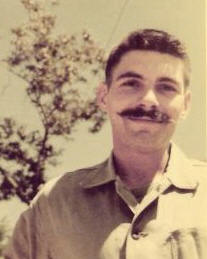
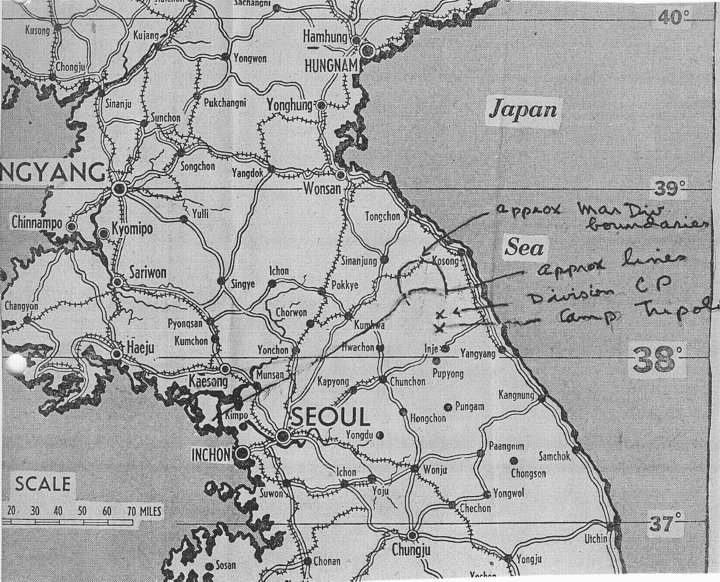
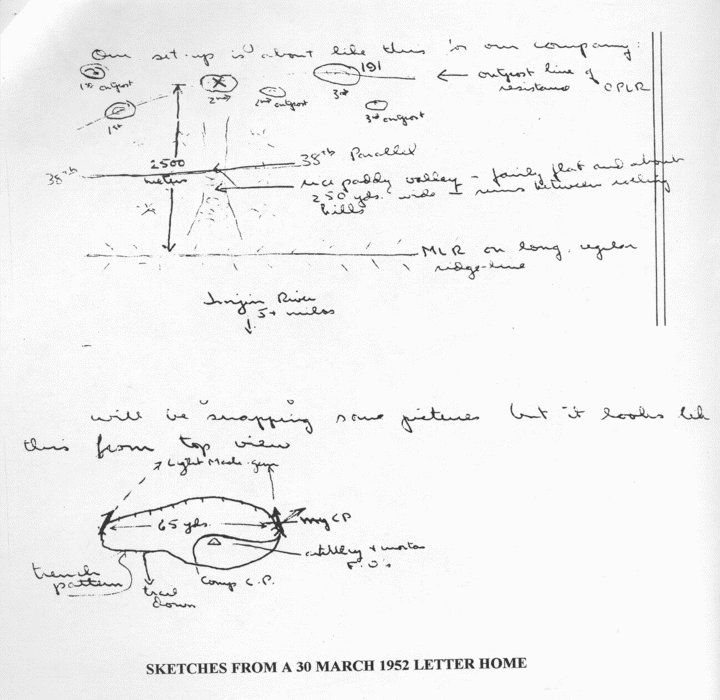
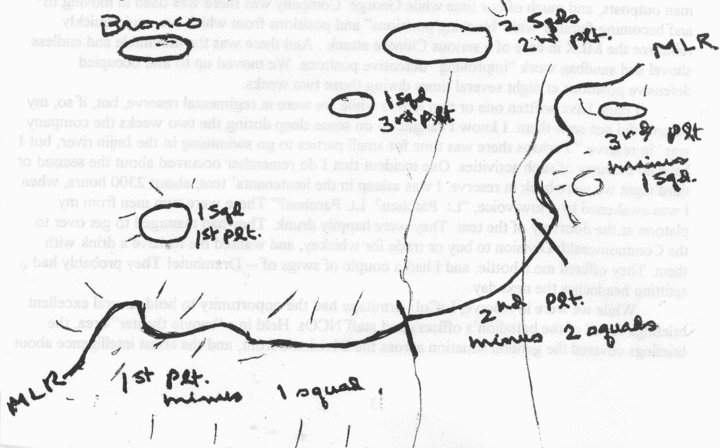
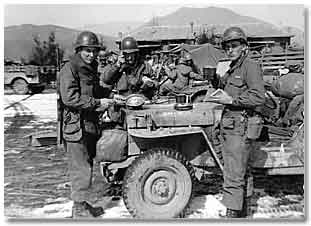 When I was in Korea in 1952, we became very familiar
with C-rations. The contents of the boxes had not evolved from what was developed during World War II, and we
sometimes thought that what we received had, in fact, been sitting on the shelf of some warehouse since the
mid-1940s. The three cans of meals were commonly called "heavies." The designation of "heavy" applied not only to
their weight, but the fact that they were designed to be high in fat, calories, and salt and could cause a lot of
heartburn while they sat in only partly-digested lumps in one’s stomach.
When I was in Korea in 1952, we became very familiar
with C-rations. The contents of the boxes had not evolved from what was developed during World War II, and we
sometimes thought that what we received had, in fact, been sitting on the shelf of some warehouse since the
mid-1940s. The three cans of meals were commonly called "heavies." The designation of "heavy" applied not only to
their weight, but the fact that they were designed to be high in fat, calories, and salt and could cause a lot of
heartburn while they sat in only partly-digested lumps in one’s stomach. In corresponding with fellow members of George Company
(G-3-1 Korea) I was somewhat surprised at the diversity of opinions concerning various types of "heavies." Bing
Bingham was a non-smoker and recalls trading his cigarettes for the "pineapple or ham and limas—the good stuff."
Lee Dauster said that his favorite snack was "the round crackers that came in every box, and the tin of jelly.
That was my treat each day. Hamburger in gravy was my favorite entree." Lee does not remember the sausage patties;
Peter Beauchamp does remember the sausage patties, but not the hamburger patties. (I know there were
sausage-patties because I mentioned in a letter saved by my parents that those were to be my supper that night.)
Jim Byrne said, "The best part of the C-rations was the candy. I liked the chocolate candy, but would trade it off
for the thick fruit bars which had the texture of gum balls." (In my experience, those chewy fruit cars also made
ideal bait for the large rat traps that some people had sent from home—but that is another story.) Peter Beauchamp
says, "We considered the worst C-ration box one that contained sausage patties, meat and spaghetti (which we
called maggots and noodles), and I believe, corned beef hash. We called that the Big Three, or Takesan Three. The
meat in the spaghetti, I believe, was ground beef, and there was a lot of gristle. During the winter, one of the
desirable "heavies" was beans and franks, as there was more liquid type stuff that would heat up better."
In corresponding with fellow members of George Company
(G-3-1 Korea) I was somewhat surprised at the diversity of opinions concerning various types of "heavies." Bing
Bingham was a non-smoker and recalls trading his cigarettes for the "pineapple or ham and limas—the good stuff."
Lee Dauster said that his favorite snack was "the round crackers that came in every box, and the tin of jelly.
That was my treat each day. Hamburger in gravy was my favorite entree." Lee does not remember the sausage patties;
Peter Beauchamp does remember the sausage patties, but not the hamburger patties. (I know there were
sausage-patties because I mentioned in a letter saved by my parents that those were to be my supper that night.)
Jim Byrne said, "The best part of the C-rations was the candy. I liked the chocolate candy, but would trade it off
for the thick fruit bars which had the texture of gum balls." (In my experience, those chewy fruit cars also made
ideal bait for the large rat traps that some people had sent from home—but that is another story.) Peter Beauchamp
says, "We considered the worst C-ration box one that contained sausage patties, meat and spaghetti (which we
called maggots and noodles), and I believe, corned beef hash. We called that the Big Three, or Takesan Three. The
meat in the spaghetti, I believe, was ground beef, and there was a lot of gristle. During the winter, one of the
desirable "heavies" was beans and franks, as there was more liquid type stuff that would heat up better."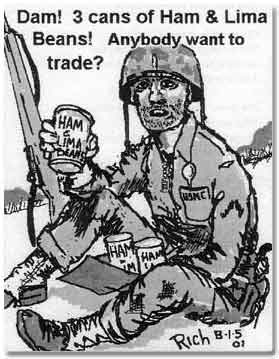 There was a stretch of twenty-six or -seven days after
the Division moved to western Korea when our company subsisted on nothing but C-rations. After a few weeks, as the
supply lines were slowly re-established from the rear forward, we began to receive a meager supply of
"supplementary rations." I remember one instance when we got two eggs and one loaf of bread per platoon! It was
during this time that I wrote home about a "black list" of companies that produced inferior C-rations. I wrote:
"The George Washington Division of the American Home Products Company is the only one that provides only single
coffee packets—when it takes a double-packet to make even a decent half-canteen cup of coffee. There are three
kinds of chocolate powder disks, Nestlé’s Baker’s, and Orange-Crush. Nestlé’s crumbled easily, and are No. 1.
Orange-Crush was hard and lumpy—takes hard work to smash the lumps to powder. Baker’s are like concrete and
virtually impossible to use—takes iron on iron pounding to reduce it to powder—like using two helmets as mortar
and pestle. Halley’s Food Products of Hillsboro, Oregon, puts up corned beef hash that is 84% potatoes and 15%
corned horse meat. I’m going to write them a letter if I get a chance—the damned stuff has so little meat it is
hardly pink."
There was a stretch of twenty-six or -seven days after
the Division moved to western Korea when our company subsisted on nothing but C-rations. After a few weeks, as the
supply lines were slowly re-established from the rear forward, we began to receive a meager supply of
"supplementary rations." I remember one instance when we got two eggs and one loaf of bread per platoon! It was
during this time that I wrote home about a "black list" of companies that produced inferior C-rations. I wrote:
"The George Washington Division of the American Home Products Company is the only one that provides only single
coffee packets—when it takes a double-packet to make even a decent half-canteen cup of coffee. There are three
kinds of chocolate powder disks, Nestlé’s Baker’s, and Orange-Crush. Nestlé’s crumbled easily, and are No. 1.
Orange-Crush was hard and lumpy—takes hard work to smash the lumps to powder. Baker’s are like concrete and
virtually impossible to use—takes iron on iron pounding to reduce it to powder—like using two helmets as mortar
and pestle. Halley’s Food Products of Hillsboro, Oregon, puts up corned beef hash that is 84% potatoes and 15%
corned horse meat. I’m going to write them a letter if I get a chance—the damned stuff has so little meat it is
hardly pink."
