|
Back to Page Contents
Condensed KCOMZ Summary
Condensed from Graves Registration Division, Korean Communications Zone (KCOMZ) Historical Summary,
Jul-Dec 1954:
Part of the Armistice Agreement signed in Panmunjom in June of 1953 called for the exchange of military
war dead on both sides. In the months that followed, members of the U.S. Graves Registration Division in
Korea met repeatedly with UN and Eighth Army officials to work out the details for how such an exchange
might be effected. The resultant draft plan was approved and signed by all the major parties on the Allied
side in early July 1954, and was forwarded to Communist officials. They, in turn, signed the new agreement
on July 20th. Together, they also agreed that the exchange of deceased personnel should formally commence on
1 September 1954 and end no later than 30 October, if possible.
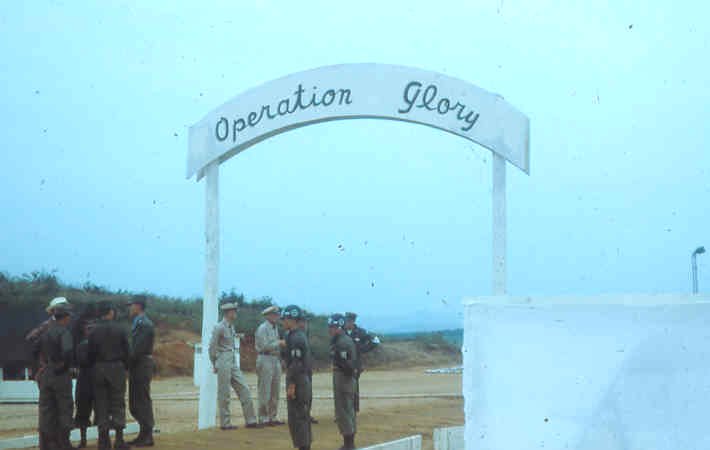
Implementation of Korean Communications Zone (KCOMZ) Op Plan 14-54, better known as "Operation Glory",
was put into effect on 22 July 1954. United States engineers furnished by the United Nations Command,
Military Armistice Commission Support Group, constructed a railhead and reception area. UN Command also
provided a battalion from the 1st Signal Unit to establish communications. The Transportation Corps made
plans for the evacuation, by rail, of all deceased military personnel on our side. The Quartermaster Corps
issued all necessary supplies and materials, and the KCOMZ Quartermaster Graves Registration proceeded with
the disinterment of all enemy remains of deceased military personnel interred in South Korea.
In the month leading up to the actual exchange of military remains, the Quartermaster Graves Registration
Committee held three additional meetings with the Communist side to discuss the approximate number of
deceased involved, examine the signatures of officers who signed receipts for the remains, and to decide how
both sides would proceed from the railheads to the reception areas within the demilitarized zone. They were
also to discuss the means of identification, use of vehicles in the prescribed areas, and ground rules for
photographers and news correspondents.
On 30 August 1954, the disinterment of all enemy deceased military personnel was completed, and all
remains delivered and stored at "Glory Railhead," near Munsan-ni, Korea. At 0930 the next day (September
1st) the Chief of KCOMZ Graves Registration Division met his North Korean counterpart at the reception area
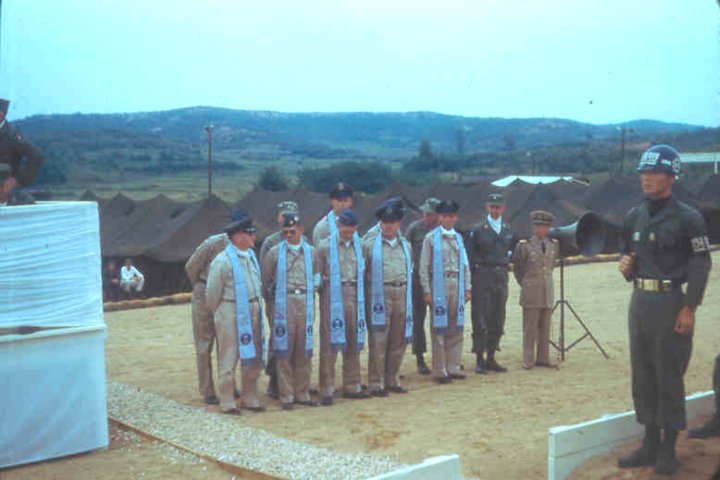
within the demilitarized zone, and received the first 200 remains of deceased UN military personnel. At 1300
hours, these remains were evacuated to "Glory Railhead", where a ceremony was held. In attendance were
several major figures from the United Nations Command, U.S. Far East Command, Military Armistice Commission,
and representatives from the Republic of Korea Army. A religious ceremony was conducted by chaplains of the
Catholic, Protestant, and Jewish faiths.
The exchange of deceased military personnel between the United Nations in South Korea, and the Communists
in North Korea, continued daily, except Sundays, until 21 September 1954. On that day, North Korean
representatives turned over 123 remains, and advised UN Graves Registration officials that there were no
more to be delivered. The United Nations group continued delivering enemy deceased until 11 October. A final
tally showed that 4,023 UN deceased personnel had been received from the North Koreans, and that 13,528 had
been delivered to them.
Of the 14,074 remains of deceased enemy military personnel disinterred in the territory of the United
Nations Command, 546 were determined to be civilians who died while interned in prisoner of war camps. The
government of the Republic of Korea requested that the 546 remains be delivered to them for further delivery
to the next of kin, who reside in South Korea. Of the 546 remains, seven were determined to be unknown
civilians. The seven remains were interred in Pusan, Korea. The remaining 539 remains were delivered to the
Republic of Korea government on 30 October 1954.
At the last formal meeting on October 11th, both sides agreed to continue searching in remote areas, and
if additional remains were discovered, they would be returned prior to the end of the month, if possible.
The UN Chief of the Graves Registration Committee further advised the North Koreans that the exchange
facilities would be left standing for as long as was felt necessary.
For their part, the North Koreans announced that they had disinterred 78 more bodies, which they
forwarded to UN officials the next day (October 12th). Then again 66 additional remains were handed over on
November 9th. This brought to 4,167 the total number of United Nations deceased military personnel turned
over by the North Koreans during Operation Glory.
Back to Page Contents
Joint POW/MIA Accounting Command
During Marty O'Brien's research for casualty information, he found the following from the Joint POW/MIA
Accounting Command:
The KPA/CCF turned over 4,167 "sets of remains" during Operation Glory. Anthropologists determined that
4,219 individuals were actually represented. Of the 4,219 remains received, 3,944 were determined to be
American. When anthropologists completed their work in February 1956, they had identified all but 416
individuals received during Glory. These individuals were subsequently interred in the Punchbowl Cemetery
located in Honolulu, HI. In March 2003, one individual was identified as Ronald Lilledahl, a Marine who
fought at the Chosin Reservoir.
Operation Glory Remains Identified (incomplete
listing0
Crawford, Pfc. Grady J.
Born December 16, 1928, Grady Crawford was the
oldest of two boys. The Crawfords lived in the Lakewood
neighborhood of Dallas. Grady lettered in football and was
active in boxing and swimming. But his passion was Junior ROTC,
where he achieved sharpshooter and marksman medals, according to
the 1947 high school yearbook. After graduating in 1947,
he enlisted in the Marines. A few years later, his brother,
Bill, joined the Merchant Marines and was also a Korean War
veteran. The year before Grady arrived in Korea, tragedy struck
the family back home. Grady’s father, Walter Grady Crawford,
died Nov. 5, 1949, from injuries sustained after a city bus
struck him near the intersection of Gaston Avenue and Dumas
Street in Old East Dallas. The elder Crawford, who was 54,
stumbled after getting off the bus and fell under its rear
wheels as the bus pulled away from the curb, according to a
front-page article in The News....Grady fought in the Battle of
the Chosin Reservoir, one of the most historic of the Korean
War. The battle is one that has come to define the legacy of the
Marine Corps, the details of which are shared with every Marine
recruit going through boot camp....Only 21 at the time, Grady
was part of the 4th Battalion, 11th Marine Regiment of the 1st
Marine Division. Assigned to an artillery unit, his mission on
Dec. 1 was to provide cover as other Marines evacuated. Grady
was last seen that day in the town of Yudam-ni, and the Marines
officially listed him as missing. Grady's brother, Bill, who
served in the Merchant Marines during the war, often told his
daughters that Grady’s best friend in the Marines told him he
last saw Grady running over a hill, and “when he looked again,
Grady was gone." [Dallas Morning News, September 27,
2019]
Fink, Army Cpl. Roy C.
A special coming back ceremony was held at the
Buffalo Niagara International Airport as the remains of Army
Cpl. Roy C. Fink, 20, was returned to his hometown for burial.
Cpl. Fink had been missing near the Chosin Reservoir, North
Korea since December 2, 1950. In 1953, Fink was declared
deceased by the U.S. Army. His remains were discovered in North
Korea decades later and were then identified by the Department
of Defense. Friends may visit the Lombardo Funeral Home 885
Niagara Falls Blvd., Amherst on November 3rd from 4-7 p.m. A
funeral service will be held Friday morning at 10 a.m. in the
Forest lawn Cemetery Chapel. The following is information from
the Department of Defense about the recovery. In late November,
1950, Fink was a member of Company B, 1st Battalion, 32nd
Infantry Regiment, 7th Infantry Division. Approximately 2,500
U.S. and 700 South Korean soldiers assembled into the 31st
Regimental Combat Team (RCT), which was deployed east of the
Chosin Reservoir, North Korea, when it was engaged by
overwhelming numbers of Chinese forces. [November 2, 2016]
Fontenot, Joseph William "J.W."
In February 1951, Fontenot [Whitehall,
Louisiana] was assigned to the 2nd Infantry Division when he was
captured by enemy forces near Saemal, South Korea. He reportedly
died June, 28 1951, while in captivity at Camp 1 near Changsong,
North Korea. Fontenot was 20 years old. He was from Whitehall,
Louisiana and was assigned to the Army's Company L, 3rd
Battalion, 38th Regiment, 2nd Infantry Division in Fort Louis,
Washington. He was a Corporal. Before joining the service,
Fontenot was a strawberry farmer, along with his father, in
Whitehall, LA. His family spent the last 61 years not knowing
where he was and if his body would ever be located....He was
buried on October 27, 2012 at Whitehall Community Cemetery.
[WAFB9, October 24, 2012]
Johnson, Cpl. Gudmund C.
Army Corporal Gudmund C. Johnson, 22, of Red
Wing, Minnesota served in Company K, 3rd Battalion, 35th
Infantry Regiment, 25th Infantry Division. On November 25, 1950,
he was captured by enemy forces near Unsan, North Korea and
reportedly died in July 1951 at Pyoktong, a prisoner of war
camp. Johnson will be buried on November 9, 2019 in Red
Wing.[Fox 9, Red Wing, Minnesota]
Kirtley, Cpl. DeMaret M. - Kaycee, Wyoming
(Army)
Lilledahl, Ronald - (USMC)
Lindquist, MSgt. Carl H.
Carl went missing on November 29, 1950 after a
battle. He was 32 years old and his hometown was Willmar,
Minnesota. In late November 1950, Lindquist was a member
of Headquarters Company, 3rd Battalion, 31st Infantry Regiment,
7th Infantry Division. The unit, designated the 31st Regimental
Combat Team (RCT), engaged with forces of the Chinese People’s
Volunteer Forces (CPVF) in a battle on the east side of the
Chosin Reservoir, North Korea. Lindquist was reported missing in
action during the battle, on Nov. 29, 1950.
Newman, Pvt. Lamar Eugene
A native of Griffin, Newman enlisted in the army
in 1949. While fighting there in Korea in 1950, he went missing.
Letters home to Griffin stopped coming. His family waited years
to hear from him. Dotson said his grandparents always held out
hope that he was alive. Their best-case scenario was that he was
a prisoner of war....Newman’s remains were flown into
Hartsfield-Jackson Atlanta International Airport on Thursday.
Beneath the morning fog, his coffin draped with an American flag
was greeted by the Georgia National Guard, the Patriot Guard
Riders, the Delta Honor Guard and his surviving family. Tears
were shed and his coffin was escorted back to Griffin by men on
motorcycles with the Red, White and Blue flying
high....According to the Defense POW/MIA Accounting Agency,
Newman went missing on Nov. 27, 1950 during a battle near the
village of Kujang, North Korea. He was a member of Company B,
1st Battalion, 9th Infantry Regiment, 2nd Infantry Division, and
taking part in a defensive operation there, the agency said.
Newman’s division suffered heavy losses and many soldiers were
killed, captured or went missing. Newman never returned to
the Army’s base. Before Newman left for the war, he asked a
woman to marry him. Carol Morris and Newman never shared an
altar. She was there Thursday morning when his remains arrived
in Atlanta. "It's sad, but I'm so glad he's home," Morris told
Channel 2 Action News. "It's been a long time." [AJC Atlanta
News] Newman's remains were identified in November of
2019. He was buried in Oak Hill Cemetery, Griffin.
White, Charles A. Jr.
June Chuvalas will never forget the day her
brother left for war, more than 60 years ago. It was May 1950.
June was a teenager, and her brother, Charles A. White Jr., was
20 years old. He had enlisted in the U.S. Army in McConnelsville,
after he was rejected in Columbus for flat feet. By September
that year, he would be across the Pacific Ocean, fighting in the
Korean War. And by December, he officially would be declared
MIA. The day he left, he told June, "Don't worry about me. I'll
make it back." Charles died in 1951 in a POW camp in North
Korea....According to the American Battle Monuments Commission,
Charles was taken as prisoner Dec. 3, 1950, and died of
malnutrition and dysentery while a prisoner at Camp 1 on the
south bank of the Yalu River in North Korea. He was awarded the
Combat Infantryman's Badge, Prisoner of War Medal, Korean
Service Medal, United Nations Service Medal, National Defense
Service Medal, Korean Presidential Unit Citation and the
Republic of Korea War Service Medal. Charles was buried in
the New Lexington Cemetery. [Times Recorder, New
Lexington, July 9, 2015]
Williams, MSgt. Olen Williams
The remains of a soldier who went missing during
the Korean War have been identified and are being returned to
his family for burial, the Defense Department announced
Wednesday. Army Master Sgt. Olen Williams, of Verbena, Ala., is
to be buried Sunday with full military honors near his hometown
in Clanton, Ala., according to a statement released by the
Department of Defense POW/Missing Personnel Office. Williams was
37 when he went missing. In late 1950, Williams and elements of
the 31st Regimental Combat Team were establishing a defensive
line near a small village in Sinhung-ni, North Korea, when they
were attacked by enemy forces, the statement said. Williams was
reported missing in action after the battle. [Stars & Stripes,
June 6, 2013]
Winchester, Pfc. William Junior
Winchester was a member of Company D, 1st
Battalion, 24th Infantry Regiment, 25th Infantry Division.
He died as a prisoner of war at the age of 20. He and his
wife, Millie Ann Cowan, were parents of a son James. Upon
identification, Winchester's remains were returned to Lima,
Ohio, and he was buried in Memorial Park Cemetery.
|