|
We need your help to keep the KWE online. Jim Doppelhammer, our longtime webhost, has passed away and his webserver will go offline
in 2025. The entire KWE website must be migrated to a modern server platform
before then. If you value this resource and want to honor our veterans by keeping their stories online
after 2024, please donate now.
For more information, click here.
|
|||||||||||||||||
 |
|||||||||||||||||
| Back to "Memoirs" Index page | |||||||||||||||||
 |
|
||||||||||||||||
|
|
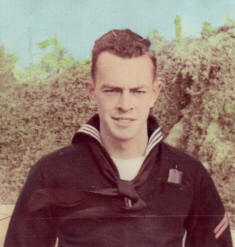
Carl Leonard GaleyMattoon, Illinois - "The Korean War was a war that had no definite beginning or ending. It just took place by mutual consent, and that's the way it ended--not because anyone surrendered, but rather, just because some politicians sitting behind desks decided that maybe we had finally sacrificed enough American lives for a war that some citizens were hardly aware of anyway." - Carl Galey |
||||||||||||||||
Memoir Contents:
Pre-MilitaryMy name is Carl L. Galey. My middle initial stands for Leonard. It was my father's middle name. I never ever used it to the extent of being called Leonard, but I did make use of my father's nickname while I was in the Navy. He was always called "Chick" Galey, and when I went into the Navy I adopted his nickname for my own. All through my Navy career I was known as Chick. Then after returning to civilian life I went back to being plain old Carl. There are a couple of my friends who were in the service at the same time as I who still call me Chick, but to the rest of my acquaintances I have returned to being Carl. My date of birth is March 11, 1930, and I was born in Mattoon, Illinois. That is where I reside today. Sometimes I wish that I had stayed in California after my discharge, but when you are 24 years old and have been away from your friends and family for four years, you think of little else except getting back home. My father's name was Charles Leonard Galey, and my mother's name was Leona Wilhemina Galey. Her maiden name was Knollenberg. She was born in America, but her grandparents came from Germany. She grew up on a farm about six miles north of Mattoon in what was known as the German Settlement. She went to a German school and the Lutheran Church in Dorans, Illinois. My father came from a little town about nine miles north of here called Cooks Mill. I don't know too much about his heritage, but I was told that he was of Scotch-Irish descent. His father was the blacksmith in town at that time. I was told that my grandfather started the first movie house in Cooks Mill. I spent my childhood right here in Mattoon. My neighborhood was made up of middle class working people. Our home was on the dividing line between the poor kids and the rich kids, but since I went to school in a neighborhood on the east side of town, I spent most of my time with the east end kids (the poor kids). In a way this was a blessing of sorts, since I learned early in life that old adage, 'Where there's a will, there's a way'. We didn't have very many fancy toys, but we sure had a hell of a lot of fun. There was lots of sandlot football, baseball, and basketball. There weren't any organized sports back then, but the kids of today really don't know what they are missing. There is, in my opinion, too much grown-up interference in sports today--too many rules and regulations. And if the truth were known, I believe that the kids of yesteryear could take on and 'whup' most any of the grownup-ruled teams of today. My father was one of the most well-known people of our town. Back in the early thirties, around 1932, he was the Chief of Police in Mattoon. This was back in the time of Dillinger and Machine Gun Kelly. There was no, 'read them their rights' back then. It was catch as catch can. If they gave you too much guff, you pulled a 'sap' out of your back pocket and whopped them up the side of their noggin. My father was a very fair man and gave most of the people he was arresting more than an even break. But if they wanted to 'rassle,' he could hold his own in rough and tumble with the best of them. He stood six foot two and weighed in at about two hundred pounds, so he was a power to be reckoned with back in those days. Every time the city administration changed, they tended to hire their friends for the city jobs. So when his four-year term as Chief expired, the next bunch of politicians brought in their own buddies. He spent one more term as a patrolman and then sought employment in the private sector. I don't remember what jobs he held back then, but I do remember that he worked on the WPA back during the Depression years. Then when World War II came along, he worked at a plant called Atlas Imperial Diesel. They made large engines for the different branches of the armed forces. I have nothing but fond memories of my father. My mother never worked outside of the house to any great extent. For two or three years she worked at the Brown Shoe Company Factory here in town. The rest of her life she was a housekeeper. I don't think my mother ever said an unkind word to anyone. This was how people remembered her. I thought a lot of my father, but my mother was always who I ran to when I wanted some comforting. She was my safe haven when anything troubled me. To me, growing up during the Great Depression was not that bad. There were lots of sacrifices, but when you have never had a great deal to begin with, you don't miss anything. I can remember going with my grandfather to the relief depot to get allotments. At that age, I thought, "This is great. We come up here and they give us flour, sugar, potatoes, and maybe sometimes we might even get a sack of broken cookies." Then Grampa and I would load them into our little Red Flyer wagon and pull them home. It was great! One thing I remember about Grampa Galey was his accepting everything with dignity. I still remember having breakfast with him one morning when we were having graham crackers and milk. When I took a spoonful of the concoction, I looked down and there were a couple of ants swimming in my spoon. I yelled, "Oh yuk, Grampa. Don't eat that. There's ants swimming in it." Without missing a bite, Grampa said, "Awe, that's all right, Bud. They don't eat too much." No, as far as my memories of the Depression years, there was no depression in my life. I had one older sister. Her name was Geraldine, but she was always called Gerry. She was six years older than me so we didn't travel in the same circle of friends. She was in high school when I was still in elementary school. I have very few memories of any activities that we did together. I do remember her singing to me one time. The song was 'My Buddy' and for some reason I still remember that event, even though I did not have a close relationship with her. The main memory that I still recall was that of being jealous of her because of the game Monopoly. Back in those days, playing board games and eating popcorn was the main form of entertainment for my family and friends. Since Gerry was older, she and her two friends always got to play with my dad and I had to be just a spectator. I pouted every night when this ritual occurred. She died alone about ten years ago, leaving one daughter. Her daughter has never contacted me since then. I would have to say that I was a well-behaved child--when around my parents. When I was off scouting around our end of town with my buddies, however, I didn't miss out on anything that the gang thought might be fun. This included things such as hanging off of the old footbridge that crossed the Illinois Central railroad tracks, dropping down on slow-moving freight cars, then riding them to the center of town before disembarking. The railroad was a gathering spot for many of my buddies. When the railroad came through Mattoon, it passed through a stretch of track that had steep embankments on both sides. These steep embankments were a source of year-around fun. We would slide down the banks on sleds during the winter and then during the times of year that there was no snow cover, we would slide down on pieces of tin or cardboard. There were a few times I came within a few feet of colliding with trains passing through. One other thing that was a favorite was getting on the footbridge when an engine was passing underneath and getting engulfed in the smoke puffing out of the smokestack. This was always a thrill except for the times that I would get a blast of hot ashes up my rear-end. With the exception of maybe a half dozen or more activities such as this, I guess I was a very well-behaved child. I was very close to my parents, but again, not too close to my sister. I think that I was close to my parents because they didn't have too many restrictions on my away-from-home activities and because they were always there during any times of difficulty. I attended grade school at Washington Elementary, located at 12th and Shelby in Mattoon. Since then it has gone the way of so many of the old schools--demolished, and the ground turned into a barren expanse of nothing. It was about seven blocks from my home and in all that time I can only recall two times that I rode home in a car. Kids back then didn't ride to school. They walked or rode their bikes. There was no such thing as snow days either. I can remember trudging to school through a couple of feet of snow many, many times. Sometimes it was kind of treacherous going across the old footbridge too. When there was ice or snow on the bridge, we took it pretty slow, as the bottom railing was about two foot high. If we weren't careful, we could slip under it and fall about thirty feet down to the railroad tracks directly below. We usually ended up making a 'snow angel' or two on our way, not to mention the endless dodging of snowballs being thrown at each other. There was no such thing as school buses for the city kids. The only ones that rode the bus were the kids who came in from the farms. Another thing that was a lot of fun was grabbing hold of the back bumper on the slow moving cars and being towed for a block or two. Kids can't do that today--the cars don't have bumpers anymore. Then after finally getting inside the school, the first thing we did was to put our coat, cap, and gloves on the steaming radiators in the classroom. Man, did that ever make a stink! From Washington School I went to Longfellow School (also gone now), where I spent three years in junior high school. There were two schools that had junior high, ours and the hated Hawthorne School. There was a rivalry between these two schools not experienced by today's schools. A big majority of the more affluent families lived on the west side of town and they sort of looked down on us poor kids. Today the more affluent families live out in the suburbs in those big mansion-type houses. About the only areas in town today housing the rich are Western Avenue and Lumpkin Heights. From Longfellow School I went to Mattoon Senior High, located at 21st and Western Avenue. It, too, has been demolished, to be replaced by nothing. I received all of my schooling in the public schools. There was one parochial school, which was a complete mystery to the rest of us. I was never inside its doors, so I don't know much about it. I graduated from Mattoon High School in the spring of 1949--a stellar occasion in anyone's memory. No more school, just get a job and enjoy being a free agent. Little did I know that many employers would make me wish I was back in school once more. As I look back on my school years, I have since realized that these were some of my most enjoyable years. Did I like school? Let's just say that it was a tolerated experience with many memories--some good and some bad. One of the things I remember quite vividly is the phrase said to me by most of my teachers, "Why aren't you as smart as your sister?" As far as liking my teachers, I probably had two teachers in my twelve years of schooling that I can look back on and say that I liked. The rest were just the person in charge during the time I spent with them. In junior high and on into high school, I was enrolled in ROTC. I think the reason I took these courses was because I was not that good in sports. The reason I didn't excel in sports was because of my size. I stood about six foot and weighed in at about 135 pounds. This was my weight when I later joined the Navy. I have since put on about 50 pounds, and with the pounds came more confidence in life in general. When I was in ROTC, I was on the rifle team. I was a pretty good shot and actually excelled at this endeavor. When I joined the Navy, this helped out as I became a member of the rifle team in boot camp. I was also on the drill squad during my stay in this fine academy of military teachings. As to being active in any clubs or extracurricular activities, if one can call spending most of my off hours in the poolroom an "extracurricular activity," I was a stellar member. From the time I was about sixteen years old until joining the Navy, I usually made an appearance in the poolroom every day. I can't tell you how many times I would lose my after-school job's paycheck. I only cleared about $15 working in a five-and-dime on Broadway Street in Mattoon, and usually about two hours after being paid it was all donated to the sharks on the pea-pool table. The proprietor of the dime store was F.E. Walters, commonly called 'Fee' behind his back. He was a character, but his eccentricities are not easily put into words, so lest I offend some of his descendants, I will not go into that. As far as balancing the work with my studies, that was easily accomplished since I did no studying whatsoever. I somehow had the ability to scratch by on my subjects without cracking a book and I wasn't planning on attending college, so what did I care about being a good student. I did take a correspondence course in art. You know the one--'Draw Me, and Enroll in The Number One School Of Art'. This came in handy later on when I joined the Navy because it qualified me as having a year's college. Having this scholastic record gave me a choice of choosing my rate in the Operations Department aboard ship. I chose the OI Division and became a radar operator, which gave me the distinction of working in CIC or Combat Information Center. This was the top of the line as far as rates go. After all, the OI Division translated to Operations Intelligence. Yes--a guy who just made barely passing grades in high school was now in Intelligence. Will wonders never cease! I was a Boy Scout. I went in as a tenderfoot and after I quit some two years later, I retired as a tenderfoot. I was not too ambitious back in those days. I can't say that scouting had any impact on my military experiences. For one thing, I didn't sleep in tents or try to rub two sticks together to make fire while I was in the Navy. They frown on making campfires aboard ship, and I would have had a hell of a time trying to erect a pup tent in the space my bunking quarters afforded. I was still in elementary school when I first heard about the United States being attacked by Japan at Pearl Harbor. I was sitting on Howard Carman's front porch when I saw my mother hurrying down the sidewalk. Mabel Broviak was in her front yard and my mother yelled at her, "Mabel, did you hear? The Japanese attacked Pearl Harbor and it looks like we are going to have to declare war on them." Mother made me come back home with her, and for the next hour or so we both listened to the newscasts about what was going on. That evening the family all gathered around the radio and heard President Roosevelt's Declaration of War on Japan. To an eleven year old boy, I guess this was not such a momentous event. I don't recall my emotions at the time, but I do remember the solemn looks my parents had during the broadcast. The war effort on our family caused everything to change. There was immediate rationing of goods and services. Families were issued ration books for different foodstuffs and gasoline ration stamps for each family's car. I don't recall how much gas each family was allotted but apparently it was sufficient, because I don't remember any curtailment of any of our activities. My dad was too old for the military service so he worked in the Atlas Diesel plant making big engines for the military. I remember that after he started working there he had an increase in salary and we were able to get a better car. There were shortages of all kinds of metal and rubber goods. We kids participated in the war effort by joining in on paper drives and scouting the alleys for any thrown-out metal and wire. All of the schools participated in paper and scrap metal drives. When these took place, we were let out of school to go look for paper and scrap metal. I remember one time going over to Longfellow junior high when one of these were being conducted. They had a pile of old magazines and newspapers that was at least twenty foot tall stacked out on the playground. New tires ceased to exist and those who needed a tire had to buy what was known as a recap. These were old tires that were given new life by having a rubber tread vulcanized to the tread area. Every once in a while blackouts were practiced. When the sirens went off, every household had to close all of their window blinds and cover their doorways so no light would show through. This was done so that, if we were ever attacked by enemy bombers, it would make it more difficult for them to find their targets. The problem never arose, so after a while there were fewer and fewer blackouts held. There were no members of my family that were inducted into the military during the war, so I have no memories of any returning veterans. A few of our neighbors had family members that actively participated in the war. One such neighbor that I remember was a young man named Johnny Reid. He lived just up the street in the corner house. As I recall, he was the first casualty that Mattoon had. He was a pilot, but I don't remember the circumstances under which he was killed. I don't recall any veteran of the war coming to our school. There were no recruiters that came to our school, either. We were an elementary school and there were no prospects to be found there. Not having any older brothers, I don't know if they showed up in the high school. I was not old enough to be in World War II, but I suppose that I wanted to be in it. All of our childhood shoot-em-up games went from Cowboys and Indians to fighting the Japs during the war. I hesitate using the word Japs because since that time I have made the acquaintance of many Japanese and I find them to be very nice people. I guess that they were just like the people of the United States--they did their patriotic duty and went to war when their government asked them to. When the war finally came to an end, it was like nothing I had ever seen before--or after, for that matter. There were people running up and down Broadway Street in Mattoon, kissing and hugging everyone in sight. Another thing I remember is some of the men carrying shotguns along with them and very once in a while they would fire off two or three rounds up into the air. That sort of behavior would meet with wide disapproval in this day and age. Yes, it was a very happy time. I can't remember the times I heard the strains of that old song, "When Johnny Comes Marchin' Home Again" being played. I don't think there will ever be a welding together of our citizens like there was during World War II. Joining UpI was never in the Naval Reserves prior to my enlistment and I was not drafted into the Navy. I suppose my reason for joining the Navy was purely based on the creature comforts that it provided over the Army or Marine Corps. When the Korean War broke out in June of 1950, I knew nothing about Korea. I just knew that my number was getting close to coming up in the draft, and rather than being a draftee into a world of sloshing and sleeping in mud, I would much rather enlist in the Navy for four years and spend my duty days in a much more comfortable environment. I reasoned that I would much prefer sleeping on a cot or 'sack' as we called them, rather than sleeping on the cold, hard ground. Also, the Navy was renowned as a provider of good food. Some of the best food I have ever had in my life was served aboard ship--aboard the Essex especially. Their bakers could make some of the most delicious pastries I have ever tasted, and their Thanksgiving spreads would put the Waldorf Astoria to shame. Then, as I have already mentioned, there were the sleeping accommodations. I didn't like sleeping on the ground when I was in the Boy Scouts, so why would I like it now. Did I want to go to war? No. I would much rather have stayed right there in the poolroom than go out into a world I knew very little about. The only newspaper I ever read was my hometown paper, but I did not follow the war news. I paid more attention to the happenings of Alley Oop than the war in Korea. My attitude about the war when it first broke out was one of passing interest. I truthfully have no recall about what my thoughts about the war were. I don't think that I envisioned a World War II situation. My life was so far removed from the happenings in Korea, I don't think that it crossed my mind about its outcome. I guess I just assumed that the situation would be taken care of by those involved--and I had more frivolous things on my mind. I joined up with an old horse-riding buddy of mine by the name of Dan Thompson. I had tried about two years
earlier to join up with two other pool-playing friends. One, Max Kramer, had been my childhood best friend.
The other was a buddy all through my teen years. His name was Royal Price. The Navy had a deal where we could
enlist for two years at that time. We went down to St. Louis to get our physicals and I was rejected because they
said I had flat feet. This affliction didn't seem to matter when I tried a couple of years later and When I was accepted in the Navy the second time I tried to enlist, my buddy that time was Dan Thompson. We were put on a train and whisked off to Great Lakes Naval Training Center, north of Chicago. I spent about four hours with Dan--just long enough to get our physicals, where it was found out that I needed extensive dental procedures before being assigned to a permanent boot camp company. Hence, I was sent to a unit called 'Triple O', where they eventually worked on my teeth and set me up with a permanent boot company. I never saw Dan again. I don't know where he finally ended up during his enlistment and only saw him about once or twice after my discharge. He died about ten years ago. My folks (at least, my father) seemed pleased that I had decided to enlist. My mother was probably a little reluctant to release control of her only son over to the government. I joined the Navy on December 26, 1950, but since this date was so close to 1951, I have always said my enlistment was from 1951 to 1954. I took my boot camp training at Great Lakes Naval Training Center. We traveled by train from St. Louis to Chicago, and from there we were transported to boot camp by bus. The only one I knew who made the trip with me from St. Louis to Chicago was Dan Thompson. The hours right before arriving at the entrance gate to Great Lakes Naval Training Center don't stir up any feelings. I was probably napping, as it was up in the early morning when we arrived. Man, was it ever cold up there--from the beginning to the end of my stay. I can remember standing outdoors in the chow line one evening when the wind-chill factor was 23 degrees below zero. Yessir...cold enough to freeze the bejangles off of a brass monkey. But all things considered, I really kind of enjoyed my life in boot camp. I met a lot of good buddies up there, and a few of them even wound up on the Essex with me. Navy Boot CampI don't know how much acreage our training center engulfed, but it was a very large facility. If I were to make a guess, I would say it encompassed around fifty acres or so. It was built right along the shore of Lake Michigan. We never were down in that area so I don't know for sure, but the way that wind howled off of the lake, I assume that it stretched to its banks. It had facilities for all aspects of a career in the Navy. When we disembarked from the bus that had ferried us to the camp, we were marched directly to our quarters where we picked up a blanket and pillow. Then we were told to grab a bunk and get some sleep as we had a busy day before us. The bunks were two-tiered and I found one on the bottom. Within minutes I was sound asleep in my new home away from home. For a guy whose mother had let him sleep in for as long as he wanted, what happened next almost gave me a heart attack. It was one moment I'll remember forever. It seemed as if I had just got to sleep when all hell broke loose. All of a sudden all of the lights in the dorm went on and the loudest speaker ever created started yelling things like, "All right, you bunch of pansies...get your butts off of those bunks and hit the deck. Do you want to sleep your life away? What the hell do you think this is? A goddamned rest home? You're in the U.S. Navy now, and your mamma ain't here to gently roll you out of your nice civilian innerspring. Your ass belongs to the Navy now, so get it up and get it on the fuckin' deck!" (That last expletive soon became one of my most-used expressions.) "You got chow at six a.m, and if you don't make it on time, tough shit. You can wait till noon. All right...last call...HIT THE DECK!" Needless to say, the whole dorm was the scene of wild and befuddled 'boots' trying to do what that speaker from hell had requested. Within minutes we were standing at the end of our bunks waiting for the next outburst. Then one of the meanest looking Chief Petty Officers I had ever seen came through the door. He walked up and down the lines of recruits shaking his head. When he got back to the door he turned and announced, "Well, I've seen some asshole examples of limp-wristed losers, but this time I think they scraped the bottom of the barrel. You clowns are one sorry lookin' bunch of material. But that's all right...I take what they give me, and I like a good challenge. In about three months, I might even have a majority of you who deserves to wear the uniform of the U.S. Navy. We'll see...we'll see. O.K., see if you can't form some semblance of a couple of lines, and we'll take you down to the mess hall." We all scurried around to try to comply with what our new father figure requested. After some pushing and shoving, we finally got a respectable assembly together. One thing I might mention here is the fact that there were about a half dozen guys in the bunch who came from Arizona. They had been told when they signed up that they would take their training in San Diego. They were all dressed for warm weather and here they were in this icebox that Chicago becomes during the winter. A couple of them didn't even have a jacket to wear. They just stood there cowering at the expectation of being sent out into a below-zero morning...and I'm here to tell you, as my mother used to say, "It was colder than Billy Blue Blixon out there today." I don't think the temperature ever got up above freezing during our three months stay in boot camp. Not only was the temperature always cold, but there was usually a howling wind coming in off of Lake Michigan. It 'weren't no Arizona resort' by any stretch of the imagination. Since it was mid winter, we had no insects out and about and I never ever saw rodents and such during my stay there. After morning chow on that first day, our life in the Navy really began. We were marched from the mess hall to a big building where we were to receive our gear. Clothing, bedding, shaving gear, and various secondary items were dispensed while we were in this building. It was a big open building about the size of a football field. We were divided into groups and given instructions on where to go first to receive our various supplies. This was where all of our gear was marked by the use of stencils. Our name was stenciled onto every piece of gear we were issued. Soon I was loaded down with bedding, clothing, and essentials needed for my life in camp. We were also issued a sea bag to carry all of this on our trip back to the barracks. It was about here that I realized, "I'm really in the Navy." After everyone had received their gear, and had it stenciled and crammed into their sea-bags, we were marched back to the barracks where we were told to get our pea-coats and a white hat out of the gear, and to line up over by the door. About here was when I learned that I was to be sent to 'Triple O' as a medical holdover for work on my teeth. There were about four or five of us that ended up in Triple O. As to the group that I came in with, I never saw any of them again. Dan Thompson waved on his way out. Then, the other holdovers and I were marched over to a large building which housed the Sick Bay. This really wasn't such a bad experience. One thing about the Navy, they had some of the best specialists in the country working on us. I stayed there for about a week before my name was ever called to be worked on. It was a pretty nice place except for the boredom. We were always on call to be next up for our treatments. I have no bad memories about Triple O, with the exception of a couple of nut cases who roamed the halls. It was hard to tell if they were really wacky or if they were just putting on an act to try to get out of their commitment. After my teeth were put into tip top shape, I was assigned a permanent Company and I was off to meet the guys that I would live with for the next three months. I don't remember my platoon number. We were only assigned one for formation marching, which we did very seldom. Somewhere around this time I was to be sent to the ship's barbershop to receive my skinhead haircut. All of the recruits received the famous skinhead treatment, and for the first month or so of training they were seldom addressed with any other name. I can still remember one of the marching chants that the senior boots sang to us when we passed them during our marches to the various classes. It went like this:
These chants were sang in time to the beat of the marchers. Another one that comes to mind is:
Ah, the dignity of the common sailor, it was something to behold. When I was finally assigned to a permanent Company, I had my first chance to meet my commanding officer. His name was Adell, and he was a Chief Petty Officer. The unit I was placed in was Company 357. Adell, all things considered, was not a bad guy. He was no stand-up comedian, but he was fair-minded about most things. When he introduced himself to me he gave me a short indoctrination speech that I had missed since I wasn't there until after the Company was formed. The one thing that I remember about his speech was that for all recruits, everyone else was to be addressed as 'Sir.' It didn't matter if the individual we were talking to was a Seaman Deuce, or an Admiral. Everyone that was not a recruit would be addressed as 'Sir.' After graduating from boot camp, I found it hard to break this habit. I was never told information about Adell's background. All I can remember is that his uniform carried about four rows of ribbons and about six hash marks, which meant that he had served in the Navy for at least 24 years. As I recall, his rating insignia identified him as a Boatswain's Mate. This rate was the rate that did most of the manual labor aboard ship such as deck swabbing and maintenance. They were also the ones who tied the knots and were responsible for tying and untying the ship when it was docking or leaving the dock. The boatswain's mate also piped visitors onboard and announced messages on the ship's loudspeakers. Mr. Adell's hash marks were red as opposed to gold. This meant that he had not worn a Good Conduct Medal during parts of his career. As to his being a combat veteran, I assume that he was from the extent of ribbons that adorned his uniform. One didn't get too many ribbons for shore duty. Boot camp was about thirteen weeks long. During that time, we usually had two classes a day of various subjects. They covered everything from Protocol to VD. We even had a class on knot-tying. I was a whiz at this since I had learned knot-tying as a Boy Scout. We also had marksmanship classes. I did well in these since I had been on the ROTC Rifle Team. Then there was marching in formation classes, which might as well have been eliminated since we never marched in formation after leaving boot camp. I was also on the drill team in boot camp. This got me out of a few classes since I was afforded time off from classes to attend drill team practice. I can still remember the Chief announcing during class, "All right, Galey. You and that other idiot are supposed to get down to drill team practice." A few of the usual films were shown to us--'Your Career In The Navy', and the old black and white VD films. We had a film on ship and aircraft recognition one time, too. The trouble was, when we got into that stuffy classroom and they turned the lights out, it wasn't too long before we caught ourselves nodding off. A couple of times I woke up when the movie was almost over. I was lucky I didn't get caught. We had a few things we were required to memorize, such as officer's ranks, instructions for serving on guard duty, identification of the different classes of ships and aircraft, Officer of the Day duties, and memorizing the nomenclature of an M1 rifle (which, incidentally, I never had the occasion to fire at any time during my enlistment). One thing I remember about rifle class is that the Chief had a little poem he performed when anyone referred to his rifle as a 'gun.' We were not supposed to call it a gun. We were supposed to call it a 'piece.' So if anyone made the mistake of calling his piece a gun, the Chief addressed the offender with this little poem: "This is my piece" (while pointing to his rifle), "and this is my gun" (while pointing to his crotch). "The piece is for shooting. The gun is for fun." The living accommodations were not fancy, but they were comfortable. Our living quarters at boot camp were standard barracks, usually two stories. They housed about four different companies. I lived on the second floor or deck. We never used the terms floors, stairs, ceilings, walls or doors when we were in the Navy. They were decks, ladders, overheads, bulkheads and hatches. This was another habit that was hard to break when returning to civilian life. Also, ropes were not ropes--they were lines, and there was no front and rear, there was only forward and a-rear deck. You'd be surprised at how easily we used these terms in our language after being in the Navy for just a short while. As I said earlier, the term platoon was not used extensively. We were a Company, and I would say the compliment was in the neighborhood of 40 to 50 recruits. After three months together, we got to know most of the other guys pretty well. There were a few recruits that were loners and we never got too close to them, but the majority we usually formed a close relationship with. Then there were always two or three guys that we grew to be very close to and we tended to gather in small groups with these guys when we had bull sessions in the evening hours. As to knowing any of them before boot camp, I did not. It's strange how one makes friends with people of totally different backgrounds than one's self. I had two best buddies in boot camp and onboard ship who came from the big city, while I came from a small farming community. I think it was because of our sense of humor being so similar that we bonded together right away. Their names were John Flood, who came from Cleveland, Ohio, and Norm Ballou who came from Detroit, Michigan. We were together all through my duty aboard the USS Essex. Then after we were discharged, John made frequent visits to my hometown of Mattoon, Illinois. We were separated after my transfer to the USS Yorktown, but as soon as we three were in San Diego at the same time, we became liberty buddies once more. While in boot camp our days were pretty much regimented. Reveille was at 5:00 a.m., morning mess at 6:00 a.m., mid-meal at 12:00 noon, evening mess at 5:00 p.m. Then after returning to our barracks, we could do pretty much as we pleased until lights-out at 9:00 p.m. We were awakened by the sound of a bugle playing reveille over the PA system. We had showers and lavatories and toilet facilities, all located in the area of our sleeping quarters. Free time was usually taken up by bull sessions and answering mail. It was well known when some recruits received cookies that were especially good. Such was the case of one recruit who was of Polish ancestry. I have never had any better tasting cookie than those--before or after my recruitment. Taking care of the barracks was a group effort. Every week we had to scrub the wooden floors with scrub brushes. Then the Chief would come in and inspect. He was pretty lenient so we never ever got less than a passing grade. After lights out we could still gather in groups and talk or go to the soda machine located on the landing and get a Coke. Usually everyone was in their bunks by ten and then the barracks would be quiet until reveille. I only recall being awakened in the middle of the night one time. It was a surprise bed-check by the Officer of the Day, and everyone was accounted for pretty quickly. Other than that one time, we were allowed to get a full night's sleep every night. Church was offered, and if memory serves, it was mandatory. There were different services for the different beliefs, so no one was forced to listen to a Protestant minister if he was Catholic or vice versa. We were marched down to the church services by our Company Commander. Our Company Commander was stern, but not to the point of being mean. I appreciate him more today than I did back during the time I spent under his rule. I look back and think about how I could have been saddled with one of those COs like one sees in the movies, and I realize that my CO was an all right guy. He was fair and he treated everyone the same. What more could one expect from a boss? No recruit was ever laid a hand on by any superior that I know of during my time in boot camp. I've heard horror stories about how some of the recruits in other branches of the service were roughed up during their basic training, but it didn't happen in the Navy. If we did as we were told, we were treated fairly. I truthfully enjoyed my boot camp days. We were not subjected to anything we were not capable of doing. To my knowledge, corporal punishment didn't exist in the Navy. We might have been verbally abused a few times, but other than that, a new recruit to the U.S. Navy had nothing to fear. I don't recall ever having been disciplined for something that I did wrong. I might have had to listen to the COs little poem for calling my piece a gun, but other than that I wasn't hassled. I do recall having to stand as a group outside of the barracks one time for something someone did but would not own up to it. The culprit finally confessed and we were allowed to return to the warmth of the barracks. I don't remember what it was that the individual did to cause this and I don't remember what his punishment was, but it must have been a minor reprimand or it would have stayed in my memory. There were no trouble-makers in our Company other than the usual prankster or two, and they tended to hold themselves in enough to not get in trouble. Other than the time we had to stand outside of the barracks, our Company was pretty much a by-the-rules group of individuals. I actually ate more well-balanced meals while in boot camp than at any time before or after my stay there. There was always a full course meal. We were not required to eat anything that we didn't want, and the portions were large. We usually had a soup, a choice of two or three meat entrees, plenty of vegetables and fruit, a choice of coffee, milk, or Kool-Aid, and there was always a good dessert to top it off. The mess hall was an enormous building able to feed the entire camp with a minimum of waiting. When we first came in we went directly to the serving area, picked up a tray, silverware, and napkin, then moved down the serving line. The hall was large enough that there was no trouble finding a place at one of the hundred or so tables. After we finished eating, we took our tray to the scullery where the mess cooks sent the dirty trays on their trip down through the scalding hot sprays of water. After the meal, according to the time of day, we returned to our Company area and then we marched off as a unit to whatever class or event was to take place next. We were given quite a few different tests. We had to qualify for physical tests by running and some hand-to-hand combat. We also had to qualify in swimming, tear gas and marksmanship. The running tests were for speed and endurance. I don't recall my grade, but I finished near the top in the company. The hand-to-hand combat consisted of little more than putting on boxing gloves and banging around on our buddy for a few minutes. The swimming test was a snap for me as I had spent many, many hours at our local municipal pool. It consisted of jumping off of a 30-foot tower with our clothes on and making it back to the pool's edge. (My swimming ability came in handy later on during my Fire Fighting career when I was a member of the search and rescue team on the department's scuba team.) The tear gas qualification consisted of simply going into a tent with no protective mask in place when we entered. The tear gas was then released and we were required to get a taste of the gas before donning our mask. (This procedure also came in handy on the Fire Department.) I finished first in the Company on the marksmanship test with a score of 337 out of a possible score of 400. I think I've still got the target here in my house. I just missed the bull's eye three times. My high score on this test was probably due to my being on the rifle team back when I was in ROTC. I was pretty satisfied with my performance in all of these tests. The only other testing I can recall at the moment was a GCT. The initials stood for General Classification Test. This was taken to try to decide what kind of rate we should strike for when we were given a permanent duty station. It helped me get into the Operations Department when I assumed duty on the Essex. Like I said earlier, I really enjoyed my time spent in boot camp. Maybe there were a few moments of trial and tribulation, but as for an overall experience, I'm glad I went through all of them. I have many fond memories of those three months spent in that frigid locale, and I wouldn't change a minute of the experience. For organized fun the camp had a recreation hall where we could go and play pool. It also had ping pong tables and pinball machines. They even had television. You've got to remember that this was back in 1951 and TV was just starting to become popular. The reception back then wasn't too good, but to a small town kid, this was really something! That moving picture was coming through the air from who knows where and we were sitting there watching it right on that little screen in the rec hall. Then, too, there was the being part of a group of interesting companions who we would never have had the chance to meet if we weren't one of this group. There was also the fact that I met two lifelong friends that I would have never had the pleasure of meeting if I hadn't gone through the boot camp experience. Yes, I had lots of fun, and I built a large amount of memories to think back on. During boot camp I don't think I ever wished that I hadn't joined the Navy. After I got married and shipped off to Korea for a year or so at a time, I suppose there were times when I thought, "What in the hell am I doing out here, half way around the world when I have a family who loves me back there in good old Illinois?" But I wasn't married when I was in boot camp, and I looked forward to what was ahead with a great expectation. I suppose the hardest part of boot camp for me was being homesick. It would last for a couple of hours until someone invited me to play cards or something. Then the homesickness went away and I was engrossed in my new life once again. We had one black recruit in our company, and I can't recall his name. He was on the drill team with me, but we were not friends. I really didn't know much about him. You have to remember that segregation was still a big part of the lives of American citizens at that time. Blacks couldn't eat in restaurants or sit in the same section in movie houses as white people. They couldn't even use public water fountains. It's interesting to think back and realize that there was a black man (they were called Negroes back then) living and eating in the same environment as white people. I don't know if he had any friends in boot camp or not. Probably not. I don't recall anyone ever verbally abusing him though, so maybe to him this might have been a pretty good life. I just don't know. I feel sad to think that I could have probably made his life a little more enjoyable by being his friend. But I wasn't. It saddens me today to think of how the Negro's life was back then. As to prejudice by the other recruits, Again, I don't know. The subject was never discussed. The only thing I can think of that may have been verbal abuse directed toward him was when the CO announced in class, "All right, Galey. You and that other idiot are excused to go to drill team practice." Being referred to as an idiot by the CO didn't affect me at all. Lots of others fell into that same category. But now that I look back, was he using that expression to verbally abuse the black kid in a sort of off-center insult? Makes me wonder. I recall only one recruit who didn't make it out of boot camp. I don't recall his name, but he had some sort of affliction that was not found during his physical exam and he was accepted into training. The affliction caused him to move both hands in the same direction when he did anything. For instance, when he reached up to get his pack of cigarettes out of his shirt pocket with one hand, his other hand did the same thing on the other side. As you can see, this would be a pretty serious detriment when performing some tasks. When they finally found out about it, they had to discharge him. He was pretty broken up about it, but there was nothing he could do to prevent it. When boot camp was completed, a big ceremony was held in the sports arena. We had been issued our dress blue uniforms and we marched down through the arena to be reviewed by some of the high brass. Then there were speeches congratulating us as full-fledged Seaman Apprentice, and a big marching band led us past the visiting crowd of family and friends. When we emerged outside, it was all over. We were now all members of the United States Navy. Family and friends then gathered around us to wish us well. There was a whole lot of hugging and kissing from all interested parties. I never left boot camp from the time I arrived at the training center until I was granted a 14-day leave before being assigned a permanent duty station. I suppose that I truly felt that I was in the Navy. I wore my dress blue uniform very proudly and smiled back at the other passengers who looked my way. I wore my uniform while home on leave. I had spent three months earning that privilege and now I was going to show it off. I think that I really felt like I had grown to be a man. I had joined a man's Navy and came through with flying colors. I had learned to rely on myself to solve any problems which might arise, and I looked to the future with a feeling of excited anticipation. I think that the most important thing that I learned in boot camp was that if I followed orders and did my best, I would get along just fine aboard any duty assignment I happened to pull during my enlistment. The Prettiest Girl in MattoonWhen I went back home on my 14-day leave, I immediately made a bee-line for my parents' house. After all of the greetings were over, I borrowed Dad's car and headed for my girlfriend's house. Her name was Kay Ellis, and she was only 16 years old. At that time, I was 21. Those kind of age differences are frowned on today, but back then it was common for girls to marry young--and that's what I had in mind. I didn't know my duty orders, but I assumed that whether I was assigned to a ship or a shore station, it would be far from Illinois and that I wouldn't be granted any more leave for at least a year. I would be assigned duty either on the west coast or the east coast, and either location would be far from the cornfields of Illinois. I think the reason that I finally decided to ask Kay to marry me was that she was the prettiest girl in Mattoon, and I didn't want to take the chance of losing her. She was still in high school and I knew how those high school dudes would be hounding her for dates. Even though I had been going steady with her for about six months, I knew she wouldn't be satisfied waiting around for me for a year or more unless there was an awful good reason. That old saying, "absence makes the heart grow fonder" would be getting some strong competition from "out of sight...out of mind." When you're a young sailor, not knowing your future for the next four years, you try to cement your relationship with the girl you love. After thinking it over, I decided that I had better try to snap up the prettiest girl in Mattoon by securing her through the bonds of matrimony. Our first date the day after I returned to Mattoon was to the spring dance at Mattoon High School. I popped the question. Without too much hesitation she said yes and I felt ten foot tall. Now the only thing remaining was getting her parents' permission. When we arrived back at her parents' home, we went inside prepared to meet the opposition. Here I was a skinny sailor, not knowing too much about my future. I thought that I was going to meet up with quite a bit of objection to the idea of marrying their daughter. Right here I'm going to explain a little bit about Kay's father. He had been a working man all of his life, and in his eyes there were certain occupations that he felt were deserving of being put on a pedestal. One of them was the occupation of blacksmith. He felt that particular calling in life was right up there with being President of the United States. In fact, he probably had a much higher regard for the village smithy than he did for those crooked politicians down in Washington, DC. Not knowing his frame of mind when I asked his permission to marry Kay, I was not too optimistic about his answer. Looking up at me (he only stood about five foot five and was skinny as rail), he kind of looked off to the side, and these are the very words that came out of his mouth: "You're old J.D. Galey's grandson, ain't you?" Completely caught off guard, I stammered, "Well, yes I am. Did you know him, Mr. Ellis?" Still looking off to the side, he responded, "Oh yeah, I knew him. He was one of the finest blacksmiths in this state. You couldn't get a better blacksmith to shoe your horse than old J.D. Why he could grab hold of a horse's back leg, and if need be, throw that sucker right on his rear-end quicker 'n you could blink. Another thing he could do was to grab onto the pointed end of an anvil and throw that thing about twenty foot or so. Wouldn't even break a sweat!" This response to my question about marrying his daughter was something I had in no way planned on--or the next. Following up to what had already been a question that had (to put it mildly) mixed me up quite a bit, he said, "You ever do any roofin'?" By now I had almost forgot what I had come in there for. "No. No, I haven't," I answered. "I do a lot of roofin' myself. It pays purty good money." Trying to get back to the subject of marriage I said, "Yes, I'm sure it does pay good money, but I'm in the Navy, Sir, and I would like to marry your daughter. Do you give your permission for us to get married?" Without too much hesitation he said, "Well, yes I guess that would be all right." Then turning to Kay's mother he said, "What do you think about it, Katherine? You think that would be all right?" Kay's mother just smiled a big smile and nodded her head. Then I extended my hand to Kay's father for the 'it's a deal' handshake and my proposal was officially accepted. After a few tears from Kay's mother, we all sat down and discussed the marriage plans--when the wedding would be, where at, and who was going to perform the ceremony. Two days later, on March 27, 1951, we were married and went on a short honeymoon trip through a few of the southern states. When I see the honeymoons that today's newlyweds invest in, I have to smile at the cost of mine. My dad handed me forty dollars when we got ready to leave on our trip and that, give or take a buck or two, was what our trip cost. It seems like today's young people commit more of their time and finances to the honeymoon trip than they do to their marriage commitment. We had our share of detractors who said it would never last. She was a pretty young 16-year old (two months from being 17), and I would be gone away from home for who knows how long. They said, "Nope, it won't last." Too many things against us. Next month I will have been married to the same woman for 56 years. She is in a nursing home now, but I still visit her every day, weather and health permitting, and we still wear our wedding rings. Even though I'm four years older than her, her eyes still sparkle when they see me. When my leave time was over, I returned to Great Lakes to receive my permanent assignment. I was assigned to duty aboard the aircraft carrier, USS Essex. Even after getting my orders I didn't know anything about the Essex's plan of operation until arriving onboard ship. After getting my sea bag together and getting my pay, I found my buddies and we boarded a troop train for San Diego, California. It took us about four days to get to California. When we boarded that train I had about three hundred dollars. By the time we got to Arizona I had lost it all in various blackjack games that were springing up in every car. I had more money than I ever had in my life when I boarded the train, and now I was borrowing money to get a Coke. Being on the troop train was quite an experience. I think it was about a ten-car train, and it was pulled by a steam locomotive. The trains back then had no air conditioning and we had to travel through some pretty hot states. After getting into the states of Texas, Arizona, and New Mexico, it was necessary to have the windows open on the train. As a result, we got a little smoke once in awhile from the trail of smoke that the locomotive was puffing out. It wasn't any worse than standing on the old footbridge and having it puff up our pants leg. I did enjoy the scenery though. Going through the deserts and canyons was quite a sight for an old Illinois corn de-tasseler. (When you're from Mattoon, Illinois and run around with two guys from Cleveland and Detroit, they think everyone from Illinois is a farmer.) When not playing cards, our time on the train was for the most part just bull sessions and napping. We did get to sleep in a Pullman car though. I had never been afforded that luxury before. All my other trips aboard a train I just traveled in the coach, which wasn't that bad if the seat next to me happened to be unoccupied. I could curl up enough to halfway make a pretty good bed out of two seats. But a majority of the time the other seat was filled and all I could do was lay the seat back as far as it would go and try to snooze that way. When we reached Phoenix, we were allowed to get off of the train and get a Coke and candy bar at the outdoor snack bar they had there. After cajoling one of my buddies out of fifty cents, I got to stock up on quite a haul of candy and chips. Back then Cokes were a nickel and we could get candy bars and small bags of chips for the same price. I remember that, long after I had returned to civilian life (around 1980, I think), I went to the little convenience store across the street from our recording studio and got a candy bar. The price had jumped from a nickel clear up to thirty cents. That was the beginning of a never-ending upward spiral of prices from then on. But I digress.... Back to the Navy. When we arrived in San Diego, we were immediately put on busses and ferried out to the Essex, which was tied up to the dock. My first glimpse of an aircraft carrier close up was an experience I'll never forget. I had never seen a ship bigger than the Admiral gambling boat down in St. Louis. When we got off and stood at the bottom of the stairs going up to the quarter deck of the Essex, it looked like it was the Empire State Building. Wow! What a sight! Life on the USS EssexAt the time I boarded her, the Essex had already served her country well. Aptly titled, 'The Fightin'est Ship in the Fleet,' her World War II record reached from Tarawa to Tokyo. She was the first of her class and had a displacement when launched of 27,000 tons. Her keel was laid in April of 1941, and she was launched in July of 1942. Her war trail took her to Tarawa, the Marshall Islands, Saipan, Tinian, Guam, Pelilu, Luzon, Iwo Jima, Okinawa, and Tokyo. She was 17 months in the forward areas of the Pacific. During World War II, the ship's guns shot down 33 attacking enemy planes. Her air groups destroyed 1,531 enemy aircraft, and the pilots of the Essex' squadrons flew more than 99,000 hours while unleashing more than 4,000 tons of bombs against the enemy. After World War II the Essex rested in the waters of Puget Sound, Washington. Yet not for long was she to rest. The Cold War grew warm and in 1949 she was literally ripped apart, redesigned, remodeled, rebuilt, and then re-commissioned on the 15th of January 1951. The Essex was once more ready for active duty. When I went onboard, the commanding officer was Captain Austin W. Wheelok. When our group was finally boarded, it was probably about 30 minutes before the ship threw off her lines and headed for Korea. After getting onboard, our group was dispatched to different parts of the ship to find available places to bunk. We were not given any permanent bunk right away because we had not yet been assigned to any department. The different departments of the ship were broken down into these categories: Operations, Air, Navigation, Engineering, Gunnery, Supply, Medical, and Dental. We also had a detachment of Marines onboard. They were there to manage the brig and to be aides to the Captain. They also were aides to the Admiral, if there was one onboard. The Captain was in command of the Essex. The Admiral was in charge of the whole task force. The Admiral was not aboard our ship on both of the Essex's trips to Korea. On one of the trips, however, I believe he was on a battleship that was in the task force. The next day we were taken to one of the offices where the different recruits were to be assigned to their duty stations. When I was interviewed, I found out that my GCT test suggested that I be assigned to one of the Operations Department rates. Since I was also credited with a year's college (the year's college credit being my correspondence course in art), I was given my choice of Radar Operator, Radio Operator, Aerologist, or Photographer--or to be assigned to Air Operations. As I recall, an Aerologist worked in the weather forecasting area. I suppose they needed a good weather forecaster to try to predict what the weather would be day to day so as to time the plane launches accordingly. Since my two best buddies had already decided they wanted to be Radar Operators, that's what I chose also. After the assignment, we were led to the Hangar Deck and up a ladder that took us to the island structure. The island structure housed the Admiral's Bridge, Captain's Bridge, Air Operations, and the place were I was to work, the Combat Information Center. Combat Information CenterCombat Information Center was the place where all of the course changes and radar contacts were plotted and evaluated. Then this information, along with recommendations for course changes, was passed on to the Captain's bridge, the aircraft aloft, and the Admiral (again, if there was one stationed aboard). The CIC was called the eyes and ears of the ship. All unidentified radar contacts were plotted as to course and speed, and if there was a danger of being on a collision course with any of the surface contacts, course changes were recommended to the Captain's bridge as to what course to steer in order to avoid such a collision. The unidentified air contacts that were plotted on the Vertical Board were all plotted as to course and speed, and then this information was relayed by radio to the flight leaders of any planes aloft. The flight leaders were given vectors (the course to set their planes on) in order make visual contact with the unidentified contacts and to establish whether they were friend or foe. An example of a request such as this to the flight leader might sound something like this.... "Vector, 217 degrees (which meant take this course to contact) to establish identity of Bogie contact with a course of 020 degrees and a speed of 350 knots." The flight leader, along with his accompanying strike group, then took this course in order to make contact with the unidentified Bogie. Going into CIC for the first time was quite an experience. The place was totally dark except for the lights that were emitted from the different radar scopes, DRT Board, and the Vertical Board. The Vertical Board was where all radar contacts were plotted. They were labeled skunks or bogies. "Skunks" were surface contacts and "Bogies" were air contacts. Two radar men stood behind the board with headphones on and plotted the estimated course and speed of the contacts with grease pencils. The board was a large Plexiglas structure which was approximately six foot by six foot. There were two pieces of Plexiglas butted up against each other so that lights shown up through the middle. On the other side of the Vertical Board were the chairs where the officers sat and sorted out the information. This was then sent to either the pilots or Air Operations, which was just next door to CIC. I might mention here that my status in CIC rose quite a bit when it was learned that I was capable of drawing the latest Playboy bunnies on the Vertical Board. The light shining up through the board also gave the assets of the bunnies a sort of three-dimensional effect which was greatly appreciated by all of the viewers. I switched to renditions of old masters once and received a chorus of boos. (The average sailor has no appreciation of the finer side of life.) There was just a curtain that covered the hatchway leading to Air Ops. This afforded easy access to the information coming from either department. Along each side were the radar scopes, surface and air. One side also was home to the DRT Board. The DR translated to 'dead reckoning.' Surface contacts were plotted here and then sent to the bridge with course and speed recommendations in order to avoid colliding with the contacts. There were about a dozen sailors working in CIC during each watch. There were usually two officers also. I would say that the Operations Department was probably the one department were the enlisted men were treated with more respect than any other. The officers treated the enlisted men of these departments more as equals than in any other department. No man had any permanently assigned duty while on watch in CIC. Every man took turns at the different stations on each watch. For instance, if a man started off as a plotter behind the Vertical Board, after an hour he would be changed to another job. One might go from the Radar Control room operating the radar scopes to the Vertical Board where he would be plotting contacts. Then the third hour he might be on the earphones that were in contact with the flight leader of the squadron of planes flying protection over the task force, where he would be giving the flight leader vectors to the position of any unidentified contacts. Then maybe on the fourth hour of a watch one might be plotting courses and speeds for any surface contacts that showed up on the DRT (Dead Reckoning Tracker). The positions were changed every hour so that no one would not get burned out on any one position. After keeping our eyes glued to a radar screen for an hour we needed a change, otherwise watching the radar screen would have become unbearable. Usually the watches only lasted for four hours, and then the next group took over for the next watch. After our watch was over, we were free to pursue any activity we wished. Living SpaceThere were about 2,500 men in the Ship's Company. When the air group was on board, there were more. The ship had living quarters for the crew. Mine was C-208-L. The 'C' was for 'Compartment' and the 'L' designated living space. Other areas were the Mess Hall, Sick Bay, Officers Quarters, Hangar Deck (where all planes not flying were stored), Flight Deck (where the actual launching and recovery took place), and the Island (where the Operations Department was located). We each were assigned a bunk which consisted of a mattress about three inches thick and about two feet wide and six foot long. Our bedding consisted of a pillow, a pillow case, and a sheet which came in the form of a sheath that was pulled over the mattress. These were more commonly referred to as 'fart sacks'. We were also each assigned a locker which was about twelve inches wide and two feet tall. All of our personal possessions where arranged in these small cubicles. You'd be surprised at how much we could store in a space that small if we rolled or folded them properly. The living compartment that I was housed in was approximately twenty foot wide and about fifty feet long. There were around sixty seaman occupying this area. The bunks were attached to the bulkheads and were usually four-tiered. The four bunks were made so that they could be folded up against the bulkhead in order to allow easier cleaning of the steel decks of the compartments. Showers, lavatories, urinals, and toilet stools were all located in the same compartment. These were more commonly called heads. Ours was located right next to our living quarters, so we had but a short distance to travel to get our towel-covered bodies to the hatchway that led to the head. Some of the other seaman from the surrounding compartments had to travel through two or three compartments and hatchways to get to the head that we used. Their towels were probably yanked off a couple of times before they reached their destination, and some of them arrived at the head towel-less and naked as a jay-bird. There was not too much modesty necessary in that environment. In fact, I think some of the more endowed individuals kind of enjoyed showing off their assets. We also had a water fountain or "scuttlebutt" located in our compartment. This particular fountain was called 'Old Faithful' because it had a quirk of just emitting a weak stream of water until the unsuspecting drinker leaned down over it. Then it would erupt with a burst that shot about four feet up into the air. This was always a maker of a few chuckles from the spectators. Water in someone else's face is always funny. My two best friends during my life aboard the Essex were Norm Ballou from Detroit, Michigan, and John Flood from Cleveland, Ohio. We hung together like brothers. The reason why we hit it off so well was because of one thing--our sense of humor. We bounced things off of each other like Martin and Lewis, and our time together was spent in constant laughter. John was not a radar operator, but he was in the Operations Department. As such, he worked in Air Operations, which was right next to CIC. After our discharges, John made several trips to Mattoon for visits. I remember on one of his visits we took him to the Coles County Fair. To a big city boy, this was quite an experience. One thing that made a big impression on him was our visit to the tent of Gob Nah the Geek. This was a guy who bit the heads off of chickens and rats. Talk about a class act! Ah, yes--the sophistication of the entertainment at a county fair has no boundaries. Usually when I talked to John on the phone after this, the subject of Gob Nah always came up. As to Norm Ballou, I never heard from him again after my discharge. I spent countless hours at the computer trying to find out what happened to him, but was never successful. I heard through the grapevine that he had taken a job as a diplomatic courier after his discharge, and thought that maybe this was the reason that he seemingly fell off of the face of the earth. While writing this memoir I finally found out what happened to him, and I will explain that later. Norm, John, and I saw all sorts of funny things while we served on the Essex. Most of them are all jumbled up into snatches here and there in my memory. One incident involved a seaman in our division who, shall we say, had an aversion to bathing. About sixty young male bodies were packed into a small space that didn't contain air conditioning. (The only areas that had air conditioning were CIC and Sick Bay. There might have been some in Officers' Country, but we didn't frequent that area very much.) Anyway, this particular individual very seldom ever frequented the shower area. He went for weeks before peeling off his clothes and cleaning up. My bunk was just about three feet from his, so I was one of the recipients of his B.O. He was one of the most likeable guys one could ever meet, but he generally emitted an over-ripe odor. And smart--man, was he smart. I won't list his name lest he or some of his kin might someday read this narration and take offense. One day while he was on watch, a bunch of the guys got together and decided to decorate his bunk. About fifty bars of soap were gathered and attached to the string. These were made into a curtain of wall-to-wall bars of soap which gently swung in cadence to the roll of the ship. Then a sign was created with these words: "Take a bath, you scuz bucket." This was hung on his bunk, along with various scrub brushes and wash cloths. Then everyone gathered around the area to see the results. When the guy came back to his bunk, this is how he reacted. He looked at the conglomeration of soap, brushes, wash cloths, and the sign, and then muttered, "Humph". After that he carefully took every article down from the display, folded the wash clothes, packed the myriad of bars of soap into his locker, climbed into his bunk, and closed his eyes. I guess everyone was so dumbfounded over his reaction that the crowd soon dispersed. The offending dirty guy went unfazed off to dreamland. I can't say for sure, but I do think the event had some effect on him, as from that day on he was seen in the showers quite often. Daily RoutineMy daily routine on the Essex was as follows. Unless we were on watch, there was reveille at 6:00 a.m., then we went to the hangar deck and joined the line waiting to get down to the mess hall. After breakfast, if not reporting to CIC for an assigned watch, our time was pretty much our own. We could return to the living quarters and just hang out, or we could go up into the Island where there was always unused office space. There we could write letters, get into the never-ending poker games, or join the group of chess players. We always played payday poker where we just wrote down what we owed or had won. Then on payday we settled up. I'm telling you, it seemed like there was always some winner sticking his hand out at me when I reached the end of the pay line. (I hadn't learned too much since my losing days on the troop train.) My pay consisted of sixteen dollars. The biggest slice of my pay--$200, went to an allotment for Kay. We were free to go wherever we chose to go on the ship, and sometimes we went up to one of the catwalks and watched the continuing show taking place on the flight deck. Planes were always taking off or being recovered, and we were witness to quite a few crashes. We were going into hazardous territory when we stood on the catwalks, but very rarely did the planes ever come in that direction. After awhile the ship became our life and we felt lost if we were not participating in the life of a sailor aboard the USS Essex CV9--'The Fightin'est Ship in the Fleet.' I missed my new bride very much, but as with all situations, I tried not to dwell on missing her too much. After awhile the ship became my home. It provided all of the things that I needed to live a comfortable life. My close friends became my family and my living quarters provided all of the things (with the exception of privacy) that I got from being in my own room back in civilian life. I remember (funny the things that come to mind when you reminisce) being on liberty with my buddies when I would decide that I was ready to call it a day. I would say something like, "I think I'll head on back home." My psyche had transposed my life from my home back in Illinois to the USS Essex. Strange how the human brain fixes the trouble parts of one's life. The holidays that we spent onboard, which was all of them, were only celebrated by special meals prepared by the cooks and bakers. I still have a little brochure that lists our menu on our 1952 Homecoming. It starts off with shrimp cocktail, and goes on with the following: green olives, stuffed celery hearts, mixed pickles, cream of tomato soup, roast turkey, baked Virginia ham, oyster dressing, giblet gravy, cranberry sauce, poppy seed rolls, snowflake potatoes, buttered peas F.F., Waldorf salad, pumpkin pie, Di'Acunto fruit cake, apples, oranges, and coffee or milk. And I'm here to tell you, our cooks and bakers were the best of the best, bar none! Of all the finest restaurants I've eaten in since my discharge, none could out-do the Navy cooks and bakers on the Essex. Any other form of holiday celebrations was non-existent. The ship carried on a daily routine, regardless of the date on the calendar. On the hangar deck we had one basketball court and two volleyball courts. We had a library, two "Ge Dunk" stands, movies shown on the hangar deck almost every evening, and a gym where weight-lifting, bag-punching, and boxing took place. The weight-lifting was pretty risky in high seas. We might find ourselves in the middle of a bench press when the ship suddenly pitched over twenty or thirty degrees and one end of the bar suddenly followed the pitch. I don't recall any USO troops every performing onboard, but we did have crew-produced variety shows. We had a ship's newspaper which came out about every week. It usually had details about what the ship was accomplishing with regards to the different air strikes, etc. It also had all of the latest sports statistics. I drew a few cartoons for the ship's newspaper, including one that got me a summons from the Ship's Chaplain. He thought that the sexual content referred to in the cartoon was not appropriate for the eyes of the crew. Now I have the utmost respect for men of the cloth, but it made me want to say, "What in the hell are you talking about? Are you onboard the same ship as me?" But I listened and said, "Yes Sir. I'll try to rectify that sort of thing in the future." Nothing came of the incident and I was allowed to continue my lurid practice of calling a spade a spade. I can't recall ever having any sort of physical training after leaving boot camp. Face to face combat training was also non-existent. The likelihood of us ever coming into contact with enemy soldiers was not great. There was quite a bit of "hand-to-hand combat" among the patrons of the various bars and bistros that we visited, but none of them ever carried bayonets or rifles. Their weapons were more likely to be beer bottles and chairs. Sometimes they even used another patron as a missile to launch at their antagonist. There were no classes that covered this sort of "hand to hand combat." There were requirements for appearance that we had to follow. Every once in awhile (when we were in a non-combat zone) we were assembled on the flight deck and the Captain and his Aides would walk up and down the lines of assembled sailors and look them over. We weren't allowed to wear custom-tailored uniforms. Our neckerchief was supposed to be tied down around the 'V' in our jumper and not up around our neck as most old salts preferred. Spit-shined shoes were also a reason for reprimand from the inspecting officers. We were also sometimes singled out to check to see if we were wearing our dog tags, which we were supposed to wear at all times. One time I forgot mine and rather than take the chance on me being the unlucky one to be asked for them, my Ensign leader loaned me his. This turned out to be a mistake because I wasn't asked about mine--he was. The Ensign, to say the least, was more than a little pissed off at me for causing him to be the receiver of a chewing out by the inspecting officer. As long as we were overseas, we were allowed to grow moustaches. Some of the crew really got some ribbon winners by growing moustaches that curled in a big circle on each side of their face. Some had moustaches that hung straight down to around their chin. It's strange, but I never could stand growing a moustache back then. After I got older, however, I grew one and kept it for about twenty years or so. I shaved it off about five years ago, and although I've tried several times since then to grow another one, they get to itching and I find myself clean-shaven again. My wife always wanted me to grow one back, but now, since there is no one here to please except the dog, I remain clean-shaven. I've asked the dog a few times if she wants me to grow one back, but she has always answered with a 'No' bark. Duties of the EssexThe leadership hierarchy onboard the Essex began with the Captain, then it came down to the Executive Officer. These two usually spent their time on the Captain's bridge overlooking the flight deck, observing flight operations. Then I suppose it came down to the COs of the different departments. These varied as to rank, some being Lieutenants and some being Commanders. After this it went down to the different department heads. Usually they were Lieutenants and sometimes Commanders, depending on the department. Ours was a Lieutenant Commander. The next in command were the watch commanders, who could be anything from a Lieutenant to a lowly Ensign. The Ensign was hard put to enlist any respect, as he had probably spent less time in the Navy than the seamen he was in charge of. The up-through-the-ranks Chief Petty Officers were next in line. They were the head of the division that they were put in charge of. The rest of the members of the division were the actual workers of group makeup. No one was particularly what one would call the "head" of the different watch groups, but they had the final say so of how their watch group performed their duties. There was usually one First Class Petty Officer, maybe a couple of Second Class, numerous Third Class, and the rest of the watch was composed of Seaman 1st Class and Seaman Deuces. The CIC Officers by name were Lieutenant Corner, Lieutenant Commander Schall, Lieutenant Poehler, Lieutenant Junior Grade Cranston, Lieutenant Junior Grade Kiernan, Lieutenant Welty, Lieutenant Cartwright, Lieutenant Walters, Lieutenant Junior Grade Coogan, and at the bottom was Ensign Swadley. One didn't become an officer in CIC unless he was a pretty sharp individual. They had a lot of responsibility riding on their shoulders. The duty of the Essex was to be an active participant in the operation of Task Force 77, operating in Korean waters in the Sea of Japan. The Task Force consisted of two aircraft carriers, a battleship and cruiser, and 16 destroyers deployed in a ring around the carriers and gun ships. The carriers launched and recovered aircraft almost every day. The weather was a factor, but I can't recall a day that flights were scratched because of it. The planes took off in all kinds of weather. The jets, Banshees and Panthers were launched by catapult and the ADs took to the air under their own power. Many times the ADs could not get their speed up enough upon reaching the end of the flight deck and ended up in the cold water of the Sea of Japan. We had many crashes upon recovery--some fatal, some minor. The catapults were used only to launch the jet aircraft. They were hydraulic-powered pistons about forty foot long and they were located on the forward end of the flight deck--one on the port side and one on the starboard side. The jets were positioned over one of these, and a launching hook attached to the catapult mechanism was secured to their underside. I might make a note here that, since I was not a member of the Air Department, my explanations of the workings of the aforementioned activities are from someone who was an observer, not a participant. As such, my explanations of how the catapults worked are a result of my countless hours of observing them. A more detailed and accurate description could be obtained from a member of an onboard Air Group. My view of the activities occurring on the flight deck was from the Captain's or Admiral's bridge. There was always a radar-man present during flight operations in these two places to man the radar scope. We had contact with CIC and from there information such as the course and speed of contacts and recommended course changes were passed on to the Officer of the Deck. To get back to the catapult jet launchings, a launching hook was attached to the jet positioned over the catapult piston and then a fire shield emerged from out of the deck directly behind the jet. The fire shield was a steel filter of sorts that arose to protect anyone who happened to be behind the fire streams that blasted from the jets' turbine or turbines, according to the type of planes they were. Panther jets had a single turbine and the Banshees had two. After revving up the engines to an almost unbearable scream, the pilot held up his hand, signaling that he was ready to go. Then he jammed his head back against the seat and held his finger up. This was the signal that meant he was prepared to be launched. The launching crew chief then dropped his arm and the plane and pilot were catapulted from a standing start to somewhere around 150 miles per hour. If all went well, the launched aircraft was airborne by the time it reached the end of the flight deck. Sometimes this didn't occur and the plane disappeared below the horizon of the flight deck. Usually they recovered and appeared once more to raise up the nose of the plane and roar off into the sky. There were also numerous times that the plane did not appear and a huge splash was visible over the end of the flight deck. This called for an immediate spinning of the ship's wheel to avoid running over the plane that was now in the water. A "tail hook" was an important aspect of landing when planes returned from their missions in Korea. The tail hook was a retractable rod at the rear of the planes that was lowered down upon landing so that it could make contact with a restraining cable located on the stern end of the flight deck. The cable emerged at the moment of landing. The landing plane's tail hook then hook it, and the cable would, by the use of hydraulics, bring the plane to a controlled stop. If the plane failed to make contact with the cable and continued on down the flight deck, there were two more restraining barriers that came up to halt its landing. These were composed of some sort of canvas material that formed a net about ten foot tall that hopefully would bring the plane's momentum to a stop. If the first one failed to do so, there was one more about fifty feet on up ahead. On September 16, 1951, a jet was coming in for a landing when its tail hook failed to connect. When the tail hook failed to come down, its angle of descent was so steep that, upon making contact with the deck, it bounced over the remaining two restraining nets and landed amidst a ready deck of some ten planes that had already returned from their missions and were parked on the forward end of the flight deck. The jet exploded on the forward deck and the result was the death of six men. All of the planes involved were pushed off of the end of the flight deck, including the pilot who was dead, but still sitting in his seat. Some of the men killed were in gun tubs which lined the sides of the flight deck. I suppose a 'gun tub' was called that because it was shaped like a tub. They were mounted all along both edges of the carrier and they were equipped with anti-aircraft guns. They were there to defend against attacking enemy aircraft. Seeing that crash was the most significant thing that happened to me while aboard the Essex. It made me realize that at any moment my life could be thrown into a turmoil. Later as I looked back on the incident, I realized just how lucky we were to have come out with no more casualties than we incurred. Everything else in my Navy career pales by comparison. I have photographs of this crash on my website, http://www.galeybookandart.com. I don't recall any non-war related tragedies that occurred while I was on the Essex. There were a couple of man overboard incidents, but they were both recovered no worse for wear. It entailed quite an effort by the ship's crew to retrieve these wet and embarrassed individuals. A helicopter had to be launched and dispatched to the location of the victim, and then a cable with a loop was lowered to the bobbing seaman. He then looped it under his arms and was lifted back up to the helicopter. There was always much cheering and applause when the wet but happy, saved-from-Davy-Jones'-Locker, individual arrived back onboard. We were not too well informed about the ground war in Korea because our primary duty was sending in air strikes. Not being privy to the returning pilots' conversations, we had little knowledge of the war on the mainland. We usually operated about twelve miles off shore from the mainland of Korea. The only time we were in danger from attack was when some Migs would start to follow our returning planes back from one of their strikes. I think this happened about three or four times during my tours, but the pursuers always turned and hightailed it back to the mainland as soon as our Panthers and Banshee went out to meet them. I suppose the most danger I was ever in was when the returning jet plane exploded on our flight deck, causing a horrendous fire on the forward part of the ship. Task Force 77As best as my memory serves, some of the other carriers that spent time in Task Force 77 included the Oriskany, the Boxer, the Bon Homme Richard, and Ticonderoga. All of the carriers performed their duties efficiently and there was never any mention of an inferior performance by any other ship. As far as the big gun boats in the formation, only two names come to mind--the Wisconsin and the Missouri. Sixteen destroyers circled the formation, but I can't remember their names, with the exception of one. I remember it because of a typhoon that hit us one time. With their huge bulk, carriers didn't have much trouble negotiating the worst of weather conditions. But the smaller destroyers and the destroyer escorts sometimes almost disappeared during the huge onslaught of forty and fifty-foot waves. Such was the case with one destroyer escort with the call name of Pecos One. Our call name was Jehovah (the call name of the ship which carried the Admiral). We were in the middle of this big storm, calling around the perimeter of the formation to see how they were taking the storm. The ship with the Pecos One call name was from a Spanish speaking county, and it was sometimes hard to understand the broken English that they used. However, the conversation went something this:
After a moment the return response came over the loudspeakers of CIC. A squeaky and very frightened voice announced,
CIC erupted in laughter and every once in a while after that we would hear some member of the crew, after being asked how things were going, come back with,
There is humor in every situation, good or bad, and this was one of those times. Oh, I forgot to mention. 'Pecos One' came through the storm safely and all was well. Many PortsWe made many dockings while I was on the Essex, including dockings in Ulongapo, in the Philippines. We went there for de-gauging, a system where the ship was de-magnetized. I really don't know the process for doing this. I just recall several big cables running from a building onshore. As I recall, they were like gigantic jumper cables that were attached to various parts of the ship. I remember that we had to turn over our wristwatches to someone so that they could take them off of the ship until the de-magnetizing was finished. Apparently the process would render them useless if we didn't. I don't remember the purpose of the procedure either. If I were to make a guess, I would say that the process probably eliminated the chance of there being an explosion from accidental sparks of any kind. We carried an awful lot of bombs when we were in the war zone, and I suppose that this process eliminated, or at least brought the odds down quite a bit, of there being an accidental ignition by sparks. I'm just making an assumption on this, but it sounds like a reasonable explanation. Incidentally, Ulongapo didn't have any ice for their beer, so talk about of bunch of sloshed sailors. Warm beer in 100 degree heat tended to inebriate us pretty fast. The town of Ulongapo consisted of no more than about a block of merchants and two nightclubs. Both clubs were on the second story of the buildings that housed them, and neither had air conditioning. There was no glass in the windows and sailors were constantly falling or being knocked out of them. There was the incident of one of my buddies wanting to leave the place we were in to go over to the other nightclub. The trouble was, he didn't want to go back down the stairs and walk over to the other nightclub. He wanted to jump from the window of the one we were in across an expanse of about ten feet or so to the open window of the other club. He climbed up on the window ledge and, without any warning, he stretched his arms out like Captain Marvel and took off. He arrived at the other nightclub about two feet under its window ledge and ended up sliding spread-eagled about fifteen feet to the ground. My buddies and I all ran to the window thinking we would find a crumpled heap of a sailor lying down there. But warm beer and pride must have turned him into a comic book hero because he was already on his feet and wobbling towards the entrance by the time we got there. We usually docked in Pearl Harbor, Hawaii, when we were returning or going to Korea. I think it was probably my favorite port to spend any time in. There was plenty of swimming on Waikiki Beach, populated by the presence of many beach beauties. There was lots of cold beer in the many night spots along the main thoroughfare, and the food was delicious. Then there was the base golf course that we could play on for 25 cents. We could check out a set of clubs from the sports locker onboard ship, and with the exception of paying for a couple of hot dogs and a Coke, we could spend the whole day there for no more than the 25-cent green fee. I do remember, though, that one of the worst sunburns I ever got was from spending the whole day on the golf course. Those of us who worked in CIC didn't get out into the sun too much. We also swung at anchor in Hong Kong harbor. Hong Kong was nice. I got a tailor-made, one-button zoot suit type sports jacket while I was there for when we got back to the States. When I got it back to the ship, I noticed that it made a noise when I moved my arms. When we examined the lining, I found out that the padding in the shoulders consisted of straw instead of the felt fabric usually used. We were only allowed to go ashore that one night, so there was no chance to go back and complain. I was stuck with it. One other thing I remember about Hong Kong is that when we went ashore, there was a crowd of kids pushing and shoving each other, wanting to shine our shoes. Most of us had spent many hours producing a spit-shine on our shoes and weren't interested in getting some kid to botch it up, so we all tried to just ignore them and be on our way. We discovered that if we turned down the shoeshine offer, the kids would step on our shoes before departing and completely eliminate the spit-shine. Looking back, I had a good time in Hong Kong. It was always dark in those bistros, so nobody saw our shoes anyway. I think the other ports or cities that I had liberty in were all in Japan. We docked many times in Yokosuka, Japan, as that was our home port when on duty in the Korean theater. I made a couple of trips up to Tokyo on the train, where I mostly went shopping for gifts for the folks back home. One time we went to the Imperial Palace. I bought Kay a set of china, a kimono, and some of those straps-between-the toes shoes while I was up there. The other time we went there, we went to one of those stage shows where they performed those yelling and screaming things. I think it was called Kabuki. There was lots of posturing and swinging of swords. I didn't know what was going on, but it was different. I made one trip up to Kamakura where the big Buddha is. That was impressive. While we were there they were performing a Japanese wedding, and we stood and watched that. The women really got dressed up for those ceremonies. There was a constant presence of "working girls" in Japan, and, unlike most of my buddies, I was a married man. I think I handled this temptation pretty well. Any girl or hostess in the Japanese bars was always ready to accompany us back to her place of business. It was a constant struggle for me to not take some of them up on their offers because some of those Japanese girls were beautiful. It took all of my willpower and self-control to not be coaxed and enticed into taking them up on their offers of a sexual dalliance. I somehow managed to always stifle the cravings and feelings that tried to take over my psyche. I returned home to my wife after my four years in the land of sexual opportunity, free of any memories of unfaithfulness. Most of my onshore activities took place in Yokosuka. We tied up inside of the shipyard area while we were there. When we went on liberty, we walked through the shipyard and then out the main gate. There was a two-man sub on display just inside the gate. It didn't look big enough for two men to spend very much time inside of it. When we went out the main gate, we were on a big, wide thoroughfare. Directly across the street was the side street that led into the area where all of the shops and night spots were located. It was like walking through a carnival. There were wall to wall crowds of citizens and sailors. I don't know where all of the people were going, but the sailors all seemed to be headed for the bars. One of the things I remember about the bars in Yokosuka was that their selection of beer consisted of one brand. It was called Nippon, and a more terrible tasting stuff can't be imagined. It came in almost quart-size bottles. After two or three, they tasted pretty good. The Marine detachment stationed onboard the Essex was in charge of the ship's brig. I never had the misfortune of being one of its inmates, but I did spend a short time in one on the mainland of Japan after a particularly rowdy visit to Yokohama. After a fun-filled liberty in that fine city, none of us were in too good of shape to make our return to Yokosuka on the train. It was decided that we would pool our resources and hire a taxi to transport us back. All went well until it was decided to make a quick stop-over in one of the villages along the way. I was against it, but was quickly voted down. The taxi took off down one of the side roads to the aforementioned village. A few miles down the road, we encountered a rough stretch of road and the taxi was careening from one side of the road to the other. The taxi had the windows rolled down and I made the mistake of sticking my head out the window to talk to the driver in the front seat. When I did this, the sudden burst of air on my head blew my hat off and it went sailing off to the side of the road, never to be heard from again. Turning to my buddies, I yelled, "Hey! Hey! We got to stop, my hat blew out of the window...I lost my hat!" Being the considerate fellows that my companions were, one of them yelled back, "Fuck your hat. You got plenty of those back on the ship!" Then the others joined in with suggestions like, "Yeah, to hell with your damned hat. We got to get to...to...well, to wherever it is we're goin'." Resigned to the fact that I would remain hatless for the rest of the night, I reasoned that there was nothing more that I could do but forget the hat and join in the revelry. When we reached the village it was boarded up for the night, so we had the cab driver turn around and head back to the dock where we were supposed to catch a liberty launch back to the ship. The time was now somewhere around midnight and the last enlisted men's launch took off just as we careened up to the gate leading to the dock. Two Marines were on duty at the gate. I was sure that I would be reprimanded for being out of uniform, so I started stammering out my explanation of the hat debacle to one of them. All I got out was, "I know I don't have my hat, but I lost it out of the window and..." I was interrupted by the Marine placing his face very close to mine and yelling that old familiar phrase, "Fuck your hat. I don't give a rat's ass about your fuckin' hat! You got worse troubles than that. Don't you bunch of idiots know that liberty for crew members was up at 'OO' hours? The last launch for enlisted just left the dock, and as of about five minutes ago, you bunch of numbskulls are AWOL." With that, he none too gently escorted our whole bunch of merrymakers down the path to the brig. Now I don't have to tell you, I was scared! I had never been in any trouble before in the Navy (excluding the cartoon incident) in my short career, and now I was being thrown in the brig. The brig was like a holding tank, and there were already four or five others in there when we checked in. What happened next turned out to be our salvation. Over in the corner, with his hat cocked over to one side, sat a Commander. He was completely smashed and looked like he had been pulled on a rope behind whatever kind of conveyance he arrived in. His uniform was dirty and torn, and his glasses hung off of one ear like some sort of antennae. He was an officer from our department and one of the most well-liked officers onboard. He was most affectionately called "Commander Hardsnaffle." It just so happened that one of our group was a good friend of Commander Hardsnaffle, and he proceeded to tell him the about the shabby manner in which some of his men were being treated. After a few minutes of conversation, the Commander wobbled up to the bars and yelled, "Hey! Hey, you...you...you Marine! Get over here! You have incarcerated some of my men, and I want it stopped. These men can ride back with me on the officers' launch, and I want you to release them to my custody right now!" With a little more discussion, the Marine was finally convinced that getting rid of us was the best solution. The brig door was swung open and five smug sailors, including one with no hat, marched along hand in hand with a slightly wobbly Commander. We boarded the officers' launch for our return to the Essex. The officers already on board the launch looked at us as intruders to their territory, so they weren't too chatty on the way back. I tried several times on the trip back to explain why I was not wearing my hat, but none of them seemed interested. When we got back to the ship, we came aboard at the officers' quarterdeck. Although we got some disgusted looks, with old Commander Hardsnaffle's help we sailed right on by and returned to our compartment with no further trouble. I served on the Essex just a few years after the end of World War II. However, about the only thing I recall seeing in the line of remnants of World War II during my time ashore in Japan was the two-man sub. I can't say about the true feelings of the Japanese people with regards to whether they had any resentment of Americans. They were nothing but polite and friendly to the American servicemen. There was lots of bowing and smiling. I personally liked the Japanese people. They were bent-over-backwards polite, and I never once heard any sailor say he was cheated in any transactions with them. I remember one incident involving a forgotten bottle of whiskey left at a shopkeeper's establishment. (It seems like a lot of my stories involve alcoholic beverages, don't they?) Well anyway, when the sailor who left the bottle behind came back after being away in the war area for two months, the bottle was given back to him and it still had the same amount of whiskey inside as there was when he left it. I was not resentful of the Japanese people. I felt that they were involved in a situation whereby they fought for their country because it was their patriotic duty to do so. Their hierarchy convinced them that they were in the right. If given their choice, most citizens involved in the actual fighting of wars would rather be somewhere else. I purchased souvenirs in Japan for the folks back home. Two of the purchases that I sent home were packaged and sent by the firms that I bought them from. They were two sets of china that I purchased in Tokyo. One was for Kay, and the other was for my sister. Kay was a little perturbed that the set I got for my sister cost more than the set that I sent to her, but the reason for this was that the set I got for Kay was, in my opinion, a lot prettier than the set I bought for my sister. It had gold leaf imbedded in the surface, while my sister's set just had painted decorations imbedded on it. I guess men will never completely fathom the workings of the female mind. I kept the smaller gifts such as a kimono and between-the-toes shoes onboard ship, and packed them into my sea bag for when I returned to Mattoon on my first leave after returning to the States. Launch AffirmIt really wasn't necessary for me to ask my wife and family to send things to me, as I was always getting boxes sent to me from Kay and my mother without asking for them. Kay was a very regular letter writer and I very seldom failed to get two or three letters from her at every mail call. As to printable things that she said in her letters, they were all printable. She was a very easily embarrassed girl and never ever wrote things that couldn't be read at the next Sunday School class. Kay spent her time divided between living at her parents' home and the home of my parents for a month or so at a time. My parents thought the world of Kay and catered to her every whim. She was pregnant with our oldest daughter during that time, and her social life was pretty much stifled. She never went out at night by herself, and devoted her life to being a good wife. About nine months after I reported for duty on the Essex, she gave birth to Carla. I was on watch when a telegram was delivered to me. I still have it. It read like this:
I was very pleased and proud to know that I was a father. I remember making a trip down to the ship's 'Ge Dunk' stand and buying a box of cigars to hand out to all of the guys in CIC. There was a lot of hand-shaking and back-slapping, and I was a kind of minor celebrity for awhile after that. I had no hand in picking out her name. The first time I was informed of it was on the telegram that they brought to me. I thought it was a very good name though, and no more was said about it. I think Carla was about a year and a half old when I finally got back to Mattoon. It was like the experience of all new fathers when they first hold their newborn children. There was a sense of wonder and awe. Here was a little life that Kay and I had created, and I can just say that it was wonderful feeling. I suppose Kay's life contained a lot of lonely times while I was overseas, but it also contained the love of two loving families who tried to make her life as pleasant as possible. Like I said, my parents thought the world of Kay and the baby, and she became like a second daughter to them. Likewise, she came to look upon them as her adopted family. My father doted on baby Carla, and there was no gift or request made by her that wasn't fulfilled. Kay received an allotment of around $200 a month, and with having very few expenses she had accumulated quite a sizeable nest egg for our life together when I finally returned. Dry Dock in BremertonAfter the fire on September 16, 1951, the Essex operated at about half of its potential. The crash and resulting fire had disabled one of the two catapults to the extent that it was inoperable. We continued to be a member of the task force, but only in a limited capacity. Only when our replacement had arrived from Yokosuka did we leave the line. We returned to the Yokosuka shipyard long enough for repair work to be done that was critical before she could attempt the long voyage back to the States. We had a limited speed capacity, so the trip home took about twice as long as when the ship was operating at its full potential. Ordinarily the trip from San Diego to Yokosuka took about thirteen days. I don't remember if we stopped off in Hawaii or not, but I assume that we did. The Essex went into dry dock sometime in the early spring of 1952. I don't remember the exact date that this occurred, and looking through my records I can't find any entry that lists our date of docking. I remained on the Essex until after we had been in dry dock up in Bremerton, Washington for about six months. "Dry dock" is when a ship is positioned in a shipyard so that workers can have access to all parts of the ship in order to repair any damage that has been sustained. In our case, we had immeasurable damage to the flight deck, gun tubs, catapults, and the compartments located directly under the forward deck. About 200 feet of the forward end of the ship was checked over and fixed before it could be considered sea worthy once more. In essence, the forward part of the ship was rebuilt until it was ready to assume sea duty once more. When we first returned to the States to put the Essex into dry dock, I got a 14-day leave of absence and traveled by train back to Illinois. I don't think there was any difficulty at all for my daughter Carla to adjust to this stranger coming into her life. At least, I don't recall any. She was only a little over a year old, and we hit it off right away. In no time at all I was changing diapers and warming milk. She was what could be called a "happy baby", so this made the whole procedure very easy to get through. I was home for about two or three days before we purchased a car and started packing for the return trip to Bremerton. My dad was the sales manager for the Desoto Plymouth dealer in Mattoon at that time, so of course I had to buy the car we would be making the return trip with off of him. He wanted to make sure that we had good reliable transportation, and his choice was a 1946 Chevrolet two-door sedan. A more undesirable car, I could not imagine. I would have liked to have had a little sportier model, but my dad convinced me that this car was a good, solid means of transportation for the 2,000 trip ahead of us. So, after arranging a monthly payment plan, I became the owner of a three-speed, shift on the steering wheel, 1946 Chevrolet. The other day I was watching a Chevy Chase movie called The Vacation. In it, Chevy bought a new car to make his trip to California. The salesman talked him into buying what had to be the most butt-ugly piece of metal that Detroit ever produced. While watching this scene, it dawned on me that my '46 Chevrolet ran a very close second (if not uglier) to the one Chevy had just purchased in the movie. Dogs didn't chase this car--they snickered as we drove past. During my short stay at home, we lived in my parents' house. Even such a short stay was a gala event. We were visited by many relatives, and a big "get-out-the-leaves-for-the-dining-room-table" dinner was held. A few days later we were on the road heading for Bremerton. My parents were congenial about the move, but Kay's mother put up quite an argument about us taking the baby back with us. She was one big tear factory when we left. Our trip from Illinois to Washington took about five days. We joined one of my shipmates in St. Louis, Missouri, who was also making the trip back to Bremerton. His name was Don. (I'm not going to reveal his last name just in case his wife is reading this.) He, too, had a new wife and a baby about the same age as Carla. He was making the trip in a 1941 Chevy Club Coupe. Right away I started hassling him about the fact that I had a newer car than he did. Don wanted to make the trip at a speed of not over fifty miles per hour and I reluctantly agreed. After we decided on the routes we would be taking back to the beautiful pine-covered state of Washington, we loaded everyone into the two cars and headed northwest at, in accordance with Don's wishes, no speed above fifty miles per hour. The first leg of our trip was relatively uneventful until we reached our stop at a restaurant. Earlier I said that I got pretty adept at warming milk and feeding Carla. Well, Don didn't have to learn how to do that. His wife, as it turned out, was a breast-feeder. When we went into the restaurant and crammed ourselves into a couple of booths, a 'first-timer' for me unfolded. After we had ordered, consumed our meals, and the dishes were cleared away from the table, Don's wife started unbuttoning her blouse. That in itself was a shock to a guy that had grown up in a pretty straight-laced environment. Then, to further add to my embarrassment, she unhooked her bra and released two of the biggest bazooms I had ever seen. Then, cradling her baby to her chest, she inserted one of her nipples into the waiting mouth. This obscured that one, but the other one remained exposed while it stared up at me. After that first initial shock of this procedure taking place, I became quite used to the sight, and its occurrence from then on didn't cause such a shock to my system. In fact, I always looked forward to our next restaurant stop after that. When we got back into the car after that first instance, there were a lot of 'Oh-Mys' coming from Kay's side of the car. But after I convinced her that the natural act of breast-feeding had no effect on me whatsoever, she soon accepted what had just taken place. One more memorable thing happened during our trip back. We had reached Colorado, and as we started up one of the mountains, we encountered a large snowstorm. After slipping and sliding and almost going off of the road a couple of times, we decided that it was time to put on the chains that my dad had thoughtfully put into the trunk. Luckily, he had not paid any attention to my statement, "Oh, we don't need those things, Dad. It's 70 degrees out!" Those who have never had to try to put chains on a car during a blizzard are in for one hell of an experience. Back then the only heat in cars was from a little foot-square heater mounted under the dash on the passenger side of the car. Since I knew that we had no chance of cold weather during our trip, I had also neglected to bring along a pair of gloves. About every two or three minutes I had to open the passenger door and shove my hands up next to the little heater before my fingers developed a second degree case of frostbite. I might mention here that I had also had the good sense to not bring along a coat of any kind either. So there I was laying down in about a foot of snow in a Hawaiian shirt, trying to put those damn fuckin' chains on tires which seemed to be resisting my every effort. It was a page right out of a Keystone Cop movie. I finally got them on and we made it on up the mountain without too much trouble. Good ole Dad! After arriving in Bremerton, we were housed in a trailer a couple of miles from the ship. Our trailer was about 30-foot long and consisted of one regular-sized bed for me and Kay and two bunks built into the side of the hallway which ran from the bedroom to the kitchen and couch area. Carla slept on one bunk and the other was used for dirty laundry. It was heated by gas and had a small furnace on one side of the hallway. The kitchen area contained a gas cook stove, counter and sink, and a small refrigerator. At the very front was a fold-down couch and a small dinette table. The exterior was what appeared to be aluminum. The wheels were taken off and the underneath was used to store things like Carla's tricycle and the lawn chairs. We rented the trailer for $40 a month, I believe. In no time at all, Kay had made friends with two or three of her trailer neighbors. Her best friend Gerry lived right next door. She and Kay used to go into town on the bus and shop around in the stores. Kay very seldom bought anything as we were always living on the edge. By the time we paid our trailer rent, bought groceries, and bought gas for the car, we had to float a loan to scratch up the ten cents admission charge at the base theater. We occasionally had people in for potluck meals and card games. We had no television and listened to the radio all during our waking hours. Sometimes in the evening we sat outside in lawn chairs and just talked. The location of the trailer park was such that we had a view of Mount Rainier off in the distance. Washington is a beautiful state. My activities during the day while the ship was in dry dock were "really, really fun." Since CIC was being completely rewired for new equipment, the OI Division had no duties at all. When I returned to the ship every morning after spending the night with Kay up in the trailer park, I first went up to the flight deck for morning muster where everyone was accounted for. Then those who had a liberty pass were free to do whatever they wanted to do. During this situation, most of the division had liberty passes for every day. But liberty didn't start until 1600 hours, so we had to find something to do with our time until then. The only time we had to stay onboard was when we drew an assignment for fire watch. This entailed being present while the welders were using acetylene torches. A break in my liberty privileges only happened once during the time I was in Bremerton. The rest of the time my buddies and I went down to the ship's sports locker and checked out tennis rackets and balls. Then we went over to the base and played tennis all day long. After we reported back onboard about three in the afternoon (we had to report back by 1600 hours or 4:00 p.m. civilian time to be accounted for once more), I then got my dress blues on, went to the quarterdeck, saluted the officer present, and said, "Permission to go ashore, Sir." I turned and saluted the Union Jack flag, and then I was off on liberty until 8:00 a.m. the next morning. Dry dock provided a pretty cushy life for the men of the Operations Department. Frequent visitors to the trailer were Norm and John, my two best buddies. They would buy groceries, come over, and Kay would fix us up a nice meal. I remember that one time Norm decided that he would like for Kay to give him a permanent. He went down to the corner convenience store and purchased a Toni Home Perm. When he got back, he gave the perm to Kay and she started making all of the necessary preparations. After she got him covered up with a makeshift cape, she started rolling his hair on small rods. About that time Norm started getting reservations about what his hair was going to look like. "Now this isn't going to be too curly is it?," he asked. "I don't want it to be too curly, okay?" Kay just smiled and said, "Oh my no! I'll put the rods in loose and the curls will come out loose. You'll look just like Rock Hudson, okay?" Well, that didn't sound too bad to Norm, so he just sat back and smiled while Kay put these little rods all over his head. Every once in awhile she looked at me and John, smiled, and winked. After she finished putting the rods in, she applied the solution that set the perm. Norm didn't take this part of the perm too well. He yelled like a banshee when that acid solution started burning his head. Now all she had to do was put him under the water faucet and rinse it out so we could see the finished result. When the rinsing was complete and Kay had dried his hair out with a towel, John and I couldn't hold back any longer. We started laughing and yelling and Norm finally realized that he had been had. He went to the mirror and when he saw what he looked like, he sat down on the couch and started moaning. "Jesus Jehovah!" he yelled. "I look like some bird has built a nest on the top of my head. How am I ever gonna put up with all of the crap I'm going to get when I get back to the ship?" Needless to say, Norm wore his white hat pulled down almost to his ears for about two months after that (he even wore it to bed) until the curls started to loosen up and he looked almost normal again. All things considered, he was a pretty good sport about the whole thing and he didn't seem to hold it against Kay for pulling this stunt on him. Or did he? Maybe that's the reason I wasn't able to locate him ever again after being discharged. Another little incident that happened while we lived in the trailer park had to do with a couple more of my buddies. One night when Kay and I were sleeping, we were suddenly awakened by a terrible pounding on the trailer door. After getting myself together, I went to see what was going on. I opened the trailer door, leaving the screen door shut just in case there was someone akin to the Boston Strangler waiting outside. It might as well have been--he would have been a little quieter anyway. Standing outside were two more of my good buddies. One was Porkchop Halcomb, a prime example of an Alabama Redneck. He stood about six foot three and tipped the scale at about 250 pounds. The other yelling guy was Mick McHugh, our division boxer. He was only about five foot eight and 150 pounds, but he was meaner than a snake after downing about six beers (which was about every time he came ashore). "What in the hell do you guys want yelling and screaming like that," I said. "Don't you know there's other people sleeping in these trailers?" Mick was the first to speak. He said, "Hey, Chickee Baby. We came to see the baby. Can you trot her out here so we can get a look at her?" Porkchop nodded his agreement, "Yee...aaaa. We want to see the baby, Chick. We promise we'll be real polite. Bring her out will you...uuuh?" Before it slips my mind, I should say here that Porkchop was also the guy who started up the gangway one night and ended up crawling under the rope railing and then falling about fifty feet down into the water between the ship and the dock. Back to the story.... After about ten minutes of arguing back and forth with two guys who couldn't find the ground, I finally convinced them to postpone their next visit to sometime during daylight hours, and the crisis was over. The last I saw of them, they were scuffling around under the streetlight. I shut the door and went back to sleep. The streets of Bremerton sometimes went up an almost vertical incline and then they invariably had a stop sign right at the top. I can't remember the number of times I went up one of those streets to the top of the hill and then, rather than run the risk of a stall-out with my '46 Chevy, I raced the motor, stood up on the brake pedal, and put my hand on the emergency brake. Then when the coast was clear, I tried to release the emergency brake and "horse" the car into the traffic of Bremerton's busy streets. Numerous times upon letting out the clutch the car died, and then without fail it refused to start again. After much cussing and yelling, I gave in to the car's wishes and rolled back down the hill to a more stable stretch of pavement. After this I usually decided to use an easier, but longer, route to my destination. There were hills around the back of the trailer court where we lived, too. Kay begged and cajoled me to teach her to drive until I broke down and consented to take her out to teach her. We went up into the hills because I thought that since it was an area where there was little traffic, it would be a good place for her first lesson. All went well for a while. She was keeping on the road and getting pretty cocky about her skills. She was making comments like, "I think I'm doing pretty good, don't you? I think that a couple of more lessons and I'll be ready to take my driver's exam, don't you?" I nodded agreement and replied, "We'll see. We'll see. You know there's more to driving than just keeping it on the road. You have to learn how to park and back up and how to anticipate other drivers' intentions. That's about the most important thing--anticipating what the other guy is going to do and making allowances for any mistakes he might make." She kept nodding and saying, "Uh huh...uh huh. I can do that. I can do that." It was about this time that I looked up and saw a 'Y' in the road up ahead. Very quietly I started prompting her, "You'd better start slowing down. Put your foot on the brake until we see if that intersection up ahead is free from traffic." I might as well have said, "Speed up," because that's what she did. Then I looked up at the road that was about to intersect with the one we were on and there was a car coming down that looked like it would reach the intersection about the same time as ours. I increased the volume of my instructions and tried another method by yelling, "Put your foot on the brake. Put your foot on the brake. We're going to run into that car!" Well, following my instructions to the letter, she responded with, "Huh?" To make a long story short, we hit the car and came to a stop in the middle of the intersection. The front end of our car was totally demolished. Luckily no one was hurt and the other driver was very congenial about the collision. Back in those days, Kay was quite a looker and I think that the middle-aged guy that we hit might have been influenced by that. To make matters worse, when I opened the door and stepped out to talk to the other driver, two beer bottles rolled out from under the front seat of our car and ended up at his feet. That was the end of Kay's driving lessons during our stay in Washington. The wrecked car was towed back to our trailer and we were afoot for about a month until my parents arrived to take Kay back to Illinois. I saw pictures of the car after it was repaired and it seemed to be ready to roll once more. By the time I got out of the service and arrived back home, however, Kay and my father had already traded it off for a 1941 Plymouth sedan. I know that was trading down, but the Plymouth turned out to be a much nicer car than the 1946 Chevrolet. Kay finally learned to drive on her own when she got back home by driving up and down a dead end street that ran by her parents' home. I think the only reason she ever got a license was because Dad pulled some strings over at the county courthouse. Kay reminded me of the witch in the Wizard of Oz when she took off in our car. (You know--that scene where the witch goes by Dorothy's window during the tornado.) After driving for about 40 years, she still was a loose cannon whenever she got behind the wheel. Our three kids can attest to that. When she drove them somewhere, they were always coming back with eyes as big as saucers. A couple of years ago she came out of the exit at Wal-Mart and got into the oncoming traffic lane. Then, instead of pulling over onto the shoulder and waiting for no traffic so she could turn around, she said that she speeded up to around 60 so she could get up to the next exit. I'll bet there were lots of scared motorists on that strip of highway when they saw the Wizard of Oz witch coming right at them. Sometime in July of 1952, two other guys in my department and I got orders transferring us off the USS Essex and onto the USS Yorktown. I did not want to leave the Essex. Most of my friends were to remain on it, and I felt like an orphan being sent to a new family. I don't remember the names of the other two who were also transferred. Who knows why I was ordered to the Yorktown. I don't think it had anything to do with my work record, as I passed all of my rating exams and was a third class petty officer when I left the ship. If any of my immediate superiors had anything to do with it, I was never told. It could have been strictly a decision made by offices far away. I only know that I was given orders to report to the USS Yorktown CVA 10 and I had no choice in the matter. When I learned of my transfer, I enlisted the help of my father in getting Kay back to Illinois. She did not have a driver's license and so my Dad volunteered to come to Bremerton and bring Kay and Carla back home. Since our car was wrecked as a result of my giving Kay driving lessons, my dad brought along a tow-bar in order to tow it back home. My mother and dad arrived and in a couple of days everything was packed into Dad's new Desoto and we took off for Oakland, California, where the USS Yorktown was tied up. My Dad let me off at the gates of the base, and then he took off for Illinois. It was a sad day for everyone. My wife was losing her husband once more, and my parents were losing their son again. Yorktown & Badoing StraitsUSS YorktownThe Yorktown was an Essex class carrier and was constructed in the same way. CIC was exactly the same, the living compartments were just the same, and the duty watches were carried out in the same manner as that onboard the Essex. The Yorktown was also a member of Task Force 77. After I boarded her in Oakland, California, it steamed directly to duty in the Korean War theater. It was like a recurring dream. Little had changed. The Yorktown had the same living compartment location and it had the same day-to-day routine of daily watches. The main thing that had changed was I didn't have the companionship of Norm Ballou and John Flood. There was no one that I met after boarding the Yorktown that could replace those two. Oh, I met some nice guys and formed some casual friendships, but the old wall-to-wall matching barbs with two of the funniest characters that I had ever met was gone. Nobody on the Yorktown ever came up with a retort like, "Oh, shut up, or I'll pinch one of your pimples and you'll bleed to death." I've never met anyone since who could match them in stinging witticisms. Nothing about the happenings on the Yorktown stand out in my memory. I simply recall it as a memory of day-to-day life aboard a carrier assigned to duty in Korea. The only port the Yorktown went to while I was onboard her was Yokosuka. As I said earlier, this was the home port of the carriers of Task Force 77. I didn't go ashore very much of the time I was there. I had pretty much seen and done all of the night club scenes, and I guess I was just fed up with the whole thing. So I did a lot of writing home, sketching shipmates, and just hanging out. There were a few poker and pinochle games and maybe a little chess, and there was a lot of standing on catwalks just shooting the breeze. I think I had "matured." Nothing bad, but also nothing that I would consider good either, comes to mind about my life aboard the Yorktown's decks. It was just another chapter in my life. Back in the States, to my knowledge Kay was just being a typical teen-aged mother. For the most part she lived with my parents and participated in their activities. What the activities were, I don't know. USS Badoing StraitsI was on the Yorktown from sometime in the fall of 1952 to a few months before my discharge came up. When we got back to the States after one tour in Korea, I was transferred to the USS Badoing Straits CVE-116. The reason for this was because the Yorktown was scheduled for another trip to Korea and I didn't have enough time left in my enlistment to complete it. So I was transferred to another ship to more or less finish my time up. The Badoing Straits was a helicopter carrier that had been converted from a transport ship. It was about a quarter of the size of my two former ships and it took some getting used to. We steamed up and down the California coast and conducted war exercises for the few months that I was onboard her. What it was doing and the purpose of the maneuvers, I don't know. I only know that I didn't like the ship too much, and that I was counting the days until my discharge. I didn't get to be buddies with any of guys in my department, and we were at sea during my stay onboard, so I never went ashore with any of them. The only memory I have of life onboard the Badoing was the head that we used. Its size was about twelve foot by twelve foot. This small area contained one shower stall, one porcelain commode, and a trough about twelve foot long which could be compared to a community outhouse. Running water ran through the trough carrying the deposits of the people who sat on a board mounted above the trough. This was the height of degradation that encompassed my Navy career. One of the standing pranks of some of the users of this place was to position themselves at the high end of the plank and then wad up some toilet paper. They would then set this on fire and deposit it in the trough. As the flaming paper made its way down the trough, the various users of the plank would suddenly jump up while yelling cuss words at the perpetrator. These guys, as the saying goes, needed to get-a-life. I sure missed Norm and John. Back in MattoonWhen my enlistment was up, I was released from duty on the Badoing Straits and sent to San Diego, California, where I was discharged on October 26, 1954. The place of separation was at the Navrecsta (Navy Recruiting Station) separation facilities in San Diego. I was recommended for re-enlistment and given the standard speech about the advantages of remaining in the Navy, to which I declined. I was then given $300 mustering out pay and $135.35 for travel allowance. All of the possessions that I had accumulated during my enlistment were retained in my sea bag, and I was allowed to take them back with me to civilian life. Then, without further ado, I was dismissed and told that I was now officially a civilian citizen of the United States. From the separation center I caught a bus into downtown San Diego for my return to the life of just an ordinary citizen. I would have possibly considered re-enlisting if my rate had been other than that of a Radar-man. The rate of radar operator was almost always given sea duty and I thought that I had received my fill of that. I had reached the rank of Petty Officer 2nd Class by this time, and although the re-enlistment rewards were tempting, my only thought at that time was to return to Mattoon, Illinois, to the loving arms of my wife and family. I was standing down by the railroad station getting ready to go inside and buy my ticket back home when lo and behold, I heard that old familiar greeting of, "Hey, Chickee Baby." Looking for the source, I looked across the street, and what a welcome sight greeted me. It was none other than Norm and John, all smiles, waving over at me. After lots of, "How ya doin', Buddy," handshakes, and a few shoulder pokes, it was decided that I should delay my train ride until we could make the rounds of San Diego's bistros. This was around 10:00 o'clock in the morning, but sailors in need of beer didn't pay much attention to that old stuff of waiting until after five before having a drink or two. The Circus Lounge was right across the street, so that's where we headed. It was right around this time that I learned that my cohorts hadn't been discharged yet and they didn't have lots of money like their buddy Chick did. So for the first time during our acquaintance, I agreed to foot the bill for the night's outing. To make a long story short, that night we rolled up the street of Broadway from its beginning down by the pier clear up to Balboa Park. What a night! What more could I ask for before making that final step into becoming an upstanding citizen once more? It was a fun night and a happy ending to the time I had spent away from these two best buddies of an old hick from Mattoon, Illinois. That night, around one in the morning, I boarded the train back to home. The train trip home was uneventful with the exception of having a lady from Florida as my seat partner. She looked to be somewhere in her middle twenties, and she was very pretty. She had a little girl with her about three or four years old who was her daughter. She took a shine to me and was, how should I say it--overly friendly. If she had her way I would have been most welcome to have accompanied her back to Florida. During the two-day trip back to Illinois on the train, the three of us were constant companions. We dined together in the dining car and spent many hours talking about our lives. At one point I commented on the unusual purse that she carried. It was shaped like a motorcycle side saddle and had fringe hanging down from it. It turned out that her calling in life was that of a daredevil in a motorcycle motordrome. That is where the participants ride motorcycles up and down the walls of a steel cage. She wanted me to come back with her to Florida and learn how to be one of these. Wouldn't that have been nice? Spending my life in an amusement park side show. One would have to be on his toes all of the time to decline offers like that. Being more inclined to ride in a 1946 Chevy, I refused the invitation. The remainder of the trip was more or less uneventful. As soon as I got back to those old familiar surroundings in Mattoon, I fell right in to the life I had lived before entering the Navy. I had no trouble at all taking up the role of a responsible family man after my return. It took a little time for me to secure employment, so I returned to my daily visits to House's Poolroom. After a week or so, I got a job at the Star Service Station where I became a full-fledged working man. The worst part about that was that I had to start wearing a uniform again. I didn't continue any formal education after my return to civilian life. I had enough to do to keep food on the table for my family. Our first place of residence after my return from the Navy was on a farm owned by my Aunt Elsie. She had insisted we live there for as long as we wished, free of charge. All I was supposed to do was to keep the place in good repair and the house was ours for as long as we needed it. This arrangement lasted for about one month before Aunt Elsie announced that she had found a renter for the place and that we would be required to move out. I might also mention here that during my stay in the Navy, my dear aunt had persuaded Kay to buy all of her old used major appliances. We had a refrigerator that rattled like a combine during its cycling and a gas cook stove that would have been red-tagged by the fire department. Yes, she was quite a big help in my adjustment to civilian life. Years later, when my son and I were operating a recording studio, someone would spot Aunt Elsie going by in her black Oldsmobile, and the cry would go up, "There goes the Wicked Witch of the West!" Kay and I lived in a couple of apartments for a few months and then eventually found a two-story house that was reasonable. We lived there for about two years. As mentioned earlier in this memoir, Kay had built up a sizeable nest egg from the allotment money she received while I was in the Navy. What wasn't used to buy those two used major appliances was soon spent on rent and a different car. About a month after my return to Mattoon, Kay and I traded the 1941 Plymouth for a 1949 Desoto Club Coupe. Kay liked the looks of it and wanted a newer car, which incidentally turned out to be a bigger lemon than either the '46 Chevy or '41 Plymouth. Oh well, live and learn. With its fluid drive, that Desoto wouldn't even have gotten to the top of those hills in Bremerton, much less stop at the top and continue on. It didn't have enough power to pull a Radio Flyer wagon, so I know it would have been downright impossible for it to negotiate those steep inclines in Bremerton, Washington. I applied for a loan for the purchase of the home I now live in, but my folks agreed to take out a second mortgage on their home and bought this home for us. After getting back on my feet enough to assume the mortgage myself, the loan was transferred over to me. Fire DepartmentAfter working at the Star Service Station for a while, I applied for a job on the Mattoon Fire Department. I found out about the opening when it was published in the Mattoon Journal Gazette. The job application included a written exam similar to the General Classification Test that I had taken in the Navy. I finished up in second place on the exam and since there was only one opening at the time, I was told that I would be hired when the next opening came up. That is when I took a job at the Young Radiator Factory. I worked at Young's for about two years before I was finally notified that an opening in the fire department was available. That was in July of 1957. I quit the job at Young's and two weeks later I was wearing the uniform of the Mattoon Fire Department. This pleased my father to no end since he was a former city employee himself. It gave him an excuse to spend time at the fire hall participating in the ever-present pinochle games. His boy was a firefighter...and he loved it. My starting salary was $275 per month or $10 a month less than the salary I received when I worked at the Star Service Station. In January of 1958 a law was passed stating that the fire departments of the state had to base their pay scale according to the population of the city that a fireman worked in. In January I received a $500 a month raise due to this law being passed. Talk about "hog heaven"! The law also established the amount of hours that a fireman could be on duty per week. For the first six months of my employment, I worked a shift of 24 hours on and 24 hours off. After the law took effect, my hours changed to one day on and two days off. This was also a good present from the lawmakers. The first of January also produced the hiring of five new members to the department, which meant that I had only been there six months and already I was five steps up on the seniority list. Would the good things never stop! I now had to work a third of the hours I used to work, and they were going to give me $500 more a month. What a country! Some of my boot camp training had qualified me to be a firefighter. I had received fire school training in boot camp, along with training in climbing ladders and the use of ropes in securing myself should I ever be in a precarious situation. This training came in handy when the fire department practiced repelling off of the training tower. The tear gas training I had in the Navy came into use when we were given the task of donning smoke masks and entering buildings on fire. Passing the gas mask test proved that I wasn't prone to panicking when I was in an environment where the visibility was bad or non existent. On the fire department, this happened quite frequently. When I first went on the fire department, my duties were the same as all new recruits. After arriving at the fire scene, we were to advance to close proximity of the building on fire and then wait for commands from the Captain. He usually told us to use the booster line, a small rubber hose which was housed on a pre-connected hose reel. This was a small capacity line that was easy to maneuver. In a large majority of cases, the fire could be extinguished with this small line. If the building was engulfed in flames at the time of our arrival, the order was given to "pull the inch and a half."' It was then pulled from its bin and advanced to the fire. These were also pre-connected lines and their water supply came from the water tank on the truck. After the one and a halves were charged, someone was usually dispatched to the nearest fire hydrant where he would attach a two and a half inch line to the hydrant's water discharge fitting. This supply line transported the water back to the truck's pressure fittings on the side of the truck and the engineer (driver) would then set the pressure on the lines so that it would be adequate to have the pressure necessary to reach the source of the fire. This was a tricky setting for the engineer to make. He had to have enough pressure to reach the fire, but not so much that it would force the fireman manning the line to suddenly be propelled backwards off of a ladder. A new man was usually one of the first choices as to who would be manning these lines. The more experienced firefighters donned air masks to enter the building in order to attack the source of the fire close-up. The Captain traveled the perimeter of the building to access the best and most effective way to extinguish the fire. I have been retired for twenty two years now and a lot has changed in equipment and the way fires are fought. Some action taken by the crews during my time in the department have become obsolete in today's fire departments. Back in My DayI don't hang around the department very much any more, so my description of the department's make-up might be inaccurate. It has three houses today. Number One is in the city building (and is also the chief's office). Number Two is located across from Sarah Bush Lincoln hospital a few miles east of Mattoon. Number Three is located in the 2600 block of Marshall Avenue near the Mattoon business district. The total compliment of firefighters today is something I don't know. Back in my day, we had 36 firefighters, which didn't include the Chief or Assistant Chief. All of its firefighters are salaried. There are no volunteer fire fighters. Again, back in my day, the department consisted of the following in Number One station: two pumpers, one antique Diamond 'T' pumper, and the rescue truck. In Number Two station, which was located on South Lakeland Boulevard then, there was one pumper and the Aerial Truck. In the station out on Marshall, there was one pumper. All stations had sleeping quarters, lounge areas, and cooking facilities. When I first went on the department back in 1957, we didn't go to any motor vehicle wrecks unless we were called to put out a fire in one of the vehicles involved. There was no such thing as a "rescue truck." Then over a matter of years, the fire department also became required to be the primary first responder to any emergency, whether involving a fire or not. The fire department back then had a search and recovery team which was called to search for any drowning victims. I was a member of that team, which was a very disheartening job. We were very seldom called for rescue, when the victim hadn't already drowned. Nine times out of ten, the water around our area was dark and murky, to say the least. Most of the time we couldn't hold a flashlight up next to our face and see the beam. I remember we had to insert black cardboard into our masks during training in order to get used to being in dark waters. Hell's bells! We were never in any other kind! I am told that today most of the firefighter's day consists of many hours of training. But in my day it was different. Between fires we played a lot of 7-up (a card game), alternated with gin rummy and pitching pennies, Ping pong was always popular, too. A lot of time was passed just sitting out in front of the station, waving at almost every passing car. For some reason it was almost irresistible to pass by a fire station and not wave at some fireman leaning back against the building in an old hickory chair, and it was a poor fireman who didn't return the gesture. In the evenings we watched TV until bedtime, and then locked up and went to bed. During the weekends there was the endless parade of football, baseball, or basketball games on television. I hated those damned games. One guy even watched soccer, kick-boxing, that great American past-time wrestling, and his favorite, hockey. I could never understand why the guys that never played any sports at all in their younger days turned out to be such authorities on any and all contact sports when they grew older. On the days they wanted sports, I usually ended up sitting out front waving at the passing cars. The new equipment that changed our firefighting to a great degree was the purchase of our first bucket truck. After that came the purchase of a piece of equipment called "The Jaws of Life." The bucket truck allowed the firefighter to fight the fire from about any angle and direction. This was not possible with the stationary base of the ladder truck. The Jaws of Life was a piece of equipment that was hydraulically-operated and was used to cut, rip, tear, or lift--whatever the situation called for in order to extract victims of vehicle crashes. It could be operated to form a tool of tremendous force. On the other end, it could be operated in such a way that it could be placed next to the victim's body and slowly but surely could eliminate anything that stood in the way of their extraction from the wrecked vehicle, One of the worst fires that I remember was one involving about a half a block of North Sixteenth Street in Mattoon. It involved a complex of apartments on the second floor over the 115 Night Club housed underneath. Two dead victims were found in the rubble during the cleanup process after the fire was over. Several occupants of the apartment complex were ushered to safety down the stairs by firemen, and two or three were taken out of the second-story windows and brought down ladders. No one knows why the two victims didn't evacuate, but it was surmised that they were either heavy sleepers, or may have been intoxicated. The other fire that I vividly recall was the Rural King building, when it was located on the south side of Route 121. It has since been reconstructed on a much larger acreage on the north side of the same road near the same location. The weather was bitterly cold, with high winds and large snow drifts that had to be negotiated to get to the building. The firemen had to be taken off of their posts from time to time to sit in vehicles to warm up. Ice clung to their helmets and coats like Christmas decorations. My Uncle Dale Knollenberg had to be brought down a ladder from a second-floor apartment over the store. He had lost one leg to diabetes, and as such wore a false leg. When the first fireman up the ladder took hold of his leg to get him down on the ladder, his leg came off and the fireman almost slid back down without him. "Holy shit!", he yelled as he stood there holding one of my uncle's legs. We were on the scene at this fire from around nine o'clock at night until about noon the next day. It was enough to test the mettle of the most veteran of firefighters. There were things other than fires that we were called to handle, too. The first that comes to mind is being first responders to vehicle wrecks. Then there was the search and rescue calls. Snake in the Toaster CallWe were sometimes called out for some emergency (or imagined emergency) that had nothing to do with fighting fires. I took a call on the red fire phone one day and the conversation went something like this:
So hanging up the phone, we climbed on board a $200,000 pumper and headed out to the 'Snake in the Toaster' call. Our Battalion Commander at this time was an old Irishman by the name of Horsefly McCoy. He jumped in his BC car and followed us out there. When we finally got up to the apartment, the lady was waiting for us. After we went inside, I leaned over and felt the carpet. No electricity, one problem solved--or at least, I thought it was solved. I told her that I couldn't detect any electricity in her floor and she shot back with, "Well sure...sure! You fellers are all wearing those big rubber boots. No wonder." Well, we couldn't convince her, so we aimed our attention at the snake-inhabited toaster. I walked over to where it was located on the kitchen counter and gingerly looked down inside. After a little more inspection, I turned the toaster upside down and shook it. "No snake in there, lady. Maybe you just saw something in there that looked like a snake. That's a common mistake with lots of people. You have nothing to worry about. I guarantee you that there is no snake in this toaster." But not to be satisfied so easily, she said, "Well, all right. But what about the electricity? You've got to do something about that. I might get electrocuted." Before I could answer, Horsefly stepped in and saved the day. He took out his walkie talkie from his pocket and said, "This is an electronic de-magnetizer, Ma'm. I'll get any electricity out of your carpet with this. This little baby never fails...it never fails." So then Horsefly proceeded to walk around the room with the walkie talkie close to the floor while making de-magnetizer noises under his breath. "There', he said after a few moments treatment with his walkie talkie. "You aren't going to have any more trouble with your floor after that treatment I just gave her." Well, the woman gingerly put one bare foot on the floor and smiled. "Well, I'll be darned," she said. "I think you're right, I don't feel anything now. I think your machine did the trick...isn't that a wonder?" With many thanks from the woman, we all climbed back on the truck and headed back to the firehouse. The snake in the toaster case had been resolved. All of the fire calls were automatically recorded back then, and that particular call was played back many times in the days to come. They kept that tape around for months after that and every once in awhile the Snake in the Toaster call could be heard in the apparatus room of Station One. Horsefly McCoy became quite a celebrity for weeks afterwards. There are hundreds of stories that could be told about Horsefly's shenanigans, but I'm going to end with his de-magnetizer treatment of the Snake Lady's carpet. Fire Truck WreckThere were various injuries sustained in the course of fighting fires, but none too serious. The one catastrophe that did occur was a wreck of two fire trucks on their way to a fire call. The theory about the reason that they got together seems to be that one driver had gotten the wrong address. He took a collision course with the other truck. Whether this was true or not is still discussed today. The two fire trucks entered the intersection of 15th Street and Broadway Avenue at the same time and met head-on. One truck careened off to the right and ended up on the sidewalk in front of Walt's Camera Shop, just about 30 feet from the entrance to the Time Theatre. It demolished a couple of parked cars by the time it came to a stop. It was a miracle that no pedestrians were injured, as well as the fact that there was no one in the parked cars. Both the driver and his passenger sustained injuries serious enough to put them in the hospital. As to the other truck, it made a complete turnover and landed with its driver's compartment directly on top of Bob DeMars, who was thrown out of the cab. Bob was the acting Captain that day and was sitting in the right hand passenger seat. He was killed instantly. The driver, Dean Elder, sustained a major fracture of one of his legs. They had to cut part of the broken bone off, which made his injured leg shorter than the other one. To this day he still walks with a limp. It was some time before wreckers could be called in to right the truck and recover Bob's body. It took almost a full day to clear the wreckage of the two trucks and to pick up the scattered hose that had been thrown out of the hose rack at impact. Two responding trucks colliding is one of a firefighter's biggest fears, and this one will live in the memories of the fireman involved for the rest of their lives. They named a building in Peterson Park in Bob's memory a few months after this happened. The Demar Center still stands in Peterson Park, but probably most citizens of Mattoon today have no idea why it is called that. My wife and I had the honor of making sketches of Bob--one in his fire gear and one in his dress uniform. They hang in the entrance way of the building. Bob was a dedicated firefighter who was liked by all of his fellow fireman. It was a very sad day when he left our ranks. Golf "Adventure"A few years after I joined the fire department, I decided to build a public golf course. The sport is something I took up while still in high school. My first game of golf was played at Sullivan, Illinois, around 1945. The golf course still had what was called 'sand greens'. When someone hit onto the green area in the sand, he would, by the use of a string, find the distance from the pin and then move the ball to a smooth runway that led to the hole. From there one proceeded to putt. This procedure was no great disappointment for someone who had never played on grass greens before. We also played on the Eastern Illinois University campus, which had sand greens, too. The big attraction to playing at Eastern was that they didn't have any green fees. In my golfing experiences I have played on courses all over. During my Navy career I played at San Diego, Honolulu, and Japan. The latter course had Mount Fujiama in the background scenery. Back in the States, I played in Bremerton, Washington. In my retirement, I still play golf whenever I can in the summertime. Knowing that my Aunt Elsie owned eighty acres about two miles west of town (two miles west of Mattoon on Route 16), I swallowed my pride and approached her about using her land on which to build this endeavor for the agreement that I would furnish all necessary labor to build it and she would be the financer. I was once more in cahoots with this out-of-touch-with-the-world female member of my family. To put it mildly, she then commenced to make the life of my family and I what can only be described as hell on earth. I could write an entire book on that adventure. The time period we worked on the golf course was from about 1969 to 1971. I worked on the project on hours that I wasn't working in the fire department. When it was opened, the work from then on was switched to maintenance of the course. My aunt had nothing to do with the construction. She provided the finances, and my family and I, along with my brother-in-law Ernie Watkins (also a firefighter) and his family, provided the labor to build the course. The only appearance that my aunt made on a regular basis was to drive onto the course and shoot down a dirt road while raising a cloud of dust to the pond we had constructed. She had a gaggle of about fifty exotic ducks that she had bought, and this was her feeding trip. These ducks, incidentally, seemed to think that the Number Five green was their toilet area. We were always cleaning up duck shit from there. Oh yes, Aunt Elsie's contribution to the golf course was dearly appreciated. My aunt was not a golfer. She thought that we were going to have the atmosphere of a country club, and when she found out that our customers were just going to be working people, she stopped coming around altogether. About the only time she showed up during the time we were open was on Grand Opening Day. She had invited a group of nuns to come and play on 'her' golf course, and she was present for this. After that, she and I got into some serious disagreements, the biggest one being that she was not getting enough return on her investment to suit her. She thought that my family and I, and my brother-in-law's family, were getting way too much salary pay compared to any profit sharing that she received. She hired a lawyer, pronounced the course closed, and proceeded to sue me for wasting her money. I remember the lawyer saying, "You people aren't ever going to have anything out there but a bunch of weeds." She had one daughter who became a nun and at one time during this fiasco I telephoned her to see if she could intervene into her mother's escapades. This is the answer I received: "Well after all, Uncle Carl. You do get to play golf for nothing, don't you?" That ended our conversation, and ever since I have been rather cool to this nun. During the years that I was in the course, at different times I brought up the possibility of perhaps buying a small acreage of the course, but my aunt always had the same answer. She was a devout Catholic who thought she already had one foot in Heaven. She would say, "No, this course will be willed to the Catholic Church when I die, and I don't want other individuals owning any of the land." Yeah, that's a laugh. When we started having serious disagreements as to the course's operation, she put a lock on the gate and closed it down. It lay idle for two years, during which time I tried to purchase the course. The bank had already agreed to purchase the course on my behalf, but when my aunt found out that I was the would-be purchaser, she refused to sell it to me. I never owned my own golf course. My dear aunt saw to that. That is how deep her feelings towards me ran at that point. About a month after that, she sold the course to another buyer for $25,000 less than what the bank had offered on my behalf. She lost $25,000 rather than see me be the new owner. The name of the course was, and still is, "Rogala." The new owners kept the name and the logo after they purchased it. The name was derived from the melding of two names--the 'Ro' part being the first two letters of my aunt's name and the 'gala' part signifying my name. I still play on the Rogala golf course and am good friends with the present owners. A little ironic, huh? I have to pay green fees on the course that I spent five years of my family's life and mine on. (Maybe this explains my coolness toward my nun cousin.) Today the course is one of the most popular destinations of the golfers of the area. Signs and RecordsI become a sign painter several years before the golf course venture. I had a born-with ability to use a paint brush to produce pictures and letters. I have to say, though, that when I first started out in the business, I was a much better picture painter than I was a letterer. Some of my first attempts at truck lettering could only be described as terrible. Eventually, through trial and error, I became quite adept at lettering though, and performed the art from about 1960 to just a couple of years ago when arthritis took over and I had to give it up. My business was listed in the phone book as Galey Sign Service. One day my son Jeff came into the sign shop and said, "Hey, you know what we should do to make lots of money, Dad? We ought to turn this place into a recording studio. You write songs and I'm a pretty good musician. Together we can write and sell radio commercials for people in the area. There aren't any other studios around the area--the closest one is Decatur, and I think that we can really make some money doing this." After giving the suggestion careful thought, which was about two minutes, I said, "You know what, Jeff? That might be a good idea. We can build it up here in the front half of the building and keep the sign shop in the back half." Later, the back half of the building was turned into Kay's first beauty salon, which was aptly titled, Studio Two. It took us about a month to convert the space into an eight-track recording studio. We had to then buy equipment such as a piano, a drum set, mikes, cords, mike stands, control board, and an eight-track master recorder. We also bought a two-track recorder to mix the eight-track tape down onto. This last item had a famous history in the music business. We bought it in Champaign, Illinois, and the seller said that it had once been the property of the group REO Speedwagon when they were situated up there. The finances of our recording studio were secured through the help of the Mattoon Bank, through the "don't ask questions" help of an old buddy of mine who happened to be the President of the Bank at that time. He is now the Mayor of Mattoon and still a good buddy, even though he had to write an awful lot of loan extensions during the time of the studio. Later he turned out to be the finance officer during the time of the golf course construction. Without his help, the course would have never gotten off of the ground. Aunt Elsie was quite impressed with him since he always would genuflect when in her presence. The studio was dubbed, Applause Recording Studio, and we were in business. We did a lot of recording and produced about 35 radio commercials for the surrounding area, but the bank account very seldom ever required anything but red ink. After Kay's beauty shop came into existence in the rear of the building, she footed about half of the bills. My banker friend always seemed to be reminding me of this. Daughter Carla was our main source for the backup singing, and when required, she sometimes became the lead vocal. By this time she had also become a hair stylist, and worked in the beauty shop with her mother. If not a money-maker, the recording studio was a source of some of the best camaraderie it has ever been my pleasure to be involved in. There were always "studio bums" hanging around, and the laughter never ceased. Then occasionally, a celebrity of some renown would make an appearance in the place, and if they stayed long enough, the studio bum crowd would grow to overflow proportions. We had Chubby Checkers' group in there all through one night due to the fact that their bus had chosen Mattoon as a place to break down. The local musicians loved this. But the biggest star we ever had was Karen Lynn Gorney, who had been the co-star of John Travolta in the hit movie, Saturday Night Fever. She had a song that she wanted to get recorded, so she contacted a group that happened to be gigging in Mattoon and made arrangements to record the song at our little studio. She came into Coles County Airport one morning and then she and the band came down to our house and had an old down-home, sit-down-dinner. That night we went back to the studio and proceeded to lay down the tracks for her new song, which was entitled, Love, Love, Love. It was a nice song and was included on one of her albums. And the crowd...we had them hanging from the rafters that night. They crowded into the little lobby in the entrance like sardines, while others tried to get a glimpse of this star through the painted-over windows from outside. It was a fun night, and it didn't end until about seven the next morning when she boarded the band's equipment truck and traveled back out to the airport. Yes-sir-ree-Bob! It was a night to remember. Karen and I still e-mail each other about every month or so, even after all of these years. She was a nice lady, and my family and I value our friendship with her very much. A page of my website at http://galeybookandart.com is devoted to that night's happenings. Pull it up. I think you'll find it interesting. After about five years, Jeff and his band decided to go on tour. After buying an old tour bus, they loaded up and took off for the east coast. They traveled along the coast and then headed for the deep south. They ended up in Birmingham, and soon found a two-year gig as the house band for the Airport Holiday Inn. The band at that time was known as Sky King. Since my chief engineer, musician, vocalist, and partner had taken off for parts unknown, it was pretty unfeasible for me to try to continue keeping Applause Recording Studio open. In about 1987 or so, we sold the building and moved Kay's beauty shop over to behind our residence. That is where it is located today, and where Carla still performs her hair-styling skills on an appointment-only basis. RetirementMy decision to retire from the fire department was based on the fact that our firefighter's pension was figured on a percentage basis as to time served. We received six percent per year for any time served over 20 years, with a maximum of 65 percent of our base salary. I had accumulated all of the 65 percent allowed in my 28 years on the department, so it was fruitless for me to continue working as an active member of the force. On July 16, 1985, I took my retirement. Exactly 28 years from the time I first donned the uniform, I took it off for the last time and became an ordinary citizen. I had some doubts about my decision to retire for a long time after that, but when the temperature was down around zero and I would hear the trucks sirens on their way to who knows what, it felt kind of nice to be able to turn over in my warm bed and go back to sleep. A year later I had a heart attack. I was in the Intensive Care Unit after my heart attack and my daughter Lori had just given birth to my grandson Cody a few months earlier. She brought him over to the bed and in words to this effect said, "Dad, why don't you give up smoking so you can see Cody grow up?" Well, that seemed to be the best reason that I had ever been confronted with, so I gave in and said, "Okay, Tee Tee Heart, I'll try my best". It worked. I quit that day and never touched another cigarette for 21 years. Cody is now 21 years old, a registered voter, and has his own car, so I think I have fulfilled my promise. I have now resumed puffing on a Marlboro now and then. I just took up smoking about two months ago, after quitting for 21 years and ten months. In about a month I'll be 77 years old with a wife in a nursing home and 24 hours a day to find something to do with my time. I figure that I can now do pretty much as I damned well please. I never had any visible effects after having the smoking habit for about forty years, so I think I'll just take my chances for another forty. Having the heart attack didn't change my lifestyle. After a little time for regaining my strength, I was back leading the same lifestyle as before. I had lost some weight during the episode, but now that I couldn't smoke anymore, I substituted eating everything in sight. In no time at all, my belt size went from a 31 to a 38. I have to smile when I hear some quitters say, "Haven't touched one for a month, and I don't even feel the urge to start up again." They should wait until they've been off of them for ten or twenty years before looking too smug. In my retirement I have self-published two books. Their titles are, The Dogs of Kaloon and Return to Kaloon. They are futuristic fantasy tales about humans finally destroying all human life form on the planet Earth. As a result, dogs, due to their undying love for their former masters, evolve into half-men. They become the ruling species on the planet and conduct themselves as America's first pioneers. They have mastered the use of gunpowder and guns and the tale reads like a western novel. In the sequel, man is rediscovered and is taken into the situation as members of the dog world. Both of these books can be purchased through various channels including Barnes and Noble.com, Amazon.com, Target.com, Borders.com, and authorhouse.com. They can also be purchased by calling 888-280-7715, which is the book order hotline. All of this information is available on my website located at http://www.galeybookandart.com. Simply pull up the website, scroll down to the bottom of the first page, and click on the button identified as 'How to Order Books.' There are about three pages devoted to the books, where one can read excerpts, read a synopsis, and travel to the page I listed above. I have been involved in writing as a sideline for many years. While my graphic art interest was my bread and butter, I still kept a finger in the writing end. When I operated the recording studio, I was the primary lyricist. Writing poems that rhyme has been something that flows out of me without too much effort, so putting prose tales down on paper was a natural step. I didn't really get serious about writing until my wrists became afflicted with arthritis. Although making all of the repetitious movements involved in day-to-day sign painting caused me to give that vocation up, the action of using a computer keyboard seemed to have no ill effects on these joints. It was more or less an easy change-over from using the paint of a brush to the print of a computer cartridge. Up until about three years ago, I was still a graphic sign-painter. As such, I painted signs and illustrations for the city. I painted all of the outfield wall advertisements for one of our local parks where the Cal Ripken Jr. World Series events were held back in the early years of 2000. I even painted a couple of bigger-than-life renditions of Cal Ripken Senior, one of which is displayed every year during the baseball season on the aforementioned wall. The other went to New York to the Babe Ruth Association. I am a completely self-taught painter. Any technique that I might have developed through the years was the result of trial and error. That's kind of like my writing career. I write something, show it to a publisher, he turns it down, and right away I realize I have made an error so I try again. At this moment we've got about six inches of snow outside, so I haven't voluntarily ventured out for about a week. I sit at my computer a lot. The one thing that I am required to do each day though, no matter what the weather, is to take my Cairn Terrier, a Toto-type dog, out for about a mile walk. Her name is Pearly Maude and she is a relentless taskmaster. She has to smell and look up into every tree to see if there is, or has recently been, evidence left of any squirrels presently in the area. Then too, she has to leave her mark where there is a sign that a prospective mate might have passed. Since she has long ago been spayed, I don't think there is any chance of these not present, prospective boyfriends ever seeking her out. You should see my get-up during these winter excursions. I look like someone ready for duty at the North Pole. Final ReflectionsI don't think I ever told my kids very much about my Navy years. Their enlightenment on that time of my life has been made more aware to them through the reading of these memories than anything that I ever told them. My daughter Carla, born while I was in the Navy serving on the Essex, has always been a wonderful daughter and I have always been very proud of her as to the way she has conducted her life. I even like the guy she picked out for a husband. He followed in his father-in-law's footsteps and became a city firefighter. He retired a couple of months ago with the same rank as I held when I retired--a Captain. Carla is not our only child. Jeff was born about a year after I returned to civilian life. He now resides in Alabama, where he is an entertainer and a music teacher. He is one of the best guitarists that I have ever heard and he is now known as a 'hired gun' when some of the other groups need a lead guitarist. He has become very well known in the Birmingham area and is always in demand. Our youngest daughter Lori came along a couple of years after Jeff was born. She still resides here in Mattoon, and is a receptionist in a medical facility here. She married well and she and her husband have a new house out in the country. I have to confess that always being the "baby" in the family, she probably received more attention than Carla and Jeff. This is brought to my attention from time to time by the other two. Doing four years in the Navy changed me for the better in my opinion. After my discharge I was much more confident than when I enlisted, and I had learned that when tough situations came up, I was better off just facing up to them rather than trying to avoid them. I got a lot of street smarts by being in the Navy, and I found out that more bad situations can be solved through negotiations than by flying off of the handle and getting physical. I don't know if others noticed the change in me. If they did, no one ever mentioned it to me. I'm not a politically-minded person. I feel that not knowing and not understanding all of the facts surrounding the Korea War means that my opinion on whether we should or should not have sent troops to Korea in the first place is strictly superficial. I don't believe in arguing about something about which I'm not knowledgeable. Who was responsible for the Korean War, I have no ready answer. When you are 21 and artistically turned, I think the workings of your government or the governments of other nations is of little interest to you. Maybe that sounds too detached and out of touch with reality, but I just knew that I felt obligated to do my part and felt that being in the service was the best way to fill that obligation. If I had a choice between being in the service or staying home, I would have chosen the latter. But I didn't, so I enlisted. As to who was in the right, I think one always feels that his or her own country is on the side of justice for all, and therefore we tend to ignore any arguments the enemy puts forth. It is sort of like the belief that your father is always right, and if he is in some sort of conflict, you stand behind him regardless of what arguments the antagonist puts forth. If your country or your father is in a confrontation, you stand behind them, right or wrong. To protect our interests in South Korea and to keep closer watch on the goof-ball that rules it now, I suppose we should still have troops stationed in Korea. I think the term, "The Forgotten War" refers to the fact that when the Korean War was over, the returning troops were never recognized like the troops coming back from World War II. There were no parades or celebrations afforded the returning veterans. They just simply melted back into the civilian society and that was that. When someone reveals that he was a veteran of the Korean War, I've heard comments such as, "Oh really? That's nice. You know my grandson was in College ROTC. He said it was really tough." Perhaps someday a student of history will read this memoir and understand that the Korean War was a war that had no definite beginning or ending. It just took place by mutual consent, and that's the way it ended--not because anyone surrendered, but rather, just because some politicians sitting behind desks decided that maybe we had finally sacrificed enough American lives for a war that some citizens were hardly aware of anyway. As to the Korean War's place in American/world history, it and the one that occurred in that place they call Vietnam both happened between World War II and that great undertaking that President George Bush got us into in Iraq. World War II was the last war that the whole of the American people bonded together as one unit to give support to the war effort. Everyone in America was involved in some way or another to 'fight the good fight' and cleanse the earth of those would-be invaders from across the sea. It was a hard, long, vicious battle that touched in some way every family in the United States. I have nothing but the highest regard for the men and women who were actually involved in the fighting. There are not too many of them still alive today and the ones who are should be given the utmost respect. As for myself, I know what hardships the Korean War veteran went through. You don't need parades or celebrations to celebrate death and destruction. Be proud of your own worth and forget about the parades. There will always be plenty of wars to go around. We don't have to advertise ours. I searched on the internet for Norm Ballou off and on for all of the years since my discharge. I had hopes that if he was out there someplace and read this account of our times together, Normie--that "old pal o' mine" would break radio silence and give me a call. I was almost resigned to the fact that he didn't want to be found and therefore left no trail as to his whereabouts. I thought that maybe if the rumors were true that he became a Diplomatic Courier, he didn't want anyone to find him. However, in the course of doing the interview that resulted in this memoir, Lynnita Brown of the Korean War Educator found out that Norm died of cancer in 1987 at the age of 55. I also found out that he had named one of his children Carl. As to my other buddy, John Flood, he made several visits to Mattoon during the first four or five years after our discharge. I learned about a year ago that he died about ten years ago. John was from Cleveland, Ohio, and Norm was from Detroit, Michigan. Whether Norm ever returned to Detroit or not, I don't know. I have never been a joiner or a mixer, and as such saw no need in volunteering to become a part of military societies or groups. I joined the American Legion a couple of times and then realized that the only time I was ever present was the night I joined. I've never joined the Veterans of Foreign Wars, although I have been asked a few times. The only military organization I belong to at the present is the Essex Association, but since joining I've never been to one of their reunions. The only organization that I really enjoyed was the Country Music Association. I guess that it can 'kind of be considered' as a military organization now. When one of the Dixie Chicks said that she was embarrassed that George Bush came from her home state of Texas, some of those country rednecks wanted to have her shot by a firing squad. After reading some of the memoirs on the KWE website written by other Korean War participants, I feel like I spent my enlistment in a rest home compared to them. Those guys in the Army and Marines really had it tough. Any hardships us guys in the Navy had pale by comparison. My time in the Navy was an experience that made me a more understanding person of the world around me, and it was something that has given me a much greater insight into this life I now live. One other benefit of being a veteran was that, when called out on a fire, I could bum a cigarette with the phrase, "Hey, can you spare a cigarette for an old Korean War veteran?" Someone would always whip one out and give it to me. I have enjoyed writing this memoir. It gave me an opportunity to reach back into forgotten memories and place them on a paper that I can pick up once in awhile. You can't really analyze or place into detail the many memories in your brain until you have the chance to see them laid out on a tangible record where you can pull them back into your memory and edit them. During the writing of this memoir, I have thought of many incidents that happened to me in my lifetime. Had I not gone through the process of writing them down, I could not have begun to recall all of the minuscule little details associated with them. It has been a very enlightening and pleasurable experience. Holding a StarTime marches on, doesn't it? Sometimes as I get older though, I feel like it has broke into a run and I have to make more and more of an effort to keep up. It gets a little harder with each passing year. I make do with what has been given me and wonder if I will have enough time to accomplish all of the things I still want to do. I still don't have a hit song or a bestseller book. I still don't have a contract on one of my books to be made into a movie. (The Dogs of Kaloon would make a blockbuster movie.) I also have never made a hole in one or hit a 330-yard drive playing golf. I have not yet won $100,000.00 on America's Funniest Home Videos or attended the Inauguration Ball of an incoming Democratic President of the United States. A cure for Alzheimer's disease has not been found, and my dog Pearly Maude has not got to be the star of her movie about being the proprietor of Pearly's Place. I have never located the end of the rainbow or sat down and chatted with Bob Newhart. My wish to become a member of the cast of Seinfeld has never materialized. Lastly, I have never been able to hold a star in my hand. So as you can see, I have many miles to travel before this journey comes to an end. |
|||||||||||||||||
|
|||||||||||||||||
 |
|||||||||||||||||